
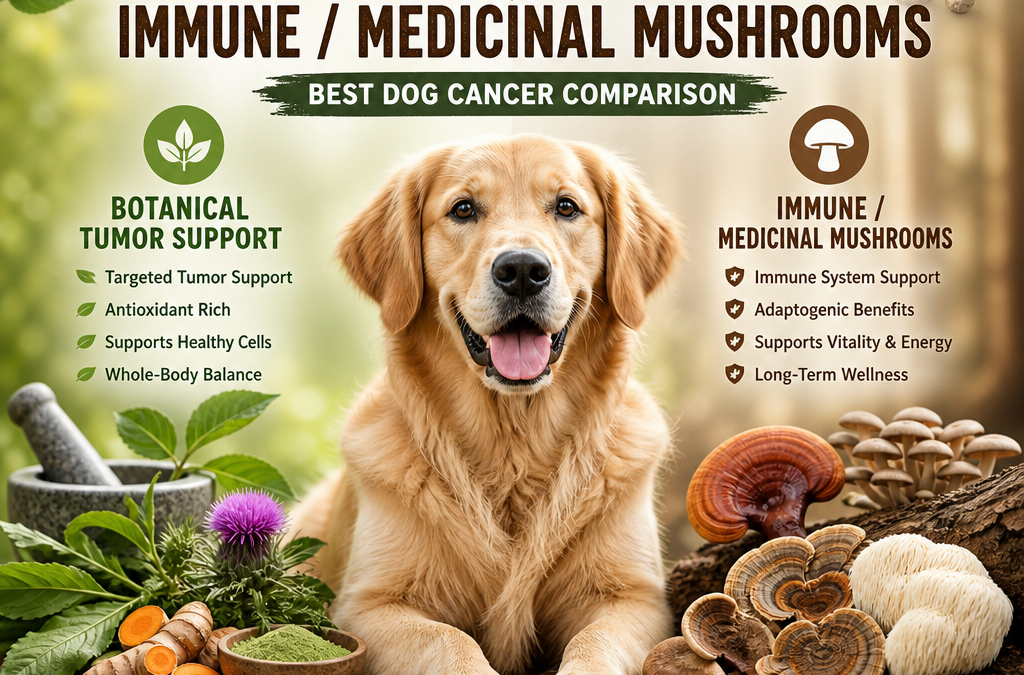
Η βοτανική υποστήριξη όγκων vs ανοσοποιητικά / φαρμακευτικά μανιτάρια είναι μια σημαντική σύγκριση για τους ιδιοκτήτες σκύλων που εξερευνούν υποστηρικτική φροντίδα μετά από διάγνωση καρκίνου. Και οι δύο προσεγγίσεις μπορούν να χρησιμοποιηθούν παράλληλα με τη θεραπεία από κτηνίατρο, αλλά δεν είναι αλληλένδετες. Οι βοτανικές φόρμουλες συχνά επικεντρώνονται σε ενώσεις που προέρχονται από φυτά και υποστηρίζουν την ισορροπία της φλεγμονής, τις αντιοξειδωτικές άμυνες, την πέψη ή την υγεία των κυττάρων. Τα προϊόντα φαρμακευτικών μανιταριών γενικά τονίζουν τη ρύθμιση του ανοσοποιητικού συστήματος μέσω ενώσεων όπως οι βήτα-γλυκάνες. Η κατανόηση αυτών των διαφορών μπορεί να βοηθήσει τους ιδιοκτήτες να κάνουν καλύτερες ερωτήσεις και να επιλέξουν συμπληρώματα πιο υπεύθυνα.
Πίνακας Περιεχομένων
- Γιατί η επιλογή συμπληρωμάτων έχει σημασία στη φροντίδα καρκίνου των σκύλων
- Βοτανική υποστήριξη όγκων: Τι σημαίνει;
- Ανοσοποιητικά και φαρμακευτικά μανιτάρια εξηγημένα
- Βοτανική υποστήριξη όγκων vs Ανοσοποιητικά / φαρμακευτικά μανιτάρια: Κύριες διαφορές
- Πέντε πρακτικές διαφορές που πρέπει να κατανοήσουν οι ιδιοκτήτες σκύλων
- Σύγκριση αποδείξεων και προσδοκιών
- Ασφάλεια, αλληλεπιδράσεις φαρμάκων και χρονοδιάγραμμα θεραπείας
- Πώς να αξιολογήσετε ένα προϊόν υπεύθυνα
- Κάνοντας την καλύτερη επιλογή για έναν μεμονωμένο σκύλο
- Επιλέγοντας με αυτοπεποίθηση
Γιατί η επιλογή συμπληρωμάτων έχει σημασία στη φροντίδα καρκίνου των σκύλων
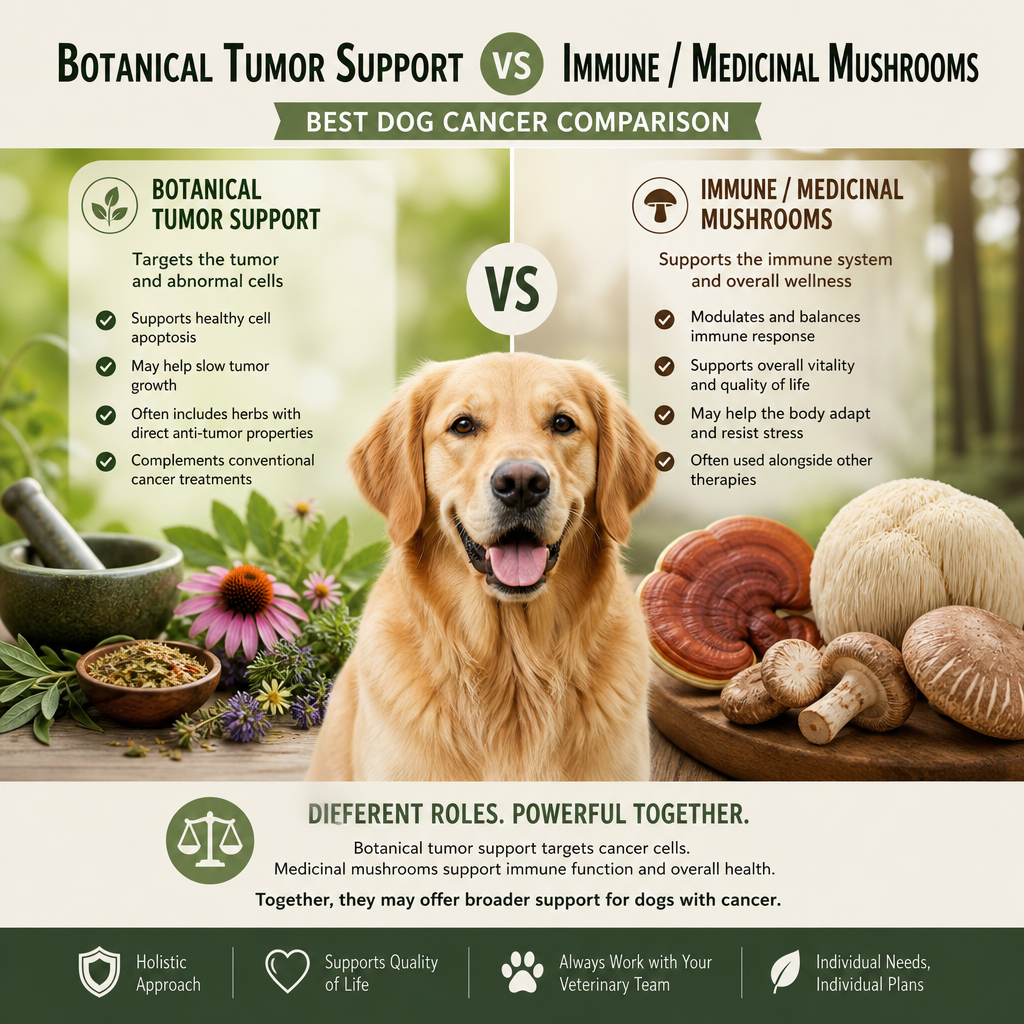
Η φροντίδα καρκίνου για σκύλους μπορεί να περιλαμβάνει χειρουργική επέμβαση, χημειοθεραπεία, ακτινοβολία, ανοσοθεραπεία, στοχευμένα φάρμακα ή παρηγορητική θεραπεία. Τα συμπληρώματα δεν θα πρέπει ποτέ να αντικαθιστούν αυτές τις θεραπείες ή να καθυστερούν τη διάγνωση. Αντίθετα, μπορούν να θεωρηθούν ως μέρος ενός ευρύτερου υποστηρικτικού σχεδίου που έχει σχεδιαστεί για να διατηρεί την όρεξη, την ενέργεια, την πέψη, την ανθεκτικότητα του ανοσοποιητικού και την ποιότητα ζωής. Όταν οι ιδιοκτήτες συγκρίνουν τη βοτανική υποστήριξη όγκων vs ανοσοποιητικά / φαρμακευτικά μανιτάρια, ο στόχος θα πρέπει να είναι να κατανοήσουν πώς κάθε επιλογή εντάσσεται σε αυτό το ευρύτερο σχέδιο.
Οι σκύλοι με καρκίνο μπορεί να αντιδρούν διαφορετικά στο ίδιο προϊόν. Ένα συμπλήρωμα που είναι κατάλληλο για έναν σκύλο μπορεί να είναι ακατάλληλο για έναν άλλο λόγω του τύπου όγκου, της λειτουργίας του ήπατος ή των νεφρών, των τρεχουσών φαρμάκων ή του χρονοδιαγράμματος θεραπείας. Για αυτόν τον λόγο, ένας κτηνίατρος—ιδανικά κάποιος με εμπειρία στην ογκολογία ή την ολοκληρωμένη ιατρική—θα πρέπει να εξετάσει οποιοδήποτε συμπλήρωμα πριν από τη χρήση. Αυτή η συμβουλή ισχύει είτε το προϊόν είναι ένα βοτανικό μείγμα, ένα εκχύλισμα μανιταριού ή μια συνδυασμένη φόρμουλα.
Ορισμένοι ιδιοκτήτες αρχίζουν να ερευνούν συμπληρώματα επειδή θέλουν κάτι ήπιο και φυσικό, ενώ άλλοι αναζητούν επιλογές για να υποστηρίξουν έναν σκύλο που είναι ήδη σε θεραπεία. Σε κάθε περίπτωση, είναι χρήσιμο να διαχωρίσετε τη γλώσσα μάρκετινγκ από τα πραγματικά συστατικά. Η βοτανική υποστήριξη όγκων vs ανοσοποιητικά / φαρμακευτικά μανιτάρια δεν είναι απλώς μια επιλογή μεταξύ “φυτικής προέλευσης” και “μυκηλιακής”. Είναι μια σύγκριση διαφορετικών βιολογικών στόχων, διαφορετικών επιπέδων αποδείξεων και διαφορετικών παραγόντων ασφάλειας.
Εάν επίσης εξετάζετε ευρύτερες φυσικές επιλογές, αυτή η επισκόπηση του τα οφέλη των φαρμακευτικών μανιταριών για σκύλους μπορεί να σας βοηθήσει να κατανοήσετε πώς τα προϊόντα που επικεντρώνονται στο ανοσοποιητικό συχνά συζητούνται στην υποστηρικτική φροντίδα.
Βοτανική υποστήριξη όγκων: Τι σημαίνει;
Η βοτανική υποστήριξη όγκων αναφέρεται συνήθως σε φόρμουλες που παρασκευάζονται από φαρμακευτικά φυτά, βότανα, ρίζες, φύλλα ή εκχυλίσματα φυτών. Αυτά τα προϊόντα μπορεί να περιέχουν αρκετά συστατικά που επιλέγονται για συμπληρωματικούς σκοπούς. Ανάλογα με τη φόρμουλα, η βοτανική υποστήριξη μπορεί να στοχεύει στη διατήρηση φυσιολογικών φλεγμονωδών οδών, στην παροχή αντιοξειδωτικών ενώσεων, στην υποστήριξη της λειτουργίας του ήπατος, στην προώθηση υγιούς πέψης ή στην ενίσχυση των γενικών κυτταρικών αμυνών. Σε πρακτικούς όρους, η βοτανική υποστήριξη όγκων συχνά προσπαθεί να υποστηρίξει το σώμα του σκύλου με έναν ευρύ, ολιστικό τρόπο αντί να εστιάζει μόνο σε έναν δείκτη ανοσίας.
Κοινά βοτανικά συστατικά που βρίσκονται σε προϊόντα υποστήριξης καρκίνου μπορεί να περιλαμβάνουν κουρκουμά ή κουρκουμίνη, γαϊδουράγκαθο, εκχυλίσματα πράσινου τσαγιού, φαρμακευτικά βότανα και άλλες τυποποιημένες φυτικές ενώσεις. Ωστόσο, το “φυσικό” δεν σημαίνει αυτόματα ασφαλές, αποτελεσματικό ή κατάλληλο για κάθε σκύλο. Τα εκχυλίσματα φυτών μπορεί να είναι πολύ συμπυκνωμένα, και ορισμένα μπορεί να επηρεάσουν την πήξη του αίματος, τα ηπατικά ένζυμα, την αρτηριακή πίεση ή την απορρόφηση και το μεταβολισμό των συνταγογραφούμενων φαρμάκων. Αυτός είναι ένας λόγος που η βοτανική υποστήριξη όγκων σε σύγκριση με τα ανοσοποιητικά / φαρμακευτικά μανιτάρια θα πρέπει να εξετάζεται προσεκτικά αντί να επιλέγεται με βάση τις τάσεις ή τη δημοτικότητα.
Η ποιότητα ενός βοτανικού προϊόντος εξαρτάται σε μεγάλο βαθμό από τις μεθόδους εκχύλισης, την τυποποίηση, την ταυτοποίηση των συστατικών και τους ελέγχους παραγωγής. Ένα προϊόν που παρασκευάζεται από ένα σαφώς προσδιορισμένο εκχύλισμα με δοκιμές παρτίδας είναι γενικά πιο εύκολο να αξιολογηθεί από ένα μείγμα που αναφέρει μόνο ένα ιδιόκτητο μείγμα χωρίς ποσότητες. Όταν η ετικέτα είναι ασαφής, γίνεται πολύ πιο δύσκολο να γνωρίζουμε αν το προϊόν είναι πιθανό να βοηθήσει, αν η δόση είναι σημαντική ή αν η φόρμουλα είναι καν κατάλληλη για την τρέχουσα κατάσταση του σκύλου.
Οι ιδιοκτήτες θα πρέπει επίσης να θυμούνται ότι οι βοτανικές φόρμουλες μπορεί να διαφέρουν ως προς τον σκοπό. Ορισμένες έχουν σχεδιαστεί κυρίως για υποστήριξη αντιοξειδωτικών, ενώ άλλες προωθούνται για υποστήριξη του ήπατος, πέψη, κυκλοφορία ή γενική ζωτικότητα. Αυτές οι διαφορές έχουν σημασία γιατί ένα συμπλήρωμα που είναι χρήσιμο κατά την ανάρρωση μετά από χειρουργική επέμβαση μπορεί να μην είναι η καλύτερη επιλογή κατά τη διάρκεια ενός ενεργού πρωτοκόλλου χημειοθεραπείας. Όταν εξετάζετε τη βοτανική υποστήριξη όγκων σε σύγκριση με τα ανοσοποιητικά / φαρμακευτικά μανιτάρια, ο πραγματικός σκοπός του προϊόντος θα πρέπει να καθοδηγεί την απόφαση περισσότερο από το όνομα της κατηγορίας.
Επιπλέον, τα βοτανικά προϊόντα μπορεί να είναι ιδιαίτερα ευαίσθητα στην ποιότητα προμήθειας. Τα φυτά απορροφούν τις συνθήκες του εδάφους, το περιβάλλον ανάπτυξης, το χρόνο συγκομιδής και τις μεθόδους επεξεργασίας. Δύο προϊόντα που αναφέρουν το ίδιο βότανο μπορεί να μην έχουν την ίδια συγκέντρωση ή καθαρότητα. Γι' αυτό η διαφάνεια και οι δοκιμές τρίτων είναι τόσο σημαντικές για τους ιδιοκτήτες σκύλων που προσπαθούν να κάνουν μια υπεύθυνη επιλογή.
Ανοσοποιητικά και φαρμακευτικά μανιτάρια εξηγημένα
Τα φαρμακευτικά μανιτάρια είναι μύκητες που χρησιμοποιούνται σε παραδοσιακές πρακτικές υγείας και σύγχρονα προϊόντα συμπληρωμάτων. Παραδείγματα περιλαμβάνουν την ουρά γαλοπούλας, το ρεϊσί, το σιτάκε, το μαϊτάκε και το κορδιτσέψ. Οι πιο συζητημένοι τους ενώσεις είναι οι πολυσακχαρίτες, ιδιαίτερα οι βήτα-γλυκάνες, οι οποίες μπορεί να αλληλεπιδρούν με υποδοχείς που εμπλέκονται στη σήμανση του ανοσοποιητικού συστήματος. Σε συζητήσεις υποστήριξης καρκίνου σε σκύλους, αυτά τα προϊόντα συνήθως τοποθετούνται ως συμπληρώματα που επικεντρώνονται στο ανοσοποιητικό αντί για άμεσες θεραπείες όγκων.
Τα συμπληρώματα φαρμακευτικών μανιταριών συχνά προωθούνται για υποστήριξη του ανοσοποιητικού αντί ως άμεσες θεραπείες καρκίνου. Ορισμένες έρευνες, συμπεριλαμβανομένων μελετών που περιλαμβάνουν ασθενείς με καρκίνο σε σκύλους, έχουν εξετάσει τις ενώσεις που προέρχονται από μανιτάρια ως μέρος υποστηρικτικής φροντίδας. Τα στοιχεία διαφέρουν ανάλογα με το είδος του μανιταριού, τον τύπο εκχύλισης, τη δόση και το πλαίσιο του καρκίνου. Τα αποτελέσματα από εργαστηριακές ή ανθρώπινες μελέτες δεν θα πρέπει να θεωρούνται αυτόματα ότι ισχύουν και για τους σκύλους. Αυτή η προσοχή είναι ιδιαίτερα σημαντική όταν συγκρίνουμε την υποστήριξη όγκων από φυτά με τα φαρμακευτικά μανιτάρια, επειδή η βάση ερευνών είναι συχνά διαφορετική για κάθε κατηγορία.
Τα προϊόντα μανιταριών διαφέρουν επίσης σημαντικά. Μια σκόνη που παρασκευάζεται από ολόκληρο το μανιτάρι μπορεί να έχει διαφορετικό χημικό προφίλ από μια εκχύλιση που έχει συγκεντρωθεί για βήτα-γλυκάνες. Η ετικέτα θα πρέπει να προσδιορίζει το είδος του μανιταριού, αν το προϊόν χρησιμοποιεί καρποφόρα σώματα ή μυκήλιο, λεπτομέρειες εκχύλισης και την ποσότητα των ενεργών ενώσεων όταν είναι διαθέσιμες. Χωρίς αυτές τις πληροφορίες, οι ιδιοκτήτες σκύλων δεν μπορούν να συγκρίνουν με σιγουριά ένα προϊόν με ένα άλλο ή να κατανοήσουν τι καθιστά ένα συμπλήρωμα μανιταριών πιο κατάλληλο από ένα άλλο.
Πολλοί ιδιοκτήτες προσελκύονται από τα φαρμακευτικά μανιτάρια επειδή ακούγονται απλά και φυσικά, αλλά οι λεπτομέρειες έχουν σημασία. Ένα προϊόν μανιταριών μπορεί να περιλαμβάνει πολλαπλά είδη, πληρωτικά, αρωματικές ουσίες ή σκόνες χαμηλής δραστικότητας που δεν μοιάζουν με τις μελετημένες εκχυλίσεις που χρησιμοποιούνται στην έρευνα. Ένα προϊόν υψηλής ποιότητας θα πρέπει να διευκρινίζει ποιο μέρος του μανιταριού χρησιμοποιείται, πώς επεξεργάζεται και ποιος είναι ο προορισμός του. Αυτή η διαφάνεια είναι εξίσου σημαντική με το όνομα του μανιταριού.
Για τους ιδιοκτήτες που θέλουν να κατανοήσουν τον ευρύτερο ρόλο αυτών των προϊόντων, το άρθρο στο τα οφέλη των φαρμακευτικών μανιταριών για σκύλους παρέχει χρήσιμο υπόβαθρο σχετικά με το πώς τα συμπληρώματα υποστήριξης του ανοσοποιητικού συνήθως πλαισιώνονται στη κτηνιατρική φροντίδα.
Βοτανική υποστήριξη όγκων vs Ανοσοποιητικά / φαρμακευτικά μανιτάρια: Κύριες διαφορές
Σε μια σύγκριση συμπληρωμάτων καρκίνου σε σκύλους, η κύρια διαφορά είναι συνήθως η προοριζόμενη βιολογική έμφαση. Οι φυτικές φόρμουλες μπορεί να είναι δομημένες γύρω από φυτικά συστατικά που υποστηρίζουν την ισορροπία της φλεγμονής, τη δραστηριότητα των αντιοξειδωτικών, την πέψη ή τη λειτουργία του ήπατος. Τα προϊόντα φαρμακευτικών μανιταριών είναι συνήθως σχεδιασμένα γύρω από την επικοινωνία του ανοσοποιητικού και την περιεκτικότητα σε πολυσακχαρίτες. Και τα δύο μπορούν να είναι μέρος υποστηρικτικής φροντίδας, αλλά προσεγγίζουν το πρόβλημα από διαφορετικές γωνίες.
Οι φυτικές φόρμουλες μπορεί να επικεντρώνονται σε:
- Ισορροπία φλεγμονής και οξειδωτικού στρες
- Υποστήριξη πέψης και ήπατος
- Γενική κυτταρική και μεταβολική υποστήριξη
- Πολλαπλά φυτικά συστατικά που συνεργάζονται
- Στρατηγικές βοτάνων συγκεκριμένες για καταστάσεις
Οι φόρμουλες φαρμακευτικών μανιταριών μπορεί να επικεντρώνονται σε:
- Επικοινωνία του ανοσοποιητικού συστήματος
- Υποστήριξη για κανονική ανοσοποιητική επιτήρηση
- Βήτα-γλυκάνες και άλλοι πολυσακχαρίτες μανιταριών
- Ευρύτερη ανθεκτικότητα του ανοσοποιητικού
- Λιγότερα, πιο συμπυκνωμένα εκχυλίσματα μανιταριών
Αυτή η διάκριση δεν είναι απόλυτη. Ορισμένα φυτικά προϊόντα μπορεί να επηρεάσουν τα ανοσοποιητικά μονοπάτια, ενώ τα φαρμακευτικά μανιτάρια μπορεί επίσης να έχουν αντιοξειδωτικές ή σχετικές με τη φλεγμονή επιδράσεις. Τα πραγματικά συστατικά και οι συγκεντρώσεις του προϊόντος έχουν μεγαλύτερη σημασία από την κατηγορία μάρκετινγκ. Ένας ιδιοκτήτης σκύλου που συγκρίνει τη φυτική υποστήριξη όγκων με τα φαρμακευτικά μανιτάρια θα πρέπει επομένως να ρωτήσει τι έχει σχεδιαστεί να κάνει η φόρμουλα, όχι μόνο τι ισχυρίζεται ότι είναι.
Μια άλλη σημαντική διαφορά είναι η πολυπλοκότητα. Οι φυτικές φόρμουλες συχνά συνδυάζουν αρκετά συστατικά, τα οποία μπορεί να είναι χρήσιμα όταν ένας σκύλος χρειάζεται ευρεία υποστήριξη, αλλά μπορεί επίσης να δυσκολεύουν την αναγνώριση ποιο συστατικό βοηθά ή προκαλεί παρενέργειες. Τα προϊόντα φαρμακευτικών μανιταριών μπορεί να είναι πιο εστιασμένα, αλλά μπορούν να διαφέρουν σημαντικά σε είδη, ποιότητα εκχύλισης και συγκέντρωση ενεργών ενώσεων. Και οι δύο επιλογές απαιτούν προσεκτική ανάγνωση ετικετών.
Αξίζει επίσης να σημειωθεί ότι ορισμένα προϊόντα συνδυάζουν και τις δύο κατηγορίες. Ένα συμπλήρωμα μπορεί να περιέχει ένα εκχύλισμα μανιταριού συν επιλεγμένα βότανα ή βιταμίνες. Σε αυτές τις περιπτώσεις, η γραμμή μεταξύ φυτικής υποστήριξης όγκων και φαρμακευτικών μανιταριών γίνεται ακόμη λιγότερο προφανής. Οι μικτές φόρμουλες μπορεί να είναι χρήσιμες, αλλά μπορούν επίσης να αυξήσουν την αβεβαιότητα αν οι ποσότητες των συστατικών δεν αποκαλύπτονται σαφώς.
Πέντε πρακτικές διαφορές που πρέπει να κατανοήσουν οι ιδιοκτήτες σκύλων
Όταν συγκρίνουν τη φυτική υποστήριξη όγκων με τα φαρμακευτικά μανιτάρια, οι ιδιοκτήτες σκύλων συχνά ωφελούνται από την εξέταση πέντε πρακτικών ερωτήσεων αντί για ευρείες δηλώσεις μάρκετινγκ. Αυτές οι ερωτήσεις μπορούν να βοηθήσουν να γίνει η απόφαση πιο θεμελιωμένη στις πραγματικές ανάγκες του σκύλου και λιγότερο εξαρτημένη από τη γλώσσα της συσκευασίας.
Ποιος είναι ο κύριος στόχος;
Ορισμένα προϊόντα έχουν σχεδιαστεί κυρίως για ισορροπία φλεγμονής, πέψη ή υποστήριξη του ήπατος. Άλλα τοποθετούνται πιο σαφώς γύρω από τη σήμανση του ανοσοποιητικού. Αυτή η διαφορά έχει σημασία γιατί το καλύτερο προϊόν είναι συνήθως αυτό που ταιριάζει στις τρέχουσες ανάγκες του σκύλου. Ένας σκύλος με ναυτία και κακή όρεξη μπορεί να χρειάζεται έναν διαφορετικό τύπο υποστήριξης από έναν σκύλο της θεραπευτικής ομάδας του οποίου προσπαθεί συγκεκριμένα να υποστηρίξει τη λειτουργία του ανοσοποιητικού.
Πόσο διαφανής είναι η ετικέτα;
Οι σαφείς λίστες συστατικών, οι ακριβείς ποσότητες και οι λεπτομέρειες εκχύλισης διευκολύνουν την εκτίμηση της ποιότητας. Αν μια ετικέτα χρησιμοποιεί αόριστη γλώσσα ή κρύβει τη φόρμουλα μέσα σε ένα ιδιόκτητο μείγμα, γίνεται πιο δύσκολο να γνωρίζετε τι παίρνει πραγματικά ο σκύλος σας. Η διαφανής σήμανση είναι ένας από τους καλύτερους τρόπους για να συγκρίνετε τη φυτική υποστήριξη όγκων με τα φαρμακευτικά μανιτάρια χωρίς να μαντεύετε.
Ποια αποδεικτικά στοιχεία υπάρχουν για το ακριβές συστατικό;
Όχι κάθε προϊόν κουρκουμά, εκχύλισμα μανιταριού ή βοτανικό μείγμα έχει το ίδιο επίπεδο έρευνας. Μια μελέτη για ένα εκχύλισμα δεν αποδεικνύει τα ίδια αποτελέσματα για ένα άλλο προϊόν που χρησιμοποιεί διαφορετική μέθοδο, δόση ή πρώτη ύλη. Οι ιδιοκτήτες θα πρέπει να αναζητούν έρευνα που να ταιριάζει όσο το δυνατόν πιο κοντά στο συστατικό, ειδικά όταν το συμπλήρωμα προορίζεται για έναν σκύλο με σοβαρή διάγνωση.
Τι άλλο παίρνει ο σκύλος;
Ένα συμπλήρωμα μπορεί να αλληλεπιδράσει με χημειοθεραπεία, χειρουργική επέμβαση, αντιφλεγμονώδη φάρμακα, κατασταλτικά ή φάρμακα αραίωσης αίματος. Αυτός είναι ένας λόγος για τον οποίο η κτηνιατρική ανασκόπηση είναι απαραίτητη πριν από την έναρξη οποιουδήποτε νέου υποστηρικτικού προϊόντος. Ακόμα και όταν ένα προϊόν διαφημίζεται ως ήπιο, μπορεί να επηρεάσει το σώμα με τρόπους που έχουν σημασία κατά τη διάρκεια της θεραπείας.
Μπορεί το προϊόν να παρακολουθείται με την πάροδο του χρόνου;
Τα ασφαλέστερα συμπληρώματα είναι αυτά που μπορούν να επαναξιολογηθούν μέσω της όρεξης, της ποιότητας των κοπράνων, της ενέργειας, των εξετάσεων αίματος και της ανεκτικότητας στη θεραπεία. Εάν ένα προϊόν δεν μπορεί να παρακολουθηθεί ή να προσαρμοστεί, μπορεί να είναι λιγότερο κατάλληλο για μακροχρόνια χρήση. Καλή παρακολούθηση βοηθά να διασφαλιστεί ότι ένα χρήσιμο συμπλήρωμα παραμένει χρήσιμο και ότι ένα κακώς ανεκτό σταματά άμεσα.
Αυτές οι πέντε ερωτήσεις είναι χρήσιμες γιατί μετατρέπουν μια ευρεία απόφαση κατηγορίας σε μια πρακτική απόφαση φροντίδας. Αντί να ρωτούν μόνο αν η βοτανική υποστήριξη όγκων σε σύγκριση με τα ανοσολογικά / φαρμακευτικά μανιτάρια ακούγεται πιο ελκυστική, οι ιδιοκτήτες μπορούν να ρωτήσουν ποιο προϊόν είναι πιο εύκολο να κατανοηθεί, ασφαλέστερο στη χρήση και πιο κοντά στις ανάγκες του σκύλου.
Σύγκριση αποδείξεων και προσδοκιών
Οι ισχυρότερες αποφάσεις για συμπληρώματα βασίζονται σε ρεαλιστικές προσδοκίες. Ούτε τα βοτανικά προϊόντα ούτε τα φαρμακευτικά μανιτάρια θα πρέπει να παρουσιάζονται ως εγγυημένες θεραπείες καρκίνου. Επιστημονικά στοιχεία μπορεί να υποστηρίζουν πιθανά οφέλη σε συγκεκριμένα περιβάλλοντα, αλλά η ποιότητα των στοιχείων μπορεί να κυμαίνεται από εργαστηριακή έρευνα έως μικρές κλινικές μελέτες και αναφορές. Αυτό σημαίνει ότι ένα υποσχόμενο συστατικό δεν είναι το ίδιο πράγμα με μια αποδεδειγμένη θεραπεία.
Οι ιδιοκτήτες θα πρέπει να ρωτούν αν ένα προϊόν έχει μελετηθεί σε σκύλους, αν η έρευνα περιλάμβανε το ίδιο συστατικό και εκχύλισμα, και αν η δόση που χρησιμοποιήθηκε στη μελέτη ταιριάζει με το προϊόν που εξετάζεται. Είναι επίσης σημαντικό να διακρίνουμε μεταξύ της βελτίωσης της άνεσης ή της όρεξης ενός σκύλου και της μείωσης ενός όγκου. Τα υποστηρικτικά οφέλη μπορεί να είναι σημαντικά ακόμη και όταν ένα συμπλήρωμα δεν έχει αποδεδειγμένη ικανότητα να εξαλείψει τον καρκίνο.
Στην πράξη, αυτό σημαίνει ότι οι προσδοκίες θα πρέπει να παραμείνουν μετριοπαθείς αλλά όχι απορριπτικές. Ένα συμπλήρωμα μπορεί να βοηθήσει στη διατήρηση της ενέργειας, να υποστηρίξει την πέψη ή να διευκολύνει την ανοχή στη θεραπεία. Αυτά τα αποτελέσματα μπορεί να έχουν μεγάλη σημασία στην καθημερινή ζωή ενός σκύλου. Ταυτόχρονα, οι ιδιοκτήτες θα πρέπει να είναι προσεκτικοί σχετικά με τις αξιώσεις ότι ένα προϊόν θα σταματήσει την πρόοδο του καρκίνου από μόνο του. Η σύγκριση της βοτανικής υποστήριξης όγκων με τα ανοσοποιητικά / φαρμακευτικά μανιτάρια λειτουργεί καλύτερα όταν και οι δύο επιλογές αξιολογούνται ως υποστηρικτικά εργαλεία, όχι ως θαυματουργές λύσεις.
Για τους ιδιοκτήτες σκύλων που θέλουν μια πιο βαθιά ματιά στην ποιότητα της μελέτης, μια αξιόπιστη επιστημονική αναφορά όπως η ανασκόπηση βιοϊατρικής έρευνας στο PubMed Central είναι ένα χρήσιμο σημείο εκκίνησης για να ελέγξετε πώς αναφέρεται η απόδειξη και αν ο σχεδιασμός της έρευνας είναι αρκετά ισχυρός για να εμπιστευτείτε.
Μπορεί επίσης να βοηθήσει να σκεφτείτε με όρους στόχων παρά κατηγοριών. Για παράδειγμα, αν η κύρια προτεραιότητα είναι η πεπτική άνεση κατά τη διάρκεια της θεραπείας, μπορεί να επιλεγεί μια βοτανική φόρμουλα για αυτόν τον σκοπό. Αν η προτεραιότητα είναι η υποστήριξη που σχετίζεται με το ανοσοποιητικό, ένα εκχύλισμα μανιταριού μπορεί να είναι πιο κατάλληλο. Η σωστή απάντηση εξαρτάται από τη διάγνωση του σκύλου, τα τρέχοντα φάρμακα και το συνολικό σχέδιο φροντίδας.
Ασφάλεια, αλληλεπιδράσεις φαρμάκων και χρονοδιάγραμμα θεραπείας
Η ασφάλεια είναι ένα από τα πιο σημαντικά μέρη οποιασδήποτε σύγκρισης συμπληρωμάτων καρκίνου σκύλων. Ορισμένα βότανα και μανιτάρια μπορεί να επηρεάσουν τη δραστηριότητα των αιμοπεταλίων ή την πήξη του αίματος, κάτι που μπορεί να είναι σημαντικό πριν από τη χειρουργική επέμβαση ή κατά τη διάρκεια της θεραπείας με φάρμακα που επηρεάζουν την αιμορραγία. Άλλα μπορεί να αλλάξουν τη δραστηριότητα των ηπατικών ενζύμων και να αλλάξουν τον τρόπο με τον οποίο επεξεργάζονται η χημειοθεραπεία ή άλλα φάρμακα. Γι' αυτό η βοτανική υποστήριξη όγκων σε σύγκριση με τα ανοσοποιητικά / φαρμακευτικά μανιτάρια δεν θα πρέπει ποτέ να αντιμετωπίζεται ως μια απλή επιλογή χωρίς συνταγή.
Πιθανές ανησυχίες περιλαμβάνουν εμετό, διάρροια, μειωμένη όρεξη, αλλεργικές αντιδράσεις, καταστολή, ερεθισμό του ήπατος και αλλαγές στις μετρήσεις των κυττάρων του αίματος. Οι σκύλοι με νεφρική νόσο, ηπατική νόσο, αυτοάνοσες καταστάσεις ή διαταραχές αιμορραγίας μπορεί να απαιτούν επιπλέον προσοχή. Ένα συμπλήρωμα μπορεί επίσης να χρειαστεί να διακοπεί γύρω από τη χειρουργική επέμβαση ή ορισμένα πρωτόκολλα χημειοθεραπείας. Σε ορισμένες περιπτώσεις, ακόμη και ένα συμπλήρωμα που γενικά είναι καλά ανεκτό μπορεί να γίνει προβληματικό όταν συνδυάζεται με ένα σύνθετο σχέδιο θεραπείας.
Διατηρήστε μια πλήρη λίστα με κάθε προϊόν που λαμβάνει ο σκύλος σας, συμπεριλαμβανομένων των συμπληρωμάτων, των λιχουδιών, των συνταγογραφούμενων φαρμάκων και των τοπικών προϊόντων. Μοιραστείτε τη λίστα με την κτηνιατρική ομάδα πριν ξεκινήσετε οτιδήποτε νέο. Η παρακολούθηση μπορεί να περιλαμβάνει αιματολογικές εξετάσεις, παρακολούθηση της όρεξης, έλεγχο βάρους, παρατήρηση κοπράνων και αξιολόγηση της ενέργειας ή του πόνου. Ένα συμπλήρωμα θα πρέπει ιδανικά να εισάγεται ένα τη φορά ώστε οποιαδήποτε αντίδραση να μπορεί να εντοπιστεί πιο εύκολα.
Ο χρόνος έχει σημασία όσο και η επιλογή των συστατικών. Ένα προϊόν μπορεί να είναι κατάλληλο σε μία φάση φροντίδας αλλά όχι σε άλλη. Για παράδειγμα, ένας κτηνίατρος μπορεί να θέλει να αποφύγει την έναρξη ενός νέου βοτανικού εκχυλίσματος αμέσως πριν από μια διαδικασία, ακόμη και αν το ίδιο προϊόν μπορεί να επανεξεταστεί αργότερα κατά τη διάρκεια της ανάρρωσης. Ομοίως, ένα συμπλήρωμα μανιταριών μπορεί να κρατηθεί αν υπάρχουν ανησυχίες σχετικά με τις αλληλεπιδράσεις ή αν ο σκύλος ήδη αντιμετωπίζει ναυτία ή μειωμένη όρεξη.
Όταν οι ιδιοκτήτες συζητούν την υποστήριξη όγκων από φυτά σε σχέση με τα μανιτάρια ανοσίας / φαρμακευτικά μανιτάρια με τον κτηνίατρό τους, είναι χρήσιμο να φέρνουν την ακριβή ετικέτα του προϊόντος, τη δόση και το σχέδιο χρόνου. Όσο πιο συγκεκριμένες είναι οι πληροφορίες, τόσο πιο εύκολο είναι για την κτηνιατρική ομάδα να αξιολογήσει τον κίνδυνο και να προσφέρει πρακτικές οδηγίες.
Πώς να αξιολογήσετε ένα προϊόν υπεύθυνα
Αναζητήστε διαφανείς ετικέτες που παρέχουν τα ακριβή συστατικά και τις ποσότητες ανά μερίδα. Προτιμήστε εταιρείες που διεξάγουν ανεξάρτητους ελέγχους για ρύπους, βαρέα μέταλλα, φυτοφάρμακα, μικροβιακούς παράγοντες και μη δηλωμένα φαρμακευτικά συστατικά. Τα προϊόντα που έχουν σχεδιαστεί ειδικά για σκύλους θα πρέπει να παρέχουν σαφείς οδηγίες δοσολογίας, αλλά η επιβεβαίωση από τον κτηνίατρο είναι ακόμα απαραίτητη.
Αποφύγετε προϊόντα που υπόσχονται να θεραπεύσουν τον καρκίνο, να αντικαταστήσουν τη χημειοθεραπεία ή να λειτουργήσουν για κάθε τύπο όγκου. Να είστε προσεκτικοί με δραματικές μαρτυρίες, ασαφείς ιδιόκτητες μίξεις και ισχυρισμούς που βασίζονται μόνο σε ανθρώπινες ή εργαστηριακές μελέτες. Ένα αξιόπιστο προϊόν θα πρέπει να εξηγεί τη σκοπούμενη χρήση του χωρίς να υπερβάλλει τα στοιχεία. Αυτό είναι ιδιαίτερα σημαντικό όταν συγκρίνετε την υποστήριξη όγκων από φυτά με τα μανιτάρια ανοσίας / φαρμακευτικά μανιτάρια, επειδή και οι δύο κατηγορίες συχνά προωθούνται με ευρείες, συναισθηματικά πειστικές μεθόδους.
Αν θέλετε μια πιο δομημένη πορεία κατά τη σύγκριση προϊόντων, αυτός ο τύπος εναλλακτικός οδηγός κτηνιατρικής μυκοθεραπείας μπορεί να είναι χρήσιμος για την κατανόηση του πώς οι επιλογές συμπληρωμάτων πλαισιώνονται για σκύλους με όγκους.
Είναι επίσης σοφό να συγκρίνετε περισσότερα από την μπροστινή ετικέτα. Ελέγξτε αν ο κατασκευαστής προσδιορίζει την πηγή των πρώτων υλών, εξηγεί πώς εξάγεται ή τυποποιείται το προϊόν και παρέχει έναν τρόπο επιβεβαίωσης της ποιότητας παρτίδας. Ένα καλά παρασκευασμένο συμπλήρωμα θα πρέπει να εμπνέει εμπιστοσύνη όχι μόνο λόγω των συστατικών του, αλλά και λόγω της προθυμίας της εταιρείας να είναι διαφανής.
Αν το προϊόν έχει κριτικές πελατών, διαβάστε τις προσεκτικά αλλά με σκεπτικισμό. Αναζητήστε ανατροφοδότηση σχετικά με την ανοχή, τη δοσολογία και τη συνέπεια παρά δραματικές ιστορίες θεραπείας. Οι ατομικές εμπειρίες μπορεί να είναι χρήσιμες, αλλά δεν αντικαθιστούν τις κτηνιατρικές συμβουλές ή τα επιστημονικά στοιχεία.
Κάνοντας την καλύτερη επιλογή για έναν μεμονωμένο σκύλο
Η καλύτερη επιλογή εξαρτάται από τη διάγνωση του σκύλου, το σχέδιο θεραπείας, τα συμπτώματα και τους στόχους. Ένας σκύλος που υποβάλλεται σε χημειοθεραπεία μπορεί να χρειάζεται διαφορετική προσέγγιση από έναν που αναρρώνει από χειρουργική επέμβαση ή λαμβάνει φροντίδα στο σπίτι. Αν η πεπτική αναστάτωση είναι μια σημαντική ανησυχία, μπορεί να εξεταστεί μια προσεκτικά επιλεγμένη βοτανική φόρμουλα για γενική υποστήριξη του γαστρεντερικού ή του ήπατος. Αν ο κύριος στόχος είναι η ανοσολογική ρύθμιση, μπορεί να συζητηθεί ένα καλά χαρακτηρισμένο εκχύλισμα φαρμακευτικού μανιταριού.
Σε ορισμένες περιπτώσεις, ένας κτηνίατρος μπορεί να προτείνει να μην δοθεί καθόλου συμπλήρωμα, ιδιαίτερα όταν ένας σκύλος είναι ασταθής, παίρνει πολύπλοκα φάρμακα ή βιώνει σημαντικές παρενέργειες. Η απλότητα μπορεί να είναι ασφαλέστερη από το να συνδυάζονται πολλά προϊόντα με επικαλυπτόμενα συστατικά. Το ασφαλέστερο σχέδιο είναι συχνά αυτό που αλλάζει τις λιγότερες μεταβλητές ενώ υποστηρίζει την άνεση και την ποιότητα ζωής.
Οι ιδιοκτήτες θα πρέπει επίσης να εξετάσουν πόσο εύκολο είναι να χορηγηθεί ένα προϊόν. Η γεύση, το μέγεθος της κάψουλας, η υφή της σκόνης και η συχνότητα δοσολογίας μπορούν να επηρεάσουν αν ο σκύλος θα πάρει το συμπλήρωμα με συνέπεια. Ακόμα και μια καλή φόρμουλα μπορεί να αποτύχει στην πράξη αν προκαλεί αντίσταση κατά τη διάρκεια του γεύματος ή καθιστά την καθημερινή φροντίδα πιο αγχωτική.
Όταν οι ιδιοκτήτες συγκρίνουν την υποστήριξη όγκων από φυτά με τα ανοσοποιητικά / φαρμακευτικά μανιτάρια, η πιο χρήσιμη ερώτηση δεν είναι ποια κατηγορία ακούγεται πιο φυσική, αλλά ποια επιλογή ταιριάζει στο τρέχον σχέδιο θεραπείας του σκύλου. Η υποστήριξη όγκων από φυτά σε σύγκριση με τα ανοσοποιητικά / φαρμακευτικά μανιτάρια θα πρέπει πάντα να αξιολογείται στο πλαίσιο, διότι κάθε προσέγγιση μπορεί να έχει διαφορετικά οφέλη, κινδύνους και επίπεδα αποδείξεων. Μια προσεκτική συζήτηση με έναν κτηνίατρο μπορεί να βοηθήσει να προσδιοριστεί αν η υποστήριξη όγκων από φυτά σε σύγκριση με τα ανοσοποιητικά / φαρμακευτικά μανιτάρια είναι κατάλληλη τώρα, ή αν η ασφαλέστερη επιλογή είναι να περιμένουμε.
Αυτό το πλαίσιο περιλαμβάνει επίσης την ηλικία του σκύλου, το επίπεδο δραστηριότητας, την κατάσταση του σώματος και την όρεξη. Ένας ηλικιωμένος σκύλος με πολλαπλά χρόνια προβλήματα μπορεί να χρειάζεται μια απλούστερη φόρμουλα από έναν νεότερο σκύλο με μια πιο απλή διάγνωση καρκίνου. Με άλλα λόγια, το “καλύτερο” συμπλήρωμα δεν είναι το πιο επιθετικό· είναι αυτό που ταιριάζει καλύτερα στις πραγματικές ανάγκες του σκύλου.
Επιλέγοντας με αυτοπεποίθηση
Η υποστήριξη όγκων από φυτά σε σύγκριση με τα ανοσοποιητικά / φαρμακευτικά μανιτάρια δεν είναι διαγωνισμός με έναν καθολικό νικητή. Οι φυτικές φόρμουλες προσφέρουν ευρεία υποστήριξη βασισμένη σε φυτά, ενώ τα φαρμακευτικά μανιτάρια επιλέγονται συνήθως για τους πολυσακχαρίτες που σχετίζονται με το ανοσοποιητικό. Και οι δύο κατηγορίες διαφέρουν ευρέως σε ποιότητα, αποδείξεις, σύνθεση και ασφάλεια.
Η πιο υπεύθυνη στρατηγική είναι να ταιριάζει το προϊόν με τον σκύλο αντί να επιλέγεται με βάση τη γλώσσα μάρκετινγκ. Η καθοδήγηση από κτηνίατρο, η διαφάνεια στην παραγωγή, οι ρεαλιστικές προσδοκίες και η προσεκτική παρακολούθηση είναι απαραίτητες. Χρησιμοποιούμενα με προσοχή, τα συμπληρώματα μπορεί να συμβάλλουν στην άνεση και την συνολική ευημερία, αλλά θα πρέπει να παραμένουν μέρος ενός ολοκληρωμένου σχεδίου φροντίδας καρκίνου - όχι υποκατάστατο για επαγγελματική διάγνωση και θεραπεία.
Για πολλούς ιδιοκτήτες σκύλων, η τελική απόφαση έρχεται σε ισορροπία. Η βοήθεια για όγκους από φυτά σε σύγκριση με τα ανοσοποιητικά / φαρμακευτικά μανιτάρια έχει καθένα τα πλεονεκτήματά του, και το καθένα μπορεί να είναι χρήσιμο σε διαφορετικές καταστάσεις. Εάν κρατήσετε τη σύγκριση επικεντρωμένη στις ανάγκες του σκύλου, στο τρέχον σχέδιο θεραπείας και στην πραγματική ποιότητα του προϊόντος, είναι πολύ πιο πιθανό να κάνετε μια επιλογή που είναι ασφαλής, λογική και υποστηρικτική.