
Les suppléments pour chiens atteints de tumeurs mammaires peuvent offrir une nutrition de soutien pour les chiens diagnostiqués avec un cancer mammaire, mais ils ne doivent jamais remplacer le traitement vétérinaire. La chirurgie, la biopsie, le stade, la chimiothérapie, la radiothérapie et la gestion de la douleur peuvent tous être appropriés en fonction du type et de l'étendue de la tumeur. L'approche la plus sûre est d'utiliser des suppléments dans le cadre d'un plan soigneusement supervisé conçu autour du diagnostic de votre chien, de son appétit, de ses médicaments et de sa santé globale.
Les tumeurs mammaires sont parmi les cancers les plus courants chez les chiennes, en particulier chez celles qui n'ont pas été stérilisées tôt dans leur vie. Certaines tumeurs sont bénignes, tandis que d'autres sont malignes et peuvent se propager aux ganglions lymphatiques voisins, aux poumons ou à d'autres organes. Comme chaque cas est différent, le soutien nutritionnel doit être personnalisé plutôt que basé sur un produit universel. Pour un aperçu plus large des préoccupations connexes, vous pouvez également trouver Risques de cancer chez le Shar Pei : signes essentiels précoces de tumeur à connaître utile.
Table des matières
- Comprendre le soutien aux tumeurs mammaires canines
- Meilleurs suppléments pour chiens atteints de tumeurs mammaires à discuter avec votre vétérinaire
- les acides gras omega-3
- Soutien nutritionnel de haute qualité
- Antioxydants
- Champignons médicinaux et produits à base de plantes
- Suppléments pour les articulations et la mobilité
- Suppléments pour le cancer mammaire chez le chien : considérations de sécurité
- Élaborer un plan de soins de soutien complet
Comprendre le soutien aux tumeurs mammaires canines
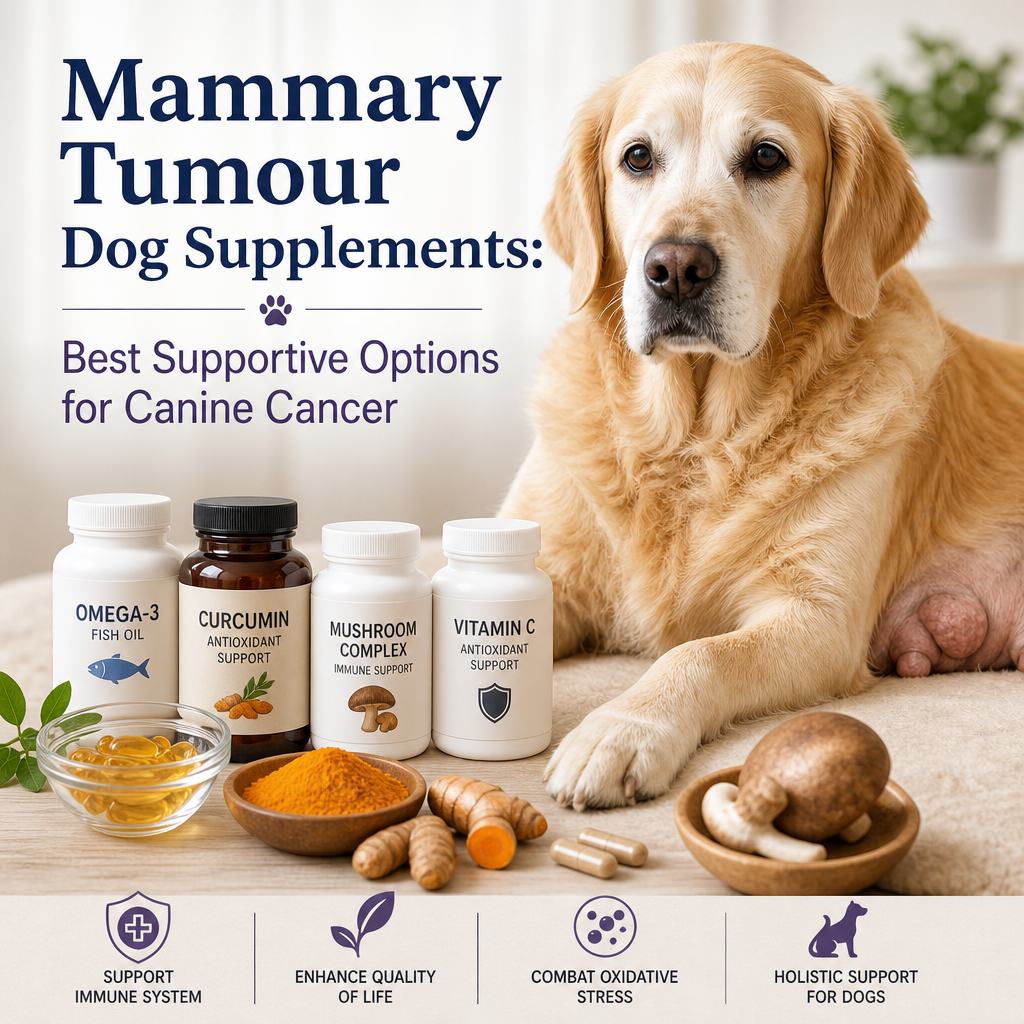
Le soutien aux tumeurs mammaires canines se concentre sur le maintien de la force, du confort, de l'appétit et de la qualité de vie. Un supplément ne peut pas réduire de manière fiable une tumeur ou guérir le cancer, et les affirmations selon lesquelles un produit peut remplacer un traitement conventionnel doivent être prises avec précaution. Cependant, un soutien nutritionnel approprié peut aider un chien à faire face à la maladie, à récupérer après une chirurgie et à tolérer certains traitements. Dans de nombreux cas, les suppléments pour chiens atteints de tumeurs mammaires sont les plus utiles lorsqu'ils soutiennent l'appétit, la digestion et la récupération.
Avant de commencer quoi que ce soit, votre vétérinaire peut recommander des analyses de sang, des imageries, une biopsie ou d'autres procédures diagnostiques. Ces résultats aident à identifier si votre chien a des problèmes rénaux, hépatiques ou digestifs qui pourraient affecter la sécurité des suppléments. Ils révèlent également si un produit pourrait interférer avec des médicaments ou une anesthésie. Si vous souhaitez comprendre les facteurs de risque de cancer dans d'autres races, l'American Veterinary Medical Association propose un aperçu utile des informations sur le cancer chez les animaux de compagnie à AVMA’s cancer in pets resource.
Il est également important de se rappeler que les soins de soutien fonctionnent mieux lorsqu'ils correspondent au stade de la maladie. Un chien qui a une petite masse complètement retirée peut avoir besoin d'un plan très différent d'un chien avec une propagation confirmée aux ganglions lymphatiques ou aux poumons. C'est pourquoi les suppléments pour chiens atteints de tumeurs mammaires doivent être sélectionnés au cas par cas, avec des objectifs clairs tels que le maintien de l'appétit, la réduction du stress lié au traitement ou le soutien à la récupération après une chirurgie.
Meilleurs suppléments pour chiens atteints de tumeurs mammaires à discuter avec votre vétérinaire
Il n'existe pas de supplément universel qui convienne à tous les chiens, mais plusieurs options de soutien peuvent être discutées avec votre vétérinaire. Le bon choix dépend de l'état corporel de votre chien, de ses médicaments actuels, du traitement prévu et de la façon dont elle mange. Dans certains cas, les suppléments pour chiens atteints de tumeurs mammaires ne sont utilisés que pendant une courte période autour de la chirurgie ou de la chimiothérapie, tandis que dans d'autres, ils deviennent partie intégrante d'un plan de soins à long terme.
les acides gras omega-3
L'huile de poisson fournit les acides gras oméga-3 EPA et DHA. Ces nutriments peuvent soutenir les réponses inflammatoires normales et aider à maintenir la peau, le pelage, les articulations et l'état général du corps. Certains plans de nutrition vétérinaire utilisent des acides gras oméga-3 pour les chiens atteints de cancer, en particulier lorsque l'appétit, l'inflammation ou la perte musculaire sont préoccupants. Parmi les suppléments pour chiens atteints de tumeurs mammaires, les oméga-3 sont souvent discutés en premier car ils peuvent s'intégrer dans de nombreux plans de soins.
La qualité et le dosage comptent. L'huile de poisson peut provoquer des troubles digestifs et peut affecter la coagulation sanguine, ce qui est particulièrement important avant une chirurgie ou lorsqu'un chien prend des médicaments anticoagulants ou antiplaquettaires. Choisissez un produit recommandé par un vétérinaire avec des niveaux d'EPA et de DHA clairement indiqués plutôt que de se fier uniquement à la quantité totale d'huile. Si un chien ne tolère pas bien l'huile, la dose peut devoir être ajustée ou changée pour un autre produit.
Soutien nutritionnel de haute qualité
Le cancer et le traitement du cancer peuvent augmenter le risque de perte de poids et de déperdition musculaire. Un régime complet et équilibré avec des protéines et des calories adéquates est souvent plus important que d'ajouter plusieurs suppléments séparés. Certains chiens bénéficient de régimes vétérinaires riches en calories, d'aliments de récupération ou de repas faits maison soigneusement préparés par un nutritionniste vétérinaire. En pratique, les suppléments pour chiens atteints de tumeurs mammaires fonctionnent mieux lorsque le régime alimentaire global répond déjà aux besoins nutritionnels de base.
Les stimulants d'appétit, les probiotiques ou le soutien digestif peuvent être envisagés lorsque des nausées, des diarrhées, de la constipation ou une diminution de l'appétit se développent. Ces produits doivent traiter un problème spécifique plutôt que d'être ajoutés automatiquement. Un chien qui perd du poids a besoin d'une attention vétérinaire rapide, car le simple fait de supplémenter peut ne pas corriger le problème sous-jacent. Si votre chien est également âgé ou a un autre problème de santé, comparez les plans de soutien avec des articles sur le cancer spécifiques à la race tels que Risques de cancer chez le Samoyède : signes précoces essentiels et tumeurs courantes.
Un soutien alimentaire pratique peut faire une différence significative. Des aliments chauds, des repas plus petits et un espace de repas calme peuvent aider un chien nauséeux à manger de manière plus cohérente. Dans certains cas, votre vétérinaire peut recommander des médicaments anti-nauséeux ou des régimes prescrits avant d'ajouter d'autres produits. Ce type de stratégie alimentaire compte souvent plus que d'essayer plusieurs suppléments pour chiens atteints de tumeurs mammaires en même temps.
Antioxydants
Les vitamines C et E, le sélénium et d'autres antioxydants sont souvent commercialisés comme suppléments pour le cancer mammaire chez les chiens. Les antioxydants jouent des rôles importants dans la santé normale, mais des doses élevées ne sont pas automatiquement bénéfiques. Dans certaines situations, un supplément excessif d'antioxydants pourrait potentiellement interférer avec les effets souhaités de certains traitements du cancer.
Demandez à l'équipe d'oncologie vétérinaire avant d'utiliser des produits antioxydants, surtout pendant la chimiothérapie ou la radiothérapie. Un régime commercial équilibré fournit généralement des nutriments de base appropriés, tandis que des doses supplémentaires devraient être basées sur une raison clinique claire. Cela est particulièrement important lors du choix de suppléments pour tumeurs mammaires chez un chien déjà sous traitement prescrit. Si la tumeur a été retirée et que votre vétérinaire surveille la récupération, le besoin d'antioxydants supplémentaires peut encore être limité.
Champignons médicinaux et produits à base de plantes
Les produits contenant des champignons médicinaux, du curcuma, des extraits de thé vert ou d'autres herbes sont parfois promus pour le soutien au cancer canin. Les preuves chez les chiens restent limitées et la qualité des produits peut varier considérablement. Certains ingrédients à base de plantes peuvent affecter le foie, les reins, la pression artérielle, la coagulation sanguine ou le métabolisme des médicaments prescrits.
“ Naturel ” ne signifie pas sans risque. Évitez les produits humains concentrés à moins qu'un vétérinaire ne les approuve spécifiquement, car ils peuvent contenir des ingrédients dangereux, des doses excessives, de l'alcool, des édulcorants ou des combinaisons qui n'ont pas été étudiées chez les chiens. Si vous recherchez des soins complémentaires, le National Center for Complementary and Integrative Health a un guide général utile sur les suppléments et les herbes à Ressource NCCIH sur les herbes en un coup d'œil.
Ces produits méritent également une attention particulière lorsque la chirurgie est prévue. Certaines herbes peuvent augmenter le risque de saignement ou modifier la façon dont d'autres médicaments sont métabolisés. Pour cette raison, les suppléments pour tumeurs mammaires chez les chiens de cette catégorie devraient être examinés par votre vétérinaire bien avant une opération ou une visite de chimiothérapie.
Suppléments pour les articulations et la mobilité
Les chiens en convalescence après une chirurgie ou souffrant d'une maladie avancée peuvent devenir moins actifs et raides. La glucosamine, la chondroïtine, le moule à lèvres vertes ou d'autres produits de soutien articulaire peuvent aider certains chiens à maintenir leur mobilité, bien qu'ils ne traitent pas la tumeur elle-même. Le soutien à la mobilité peut être précieux pour le confort, mais il doit être associé à un contrôle de la douleur, à un exercice approprié, à la gestion du poids et à un couchage doux.
Ces produits ne remplacent pas le soulagement de la douleur, mais ils peuvent faire partie d'un plan de confort pratique. Lorsque votre vétérinaire examine les suppléments pour tumeurs mammaires chez les chiens, demandez si un produit de mobilité correspond à l'étape de récupération de votre chien ou à ses besoins de confort à long terme. Même une petite amélioration du mouvement peut faciliter le fait pour un chien de se lever, de se reposer confortablement et de continuer ses routines quotidiennes normales.
Suppléments pour le cancer mammaire chez le chien : considérations de sécurité
La règle de sécurité la plus importante est de donner à votre vétérinaire une liste complète de tout ce que votre chien reçoit. Incluez les médicaments prescrits, les produits en vente libre, les vitamines, les herbes, les friandises et les préparations topiques. Cela permet à l'équipe vétérinaire d'évaluer les interactions possibles et de déterminer si un supplément doit être arrêté avant la chirurgie.
Surveillez les vomissements, la diarrhée, les démangeaisons, la léthargie, des ecchymoses inhabituelles, le jaunissement des gencives ou des yeux, des changements dans la soif, ou une diminution de l'appétit. Arrêtez le produit et contactez votre vétérinaire si des symptômes préoccupants apparaissent. Ne jamais donner d'analgésiques humains, de vitamines à forte dose, ou d'huiles essentielles sans conseils professionnels.
Les tests de produits sont une autre préoccupation. Les suppléments ne sont pas toujours réglementés aussi strictement que les médicaments sur ordonnance, et les étiquettes peuvent ne pas refléter avec précision la pureté ou la puissance. Recherchez des produits fabriqués par des fabricants réputés qui fournissent des tests de lot, des listes d'ingrédients claires, et des informations sur le dosage pour les chiens. Cette prudence s'applique aux suppléments pour tumeurs mammaires chez les chiens autant qu'à tout autre produit de soutien contre le cancer.
Le timing est également important. Un supplément qui semble inoffensif pendant la récupération peut encore être inapproprié pendant la chimiothérapie, la radiothérapie, ou les jours précédant la chirurgie. Si votre chien a reçu des antibiotiques, des analgésiques, des stéroïdes, ou des médicaments anti-nauséeux, la liste complète des traitements doit être examinée avant d'introduire quoi que ce soit de nouveau.
Élaborer un plan de soins de soutien complet
La nutrition n'est qu'une partie du soutien aux tumeurs mammaires canines. Des examens vétérinaires réguliers aident à surveiller le site chirurgical, les ganglions lymphatiques, la respiration, l'appétit, le poids, et le confort. Des examens d'imagerie ou des tests de laboratoire de suivi peuvent être recommandés pour détecter les changements tôt.
À la maison, enregistrez l'apport alimentaire et hydrique de votre chien, son poids, son activité, ses selles, et son confort quotidien. De petits repas fréquents peuvent être plus faciles à tolérer que de grandes portions. Gardez la nourriture attrayante sans changer constamment de régime, et demandez à votre vétérinaire des moyens sûrs d'augmenter les calories si l'appétit diminue.
Une activité douce peut aider à préserver les muscles et le bien-être émotionnel, mais l'exercice doit correspondre à l'énergie de votre chien et aux restrictions post-opératoires. Une zone de repos calme, un accès facile à l'eau, et un sol antidérapant peuvent rendre la vie quotidienne plus confortable.
Les suppléments pour tumeurs mammaires chez les chiens peuvent être utiles lorsqu'ils sont sélectionnés pour un besoin spécifique et utilisés sous supervision vétérinaire. Le plan de soutien le plus solide combine un traitement contre le cancer approprié avec une nutrition complète, une surveillance attentive, un soulagement de la douleur, et une attention à la qualité de vie. Plutôt que de chercher un seul “ meilleur ” supplément, travaillez avec votre vétérinaire pour choisir des options sûres qui complètent le diagnostic et les objectifs de traitement de votre chien.
Lorsqu'ils sont choisis avec soin, les suppléments pour tumeurs mammaires chez les chiens peuvent aider à soutenir l'appétit, la récupération, et le confort sans interférer avec le plan médical. La clé est de les utiliser de manière sélective, de tenir l'équipe vétérinaire informée, et de se concentrer sur ce dont votre chien a vraiment besoin.