

Le système Energyvet / Cytovet vs alternatives est une comparaison importante pour les propriétaires de chiens explorant un soutien naturel ou intégratif lors d'un diagnostic de cancer en Slovaquie et au-delà. Ces produits sont souvent discutés aux côtés de la nutrition, des champignons médicinaux, des antioxydants, de l'acupuncture et d'autres approches complémentaires. Cependant, aucun supplément ne devrait remplacer le diagnostic vétérinaire ou un traitement anticancéreux prouvé. Le plan le plus sûr combine des conseils médicaux professionnels avec des options de soutien soigneusement sélectionnées, adaptées au type de tumeur du chien, à sa santé globale, à ses médicaments et à sa qualité de vie.
Table des matières
- Comprendre les options de soutien aux tumeurs chez les chiens
- Qu'est-ce que le système Energyvet / Cytovet ?
- Avantages et limitations potentiels
- Soutien naturel/intégratif : alternatives courantes
- Comparer les alternatives en toute sécurité
- Élaborer un plan guidé par un vétérinaire
- Quand chercher une aide vétérinaire urgente
Comprendre les options de soutien aux tumeurs chez les chiens
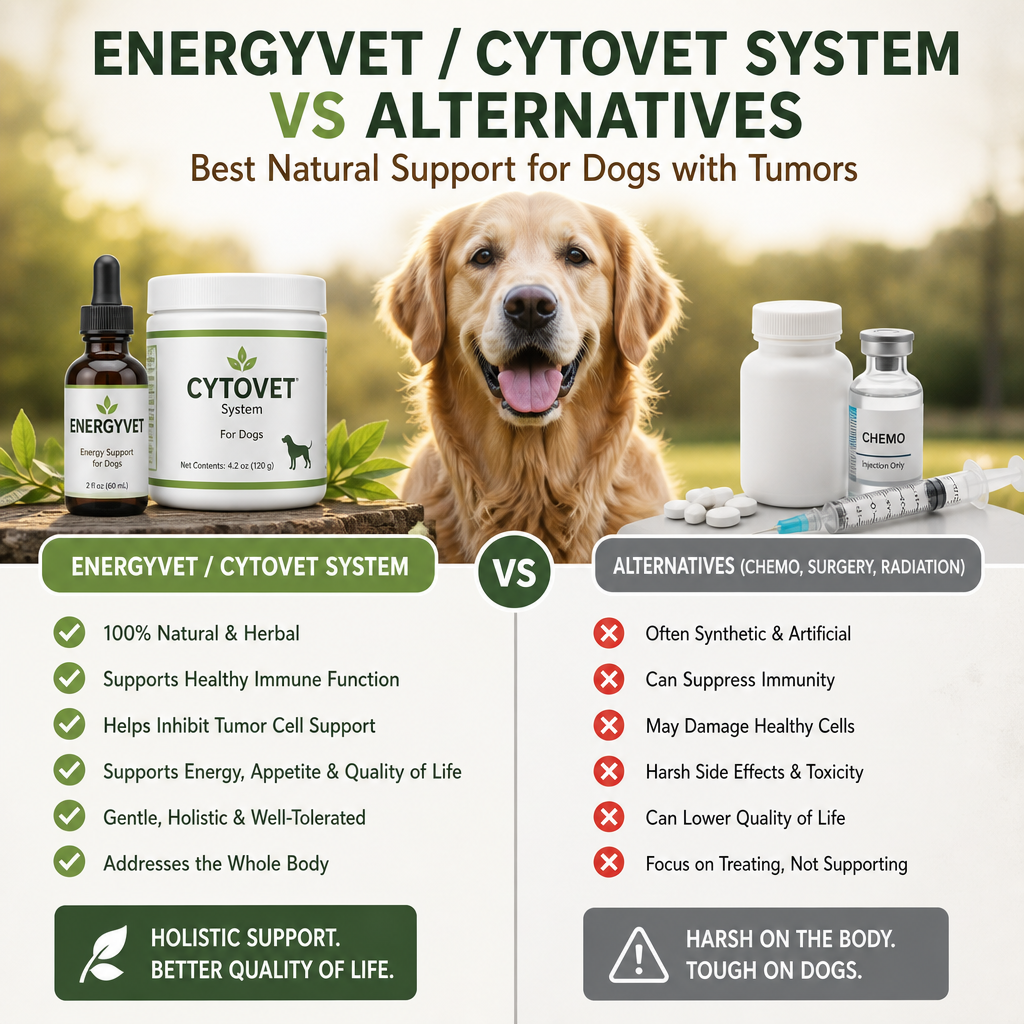
“Soutien” peut signifier plusieurs choses différentes. Certaines approches visent à aider à maintenir l'appétit, la digestion, l'hydratation, la mobilité ou la fonction immunitaire. D'autres sont commercialisées comme ayant des effets anticancéreux directs, bien que les preuves puissent être limitées ou basées principalement sur des données de laboratoire, animales ou anecdotiques.
Avant de choisir un produit, les propriétaires devraient clarifier l'objectif. La priorité est-elle de réduire les nausées après la chimiothérapie, de soutenir le maintien du poids, d'améliorer le confort, de gérer l'inflammation ou de traiter l'anxiété ? Un objectif clairement défini facilite l'évaluation de l'utilité d'une intervention et de sa sécurité en parallèle d'un traitement conventionnel.
Un vétérinaire peut recommander une chirurgie, une chimiothérapie, une radiothérapie, une immunothérapie, un médicament ciblé, un contrôle de la douleur ou des soins palliatifs en fonction du diagnostic. Des mesures naturelles ou intégratives peuvent parfois compléter ces traitements, mais elles doivent être coordonnées avec l'équipe vétérinaire.
En termes pratiques, le plan le plus utile est celui qui soutient le chien au quotidien. Une petite amélioration de l'appétit, de l'énergie, du confort ou de l'hydratation peut faire une différence significative dans la qualité de vie même lorsque la tumeur elle-même est encore en cours de traitement. C'est pourquoi de nombreuses familles comparent le système Energyvet / Cytovet vs alternatives non seulement par les revendications, mais aussi par la sécurité, le coût, la simplicité et l'adéquation avec le plan de soins actuel du chien.
Il est également utile de garder des attentes réalistes. Le soutien naturel peut atténuer les effets secondaires, améliorer le confort ou aider le chien à tolérer un plan de traitement, mais ce n'est pas un substitut à un examen diagnostique complet. La réponse d'un chien dépend de la biologie de la tumeur, de l'emplacement de la tumeur, de la propagation de la maladie et de la question de savoir si le chien souffre déjà de maladies rénales, hépatiques ou gastro-intestinales.
En raison de cela, le même produit peut être un choix raisonnable pour un patient et un mauvais choix pour un autre. Les meilleures comparaisons sont spécifiques, pas génériques. Au lieu de demander si un supplément est “bon”, demandez s'il est adapté à ce chien, à ce stade, avec ces médicaments, et pour cet objectif précis.
Qu'est-ce que le système Energyvet / Cytovet ?
Le système Energyvet / Cytovet est couramment discuté dans les cercles de soins pour animaux holistiques comme une approche de soutien naturel pour les chiens atteints de maladies graves. Cytovet est généralement présenté comme un complément destiné à soutenir la fonction cellulaire et immunitaire, tandis que les produits Energyvet peuvent être utilisés dans un système de soins complémentaires plus large.
Les formulations de produits, les utilisations recommandées et la disponibilité peuvent varier selon le pays et le fournisseur. Pour cette raison, les propriétaires devraient examiner l'étiquette actuelle, la liste des ingrédients, les instructions de dosage et les contrôles de qualité plutôt que de se fier uniquement aux descriptions promotionnelles ou aux témoignages en ligne.
La considération la plus importante n'est pas de savoir si un produit est étiqueté “ naturel ”, mais si ses ingrédients sont appropriés pour un chien individuel. Un chien souffrant de maladie rénale, de dysfonction hépatique, d'ulcères gastro-intestinaux, de risque de saignement ou ayant des antécédents de réactions indésirables peut nécessiter un plan très différent d'un chien par ailleurs en bonne santé.
Lorsque les gens recherchent le système Energyvet / Cytovet vs alternatives, ils veulent souvent savoir si le produit est destiné à un bien-être général ou à un objectif de soutien plus spécifique. Cette distinction est importante. Un complément qui soutient le corps de manière générale peut encore être raisonnable pour certains chiens, mais il ne doit pas être confondu avec une thérapie ayant des effets prouvés sur le contrôle des tumeurs.
Les propriétaires espèrent parfois qu'un complément “ renforcera ” un chien suffisamment pour mieux faire face au traitement. Dans certains cas, les soins de soutien peuvent effectivement aider à maintenir l'appétit ou le confort. Pourtant, le timing est important. Ce qui est approprié avant une chirurgie peut ne pas être approprié pendant une chimiothérapie, et ce qui fonctionne pendant la rémission peut ne pas être le bon choix pendant une maladie active. Un plan sensé est construit autour de l'étape médicale réelle plutôt qu'autour du marketing du produit.
Avantages et limitations potentiels
Certains propriétaires envisagent le système Energyvet / Cytovet parce qu'il peut s'inscrire dans une philosophie de soins intégratifs plus large et peut être intégré dans une routine quotidienne. Les partisans peuvent apprécier son accent sur le bien-être général, la santé cellulaire et le soutien lié à l'immunité.
En même temps, les preuves pour de nombreux systèmes de compléments commercialisés pour les tumeurs canines restent incomplètes. Un produit peut avoir des ingrédients plausibles sans avoir d'études cliniques solides montrant qu'il réduit les tumeurs, prolonge la survie ou améliore la réponse au traitement chez les chiens. Les témoignages peuvent être encourageants, mais ils ne peuvent pas établir l'efficacité car les résultats individuels sont influencés par la biologie de la tumeur, le stade, la génétique, le traitement et les soins globaux.
Une autre limitation est la possibilité d'interactions. Les compléments ayant des effets antioxydants ou immunomodulateurs peuvent théoriquement affecter la chimiothérapie ou la radiothérapie, bien que l'importance dépende de la substance spécifique et du protocole de traitement. Donner plusieurs produits en même temps peut également rendre difficile de déterminer ce qui aide ou cause des effets secondaires.
Pour cette raison, le système Energyvet / Cytovet vs alternatives devrait être jugé selon le même standard : quelle est la preuve, quel est le risque, et quel bénéfice mesurable la famille du chien peut-elle attendre ? Si la réponse n'est pas claire, la meilleure prochaine étape est une conversation avec le vétérinaire ou l'équipe d'oncologie du chien.
Il existe également des limitations pratiques. Certains produits sont difficiles à se procurer de manière constante, peuvent ne pas avoir de tests de lot clairs, ou peuvent nécessiter un calendrier de dosage difficile à maintenir pour une famille. Si une option de soutien est trop coûteuse, trop compliquée, ou trop difficile à administrer, elle peut ne pas être un choix réaliste même si le concept semble attrayant. La simplicité est importante dans les soins à long terme.
Un autre point important est qu'un produit de soutien ne devrait pas retarder un plan de traitement décisif. Si l'imagerie, les résultats de biopsie, ou les signes cliniques suggèrent une tumeur agressive, la fenêtre pour une intervention efficace peut être courte. Dans ces situations, le soutien intégratif devrait se dérouler parallèlement aux soins basés sur des preuves, et non à la place de ceux-ci.
Soutien naturel/intégratif : alternatives courantes
Le soutien naturel/intégratif inclut souvent plusieurs stratégies soigneusement sélectionnées plutôt qu'un seul produit “miracle”. La thérapie nutritionnelle est l'une des options les plus pratiques. Un régime complet et équilibré qui maintient le poids corporel et la masse musculaire est essentiel. Certains chiens bénéficient de repas riches en calories, de soutien à l'appétit, ou de plans nutritionnels personnalisés préparés avec un nutritionniste vétérinaire.
Les champignons médicinaux, tels que le champignon queue de dinde, sont également fréquemment discutés. Certains composés de champignons ont montré une activité liée à l'immunité dans la recherche, et certaines études vétérinaires préliminaires sont intéressantes. Cependant, la qualité des produits varie considérablement, et le dosage doit être examiné avec un vétérinaire, surtout lorsqu'un chien reçoit une chimiothérapie ou d'autres médicaments.
Les acides gras oméga-3 peuvent soutenir la santé de la peau, des articulations, et l'inflammation chez certains patients. Ils peuvent également créer des risques à des doses inappropriées, en particulier chez les chiens atteints de pancréatite, de problèmes de coagulation, ou de sensibilité gastro-intestinale. Les suppléments antioxydants, les herbes, et les huiles concentrées nécessitent une prudence similaire.
L'acupuncture, le massage, la réhabilitation physique, et l'exercice doux peuvent aider avec la mobilité, la douleur, le stress, et la récupération. Ces approches n'éliminent pas directement les tumeurs, mais elles peuvent contribuer de manière significative au confort et à la fonction quotidienne. La planification des soins palliatifs peut inclure des analgésiques sur ordonnance, des médicaments anti-nauséeux, des stimulants de l'appétit, et d'autres thérapies basées sur des preuves en complément des soins.
De nombreux propriétaires en Slovaquie recherchent également un soutien pratique qui peut être coordonné localement avec leur vétérinaire. Cela peut inclure la vérification de l'accès au suivi diagnostique, la demande de disponibilité en pharmacie, et la discussion sur la faisabilité d'un plan de supplémentation à maintenir dans le temps. Dans ce contexte, le système Energyvet / Cytovet vs alternatives devient moins une question de marketing et plus une question de soins durables.
Certaines familles se demandent également si une option naturelle doit être utilisée uniquement après un traitement conventionnel, ou si elle peut être utilisée dès le départ. La réponse dépend de l'état du chien et du plan de traitement spécifique. Par exemple, un chien en attente de chirurgie peut nécessiter une stratégie différente de celle d'un chien en soins palliatifs. C'est pourquoi une comparaison large du système Energyvet / Cytovet par rapport aux alternatives devrait inclure le timing, pas seulement les ingrédients.
Nutrition comme fondement
La nutrition mérite une attention particulière car elle affecte la force, la guérison et la tolérance au traitement. Les chiens atteints de tumeurs perdent souvent du poids en raison d'une diminution de l'appétit, de nausées, de douleurs ou d'une demande métabolique accrue. Même lorsqu'un chien mange encore, une perte de poids subtile peut se produire rapidement. Les propriétaires devraient surveiller l'état corporel, l'état musculaire, la qualité des selles et l'intérêt pour les repas.
Certains chiens se portent mieux avec des repas plus petits et plus fréquents. D'autres ont besoin d'une meilleure appétence, de nourriture réchauffée ou d'un soutien à l'appétit sur ordonnance. Un nutritionniste vétérinaire peut aider à élaborer un plan qui correspond au diagnostic et au stade de traitement du chien. Dans de nombreux cas, ce soutien pratique fait plus pour le confort quotidien qu'un supplément seul.
Lorsque la nutrition est stabilisée, il devient plus facile d'évaluer d'autres interventions de manière équitable. Si l'appétit du chien s'améliore après un changement de nourriture, l'ajout d'un supplément en même temps peut prêter à confusion. Pour cette raison, les changements devraient être introduits avec précaution et documentés. Cette approche aide à distinguer le véritable bénéfice de la variation normale au jour le jour.
Champignons médicinaux et soutien immunitaire
L'intérêt pour les champignons médicinaux a augmenté car certains composés peuvent influencer l'activité immunitaire. Cela dit, tous les produits ne sont pas créés égaux. La concentration, la méthode d'extraction, le contrôle de la contamination et l'exactitude de l'étiquetage peuvent varier considérablement. Un produit réputé devrait clairement identifier l'espèce, les ingrédients et les informations posologiques.
Comme pour la comparaison du système Energyvet / Cytovet par rapport aux alternatives, la question clé est de savoir si le produit a été évalué de manière significative pour les chiens. Si un supplément de champignon est envisagé, il devrait être discuté avant de commencer, surtout si le chien prend des stéroïdes, subit une radiothérapie ou reçoit une chimiothérapie.
Les propriétaires devraient également se rappeler que “le soutien immunitaire” n'est pas toujours le même que “le soutien aux tumeurs”. Un produit qui semble soutenir l'équilibre immunitaire général peut encore être inapproprié si le chien a une condition médiée par le système immunitaire, prend des médicaments immunosuppresseurs ou a un type de cancer où la stimulation immunitaire n'est pas souhaitable. C'est une autre raison pour laquelle l'avis vétérinaire est important.
Mouvement, confort et réhabilitation
Les thérapies axées sur le confort sont souvent négligées, pourtant elles peuvent faire une grande différence. Les chiens atteints de cancer peuvent devenir raides, fatigués ou réticents à bouger. La réhabilitation douce, les courtes promenades, le massage et l'acupuncture peuvent soutenir la mobilité et réduire le stress. Ces approches sont particulièrement précieuses lorsque l'objectif n'est pas la guérison mais de maintenir une bonne qualité de vie aussi longtemps que possible.
Dans de nombreux cas concrets, les soins intégratifs fonctionnent mieux lorsqu'ils soutiennent la capacité du chien à manger, dormir, bouger et interagir normalement. Cette perspective pratique est plus utile que toute affirmation selon laquelle un système de supplément est universellement supérieur.
Pour certains chiens, les gains les plus significatifs proviennent de multiples petites améliorations plutôt que d'un seul changement dramatique. Un meilleur sommeil, moins de nausées, moins de pas douloureux et un intérêt accru pour la nourriture peuvent tous s'accumuler. C'est pourquoi un plan de soins réfléchi peut inclure la réhabilitation, le contrôle de la douleur et la gestion des symptômes même lorsque la famille explore encore des produits naturels.
Comparer les alternatives en toute sécurité
Lors de la comparaison du système Energyvet / Cytovet vs alternatives, considérez cinq questions pratiques :
1. Quelles preuves soutiennent le produit ou la thérapie ? Recherchez des recherches cliniques vétérinaires plutôt que des affirmations de laboratoire seules.
2. La liste des ingrédients est-elle transparente ? Évitez les produits qui n'identifient pas clairement les ingrédients, les quantités, les informations sur le lot et les détails du fabricant.
3. Pourrait-il interagir avec le traitement ? Fournissez la liste complète des suppléments à l'oncologue ou au vétérinaire principal.
4. Comment le succès sera-t-il mesuré ? Suivez l'appétit, le poids, la qualité des selles, l'énergie, la douleur et l'imagerie vétérinaire lorsque cela est approprié.
5. Quel est le risque si cela ne fonctionne pas ? Retarder un traitement efficace peut permettre à une tumeur agressive de progresser.
Une comparaison utile n'est pas simplement “ naturel contre pharmaceutique ”. C'est “ bien soutenu et surveillé contre incertain et non géré ”. Certains produits naturels peuvent être des compléments raisonnables, tandis que d'autres peuvent être coûteux, mal standardisés ou potentiellement nuisibles.
Il est également utile de séparer le soulagement des symptômes à court terme de la gestion des maladies à long terme. Un complément qui aide un chien à se sentir mieux pendant une semaine n'est pas automatiquement un traitement contre le cancer. De même, une thérapie qui soutient la récupération mais ne prétend pas traiter la tumeur peut toujours être précieuse. Des objectifs clairs facilitent les décisions et réduisent le risque de déception.
Lorsque vous parlez avec un vétérinaire, apportez l'étiquette du produit, une liste des ingrédients et le plan de médication actuel. Si un complément est utilisé en parallèle avec des prescriptions, toute l'équipe devrait être informée. Ce type de coordination est particulièrement important si le chien a déjà commencé un traitement contre le cancer ou a subi une chirurgie, car les périodes de récupération peuvent changer ce qui est approprié.
Des informations externes fiables peuvent également aider les propriétaires à évaluer les revendications. Le L'Association américaine des médecins vétérinaires sur le cancer pour les animaux de compagnie explique les options de traitement courantes et souligne pourquoi la supervision vétérinaire est importante.
Une autre habitude de sécurité est de vérifier si un produit a une politique de retour claire, des informations de contact et un suivi de lot. Ces détails ne prouvent pas que quelque chose fonctionne, mais ils reflètent une responsabilité de base du produit. Dans un domaine où les propriétaires prennent des décisions émotionnelles sous stress, ce niveau de transparence peut être utile.
Questions courantes que les propriétaires posent sur le système Energyvet / Cytovet par rapport aux alternatives
De nombreuses familles veulent savoir si choisir un plan de soutien naturel signifie rejeter les soins conventionnels. Ce n'est pas le cas. Dans la plupart des cas, l'approche la plus responsable combine diagnostic médical, traitement basé sur des preuves et soins de soutien soigneusement sélectionnés. L'objectif n'est pas de choisir un camp ; il s'agit d'aider le chien à vivre aussi bien que possible.
Une autre question fréquente est de savoir si le meilleur choix est l'option la plus coûteuse. Le prix ne reflète pas toujours la qualité. Certains compléments coûteux ont des données minimales, tandis que certaines mesures à coût réduit, comme l'ajustement du régime alimentaire ou le contrôle des nausées, peuvent avoir un effet beaucoup plus important sur le confort quotidien. Une comparaison réfléchie devrait toujours examiner le bénéfice attendu, pas seulement le prix.
Les propriétaires demandent également si un produit peut être poursuivi tout au long du parcours du cancer. Parfois oui, parfois non. Un produit qui est bien toléré pendant une maladie stable peut devoir être suspendu autour de la chirurgie ou changé lorsque les médicaments sont ajustés. La surveillance est plus importante que l'étiquette elle-même.
Si un chien reçoit plus d'une thérapie de soutien, le nombre de changements doit rester gérable. Ajouter de nombreux produits en même temps augmente le risque de confusion, d'effets secondaires et de coûts sans prouver qu'une option aide réellement. Des étapes petites et mesurées sont généralement le chemin le plus sûr.
Élaborer un plan guidé par un vétérinaire
Commencez par un diagnostic confirmé et un stade chaque fois que possible. Le type de tumeur, son emplacement, son grade, sa propagation et son comportement attendu devraient guider les décisions. Demandez à l'équipe vétérinaire si un supplément est compatible avec la chirurgie, la chimiothérapie, la radiothérapie, les stéroïdes, les médicaments contre la douleur ou les médicaments ciblés.
Introduisez un seul nouveau produit à la fois. Cela facilite l'identification des effets secondaires tels que vomissements, diarrhée, léthargie, changements d'appétit, démangeaisons ou saignements anormaux. Tenez un registre écrit du nom du produit, de la dose, de la date de début et des changements observés.
Enfin, évaluez chaque option de soutien à la tumeur chez le chien par son impact sur la qualité de vie. Une thérapie de soutien devrait idéalement aider le chien à manger, se reposer, bouger, interagir et profiter des activités quotidiennes sans ajouter de risque inutile. Les soins naturels peuvent faire partie intégrante d'un plan d'intégration, mais l'approche la plus solide est individualisée, transparente et supervisée par des professionnels vétérinaires qualifiés.
Si vous examinez le système Energyvet / Cytovet par rapport aux alternatives, demandez si le même argent et les mêmes efforts pourraient mieux soutenir un plan nutritionnel, le contrôle de la douleur, la gestion des nausées ou une séance de réhabilitation. Ces bases ne sont pas glamour, mais elles offrent souvent le bénéfice le plus fiable.
Il peut également être utile de fixer une date de révision. Après deux à quatre semaines, évaluez si le chien mange mieux, se déplace plus confortablement ou tolère le traitement plus facilement. S'il n'y a pas d'amélioration mesurable, le plan devrait être reconsidéré plutôt que poursuivi automatiquement. Les soins de soutien devraient mériter leur place en aidant le chien, et non par habitude seule.
Quand chercher une aide vétérinaire urgente
Certains signes ne devraient jamais être gérés à domicile seul. Contactez rapidement un vétérinaire si le chien cesse de manger pendant plus d'un jour, a des vomissements ou des diarrhées répétés, semble faible ou s'effondre, a des difficultés à respirer, présente des saignements, développe une douleur sévère ou devient soudainement désorienté. Des changements rapides peuvent signaler des complications de traitement, une infection, une déshydratation, un saignement interne ou une progression de la tumeur.
N'attendez pas qu'un supplément “fasse effet” si le chien décline. Les soins de soutien fonctionnent mieux lorsqu'ils sont associés à une attention médicale rapide. Si un produit semble aggraver les symptômes, arrêtez-le et demandez au vétérinaire s'il doit être évité à l'avenir.
En fin de compte, la meilleure décision n'est généralement pas la plus dramatique. C'est la plus informée. La comparaison entre le système Energyvet / Cytovet et les alternatives devrait aider les propriétaires à choisir un plan qui est réaliste, sûr et centré sur le confort et les besoins médicaux du chien. Avec une coordination soigneuse, le soutien naturel et intégratif peut jouer un rôle constructif sans remplacer les soins essentiels dont un chien atteint de cancer a encore besoin.
Pour de nombreux chiens, le succès signifie moins de mauvais jours, un appétit plus régulier et un meilleur confort plutôt qu'un changement dramatique unique. C'est une manière sensée d'évaluer le système Energyvet / Cytovet par rapport aux alternatives et à chaque autre option de soutien. Si le plan aide le chien à se sentir et à fonctionner mieux tout en restant compatible avec les soins médicaux, il a une réelle valeur.