

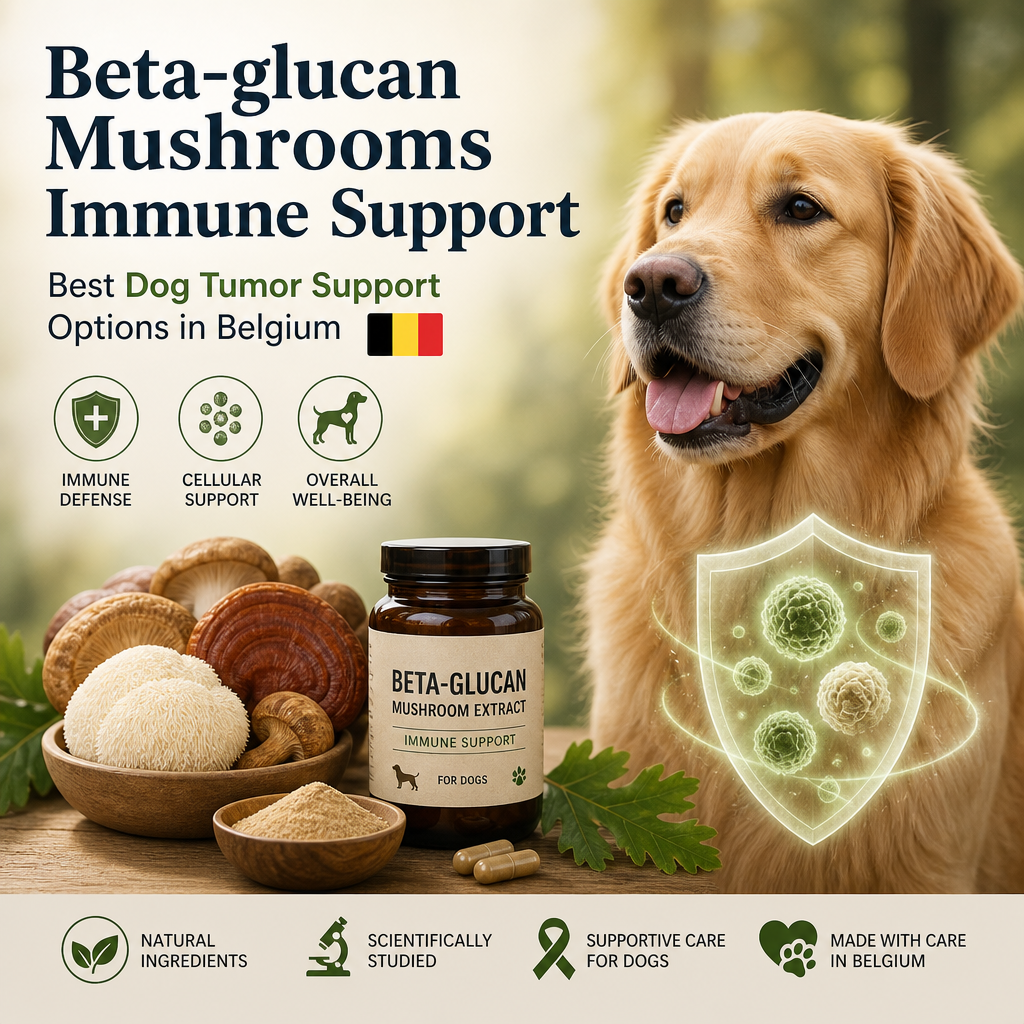
Le bêta-glucane / les champignons / le soutien immunitaire suscite un intérêt croissant parmi les propriétaires de chiens belges à la recherche de moyens complémentaires pour s'occuper d'un chien atteint d'une tumeur. Les extraits de champignons médicinaux et les bêta-glucanes peuvent aider à soutenir une fonction immunitaire normale, mais ils ne doivent jamais remplacer le diagnostic vétérinaire, la chirurgie, la chimiothérapie, la radiothérapie, le contrôle de la douleur ou d'autres traitements recommandés. La meilleure approche combine une supplémentation fondée sur des preuves avec une supervision vétérinaire régulière, une sélection soigneuse des produits et une attention à la qualité de vie globale du chien.
Table des matières
- Comprendre le soutien aux tumeurs chez les chiens en Belgique
- Bêta-glucane / champignons / soutien immunitaire : que signifie-t-il ?
- Queue de dinde et autres champignons médicinaux
- Choisir des suppléments contre le cancer chez les chiens en Belgique
- Sécurité et interactions possibles
- La nutrition comme fondement du soutien aux tumeurs
- Un plan pratique pour le soutien aux tumeurs chez les chiens en Belgique
Comprendre le soutien aux tumeurs chez les chiens en Belgique
Une tumeur peut être bénigne ou maligne, et différents cancers se comportent très différemment. Une tumeur à mastocytes, un lymphome, un ostéosarcome, une tumeur mammaire et un sarcome des tissus mous peuvent chacun nécessiter un plan de traitement différent. Avant de considérer des suppléments, un vétérinaire doit confirmer le diagnostic chaque fois que cela est possible par examen, imagerie, cytologie, biopsie ou d'autres tests appropriés.
Les options de soutien aux tumeurs chez les chiens en Belgique tombent généralement dans plusieurs catégories :
– Traitement vétérinaire du cancer
– Soutien nutritionnel
– Gestion de la douleur, des nausées et de l'inflammation
– Soutien à l'appétit et au poids corporel
– Suppléments soigneusement sélectionnés
– Soutien émotionnel et pratique pour le chien et la famille
Les suppléments peuvent être utiles dans le cadre de ce plan plus large, mais “ naturel ” ne signifie pas automatiquement sûr. Certains produits peuvent affecter la coagulation sanguine, les enzymes hépatiques, la pression artérielle ou la façon dont les médicaments de chimiothérapie sont métabolisés. Pour cette raison, chaque supplément doit être discuté avec le vétérinaire traitant, en particulier lorsqu'un chien reçoit des médicaments ou se prépare à une chirurgie.
Bêta-glucane / champignons / soutien immunitaire : que signifie-t-il ?
Les bêta-glucanes sont des polysaccharides naturellement présents dans les parois cellulaires de certains champignons, levures, avoines et autres organismes. Dans les champignons médicinaux, les bêta-glucanes sont souvent considérés comme l'un des composés les plus pertinents pour la recherche sur le soutien immunitaire. Ils peuvent interagir avec des récepteurs impliqués dans la réponse immunitaire innée de l'organisme, y compris des cellules immunitaires telles que les macrophages et les cellules tueuses naturelles.
Cela ne signifie pas que les bêta-glucanes détruisent directement les tumeurs ou garantissent une réponse immunitaire plus forte. Leur rôle potentiel est mieux décrit comme une modulation immunitaire : aider à réguler l'activité immunitaire plutôt que de simplement “ l'augmenter ”. La recherche en médecine vétérinaire est encore en développement, et les résultats des études en laboratoire, des recherches humaines et des études sur de petits animaux ne doivent pas être considérés comme une preuve qu'un produit fonctionnera pour chaque chien.
Les champignons couramment inclus dans les formules de soutien immunitaire comprennent :
– Queue de dinde, également connue sous le nom de Tramète versicolore
– Reishi, ou Ganoderma lucidum
– Maitake, ou Grifola frondosa
– Shiitake, ou Lentinula edodes
– Chaga, ou Inonotus obliquus
– Espèces de Cordyceps
Ces champignons diffèrent par leurs composés actifs, méthodes d'extraction, profils de sécurité et recherches disponibles. Un produit de qualité doit identifier l'espèce de champignon, la méthode d'extraction, la teneur en bêta-glucane, la taille de la portion, les informations sur le lot et les tests pour les contaminants. Lorsque les propriétaires comparent Bêta-glucane / champignons / immunitaire des produits, ces détails d'étiquette font une grande différence dans la façon dont une formule semble digne de confiance.
Queue de dinde et autres champignons médicinaux
La queue de dinde est l'un des champignons les plus souvent discutés dans le contexte du soutien aux tumeurs canines. Ses composés polysaccharidiques, y compris le polysaccharide-K et le peptide polysaccharidique, ont été étudiés pour des applications liées à l'immunité. Certaines recherches ont exploré les extraits de queue de dinde chez les chiens atteints de cancer, mais les preuves restent limitées par rapport aux traitements d'oncologie vétérinaire conventionnels. Pour les propriétaires comparant bêta-glucane / champignons / immunitaire des produits, la queue de dinde est souvent le point de départ car c'est l'une des options les mieux connues.
Le Reishi peut être sélectionné pour son utilisation traditionnelle dans le soutien immunitaire et inflammatoire, tandis que le maitake est souvent commercialisé pour les bêta-glucanes et la santé immunitaire générale. Le shiitake et le cordyceps peuvent également apparaître dans des formules mélangées. Cependant, combiner plusieurs champignons ne rend pas automatiquement un supplément plus efficace. Les produits multi-ingrédients peuvent rendre plus difficile l'identification de l'ingrédient qui cause un bénéfice ou un effet secondaire.
La qualité de l'extraction est importante. Les extraits à l'eau chaude peuvent concentrer certains polysaccharides, tandis que les extraits doubles utilisent à la fois de l'eau et de l'alcool pour obtenir une plus large gamme de composés. Les produits ne listant que “ poudre de champignon ” peuvent contenir moins de matière active concentrée que les extraits standardisés. Recherchez un étiquetage transparent plutôt que des affirmations vagues telles que “ soutient la guérison du cancer ” ou “ tue les tumeurs ”.”
Pour un aperçu plus large de la façon dont des ingrédients spécifiques de champignon peuvent être utilisés dans les soins canins, voir Les bienfaits surprenants des champignons pour la santé de votre chien.
Un autre point de comparaison utile est une gamme de produits construite autour du soutien immunitaire pour les chiens, comme Explorer les champignons de queue de dinde : un allié naturel pour les chiens qui luttent contre le cancer, qui aide les propriétaires à comprendre comment un champignon peut s'intégrer dans un plan de soins plus large.
Choisir des suppléments contre le cancer chez les chiens en Belgique
Lors de la comparaison des suppléments pour le cancer des chiens en Belgique, les propriétaires devraient évaluer à la fois la formule et l'entreprise qui la soutient. Les questions importantes incluent :
L'étiquette indique-t-elle l'espèce exacte de champignon ?
La quantité de bêta-glucane est-elle indiquée séparément des polysaccharides totaux ?
Le produit est-il conçu pour les chiens plutôt que adapté d'un supplément humain ?
Les ingrédients sont-ils testés pour les métaux lourds, les pesticides, les bactéries et les mycotoxines ?
Le fabricant fournit-il des numéros de lot et un certificat d'analyse ?
Les instructions de dosage sont-elles basées sur le poids corporel ?
Le produit évite-t-il les édulcorants, arômes ou ingrédients à base de plantes inutiles ?
L'entreprise peut-elle expliquer d'où proviennent les matières premières ?
Les propriétaires belges peuvent trouver des suppléments via des pratiques vétérinaires, des pharmacies, des détaillants spécialisés pour animaux de compagnie et des fournisseurs en ligne européens. Acheter auprès d'une entreprise belge ou basée dans l'UE réputée peut faciliter la vérification des étiquettes, le contact avec le fabricant et la compréhension des exigences d'expédition et de stockage. Les produits importés de l'extérieur de l'Europe peuvent avoir des contrôles de qualité ou des normes d'étiquetage peu clairs.
Un nutritionniste vétérinaire ou un oncologue vétérinaire peut également aider à déterminer si un supplément est approprié pour le diagnostic d'un chien, son traitement actuel, son appétit, sa fonction rénale, sa fonction hépatique et sa santé digestive. Dans de nombreux cas, le meilleur bêta-glucane / champignons / immunitaire produit est celui qui s'intègre en toute sécurité dans un plan de traitement déjà coordonné.
Sécurité et interactions possibles
Les extraits de champignons et les bêta-glucanes sont souvent bien tolérés, mais des effets secondaires peuvent survenir. Un léger dérangement digestif, des selles molles, des vomissements, une diminution de l'appétit ou des démangeaisons peuvent se développer, surtout lorsqu'un produit est introduit à une dose élevée. Des préoccupations plus graves peuvent survenir chez les chiens atteints de maladies auto-immunes, de troubles de la coagulation, de problèmes hépatiques ou rénaux, ou d'allergies connues.
Une prudence supplémentaire est appropriée lorsqu'un chien prend :
– Médicaments de chimiothérapie
– Corticostéroïdes
– Médicaments anti-inflammatoires non stéroïdiens
– Anticoagulants
– Médicaments immunosuppresseurs
– Médicaments pour le diabète
– Médicaments traités par le foie
Les suppléments ne sont pas toujours appropriés immédiatement avant une chirurgie. Certains ingrédients peuvent influencer la fonction plaquettaire ou la coagulation, donc le vétérinaire peut conseiller de les arrêter à l'avance. Ne supposez jamais qu'un supplément est inoffensif simplement parce qu'il est vendu sans ordonnance.
Introduisez un seul nouveau produit à la fois et tenez un registre de la dose, de la date de début, de l'appétit, de la qualité des selles, de l'énergie et de tout symptôme inhabituel. Arrêtez le produit et contactez un vétérinaire si le chien développe des vomissements répétés, une diarrhée sévère, un gonflement du visage, des difficultés respiratoires, des saignements inhabituels, une léthargie marquée ou un déclin soudain.
Pour des conseils de sécurité vétérinaire officiels sur les produits complémentaires, le politique des thérapies complémentaires et alternatives de l'Association vétérinaire australienne offre un point de référence utile pour discuter des risques et des limitations.
La nutrition comme fondement du soutien aux tumeurs
Un supplément ne peut pas compenser une nutrition inadéquate. Les chiens atteints de cancer peuvent perdre du poids en raison d'une diminution de l'appétit, de nausées, de douleurs, d'inflammation ou de changements dans le métabolisme. Maintenir un confort alimentaire et une condition corporelle saine est souvent plus important que d'ajouter de nombreux produits.
Offrez un régime complet et équilibré recommandé par un vétérinaire. Certains chiens bénéficient de repas riches en calories, de portions plus petites servies plus fréquemment, ou de niveaux de protéines et de graisses soigneusement sélectionnés. Les changements alimentaires doivent tenir compte du type de tumeur, du plan de traitement, de la santé des reins et du foie, et de la tolérance digestive. Les régimes faits maison doivent être formulés avec l'aide d'un professionnel car des carences nutritionnelles peuvent se développer rapidement.
L'hydratation, le confort dentaire, le contrôle des nausées et la gestion de la douleur influencent également l'appétit. Un chien qui refuse de manger peut nécessiter une évaluation médicale plutôt qu'un autre supplément. Même lorsque les propriétaires se concentrent sur le bêta-glucane / les champignons / les options immunitaires, la base doit toujours être la nourriture, le confort et la surveillance médicale.
Un plan pratique pour le soutien aux tumeurs chez les chiens en Belgique
Un plan sensé commence par un diagnostic confirmé et une discussion claire sur le traitement. Demandez à l'équipe vétérinaire quels sont les objectifs : retirer la tumeur, ralentir la progression, contrôler la douleur, soutenir la récupération ou préserver la qualité de vie. Ensuite, examinez tout produit de bêta-glucane ou de champignon proposé avant de le donner.
Surveillez des indicateurs pratiques tels que l'appétit, le poids corporel, la mobilité, le sommeil, l'intérêt pour les activités familiales, la respiration, les selles et les signes de douleur. Ces observations aident à déterminer si le plan de soins global est efficace. Des contrôles réguliers permettent au vétérinaire d'évaluer la progression de la tumeur et d'identifier les effets secondaires tôt.
Bêta-glucane / champignons / immunitaire Une prudence supplémentaire est appropriée lorsqu'un chien prend :.
– Médicaments de chimiothérapie bêta-glucane / champignons / immunitaire – Corticostéroïdes.