
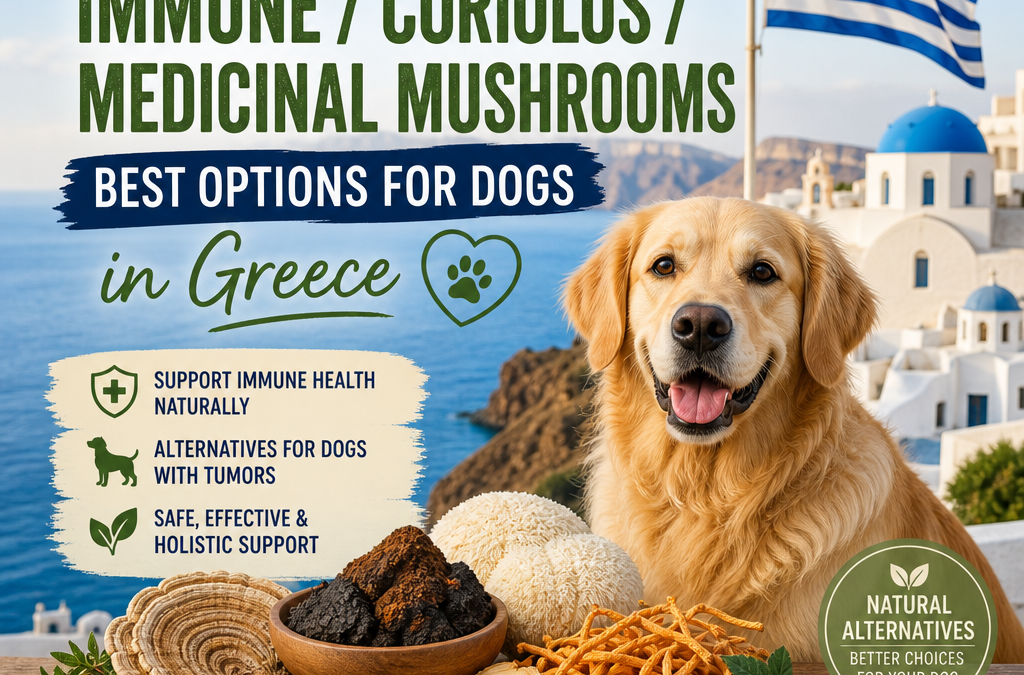
Alternatieven voor Immune / Coriolus / medicinale paddenstoelen kunnen nuttig zijn om te overwegen wanneer een hond een bepaald product niet kan verdragen, wanneer het niet beschikbaar is in Griekenland, of wanneer een dierenarts een breder ondersteunend zorgplan aanbeveelt. Echter, geen enkel supplement kan diagnose en behandeling voor kanker of een andere ernstige ziekte vervangen. De veiligste aanpak is om de toestand van de hond, huidige medicatie, voedingsbehoeften en behandeldoelen te identificeren voordat er een nieuw product wordt toegevoegd.
Voor veel eigenaren begint de zoektocht omdat ze iets praktisch, veilig en gemakkelijk lokaal willen verkrijgen. In dat verband gaat het bij alternatieven voor Immune / Coriolus / medicinale paddenstoelen niet om het vervangen van veterinaire zorg. Het gaat om het kiezen van het juiste ondersteunende hulpmiddel voor de juiste hond op het juiste moment.
Inhoudsopgave
- Waarom eigenaren op zoek zijn naar alternatieven voor hondentumorsupplementen
- Omega-3 vetzuren als een ondersteunende optie
- Antioxidant en voedingsondersteuning
- Alternatieven voor medicinale paddenstoelen en belangrijke voorzorgsmaatregelen
- Kruidenproducten: veelbelovend maar niet zonder risico
- Veilig producten kiezen in Griekenland
- Het belang van veterinaire supervisie
Waarom eigenaren op zoek zijn naar alternatieven voor hondentumorsupplementen
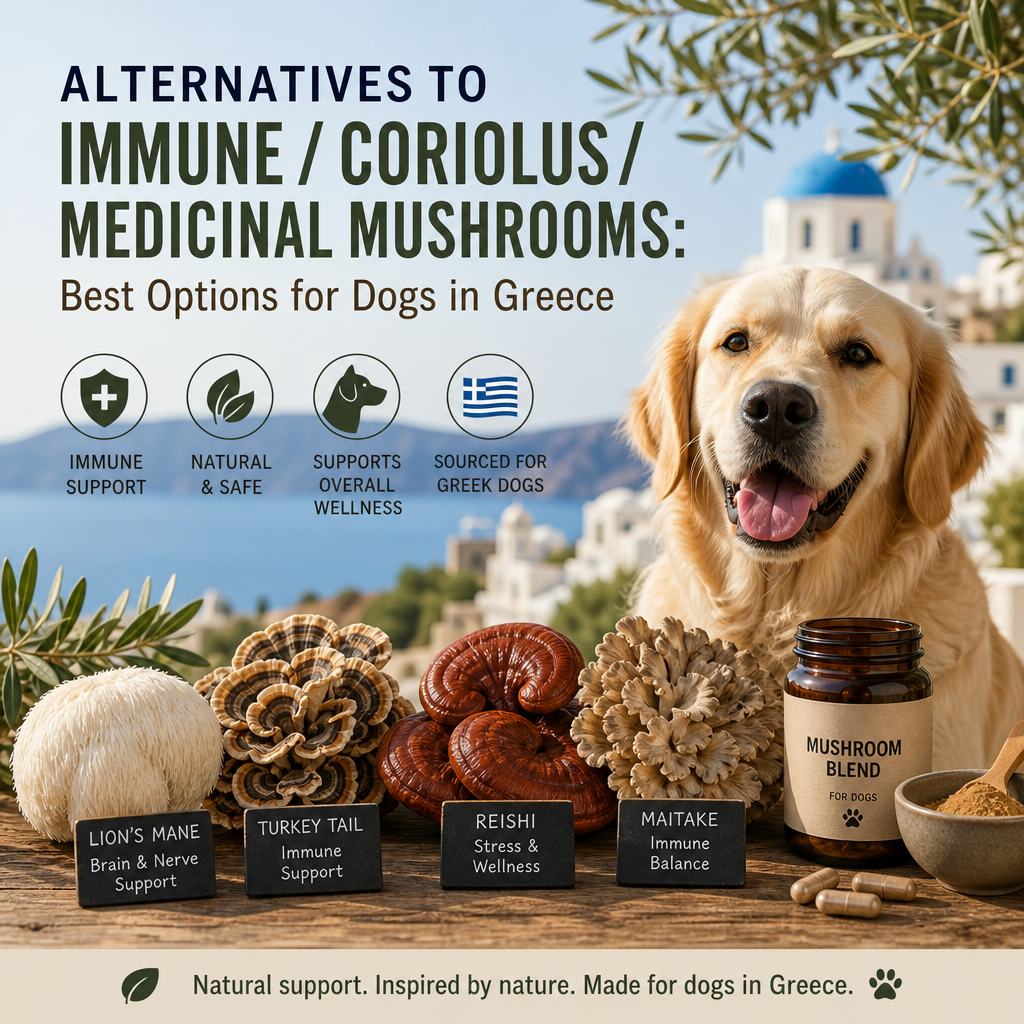
Coriolus versicolor, ook bekend als kalkoenstaartpaddenstoel, wordt vaak besproken als een ondersteunend supplement voor honden met tumoren omdat het verbindingen bevat zoals polysaccharide-K en polysaccharopeptide. Onderzoek naar deze verbindingen is veelbelovend maar nog beperkt, en resultaten van laboratoriumstudies of kleine klinische onderzoeken moeten niet worden behandeld als bewijs dat een supplement kanker kan genezen.
Eigenaren kunnen om verschillende praktische redenen op zoek zijn naar alternatieven voor Immune / Coriolus / medicinale paddenstoelen:
- Het originele supplement is niet beschikbaar bij een betrouwbare verkoper in Griekenland.
- De hond ervaart spijsverteringsproblemen, jeuk of een andere vermoedelijke reactie.
- Het product bevat verschillende ingrediënten die kunnen interageren met medicatie.
- De hond weigert capsules of poeders.
- Een dierenarts wil immuunstimulerende producten vermijden tijdens chemotherapie, steroidbehandeling of auto-immuunziekte.
- Het productlabel identificeert niet duidelijk de hoeveelheid actieve ingrediënten.
Een supplement moet worden beoordeeld op basis van de veiligheid, kwaliteit, relevantie voor de toestand van de hond en compatibiliteit met veterinaire behandeling—niet alleen op basis van de populariteit online. In het echte leven komt het beste resultaat vaak van een eenvoudige, goed geteste optie in plaats van een gecompliceerde formule met een lange ingrediëntenlijst.
Hoe alternatieven voor Immune / Coriolus / medicinale paddenstoelen meestal worden geëvalueerd
Wanneer dierenartsen ondersteunende producten vergelijken, kijken ze naar het bewijs achter elk ingrediënt, hoe de hond het waarschijnlijk zal verdragen, en of de formule past bij de exacte behoeften van de patiënt. Dat maakt alternatieven voor Immune / Coriolus / medicinale paddenstoelen meer een kwestie van klinisch oordeel dan van merknamen.
In veel gevallen is de meest nuttige optie geen directe vervanging met een vergelijkbare marketingclaim. Het kan een voeding-gerelateerd product zijn, een zorgvuldig gedoseerde olie, of een supplement met één ingrediënt dat gemakkelijker te monitoren en aan te passen is. Dit is vooral belangrijk voor honden die al voorgeschreven medicatie gebruiken of onder behandeling zijn voor kanker.
Het is ook verstandig om te vragen of het doel immuunondersteuning, eetlustondersteuning, spijsverteringsondersteuning of algemene conditie is. Zodra dat doel duidelijk is, worden alternatieven voor Immune / Coriolus / medicinale paddenstoelen gemakkelijker op een zinvolle manier te vergelijken.
Omega-3 vetzuren als een ondersteunende optie
Visolie die EPA en DHA bevat, is een van de beter bekende voedingsopties voor honden die algemene ondersteuning nodig hebben. Deze vetzuren kunnen helpen de huid, vacht, gewrichten en ontstekingsgezondheid te behouden. Bij honden met kanker worden omega-3 vetzuren soms opgenomen in voedingsplannen omdat ze de lichaamsconditie kunnen ondersteunen en helpen extra calorieën op een evenwichtige manier te bieden.
Kwaliteit is belangrijk. Kies een veterinaire geschikte product dat duidelijk de hoeveelheid EPA en DHA vermeldt in plaats van alleen de totale hoeveelheid “visolie” te vermelden. Producten moeten correct worden opgeslagen om oxidatie te verminderen, en de dosis moet worden berekend op basis van het gewicht en de gezondheidstoestand van de hond.
Visolie is niet geschikt voor elke hond. Het kan voorzichtig worden gebruikt bij honden met pancreatitis, bloedingsstoornissen, gastro-intestinale aandoeningen of bepaalde medicijncombinaties. Bespreek het altijd met een dierenarts, vooral voor een operatie of tijdens het gebruik van anticoagulantia.
Voor lezers die praktische ondersteuningsproducten vergelijken, kan een dierenarts ook voorstellen om de opties op de productpagina naast de medische geschiedenis van de hond en het huidige behandelplan te bekijken.
Waarom omega-3 producten vaak als eerste worden overwogen
Onder de alternatieven voor Immune / Coriolus / medicinale paddenstoelen worden omega-3 producten vaak vroeg besproken omdat ze bekend, breed beschikbaar en gemakkelijker in een dagelijkse routine te passen zijn. Ze kunnen ook nauwkeuriger worden aangepast dan veel gemengde formules. Dat maakt ze een praktische keuze voor eigenaren die ondersteuning willen zonder onnodige complexiteit toe te voegen.
Toch moet het product worden afgestemd op de hond, niet alleen op de diagnose. Een kleine hond met een gevoelige maag heeft misschien een heel andere aanpak nodig dan een grote hond die herstelt van een kankerprocedure. Hetzelfde geldt wanneer de hond al anti-misselijkheid medicatie, pijnstillers of antibiotica gebruikt.
Antioxidant en voedingsondersteuning
Sommige honden met ernstige ziekten hebben verhoogde voedingsbehoeften of verliezen gewicht door een slechte eetlust, misselijkheid, pijn of bijwerkingen van de behandeling. In deze gevallen kan een compleet veterinaire voedingsplan waardevoller zijn dan een complex immuunsupplement.
Afhankelijk van de toestand van de hond kan een dierenarts aanbevelen:
- Een zeer verteerbaar, energierijk dieet
- Zorgvuldig geselecteerde eiwit- en vetniveaus
- Eetlustondersteuning
- Probiotica voor geschikte gastro-intestinale gevallen
- B-vitamines wanneer er een gedocumenteerde behoefte bestaat
- Vitamine- of mineraalcorrectie wanneer bloedonderzoek een tekort aantoont
Hoge doses vitamines en antioxidanten mogen niet casual worden gegeven. Bepaalde supplementen kunnen interfereren met chemotherapie, radiotherapie, leverfunctie of bloedstolling. “Natuurlijk” betekent niet automatisch onschadelijk, en geconcentreerde menselijke supplementen kunnen ingrediënten bevatten die onveilig zijn voor honden.
Voor een diepere kijk op hoe ondersteunende ingrediënten worden besproken in de kankerzorg, zie controverse en belofte van kruidenmedicijnen in de behandeling van huisdierkanker.
Wanneer de eetlust en de lichaamsconditie slecht zijn, kunnen de meest nuttige alternatieven voor Immune / Coriolus / medicinale paddenstoelen voedingsmiddelen zijn in plaats van botanische. Een hond die slecht eet, kan niet profiteren van een supplement dat onafgemaakt in de kom blijft liggen.
Wanneer voeding belangrijker is dan een paddenstoelenextract
Als een hond spiermassa verliest, voedsel weigert of moeite heeft om energie te behouden, kan het beste alternatief een voedingsplan zijn in plaats van een ander supplement. In die setting moeten alternatieven voor Immune / Coriolus / medicinale paddenstoelen worden gekozen om de inname te verbeteren, de spijsvertering te ondersteunen en de last van bijwerkingen te verminderen.
Een dierenarts kan ook de maaltijdfrequentie aanpassen, smakelijkere texturen kiezen of een therapeutisch dieet aanbevelen dat beter aansluit bij de diagnose van de hond. Die stappen hebben vaak een grotere impact in de praktijk dan het gelijktijdig toevoegen van verschillende overlappende producten.
Ondersteunende voedingsplannen zijn vooral nuttig wanneer de behandeldoelen veranderen. Een hond kan kortetermijn calorieondersteuning nodig hebben na een operatie, of langdurig voedingsonderhoud tijdens chemotherapie. Het beste plan is het plan dat de hond elke dag daadwerkelijk kan verdragen.
Alternatieven voor medicinale paddenstoelen en belangrijke voorzorgsmaatregelen
Andere medicinale paddenstoelen, waaronder reishi, maitake, shiitake en verwante extracten, worden vaak gepromoot als producten ter ondersteuning van het immuunsysteem. Ze kunnen beta-glucanen en andere biologisch actieve verbindingen bevatten, maar bewijs bij honden blijft beperkt. Producten kunnen ook aanzienlijk variëren in extractiemethode, zuiverheid, concentratie en contaminatierisico.
Als een op paddenstoelen gebaseerd product wordt overwogen, let dan op:
- De exacte paddenstoelensoort en het gebruikte deel
- Een duidelijk vermelde extractverhouding of actieve stofinhoud
- Onafhankelijke tests op zware metalen, pesticiden en microben
- Een batchnummer en vervaldatum
- Een fabrikant met transparante kwaliteitscontrolepraktijken
- Dierenartsadvies over interacties
Vermijd wildgeplukte paddenstoelen en producten met vage “proprietary blends.” Honden kunnen ook anders reageren op paddenstoelenextracten dan mensen, vooral als ze leverziekte, immuungemedieerde ziekten of een geschiedenis van gastro-intestinale gevoeligheid hebben.
Wanneer eigenaren vragen naar alternatieven voor Immune / Coriolus / medicinale paddenstoelen, is het beste antwoord meestal geen enkele vervanging maar een veiliger, beter afgestemd ondersteunend plan. Dat kan betekenen dat er een ander paddenstoelenproduct nodig is, of het kan betekenen dat er helemaal van paddenstoelenextracten moet worden afgezien.
Wat te vragen voordat je van paddenstoelenproducten wisselt
Vraag voordat je van het ene paddenstoelen supplement naar het andere overstapt of het nieuwe product daadwerkelijk transparanter, gemakkelijker te doseren en beter compatibel is met de behandeling van je hond. De term alternatieven voor Immune / Coriolus / medicinale paddenstoelen zou moeten wijzen op een zorgvuldige vergelijking, niet op een snelle vervanging.
Het helpt ook om te beoordelen of de hond echt een immuungerichte formule nodig heeft. In sommige gevallen kan een product dat de eetlust, hydratatie of spijsverteringscomfort ondersteunt beter passen dan een ander paddenstoelenmengsel.
Eigenaren willen vaak een duidelijke keuze, maar deze categorie is niet altijd eenvoudig. Hoe ernstiger de ziekte, hoe belangrijker het wordt om het supplementplan eenvoudig en duidelijk gerechtvaardigd te houden.
Kruidenproducten: veelbelovend maar niet zonder risico
Kruiden zoals kurkuma, mariadistel of astragalus worden soms voorgesteld als alternatieven voor hondentumor supplementen. Hun toepassingen variëren: kurkuma wordt vaak gepromoot voor ontstekingsondersteuning, terwijl mariadistel vaak wordt overwogen voor leverondersteuning. Toch zijn bewijs, dosering en productkwaliteit inconsistent.
Kurkuma-producten kunnen spijsverteringsproblemen veroorzaken en zijn mogelijk niet geschikt voor honden met galblaasaandoeningen, bloedingsproblemen of bepaalde medicijnen. Mariadistel kan invloed hebben op hoe het lichaam sommige medicijnen verwerkt. Astragalus en andere immuunactieve kruiden kunnen ongepast zijn voor honden die immunosuppressieve behandeling krijgen of voor honden met auto-immuun aandoeningen.
Een dierenarts moet de volledige ingrediëntenlijst bekijken, niet alleen het belangrijkste kruid. Menselijke producten kunnen xylitol, alcohol, overmatige mineralen of andere additieven bevatten die gevaarlijk zijn voor honden.
Kruidenkeuzes moeten conservatief zijn wanneer een hond al medisch kwetsbaar is. Zelfs wanneer eigenaren specifiek op zoek zijn naar alternatieven voor Immune / Coriolus / medicinale paddenstoelen, kan het veiligste antwoord een eenvoudiger product met een duidelijker veiligheidsprofiel zijn.
In de praktijk is de beste kruidenoptie vaak degene met de minste onbekenden. Een enkel ingrediënt met een duidelijk label is meestal gemakkelijker te beoordelen dan een brede formule die veel botanicals, vitamines en paddenstoelenextracten mengt.
Hoe realistisch te denken over kruidenondersteuning
Alternatieve producten kunnen aantrekkelijk lijken omdat ze worden gepromoot als zacht, natuurlijk of holistisch. Maar hondenverzorging is het veiligst wanneer het gesprek praktisch blijft. Welk symptoom wordt aangepakt? Welk bewijs is er? Wat zijn de bijwerkingen? Zou het de behandeling kunnen verstoren?
Die vragen zijn nog belangrijker bij het vergelijken van alternatieven voor Immune / Coriolus / medicinale paddenstoelen, omdat dezelfde brede belofte van “ondersteuning” heel verschillende mechanismen en risiconiveaus kan verbergen. Een product dat op een label vergelijkbaar lijkt, kan zich heel anders gedragen bij een echte hond.
Veilig producten kiezen in Griekenland
Bij het zoeken in Griekenland, koop supplementen via een gerenommeerde dierenkliniek, gevestigde apotheek of betrouwbare specialistische winkel. Alleen online beschikbaarheid bewijst de kwaliteit niet. Controleer of het label gemakkelijk te lezen is, de fabrikant identificeerbaar is en dat opslag- en vervaldatuminformatie wordt verstrekt.
Wees voorzichtig met geïmporteerde producten die geen Griekse of Europese labeling hebben, overdreven kankerverklaringen bevatten of beloven chemotherapie, chirurgie of veterinaire zorg te vervangen. Een supplement dat als een genezing voor tumoren wordt geadverteerd, moet als een waarschuwingssignaal worden behandeld.
Vergelijk voor aankoop de actieve ingrediënten per portie, niet alleen de prijs van de verpakking. Een geconcentreerd product kan praktischer zijn, terwijl een goedkoop product heel weinig van het bestudeerde ingrediënt kan bevatten. Bewaar facturen, verpakkingen en batchgegevens voor het geval er een ongewenste reactie optreedt.
Voor algemene informatie over het toezicht op veterinaire geneeskundige producten in Europa, kunnen eigenaren de informatie over diergezondheid van het Europees Geneesmiddelenbureau bekijken.
Een praktische checklist voor Griekse hondenbezitters
Bij het evalueren van alternatieven voor Immune / Coriolus / medicinale paddenstoelen, gebruik een eenvoudige checklist: Identificeert het label het ingrediënt duidelijk? Is de dosis geschikt voor de grootte en toestand van uw hond? Is de bron betrouwbaar? Heeft een dierenarts het plan beoordeeld?
Als het antwoord op een van die vragen nee is, is het meestal beter om te pauzeren dan om snel te bestellen. Zorgvuldige productselectie kan onnodige bijwerkingen en verspilde kosten voorkomen.
Het helpt ook om vooruit te denken over follow-up. Een goed ondersteunend plan moet gemakkelijk te monitoren zijn, met een duidelijk plan voor wat te doen als de eetlust verandert, de ontlasting zachter wordt of de hond vermoeider wordt.
Het belang van veterinaire supervisie
De beste alternatieven voor Immune / Coriolus / medicinale paddenstoelen hangen af van de individuele hond. Een hond met lymfoom, mastcelziekte, osteosarcoom of een goedaardige groei kan volledig andere zorg vereisen. Leeftijd, gewicht, nier- en leverfunctie, eetlust, medicatie en geplande behandeling beïnvloeden allemaal de beslissing over supplementen.
Vraag de dierenarts om elk product te beoordelen, inclusief traktaties, oliën, kruidenmengsels en menselijke vitamines. Meld braken, diarree, jeuk, zwakte, ongebruikelijke dorst, geelzucht, blauwe plekken of verminderde eetlust na het starten van een supplement. Stop-en-contact begeleiding is vooral belangrijk tijdens chemotherapie, bestraling, chirurgie of herstel van een ernstige ziekte.
Ondersteunende voeding, pijnbestrijding, hydratatie, regelmatige onderzoeken en evidence-based kankerbehandeling blijven de basis van zorg. Supplementen kunnen een rol spelen, maar ze moeten zorgvuldig worden geselecteerd en gebruikt als onderdeel van een gemonitord plan in plaats van als vervanging voor veterinaire geneeskunde.
In de praktijk moeten alternatieven voor Immune / Coriolus / medicinale paddenstoelen worden gekozen op basis van veiligheid, duidelijkheid en aansluiting bij de diagnose van de hond, in plaats van op basis van marketingclaims. Deze aanpak geeft Griekse hondenbezitters de beste kans om geïnformeerde, door dierenartsen geleide beslissingen te nemen.
Voor eigenaren die opties vergelijken, kan de zin alternatieven voor Immune / Coriolus / medicinale paddenstoelen visolie, betere voeding of zorgvuldig geselecteerde kruidenondersteuning omvatten. De juiste keuze is degene die past bij de medische situatie van de hond en veilig kan worden gebruikt in de loop van de tijd.
Goed gebruikt, kunnen alternatieven voor Immune / Coriolus / medicinale paddenstoelen comfort en voeding ondersteunen zonder onnodig risico toe te voegen. Slecht gebruikt, kunnen ze verwarring creëren, geld verspillen of de zorg verstoren. Daarom is een zorgvuldige, op bewijs gebaseerde aanpak altijd het beste.