
Botanische tumorondersteuning vs Immunologische / medicinale paddenstoelen is een belangrijke vergelijking voor hondenbezitters die complementaire zorg verkennen tijdens een diagnose van kanker bij honden. Beide categorieën kunnen ondersteunende voordelen bieden, maar ze zijn niet uitwisselbaar en geen van beiden zou veterinaire behandeling moeten vervangen. De juiste keuze hangt af van de diagnose van de hond, huidige medicatie, algehele gezondheid en behandeldoelen.
Kankerzorg voor honden omvat vaak chirurgie, chemotherapie, bestraling, gerichte medicatie of palliatieve ondersteuning. Supplementen kunnen worden overwogen om de eetlust, spijsvertering, energie, immuunfunctie of kwaliteit van leven te behouden. Echter, “natuurlijk” betekent niet automatisch veilig. Plantenextracten en paddenstoelenproducten kunnen krachtige biologische effecten hebben, interageren met medicatie of extra druk op de lever en nieren uitoefenen. Een dierenarts—bij voorkeur een met ervaring in veterinaire oncologie—moet elk supplement beoordelen voordat het wordt geïntroduceerd.
Inhoudsopgave
- Wat is het verschil?
- Potentiële voordelen van botanische formules
- Potentiële voordelen van medicinale paddenstoelen supplementen
- Vergelijking van hondenkankersupplementen: Welke optie is beter?
- Veiligheidsoverwegingen voordat je een supplement kiest
- Hoe supplementen te bespreken met een veterinaire team
Botanische tumorondersteuning vs Immunologische / medicinale paddenstoelen: Wat is het verschil?
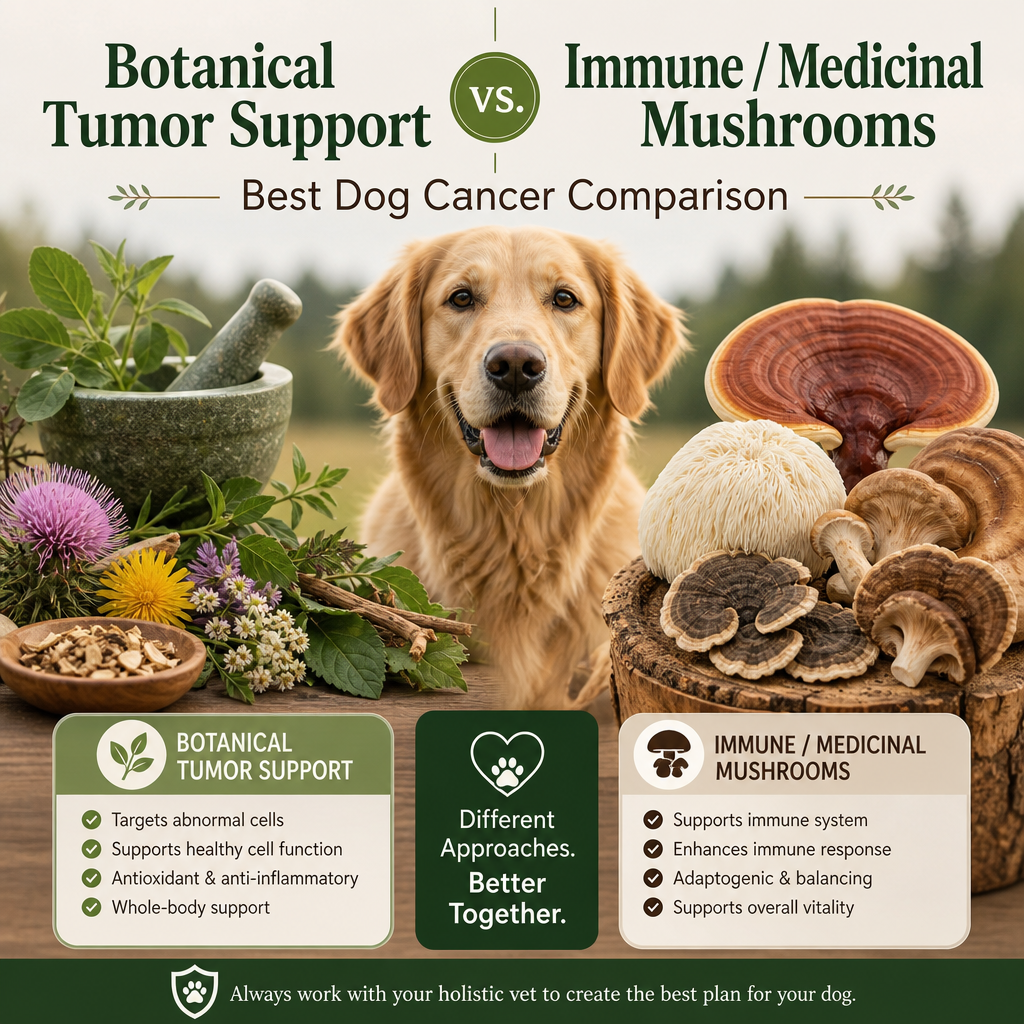
Botanische tumorondersteuning verwijst over het algemeen naar plantaardige ingrediënten die zijn geselecteerd op basis van hun potentiële effecten op ontsteking, oxidatieve stress, cellulaire signalering, circulatie of tumorbiologie. Voorbeelden kunnen kurkuma-extracten, groene thee-verbindingen, mariadistel, resveratrol, medicinale kruiden en andere geconcentreerde plantaardige bestanddelen omvatten. Formules variëren aanzienlijk, en hun effecten hangen af van de specifieke plant, extractiemethode, dosis en combinatie van ingrediënten.
Immunologische of medicinale paddenstoelen zijn schimmels die worden gebruikt in traditionele welzijnssystemen en moderne complementaire producten. Veelvoorkomende voorbeelden zijn kalkoenstaart, reishi, maitake, shiitake en cordyceps. Deze paddenstoelen bevatten verbindingen zoals bèta-glucanen, polysacchariden, triterpenen en andere bioactieve stoffen. Veel paddenstoelsupplementen worden voornamelijk gepromoot voor immuunmodulatie in plaats van directe tumorondersteuning.
Het onderscheid is niet absoluut. Sommige botanicals kunnen de immuunactiviteit beïnvloeden, terwijl paddenstoelen ontsteking en cellulaire paden buiten het immuunsysteem kunnen beïnvloeden. Toch zijn de categorieën nuttig bij het vergelijken van producten en het bespreken van doelen met een veterinaire professional. Voor hondenbezitters in Europa geldt dezelfde logica, ongeacht of het product een paddenstoelenmix of een plantenformule is.
Als je een breder overzicht wilt van de selectie van supplementen, deze gids naar Hond Kanker Supplementen: 7 Essentiële, Betaalbare en Positieve Kooptips voor Britse Huisdiereigenaren is een nuttig startpunt.
In praktische termen komt botanische tumorondersteuning vs Immune / medicinale paddenstoelen neer op hoe een product is ontworpen en wat de fabrikant zegt dat het zou moeten doen. Een botanische formule kan gericht zijn op leverondersteuning, antioxidantactiviteit, ontstekingscontrole of circulatie. Een paddenstoelenproduct is vaker gepositioneerd rond immuunevenwicht, hoewel sommige paddenstoelen ook kunnen worden gebruikt voor energie of veerkracht. Het begrijpen van de beoogde rol van het supplement maakt het gemakkelijker om met uw veterinaire team te praten.
Potentiële voordelen van botanische formules
Botanische producten kunnen zijn ontworpen om verschillende aspecten van het welzijn van honden tijdens kankerzorg te ondersteunen. Bepaalde plantaardige verbindingen hebben antioxidant- of ontstekingsremmende eigenschappen, terwijl andere worden bestudeerd op effecten op celcommunicatie of de vorming van bloedvaten. Sommige kruiden kunnen ook de spijsvertering, leverfunctie of algemeen comfort ondersteunen.
Bijvoorbeeld, mariadistel wordt vaak opgenomen in formules die bedoeld zijn om de lever te ondersteunen, vooral wanneer een hond medicijnen ontvangt die levermetabolisme vereisen. Afgeleid van kurkuma curcumine wordt vaak gebruikt voor ontstekingsondersteuning, hoewel de absorptie beperkt kan zijn en hoge doses spijsverteringsproblemen kunnen veroorzaken of de bloedstolling kunnen beïnvloeden. Groene thee-extracten bevatten verbindingen die zijn bestudeerd voor cellulaire en antioxidantactiviteit, maar geconcentreerde producten vereisen voorzichtigheid vanwege mogelijke leverproblemen en cafeïne-gerelateerde risico's.
Botanische formules kunnen daarom breed van doel zijn. Eén product kan zich richten op ontsteking, een ander op leverondersteuning, en weer een ander op een combinatie van cellulaire en immuunpaden. Deze flexibiliteit kan nuttig zijn, maar het maakt ook het beoordelen van etiketten essentieel. Een lange ingrediëntenlijst is niet per se een teken van grotere effectiviteit of veiligheid. In de context van botanische tumorondersteuning vs Immune / medicinale paddenstoelen biedt de plantaardige kant vaak meer gerichte keuzes voor comfort of detox-achtige ondersteuning.
Sommige hondenbezitters worden aangetrokken tot botanische producten omdat ze gemakkelijker te integreren zijn in dagelijkse voedingsroutines. Een vloeibaar extract, capsule of poeder kan aan voedsel worden toegevoegd en worden gebruikt naast standaardzorg wanneer het ingrediëntenprofiel duidelijk is. Toch mag gemak nooit zwaarder wegen dan veiligheid. Als een product slecht is gelabeld, vage eigen mengsels gebruikt of de werkelijke hoeveelheid van elk ingrediënt verbergt, wordt het veel moeilijker om te beoordelen of het in het plan van de hond thuishoort.
Botanische formules kunnen ook aantrekkelijk zijn wanneer het primaire doel niet directe immuunmodulatie is, maar bredere ondersteuning voor het lichaam tijdens de behandeling. Bijvoorbeeld, een hond die minder eet, milde spijsverteringsproblemen heeft of extra antioxidantondersteuning nodig heeft, kan meer profiteren van een zorgvuldig geselecteerde kruidenformule dan van een alleen paddenstoelenoptie. Dat gezegd hebbende, is botanische ondersteuning niet automatisch mild. Geconcentreerde extracten kunnen krachtig zijn, en dezelfde eigenschappen die ze interessant maken voor onderzoekers kunnen ook het risico op interacties verhogen.
Een andere reden waarom dierenartsen plant-based producten kunnen overwegen, is dat sommige ingrediënten een geschiedenis hebben van gebruik in ondersteunende zorgplannen voor lever- en gastro-intestinale functie. Bij een hond met kanker zijn die systemen belangrijk omdat medicijnen, stress, verminderde eetlust en veranderende routines allemaal van invloed kunnen zijn op hoe goed het lichaam de behandeling verdraagt. Een botanische formule kan helpen om een smalle ondersteuningskloof te vullen als deze doordacht wordt gekozen en nauwlettend wordt gemonitord.
Potentiële voordelen van medicinale paddenstoelen supplementen
Medicinale paddenstoelen worden vaak geselecteerd op basis van hun beta-glucaaninhoud. Deze verbindingen kunnen interageren met immuunreceptoren en helpen bij het reguleren van immuunresponsen. Het doel is over het algemeen niet om het immuunsysteem willekeurig te “versterken”, maar om een evenwichtige immuunactiviteit te ondersteunen.
Turkey tail is een van de meest besproken paddenstoelen in het onderzoek naar kanker bij honden. Sommige veterinaire studies hebben paddenstoelenafgeleide verbindingen onderzocht als aanvullende ondersteuning, met name bij honden met bepaalde kankers. Resultaten uit onderzoek kunnen bemoedigend zijn, maar bevindingen van een specifieke extract, dosis of klinische setting kunnen niet automatisch worden toegepast op elk paddenstoelenpoeder of gemengd supplement.
Reishi kan worden gebruikt voor immuun- en ontstekingsondersteuning, terwijl maitake en shiitake ook worden aangetroffen in immuun-gerichte producten. Cordyceps wordt soms gepromoot voor uithoudingsvermogen en energie. De kwaliteit en concentratie van deze producten verschillen sterk, en hele paddenstoelenpoeders bevatten mogelijk niet dezelfde actieve verbindingen als gestandaardiseerde extracten.
Paddenstoelen kunnen aantrekkelijk zijn in een vergelijking van kankersupplementen voor honden omdat ze vaak worden gezien als relatief gerichte producten. Desondanks kunnen ze nog steeds gastro-intestinale problemen, allergische reacties, veranderingen in de bloedsuikerspiegel of interacties met immuun-modulerende en bloedverdunnende medicijnen veroorzaken. Voor lezers die paddenstoelen-gebaseerde opties overwegen, biedt het artikel op Alternatieven voor Geneeskrachtige Paddenstoelen / Veterinaire Mycotherapie: 7 Beste Hond Tumor Supplementen in Zwitserland een ander nuttig referentiepunt.
Een voordeel van paddenstoelen is dat ze vaak specifiek worden besproken in de context van immuunbalans, wat het gemakkelijker kan maken om ze te vergelijken met de huidige behoeften van een hond. Als de dierenarts een meer gerichte supplementstrategie wil, kan een gestandaardiseerd paddenstoelenextract de voorkeur hebben boven een multi-ingrediënt botanische mix. Aan de andere kant, als de hond leverproblemen heeft, een slechte eetlust heeft of een bredere comfortbenadering nodig heeft, kan een paddenstoel alleen het doel niet volledig bereiken. Daarom moet botanische tumorondersteuning versus immuun / medicinale paddenstoelen worden gezien als twee verschillende hulpmiddelen in plaats van directe vervangers.
Het is ook vermeldenswaard dat niet elk product dat als paddenstoelen supplement wordt gepromoot, hetzelfde niveau van actieve verbindingen bevat. De extractiemethode is belangrijk, en sommige producten zijn sterk afhankelijk van poeders die mogelijk niet de concentratie leveren die veel eigenaren verwachten. Een label dat de soort noemt maar niet de extractverhouding, beta-glucaaninhoud of teststatus vermeldt, kan te veel vragen onbeantwoord laten. Bij een gevoelige patiënt zijn die details belangrijk.
Vergelijking van hondenkankersupplementen: Welke optie is beter?
Er is geen universele winnaar tussen botanische ondersteuning en medicinale paddenstoelen. De betere optie hangt af van de medische situatie van de hond en het doel van de supplementatie.
Een op paddenstoelen gebaseerd product kan worden overwogen wanneer het primaire doel immuunmodulatie is en de formulering geloofwaardige bronnen, geschikte tests en duidelijke informatie over de beta-glucaaninhoud heeft. Een botanische formule kan geschikter zijn wanneer het doel ontsteking, spijsverteringsondersteuning, antioxidantbescherming of leverondersteuning betreft. In sommige gevallen kan een dierenarts aanbevelen om beide categorieën tijdelijk te vermijden, vooral rond chirurgie of tijdens periodes van intensieve chemotherapie.
De diagnose is ook belangrijk. Een supplement dat redelijk kan zijn voor het ene type tumor, kan ongeschikt zijn voor een ander. Bijvoorbeeld, ingrediënten die hormonen, bloedstolling of immuunactiviteit beïnvloeden, kunnen speciale voorzichtigheid vereisen bij honden met hormoongevoelige ziekten, bloedingsrisico's, auto-immuunstoornissen of lage bloedplaatjesaantallen.
Voor eigenaren die opties in verschillende landen vergelijken, kan hetzelfde besluitvormingsproces helpen om het veld te verkleinen. De sleutel is niet simpelweg botanische tumorondersteuning versus immuun-/medicinale paddenstoelen, maar of een product past bij de exacte situatie van de hond en het veterinaire plan.
In de praktijk is de meest nuttige vraag vaak of het product de huidige doelen van de hond ondersteunt: comfort, eetlust, energie, immuunbalans of tolerantie voor behandeling. Daarom geven veel dierenartsen de voorkeur aan een stapsgewijze beoordeling in plaats van meerdere producten tegelijk te stapelen. Als een hond al op een kankerprotocol staat, moet zelfs een veelbelovend supplement worden beoordeeld op timing, dosis en mogelijke interacties voordat het wordt gebruikt.
Eigenaren veronderstellen soms dat één categorie altijd veiliger is omdat deze “plantaardig” of “op paddenstoelen gebaseerd” is. Die veronderstelling kan misleidend zijn. Een geconcentreerd botanisch extract kan krachtiger zijn dan een basis paddenstoelenpoeder, terwijl een gestandaardiseerd paddenstoelenextract meer onderzoek-gericht kan zijn dan een losjes gelabelde kruidenmix. Bij het vergelijken van botanische tumorondersteuning versus immuun-/medicinale paddenstoelen, zijn kwaliteit en context net zo belangrijk als het type ingrediënt.
Een ander praktisch verschil is het beoogde gebruik. Botanische formules worden vaak gekozen voor bredere ondersteuning, terwijl paddenstoelenproducten vaak worden gekozen voor immuun-gerichte ondersteuning. Dat maakt geen van beide opties per definitie beter, maar het kan eigenaren van honden helpen om het supplement af te stemmen op het zorgdoel. Het veiligste pad is degene die onnodige complexiteit vermijdt en past bij het behandelingsschema.
In een consult in de echte wereld kan het veterinaire team ook vragen naar de eetlust van de hond, de kwaliteit van de ontlasting, de huidige pijnbestrijding en het energieniveau voordat ze de ene categorie boven de andere aanbevelen. Als een hond al worstelt met misselijkheid of losse ontlasting, kan de agressievere formule het verkeerde startpunt zijn. Als de hond stabiel is maar een langdurige ondersteunende optie nodig heeft, kan de keuze neigen naar het product dat gemakkelijker te monitoren is en beter gedocumenteerd.
Voor sommige gezinnen wordt de keuze ook beïnvloed door wat ze realistisch elke dag kunnen geven. Een supplement helpt alleen als het verdraagzaam, betaalbaar en consistent is. Bij het beoordelen van botanische tumorondersteuning versus immuun / medicinale paddenstoelen, kunnen eenvoudigere opties soms beter presteren dan meer gecompliceerde mengsels omdat ze gemakkelijker nauwkeurig te doseren zijn en gemakkelijker te stoppen als er problemen optreden.
Wanneer botanische ondersteuning de meer praktische keuze kan zijn
Botanische formules kunnen nuttig zijn wanneer een hond ondersteuning nodig heeft die verder gaat dan de immuunfunctie. Bijvoorbeeld, een hond met een verminderde eetlust, trage spijsvertering of verhoogde leverenzymen kan meer profiteren van een zorgvuldig geselecteerde plantaardige formule dan van een alleen paddenstoelenproduct. Sommige botanische ingrediënten worden specifiek gekozen voor circulatie, galstroom, antioxidantondersteuning of comfort.
Dat gezegd hebbende, betekent “meer praktisch” niet “meer agressief.” Veel plantaardige verbindingen zijn bioactief en moeten doordacht worden gebruikt. Honden die gevoelig zijn voor medicijnen, een geschiedenis van spijsverteringsproblemen hebben of bloedverdunners gebruiken, hebben mogelijk extra voorzichtigheid nodig. Een dierenarts kan helpen bepalen of een botanische benadering zinvol is op basis van het huidige laboratoriumonderzoek en de medische geschiedenis van de hond.
Botanische producten kunnen ook nuttig zijn wanneer het kankerzorgplan van een hond medicijnen omvat die de lever belasten of wanneer het doel is om algemene veerkracht te ondersteunen. In die gevallen willen eigenaren vaak een formule die gemakkelijk te begrijpen is en kan worden geïntegreerd zonder onnodige complexiteit toe te voegen. Als het product meerdere kruiden bevat, is het vooral belangrijk om te weten waarom elk ingrediënt aanwezig is. Meer ingrediënten maken de formule niet noodzakelijk beter; ze kunnen simpelweg de reacties moeilijker te volgen maken.
Wanneer medicinale paddenstoelen de meer praktische keuze kunnen zijn
Medicinale paddenstoelen worden vaak geprefereerd wanneer het doel immuunmodulatie is met een relatief gefocust ingrediëntenprofiel. Sommige eigenaren vinden het fijn dat paddenstoelenproducten vaak vertrouwen op herkenbare soorten zoals kalkoenstaart of reishi, vooral wanneer het extract gestandaardiseerd en onafhankelijk getest is. Die structuur kan het product gemakkelijker te evalueren maken.
Echter, paddenstoelenproducten zijn niet uitwisselbaar. Een hele paddenstoelenpoeder, een extract en een mengsel met meerdere schimmels kunnen zich anders gedragen. Het etiket moet de soort, de extractiemethode, de hoeveelheid per portie en de teststatus specificeren wanneer mogelijk. Als een van die informatie ontbreekt, kan het product moeilijker veilig te beoordelen zijn.
Veel eigenaren vinden ook dat paddenstoelenformules vaak zijn gepositioneerd rond immuunondersteuning in plaats van bredere “kanker genezing” claims. Dat kan de verwachtingen realistischer maken. Toch is een realistische verwachting niet hetzelfde als een onschadelijke. Een product dat de immuunbalans ondersteunt, kan nog steeds ongeschikt zijn voor honden met auto-immuunziekten, stollingsproblemen of specifieke medicijnprotocollen. Dit is waarom botanische tumorondersteuning versus immuun / medicinale paddenstoelen altijd moet worden besproken in de context van het hele medische plan.
In sommige gevallen worden paddenstoelenproducten gekozen omdat de hond al andere ondersteunende therapieën ontvangt en het zorgteam een nauwere, gemakkelijker te monitoren aanvulling wil. Dat kan vooral nuttig zijn voor oudere honden of honden die meerdere medicijnen gebruiken. Een eenvoudig paddenstoelenprotocol kan gemakkelijker te pauzeren zijn als de eetlust verandert, de kwaliteit van de ontlasting verschuift of laboratoriumresultaten onverwacht veranderen.
Veiligheidsoverwegingen voordat je een supplement kiest
De belangrijkste factor is productkwaliteit. Zoek naar duidelijke ingrediëntnamen, precieze hoeveelheden, partijidentificatie, vervaldatums en onafhankelijke tests op verontreinigingen zoals zware metalen, pesticiden, bacteriën en niet-verklaarde farmaceutica. Vermijd producten die volledig afhankelijk zijn van vage claims zoals “geneest kanker” of “werkt voor elke tumor.”
Medicatie-interacties zijn een andere grote zorg. Botanicals en paddenstoelen kunnen de bloedstolling, bloeddruk, bloedsuiker, leverenzymen of immuunactiviteit beïnvloeden. Deze effecten kunnen veranderen hoe chemotherapie medicijnen, steroïden, niet-steroïde ontstekingsremmers, anticoagulantia, anesthetica en andere medicijnen werken.
Het is ook verstandig om slechts één nieuw product tegelijk in te voeren. Dit maakt het gemakkelijker om bijwerkingen te identificeren en te bepalen of de aanvulling helpt. Let op braken, diarree, veranderingen in eetlust, lethargie, jeuk, ongebruikelijke blauwe plekken, bleke tandvlees, verhoogde dorst of veranderingen in urineren. Elk verontrustend symptoom moet snel worden gerapporteerd.
Wanneer onderzoek nodig is, kan een betrouwbare referentie zoals de overzicht van complementaire en alternatieve geneeskunde van het Nationaal Kanker Instituut helpen lezers te begrijpen hoe ondersteunende therapieën worden geëvalueerd.
Het is ook belangrijk om te onthouden dat kwaliteitscontrole varieert per merk en per partij. Een product dat veelbelovend lijkt op papier, kan nog steeds slecht worden verdragen als het onnodige vulstoffen, onduidelijke extracten of inconsistente actieve verbindingen bevat. Om die reden geven veel oncologieteams de voorkeur aan merken die transparante etikettering en duidelijke onafhankelijke tests bieden. Dit is vooral relevant bij het vergelijken van botanische tumorondersteuning versus immuun / medicinale paddenstoelen, aangezien beide categorieën sterk geconcentreerde ingrediënten kunnen bevatten.
Voordat je iets nieuws begint, vraag of de laatste bloedonderzoeken van de hond enige voorzichtigheid suggereren. Leverwaarden, nierwaarden, bloedplaatjesaantallen en ontstekingsmarkers kunnen allemaal invloed hebben op hoe een aanvulling moet worden gebruikt. Als de hond zwak is, gewicht verliest of diarree heeft, kan de drempel voor bijwerkingen lager zijn dan verwacht. Een kleine dosis kan in het begin geschikt zijn, gevolgd door zorgvuldige monitoring.
Een andere nuttige veiligheidsstap is om de complete formule te bekijken, niet alleen het hoofdingrediënt. Toegevoegde conserveermiddelen, smaakstoffen, draagoliën, zoetstoffen of onnodige kruiden kunnen problemen veroorzaken bij gevoelige honden. Een product met een korte, transparante ingrediëntenlijst is vaak gemakkelijker te evalueren dan een complexe mix met marketingzware taal. Wanneer mogelijk, houd een record bij van het exacte merk, de dosis en de startdatum, zodat het veterinaire team de reactie van de hond nauwkeurig kan volgen.
Hoe supplementen te bespreken met een veterinaire team
Breng het complete productlabel mee, inclusief inactieve ingrediënten en de aanbevolen portiegrootte, naar de afspraak. De dierenarts kan het bloedonderzoek van de hond, de lever- en nierfunctie, het aantal bloedplaatjes, het type kanker, het behandelingsschema en de huidige medicatie beoordelen voordat hij advies geeft.
Vraag of het product voor de operatie moet worden gestopt, of het geschikt is tijdens chemotherapie of bestraling, en welke tekenen intolerantie zouden aangeven. Regelmatige monitoring kan nodig zijn, vooral wanneer een supplement gedurende meerdere weken wordt gebruikt of gecombineerd met voorgeschreven behandeling.
Uiteindelijk moeten supplementen worden gezien als ondersteunende hulpmiddelen in plaats van op zichzelf staande kankertherapieën. Voeding, pijnbestrijding, hydratatie, therapietrouw, stressreductie en regelmatige veterinaire monitoring hebben vaak een groter effect op de dagelijkse kwaliteit van leven dan het toevoegen van meerdere ongeteste producten.
Botanische tumorsupport versus immuun / medicinale paddenstoelen wordt het beste begrepen als een gepersonaliseerde beslissing, niet als een eenvoudige competitie. Zorgvuldig geselecteerde producten kunnen de conventionele zorg aanvullen, maar bewijs, veiligheid, transparantie en veterinaire toezicht moeten elke keuze begeleiden. Bij twijfel, kies de optie die het beste aansluit bij de diagnose van de hond, de behandelingslijn en de aanbevelingen van het veterinaire team.
Voor veel hondenbezitters is de meest geruststellende aanpak om het plan eenvoudig te houden: één duidelijk doel, één goed beoordeeld product indien nodig, en regelmatige follow-up met de dierenarts. Deze aanpak vermindert verwarring, helpt bij het vroegtijdig identificeren van bijwerkingen en maakt het gemakkelijker om te beoordelen of het supplement echt nuttig is. Of je nu neigt naar botanische tumorsupport versus immuun / medicinale paddenstoelen, de beste resultaten komen meestal voort uit zorgvuldige selectie in plaats van agressief stapelen.
Als je nog steeds productcategorieën vergelijkt, is een nuttige volgende stap om te bekijken hoe vergelijkbare formules zijn gepositioneerd in andere markten en of het ingrediëntenprofiel aansluit bij de behoeften van je hond. Dat maakt het gemakkelijker om marketingtaal van praktische ondersteuning te scheiden. Met een doordacht plan kan botanische tumorsupport versus immuun / medicinale paddenstoelen worden beoordeeld op een manier die het comfort en de veiligheid van je hond vooropstelt.