
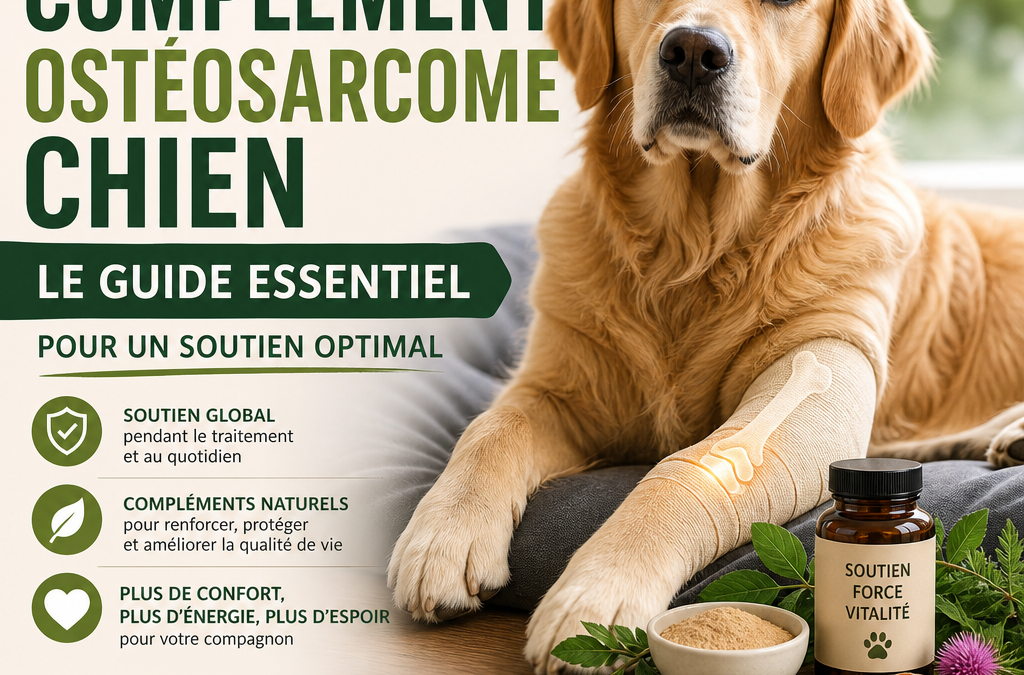
Complément ostéosarcome chien : lorsqu’un chien reçoit ce diagnostic, chaque décision concernant son alimentation, son confort et son accompagnement mérite une attention particulière. Les compléments alimentaires peuvent parfois contribuer au soutien général de l’organisme, mais ils ne remplacent jamais les traitements vétérinaires ni un suivi médical adapté. L’objectif est de mieux comprendre leur rôle, leurs limites et les précautions indispensables avant toute utilisation.
Dans un contexte de cancer osseux, la priorité reste de préserver la qualité de vie du chien, de limiter la douleur et de soutenir l’appétit. Un complément ostéosarcome chien peut alors s’inscrire dans une stratégie globale, toujours validée par le vétérinaire et ajustée selon l’évolution clinique.
Table of contents
Comprendre l’ostéosarcome chez le chien
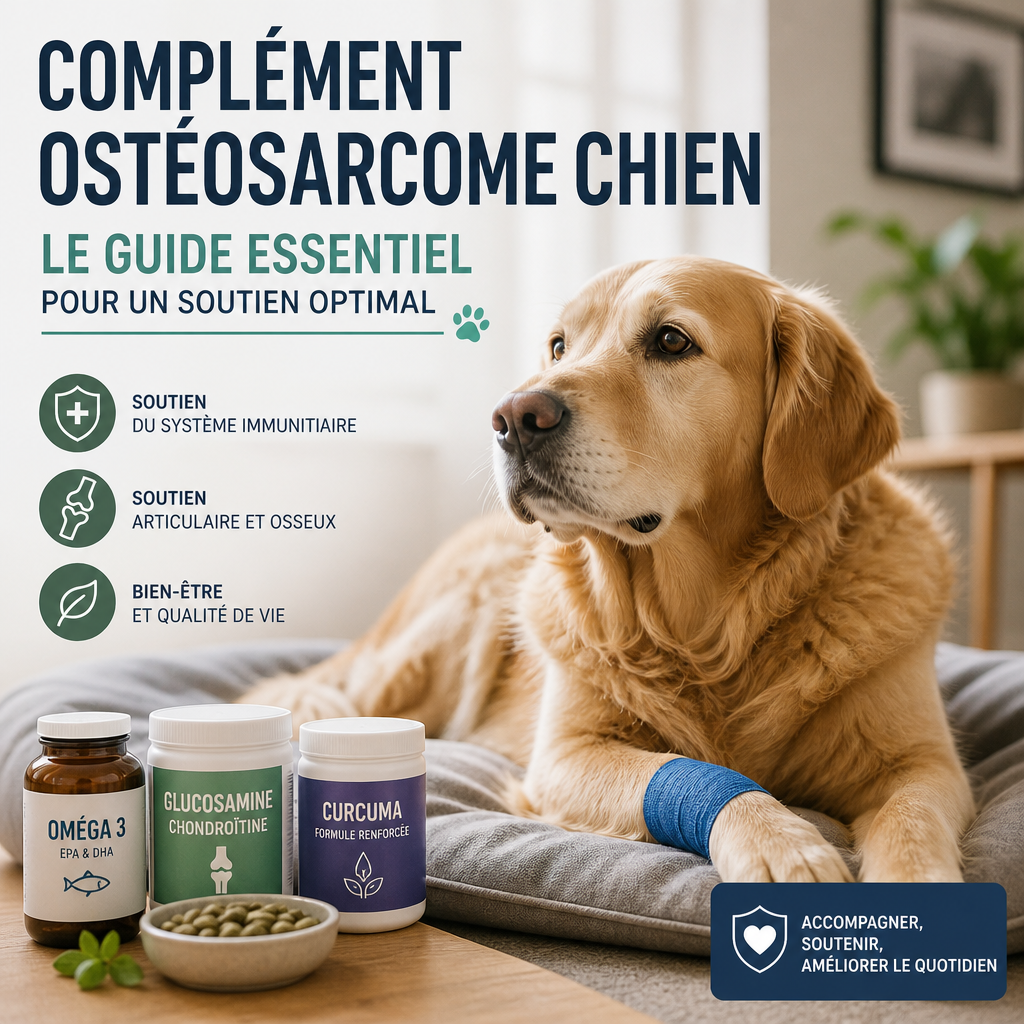
L’ostéosarcome est une tumeur osseuse agressive qui touche principalement les chiens de grande taille ou de format géant. Il se développe souvent au niveau des membres, mais peut également concerner d’autres os. Les signes les plus fréquents sont une boiterie persistante, une douleur, un gonflement localisé ou une diminution progressive de l’activité.
La prise en charge dépend de plusieurs facteurs : localisation de la tumeur, état général du chien, éventuelle propagation et projet de vie défini avec le vétérinaire. La chirurgie, la chimiothérapie, les traitements antalgiques et les soins palliatifs peuvent être envisagés selon la situation. Dans tous les cas, un complément alimentaire doit être considéré comme un soutien et non comme un traitement anticancéreux.
Pour mieux comprendre l’évolution possible de la maladie et l’importance d’une surveillance attentive, il peut être utile de consulter une ressource vétérinaire sur la propagation tumorale, comme cet article de référence sur la présentation clinique de l’ostéosarcome chez le chien.
Quel peut être le rôle d’un complément ostéosarcome chien ?
Un complément ostéosarcome chien peut être proposé pour accompagner certains besoins associés à la maladie ou à ses traitements. Selon sa composition, il peut viser le maintien de l’appétit, le soutien nutritionnel, la protection des articulations, la préservation de la masse musculaire ou l’aide au fonctionnement normal du système immunitaire.
Cependant, les bénéfices dépendent fortement de l’état du chien. Un animal qui mange correctement, conserve un poids stable et tolère bien ses traitements n’aura pas forcément les mêmes besoins qu’un chien présentant une perte d’appétit, une fonte musculaire ou des troubles digestifs.
The supplement must therefore meet a specific objective. A formula that is very rich in certain nutrients is not necessarily suitable for all dogs, and the accumulation of several products can lead to imbalances or interactions.
In some cases, the veterinarian may also recommend a diet that is more energy-dense, more palatable, or easier to digest. The idea is to improve overall intake without unnecessarily overloading the body.
Before purchasing any product, it is useful to check whether the main need concerns energy, appetite, mobility, or digestive comfort. This step avoids using a too general osteosarcoma dog supplement when more targeted support would be more relevant.
It should also be noted that an osteosarcoma dog supplement can only complement a coherent medical strategy. When integrated into a structured veterinary follow-up, it can help better navigate certain more difficult periods, especially if the animal eats less or tires quickly.
In practice, the role of the supplement is often to support daily life, not to disrupt the prognosis. This nuance is important, as it allows for maintaining realistic expectations and avoiding disappointments related to overly ambitious promises.
Les nutriments à examiner avec prudence
Certain ingredients are regularly present in supplements intended for weakened dogs. Omega-3 fatty acids, particularly from fish oils, can help maintain a balanced inflammatory response and support overall health. Their use should, however, be validated by the veterinarian, especially in cases of medication treatment or coagulation disorders.
Quality proteins are essential for preserving muscle mass. In the context of a dog bone cancer supplement, it is often more relevant to check the entire ration and energy intake rather than choosing an isolated product. A medicated food or an adapted diet can sometimes be more useful than a powder or tablet supplement.
Antioxidants, vitamins, and minerals should also be used judiciously. Some treatments can be influenced by high doses of particular nutrients. It is therefore not advisable to give large quantities of vitamins or to mix several formulas without professional advice.
Probiotics may sometimes be considered when appetite is fluctuating or digestion is fragile, but they are not suitable for all situations. The most important thing remains to target the real need, rather than piling up solutions.
It is also recommended to check the dog's digestive tolerance before introducing a new product. An osteosarcoma dog supplement may seem interesting on paper but become unnecessary if it causes nausea, loose stools, or food refusal.
Some owners are also interested in the nutrients used to support dogs with distant tumors, as the progression of bone cancer can raise many questions. To delve deeper into this point, a useful article is available on the Metastasis in dogs and understanding tumor spread, which can help better grasp the stakes of a global support.
It is also important to remember that some natural supplements contain complex mixtures. The longer the formula, the greater the risk of interaction or poor tolerance. A simple approach is often preferable, especially when a dog is already undergoing several treatments.
Soutien ostéosarcome chien : les priorités au quotidien
Support for osteosarcoma in dogs does not rely solely on dietary supplements. Comfort and quality of life must remain priorities. Pain management is fundamental: a painful dog may eat less, have difficulty sleeping, lose muscle, and become disinterested in its environment.
Home modifications can also make a big difference. Non-slip rugs, thick bedding, a ramp to avoid stairs, and short outings adapted to its abilities can limit unnecessary efforts. It is important to respect its pace without encouraging activities that would worsen pain or fatigue.
Regular monitoring of weight, appetite, mobility, sleep, and behavior allows for the quick detection of deterioration or, conversely, the evaluation of the effectiveness of the measures implemented.
Good follow-up also helps to know if the chosen dog osteosarcoma supplement is truly useful or if the strategy needs to be readjusted. This point is often more important than the product itself.
In this logic, support must remain concrete: offering easier-to-eat meals, breaking down portions, promoting a calm environment, and maintaining familiar landmarks can provide immediate comfort to the dog. Together, they form a reassuring support, much more effective than an accumulation of products.
When mobility decreases, it may also be useful to reduce unnecessary movements and secure passage areas. A comfortable dog expends less energy, which leaves more room for appetite and rest.
Dog osteosarcoma support also involves regularity. Stable routines, meal times close from one day to the next, and a predictable environment can reduce stress. In some dogs, this calming effect translates into better food intake and a calmer attitude.
It is also useful to monitor small changes: a dog that hesitates to get up, refuses a favorite treat, or changes its posture to lie down may express discomfort even before it becomes obvious. Spotting these signals early allows for quicker adjustments to comfort or treatment.
Comment choisir un complément adapté ?
Before purchasing a supplement, several elements must be checked. The composition must be clearly indicated, with precise quantities of each ingredient. It is preferable to favor products made by a reputable laboratory, benefiting from quality controls and specifically designed for dogs.
The form of the product also matters. A nauseous dog or one having difficulty swallowing may tolerate a palatable powder better than a tablet. It is also important to consider excipients, the possible presence of allergens, and ease of administration.
The veterinarian must be aware of all products used, including natural supplements, plants, and preparations purchased online. Natural does not automatically mean safe. Some plants can alter the metabolism of medications or cause undesirable digestive, hepatic, or renal effects.
When a product is presented as “complete” or “revolutionary,” it is better to remain vigilant. For a dog with bone cancer, caution is generally more useful than overly optimistic promises.
For owners looking to compare more targeted options, this resource can help evaluate possible choices: Meilleur complément alimentaire chien cancer : 7 choix efficaces et rassurants.
Another important criterion is the ease of acceptance by the dog. Even a good quality product becomes less useful if it is consistently refused. It is therefore better to choose a form suited to the animal's temperament, dietary preferences, and digestive state.
It may also be relevant to ask the veterinarian whether the supplement should be given continuously or in periods. In some cases, a one-time use is sufficient, while other situations require more regular support, always under supervision.
Les erreurs à éviter
The first mistake is to believe that a supplement can slow down or cure osteosarcoma. No nutritional formula should replace a consultation, surgery, or prescribed treatment.
It is also important to avoid sudden dietary changes. A gradual transition limits diarrhea and vomiting, which can be particularly distressing for a sick dog. Giving multiple supplements simultaneously also complicates the identification of any potential adverse reaction.
Finally, one should not rely solely on advertising or testimonials. Promises of healing, guaranteed tumor reduction, or replacement of conventional care should be viewed with caution. The best decision is one that is based on the dog's medical history and regular dialogue with the veterinary team.
For families wishing to compare nutritional support options in a structured way, a complementary resource can help better understand the criteria for choosing a better dog cancer dietary supplement.
Another common mistake is changing too many things at once. If the diet, meal schedule, and supplement change simultaneously, it becomes difficult to know what is actually helping the dog or what is, on the contrary, bothering him.
Il faut aussi éviter de sous-estimer la douleur. Un chien qui mange moins n’a pas toujours un simple “petit creux” : il peut souffrir, être nauséeux ou fatigué. Dans ce cas, un complément ostéosarcome chien n’aura pas l’effet espéré si le problème principal n’est pas pris en charge.
Une approche personnalisée et réaliste
Chaque chien atteint d’ostéosarcome évolue différemment. L’âge, le poids, la localisation de la tumeur, les traitements reçus et les maladies associées influencent directement les besoins nutritionnels et le choix d’un éventuel complément.
Un accompagnement pertinent peut inclure un bilan sanguin, une évaluation nutritionnelle et un suivi de la douleur. Le vétérinaire pourra alors déterminer si une supplémentation est réellement nécessaire, recommander un produit précis et fixer une dose adaptée.
L’essentiel est de conserver une approche réaliste : soutenir l’organisme, préserver l’appétit, limiter l’inconfort et maintenir autant que possible les habitudes appréciées par le chien. Un complément ostéosarcome chien peut avoir sa place dans cette stratégie, à condition d’être intégré à un plan global, personnalisé et médicalement encadré.
Avec des choix prudents et un suivi régulier, il est souvent possible d’améliorer le quotidien sans multiplier les produits. C’est généralement cette approche simple, cohérente et rassurante qui apporte le plus de bénéfices au chien et à sa famille.
In practice, it is essential to remember that a dog osteosarcoma supplement is meant to accompany, not replace. When chosen methodically, it can support nutrition, help with comfort, and fit into a more serene care approach.
The best results almost always come from a combination of measures: tailored nutrition, veterinary monitoring, pain management, a calming environment, and reasoned supplementation. This strategy remains the most reliable for providing the dog with a more stable and comfortable daily life.
During more delicate periods, it may be helpful to revisit short-term goals with the veterinarian: eating better, suffering less, recovering better after a clinical visit, or simply staying comfortable at home. This progressive vision makes the support more concrete and less anxiety-inducing.
Ultimately, a dog osteosarcoma supplement only makes sense if it is part of a personalized, regular, and easy-to-follow decision. It is this coherence that helps the dog the most, day after day.