
The best dog cancer dietary supplement always depends on the animal's overall condition, its treatments, and its nutritional needs. The goal is not to replace veterinary care, but to support energy, appetite, digestion, and daily comfort.
Faced with a cancer diagnosis, many owners seek the best dog cancer dietary supplement to help their companion without taking unnecessary risks. This approach is legitimate, provided that a simple rule is kept in mind: a useful supplement is one that is suitable, well-tolerated, and validated by the veterinarian.
Table of contents
Before making a decision, it is useful to calmly compare the composition, dosages, and the actual purpose of the product. A good choice is based on concrete facts, not on marketing promises. In this logic, the best dog cancer dietary supplement is one that integrates into the overall care of the dog and supports its quality of life without disrupting its treatments.
Cancer can also change daily priorities. Some dogs eat less, others lose weight, and still others primarily need digestive support or better palatability. The best dietary supplement for dogs with cancer is therefore not a one-size-fits-all formula, but a support tool to be personalized with care.
Why consider a dog cancer supplement?
Cancer can profoundly alter a dog's nutritional needs. Some animals lose their appetite, lose weight, or experience muscle wasting. Others suffer from nausea, digestive issues, or significant fatigue, especially during chemotherapy or radiation therapy.
A cancer supplement for dogs can have several objectives:
- support energy intake when the dog eats less; ;
- contribute to maintaining muscle mass; ;
- provide essential fatty acids or certain targeted nutrients; ;
- promote a more palatable diet; ;
- support recovery and overall comfort.
However, a dietary supplement is not a cancer treatment. Its value lies mainly in its supportive role, as part of a strategy defined with the treating veterinarian or a veterinarian specialized in nutrition. To better understand the progression of the disease and its effects on the body, you can also consult this article on metastasis in dogs and the impact of tumor spread..
In some cases, the dog primarily needs a better caloric intake or an easier-to-consume ration. In others, the priority will be to maintain hydration, improve digestive comfort, or avoid excessive weight loss. The choice of supplement must therefore follow the needs of the moment, not a uniform approach.
It is also important to remember that the general condition of the dog can change rapidly. A supplement useful at the beginning of an illness may become less relevant if appetite decreases further, if stools change, or if the therapeutic protocol evolves. This is why veterinary follow-up remains essential to regularly reassess the best dog cancer dietary supplement.
Best dog cancer dietary supplement: essential criteria
The best dog cancer dietary supplement is not necessarily the most well-known product, the most expensive, or the one that contains the most ingredients. It must primarily be adapted to the real needs of the animal.
A transparent composition
The first step is to check the complete list of ingredients and their dosage. Serious products clearly indicate the quantities of each active substance, usage recommendations, and precautions for use.
It is preferable to avoid formulas that rely solely on general promises such as «boosts natural defenses» or «fights tumors,» without precise data or scientific explanations. A transparent composition allows the veterinarian to assess potential interactions with medications.
This transparency is all the more useful as some products display complex mixtures. When several extracts, vitamins, and plants accumulate in the same formula, the risk of overdose or interaction increases. For an already fragile dog, a simple, readable formula that is consistent with its health status is preferable.
Good digestive tolerance
A dog with cancer may already have a fragile digestive system. The chosen supplement must therefore be easy to administer and generally well tolerated. Powders to mix with food, properly dosed oils, or palatable bites can be practical, but the ideal form depends on the dog's preferences and any potential issues.
In case of vomiting, diarrhea, or persistent nausea, the addition of a new product should be postponed or done with caution.
Tolerance also depends on texture and smell. A supplement that is too fatty, too odorous, or too bulky may be refused, even if it is nutritionally interesting. The best dietary supplement for a cancer dog is therefore one that the dog actually accepts, without stress or food rejection.
An indication adapted to the dog's condition
A supplement intended for maintaining muscle mass does not meet the same need as a product aimed at supporting appetite or digestion. The choice must take into account weight, age, body condition, renal and hepatic function, as well as the care protocol.
A dog with significant weight loss may need a more energy-dense therapeutic diet even before considering a specific supplement.
It is also important to check the ease of use on a daily basis. If a product is too complex to dose, too odorous, or difficult to mix, it may be poorly accepted. A good supplement should therefore be useful, but also practical for the owner and comfortable for the animal.
Compatibility with ongoing treatments
The best cancer dog dietary supplement must also be compatible with the treatments already prescribed. Some products may be nutritionally interesting but unsuitable if the dog is receiving chemotherapy, an anti-inflammatory, a hepatic treatment, or a medication that alters appetite.
It is therefore wise to present the veterinarian with the complete list of what the dog is already receiving. This simple step helps avoid unnecessary combinations and secures the care process.
Nutrients often studied in dogs with cancer
Omega-3 fatty acids
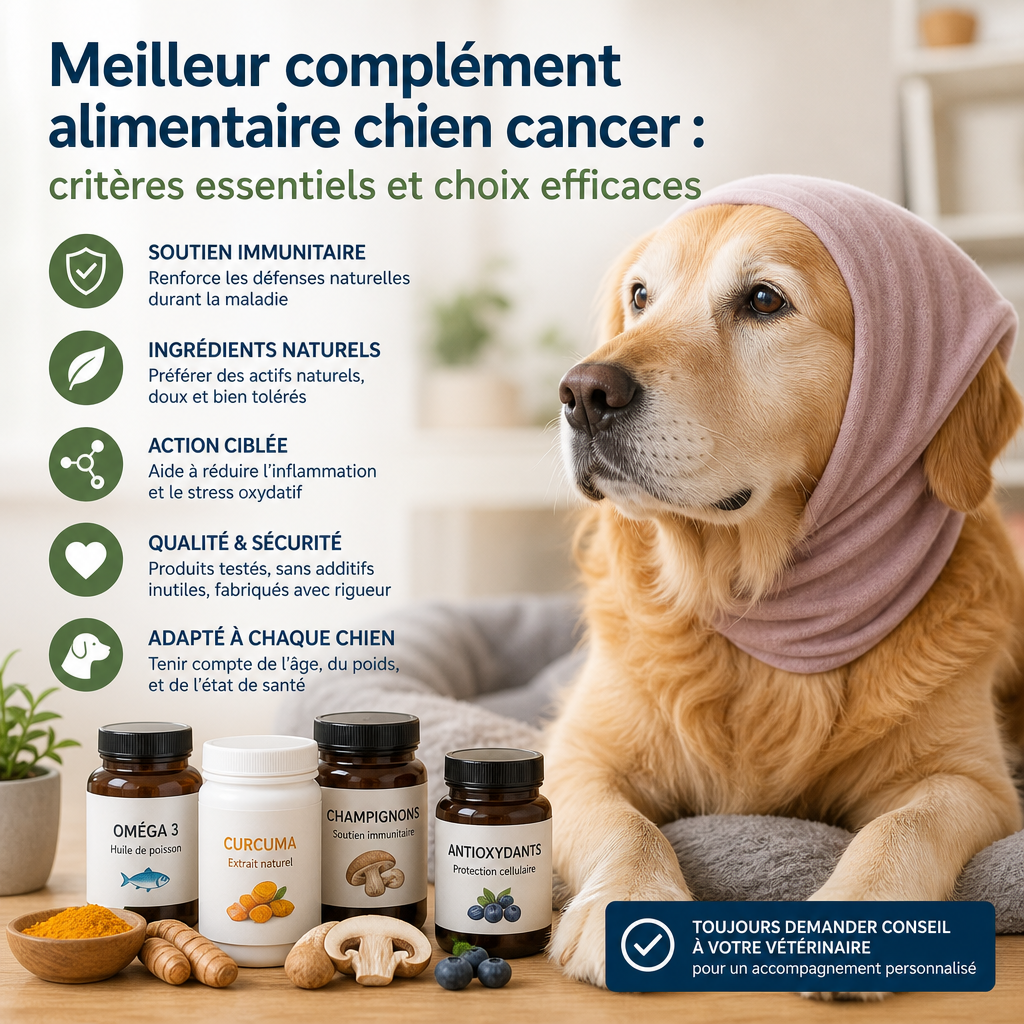
Omega-3, including EPA and DHA from purified fish oils, are frequently studied in the context of nutrition for sick dogs. They can help support inflammatory balance and overall condition.
However, their dosage must remain controlled. Poor quality oil, improperly stored or overly dosed, can cause digestive issues and provide excess calories. The presence of antioxidants and the quality of purification are also important.
In practice, it is better to prioritize a reliable source, well-preserved and easy to dose. A regular and moderate intake is often more beneficial than a large dose given irregularly.
Proteins and amino acids
Maintaining muscle mass is a major goal for many dogs with cancer. Depending on the animal's condition, the veterinarian may recommend a diet rich in highly digestible proteins or nutritional support containing certain amino acids.
However, one should not significantly increase protein without prior assessment. In cases of renal, hepatic insufficiency, or other associated diseases, needs may be different.
A good strategy often involves starting with the basic diet before adding anything. If the ration already meets the needs well, the supplement will mainly serve to improve acceptance or target a specific need. If the ration is insufficient, even the best dog cancer dietary supplement will not compensate for an overall intake that is too low.
Antioxidants
Les vitamines et substances antioxydantes sont souvent présentes dans les compléments pour chiens atteints de cancer. Pourtant, leur utilisation demande de la prudence, surtout pendant certains traitements. Des doses élevées d’antioxydants peuvent théoriquement modifier l’action de certaines thérapies, même si les effets dépendent de la molécule, de la dose et du protocole utilisé.
La règle la plus sûre consiste à ne jamais administrer un complexe riche en vitamines ou en antioxydants sans en parler à l’équipe vétérinaire.
La prudence est particulièrement importante lorsque plusieurs compléments sont donnés en même temps. Deux produits différents peuvent contenir les mêmes vitamines ou les mêmes extraits actifs, ce qui augmente le risque de cumul involontaire.
Les probiotiques et les fibres
Les probiotiques ou certaines fibres peuvent être proposés lorsque le chien présente une digestion perturbée, notamment après un traitement médicamenteux. Leur intérêt dépend toutefois de la cause des troubles digestifs et de la tolérance individuelle.
Un complément destiné au confort intestinal ne doit pas retarder la prise en charge d’une diarrhée persistante, de vomissements ou d’une déshydratation.
Dans un contexte de maladie chronique, le bon produit n’est pas celui qui agit le plus fort, mais celui qui répond le mieux au besoin ciblé. Cette approche évite les achats inutiles et limite les risques d’erreur d’association avec d’autres traitements.
Les calories facilement assimilables
For some dogs, the main issue is not the vitamin or the plant, but the ability to eat enough. A highly palatable, digestible, and more energetic dietary supplement can help support food intake when the animal tires quickly.
In this case, the goal is simple: to maintain body condition without overloading the stomach. The best dietary supplement for cancer dogs can therefore be a relatively simple product, provided it meets the actual energy needs well.
Precautions before giving supplements to dogs with cancer
Even a product labeled as natural can be active and cause side effects. Some plants and extracts can interact with medications, alter coagulation, influence the liver, or disrupt the absorption of a treatment.
It is particularly important to seek advice before using:
- concentrated medicinal plants; ;
- mushroom extracts; ;
- products rich in curcumin; ;
- essential oils; ;
- preparations containing high doses of vitamins; ;
- supplements intended to strongly stimulate immunity.
The veterinarian must be aware of all products administered to the dog, including those purchased without a prescription. They can check for interactions, adjust the dose, and determine the most appropriate time for administration. For general medical references on oncology, the reference sheet of the’Les vitamines et substances antioxydantes sont souvent présentes dans les complé… La règle la plus sûre consiste à ne jamais administrer un complexe riche en vita….
La prudence est particulièrement importante lorsque plusieurs compléments sont d….
Autre point important : ne pas multiplier les essais. Changer plusieurs produits à la fois empêche de savoir lequel est utile, lequel est mal toléré et lequel pourrait être responsable d’un trouble digestif ou d’une baisse d’appétit.
How to choose and administer the right product?
Avant l’achat, il est utile de noter le poids du chien, son alimentation actuelle, ses médicaments, ses symptômes et l’évolution de son appétit. Ces informations aideront à distinguer un besoin réel d’une simple promesse commerciale.
L’introduction doit généralement être progressive, avec une observation de l’appétit, des selles, du poids et du comportement. Si le chien refuse sa ration après l’ajout du produit, vomit, développe une diarrhée ou semble plus abattu, il faut interrompre l’administration et contacter le vétérinaire.
Le suivi du poids et de la masse musculaire est essentiel. Le meilleur complément alimentaire chien cancer ne sera pertinent que s’il s’intègre à une alimentation suffisamment appétente, digestible et adaptée aux besoins énergétiques de l’animal.
Pour faciliter l’acceptation, il peut être utile de mélanger le complément à une petite portion très appétente au début, puis d’augmenter progressivement la quantité si la tolérance est bonne. Cette méthode simple permet de limiter les refus et de repérer rapidement un problème de tolérance.
A regular follow-up also helps to reassess the chosen product. If the dog's condition evolves, its nutritional priorities may change. A relevant supplement at the beginning of treatment may become unnecessary, or conversely be replaced by a formula more suited to the next phase.
In some cases, the veterinary team may recommend further splitting meals, testing another texture, or adjusting the timing of administration. These small changes can sometimes have as much effect as the supplement itself, especially when the dog is sensitive to smells or food volumes.
Signs that should prompt a reconsideration of the supplement choice
Certain signs should encourage a review of the product with the veterinarian:
- marked decrease in appetite after introduction; ;
- repeated vomiting or persistent diarrhea; ;
- abdominal pain or bloating; ;
- unusual fatigue after administration; ;
- systematic refusal of the ration; ;
- weight loss despite supplementation.
When these signs appear, it is not advisable to insist. The supplement may be unsuitable, poorly dosed, or simply poorly tolerated. A quick reassessment helps avoid unnecessary discomfort and maintain adherence to the main treatment.
It is also important to remain attentive to more subtle changes: a dog may seem «a little less interested» in its bowl before showing real signs of rejection. Reacting early often helps avoid a downward spiral of decreased appetite and loss of body condition.
A holistic approach above all
The choice of a cancer dog supplement must be part of a comprehensive approach that includes tumor treatment, pain management, nausea prevention, hydration support, and maintaining a reassuring environment.
In many cases, improving the main diet, splitting meals, or lightly warming the food can be as helpful as adding a new product. The priority remains to preserve the comfort and quality of life of the dog.
Thus, the best cancer dog supplement is one whose usefulness is clearly defined, whose composition is reliable, and whose administration is validated by a professional. Careful selection allows for supporting the animal without compromising its treatment or overloading its system.
In practice, the best decision is often the simplest: starting from the dog's real needs, checking tolerance, and then adjusting with the help of the veterinarian. This method provides the owner with a reassuring framework and increases the chances of choosing truly useful support.
If the dog tolerates the chosen product well, it can become a discreet but valuable support in daily life. If it is poorly tolerated, it is better to quickly review the strategy rather than insist. This flexibility is often the key to successful and calm management.
Frequently asked questions
Should a dietary supplement always be given to a dog with cancer?
Non. A supplement is not systematic. It must meet an identified need, such as loss of appetite, muscle wasting, digestive disorders, or insufficient nutrition. Without a clear objective, the benefit is limited.
Is a natural supplement necessarily safe?
Not necessarily. Natural does not mean harmless. Some plants, oils, or extracts can interact with treatments or cause side effects. The veterinarian remains the best contact before any use.
Can multiple supplements be given at the same time?
C’est parfois possible, mais seulement après validation vétérinaire. Additionner plusieurs produits augmente le risque de doublons, d’interactions ou de troubles digestifs. Mieux vaut avancer par étapes et surveiller la tolérance.
Comment savoir si le produit choisi est vraiment utile ?
On observe l’appétit, le poids, la masse musculaire, les selles et le confort général. Si ces paramètres se stabilisent ou s’améliorent sans effet indésirable, le complément peut être considéré comme pertinent. Sinon, il faut réévaluer le choix.
En résumé, le meilleur complément alimentaire chien cancer est celui qui sert un objectif précis, respecte la tolérance digestive et s’intègre à un suivi vétérinaire sérieux. Avec une sélection prudente, une bonne observation et des ajustements réguliers, il peut devenir un soutien utile et rassurant pour le chien comme pour son propriétaire.