
After the announcement of a mammary mass, many owners look for a dog mammary tumor supplement to accompany their pet with caution. This approach is understandable, but it must always be part of a rigorous veterinary follow-up. A dietary supplement does not replace clinical examination, analysis, surgery, or recommended treatments. However, it can sometimes contribute to the dog's overall well-being, support its nutritional status, and help it better navigate this delicate period.
Understanding mammary tumors in dogs
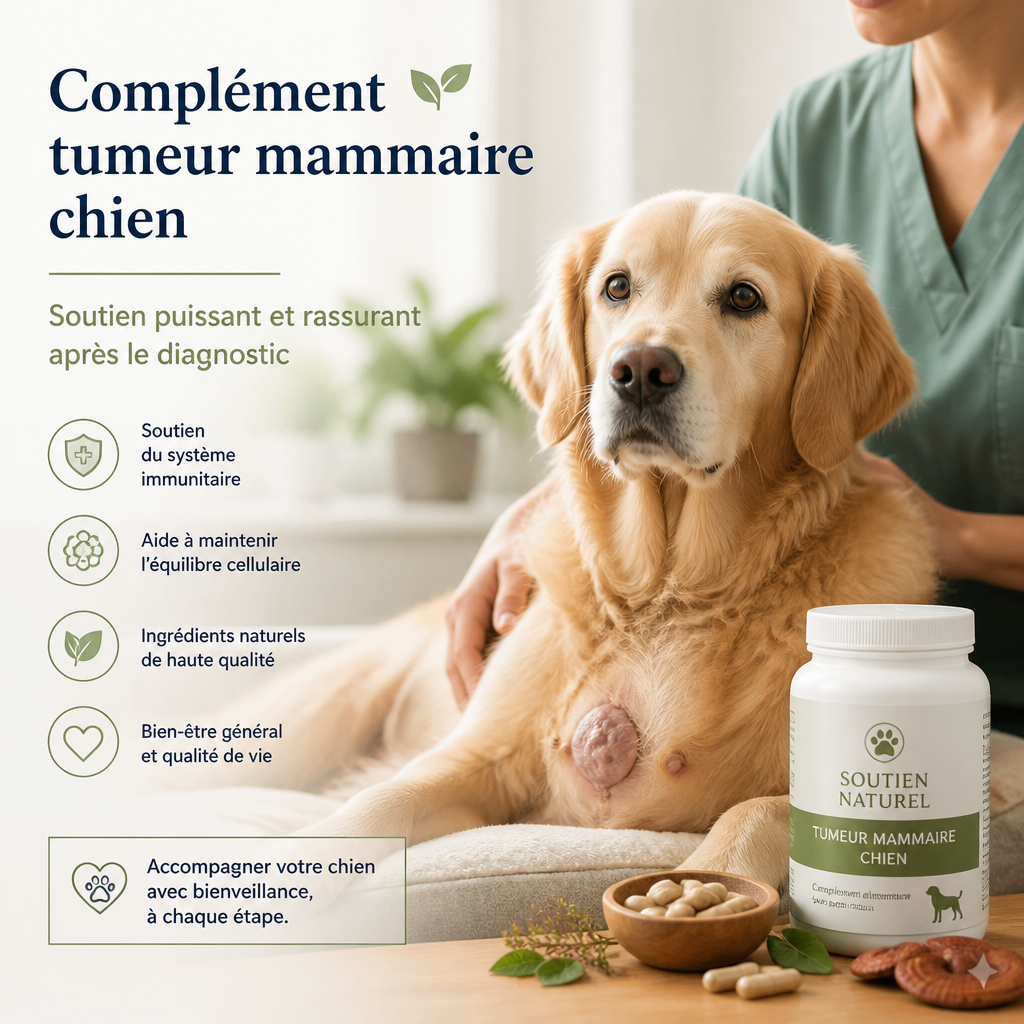
Mammary tumors are relatively common in female dogs, especially when they have not been spayed or have been spayed late. A mass can be benign or malignant, and its external appearance is not enough to determine its nature. Several nodules may also be present at the same time along the mammary chain.
The veterinarian may propose a complete palpation, blood tests, a cytopuncture, a biopsy, or surgical removal of the mass. Depending on the results, further examinations may be necessary to check for possible spread to the lymph nodes or lungs. Each situation is different: the dog's age, overall health, tumor size, and progression influence therapeutic decisions.
To better understand the warning signs and medical management, you can also consult the reference information from the American Kennel Club on mammary tumors in dogs.
What role for a dog mammary tumor supplement?
A mammary tumor supplement for dogs should be considered as support, not as an independent anticancer treatment. Its goal may be to provide useful nutrients for maintaining vitality, supporting appetite, or contributing to the normal functioning of the body during medical management.
Some supplements are formulated with vitamins, minerals, essential fatty acids, antioxidants, or plant extracts. However, “natural” does not automatically mean “safe.” Some plants can interact with anesthesia, medication, anticoagulants, or treatments used after surgery. Therefore, the composition, dosage, and quality of the product are essential.
Avant toute administration, il est recommandé de transmettre au vétérinaire la liste complète des produits envisagés. Cette précaution permet d’éviter les associations inadaptées et de vérifier que le complément correspond réellement aux besoins de l’animal.
In some cases, the veterinarian may also recommend more targeted nutritional support. A useful reading on oncological follow-up is available on the site of the Hôpital pour animaux de l'Université Cornell, which presents resources on veterinary oncology.
In a thoughtful care strategy, a dog mammary tumor supplement can help maintain daily comfort and support nutrition when appetite fluctuates. However, the product's relevance depends on the medical context, the stage of the disease, and the treatments already in place.
Dog mammary tumor support: daily priorities
The best dog mammary tumor support starts with simple and regular measures. A complete and appropriate diet is a priority. The dog must receive enough protein and energy to maintain its muscle mass, especially if it eats less or is recovering after surgery.
Hydration must also be monitored. A decrease in water intake, vomiting, persistent diarrhea, or prolonged loss of appetite should be reported quickly to the veterinarian. In some cases, wet or slightly warmed food can make meals more appetizing, but any change should remain gradual.
Emotional comfort also matters. A calm environment, walks suited to its condition, and maintaining a familiar routine can reduce stress. After surgery, it is important to follow the instructions regarding rest, protecting the scar, and resuming physical activity.
Dog mammary tumor support also involves good pain monitoring. If the dog seems less mobile, whines, refuses to lie on one side, or reacts to touch, it should be discussed quickly with the veterinarian to adjust the care.
In a broader care context, a global veterinary support often helps better coordinate nutrition, rest, and prescribed treatments.
When an owner is looking for a dog mammary tumor supplement, it is better to first think about the animal's daily life: regular meals, fresh water, calm, attentive monitoring, and activity adaptation. This simple framework often promotes better tolerance of care.
Ingredients often sought
Omega-3 fatty acids, particularly from fish, are frequently studied for their role in inflammatory balance and skin maintenance. They can be interesting in certain situations, but their dosage must be controlled. An excessive amount can cause digestive issues or pose problems in dogs with certain vulnerabilities.
Antioxidants are also present in several formulas intended for older or convalescent animals. They contribute to the normal functioning of cells, but their use during chemotherapy or radiotherapy should be discussed with the veterinarian. Depending on the treatment and medical objectives, inappropriate supplementation may not be desirable.
Les protéines digestibles, les vitamines du groupe B et certains minéraux peuvent être utiles lorsque l’alimentation est insuffisante. Cependant, un complément ne corrige pas une ration déséquilibrée. Il ne doit pas non plus être donné en remplacement d’un repas complet.
Le choix d’un complément tumeur mammaire chien doit donc rester raisonné. Les produits les plus intéressants sont généralement ceux qui complètent vraiment l’alimentation, sans promettre d’effet miracle ni multiplier les ingrédients inutiles.
Dans certains cas, un complément tumeur mammaire chien peut aussi être formulé pour soutenir la digestion, ce qui peut être utile si l’animal mange moins bien. Cette approche reste toutefois secondaire par rapport à la surveillance vétérinaire et à l’évaluation régulière de l’état général.
Dog mammary cancer supplement: how to choose wisely?
La recherche d’un complément cancer mammaire chien conduit parfois vers des produits promettant une guérison rapide ou une action directe sur la tumeur. Ces affirmations doivent inciter à la prudence. Aucun complément ne doit prétendre remplacer la chirurgie, la chimiothérapie ou le suivi oncologique lorsqu’ils sont recommandés.
Pour choisir un produit, il est préférable de vérifier :
- la liste précise des ingrédients et leurs quantités ;
- l’absence de promesses médicales irréalistes ;
- la traçabilité et la qualité de fabrication ;
- l’adaptation du dosage au poids et à l’âge du chien ;
- la compatibilité avec les traitements en cours ;
- les recommandations du vétérinaire traitant.
Il est également utile de commencer un seul produit à la fois. Cette méthode facilite l’identification d’une éventuelle intolérance, comme des selles molles, des nausées, des démangeaisons ou une baisse de l'appétit.
Dans un contexte de tumeur mammaire chez le chien, la prudence reste le meilleur réflexe. Un produit bien choisi doit s’intégrer à la stratégie médicale, pas la brouiller.
Si l’objectif est de trouver un complément tumeur mammaire chien, la lecture attentive de l’étiquette est indispensable. Un bon produit reste simple, cohérent et compatible avec les besoins réels de l’animal, sans surcharge d’actifs ni argumentaire excessif.
Monitor the animal's progress
Après le diagnostic, une observation régulière permet de repérer rapidement tout changement. Il faut surveiller la taille et l’aspect de la masse, l’état de la peau, la présence d’écoulements, la douleur, l’appétit, le poids et le niveau d’activité. Une masse qui grossit rapidement, s’ulcère ou devient douloureuse nécessite un avis vétérinaire sans attendre.
Monitoring should not be limited to administering a supplement. Appointments, follow-up exams, and quality of life assessments are essential. The veterinarian can adjust the diet, propose pain management, or modify treatment based on progress.
The owner can also note each week the changes in weight, appetite, and behavior. This simple monitoring often helps to detect a decline in overall condition earlier.
Lorsque la maladie progresse, le soutien tumeur mammaire chien repose aussi sur la réévaluation régulière des priorités : confort, mobilité, appétit et sérénité du chien passent avant tout.
A mammary tumor supplement for dogs should never distract from warning signs. On the contrary, it is part of active monitoring, where every observed change can guide the subsequent care.
A global and personalized support
A supplement can play an interesting role in supporting a dog with a mammary tumor, provided it is chosen wisely. The most effective support relies on a holistic approach: accurate diagnosis, appropriate treatment, balanced nutrition, pain management, reasonable activity, and attentive presence of the owner.
The priority always remains the well-being of the animal. By combining the veterinarian's advice with daily observation and appropriate supplementation when relevant, it is possible to offer a more serene, coherent, and secure support after the diagnosis.
En résumé, un complément tumeur mammaire chien peut aider à soutenir la vitalité et le confort de votre compagnon, mais il doit toujours être choisi avec méthode et validé par un professionnel de santé animale. Avec un suivi rigoureux, un soutien tumeur mammaire chien bien pensé et des décisions prudentes, vous mettez toutes les chances du côté de votre animal.
If you want to go further, the key is to maintain a simple logic: a dog mammary tumor supplement is meant to accompany, not to replace. It is this measured approach that allows for real daily support, without false hopes or unnecessary actions.
When deciding, remember that a dog mammary tumor supplement is only useful if it fits into a clear care plan. This coherence helps to preserve the dog's quality of life while respecting the veterinarian's therapeutic choices.