Complément sarcome chien : 7 conseils indispensables et questions essentielles à poser
The complément sarcome chien est souvent envisagé comme un soutien nutritionnel en complément des soins vétérinaires lorsqu’un chien est atteint d’un sarcome. Cette maladie, qui regroupe plusieurs types de tumeurs des tissus conjonctifs, nécessite une prise en charge personnalisée. Les compléments alimentaires peuvent parfois contribuer au maintien de l’état général, mais ils ne remplacent ni la chirurgie, ni la radiothérapie, ni la chimiothérapie, ni les contrôles réguliers chez le vétérinaire.
Dans ce contexte, le bon choix repose surtout sur un objectif clair : aider le chien sans interférer avec son traitement ni créer de déséquilibre. Pour aller plus loin, vous pouvez aussi consulter ce guide sur the best dietary supplement for dog cancer, qui détaille plusieurs options de soutien utiles dans les situations oncologiques.
Table of contents
- Comprendre le sarcome chez le chien
- Sarcome tissus mous chien soutien : quel rôle pour les compléments ?
- Complément alimentaire sarcome chien : quels ingrédients sont parfois étudiés ?
- Les questions essentielles à poser au vétérinaire
- Les erreurs à éviter
- Un accompagnement fondé sur le confort et la qualité de vie
Comprendre le sarcome chez le chien
Le sarcome est une tumeur qui se développe à partir de tissus tels que les muscles, les tendons, les tissus graisseux, les vaisseaux sanguins ou les structures autour des articulations. Les sarcomes des tissus mous sont relativement fréquents chez le chien. Leur comportement varie fortement selon leur type, leur localisation, leur taille et leur grade histologique.
A mass under the skin is not necessarily a sarcoma. It may correspond to a lipoma, a cyst, an abscess, or another lesion. However, any mass that increases in size, becomes hard, adheres to deep tissues, or causes discomfort should be examined quickly. The diagnosis generally relies on cytology, a biopsy, and histological analysis. Imaging tests may also be necessary to assess the extent of the disease.
The complément sarcome chien should not be considered before this diagnostic step. In practice, it is more useful to first identify the exact nature of the tumor, as the supportive strategy depends on the chosen treatment. A dog that has undergone surgery may not necessarily have the same needs as a dog undergoing radiation therapy or chemotherapy.
The veterinarian can also specify if additional tests are necessary to look for metastases or check the general condition of the animal. Depending on the case, a chest X-ray, an abdominal ultrasound, or other imaging may be proposed to better guide the care. This overall assessment helps to choose a coherent nutritional support.
It is important to keep in mind that a sarcoma can evolve in a locally invasive manner even when it appears discreet at first. That is why regular monitoring remains essential. The earlier the management, the simpler it often is to organize care, adapt nutrition, and select a complément sarcome chien appropriate.
Lorsque l’animal vit avec une tumeur des tissus mous, les propriétaires remarquent parfois une fatigue plus marquée, un appétit changeant ou une perte de masse musculaire. Ces signes ne sont pas spécifiques au sarcome, mais ils justifient une attention particulière. Ils peuvent aider le vétérinaire à décider si un soutien nutritionnel est nécessaire et sous quelle forme.
Sarcome tissus mous chien soutien : quel rôle pour les compléments ?
La recherche d’un sarcome tissus mous chien soutien traduit souvent le souhait des propriétaires d’aider leur animal à mieux traverser la maladie et les traitements. Dans ce contexte, le soutien doit être global. Il comprend une alimentation adaptée, une bonne hydratation, le contrôle de la douleur, le maintien de l’activité selon les capacités du chien et une surveillance attentive des effets secondaires.
Un complément sarcome chien peut être envisagé pour répondre à un besoin identifié : baisse d’appétit, perte de poids, convalescence, fragilité digestive ou apport insuffisant en certains nutriments. Il ne doit toutefois pas être choisi uniquement en fonction de promesses commerciales telles que « anti-tumeur », « détoxifiant » ou « stimulant des défenses naturelles ». Ces formulations sont souvent vagues et ne permettent pas d’évaluer l’efficacité réelle du produit.
Le vétérinaire peut recommander un soutien nutritionnel particulièrement lorsque le chien mange moins, perd de la masse musculaire ou se remet d’une intervention. Dans certains cas, une consultation avec un vétérinaire spécialisé en nutrition permet d’établir une ration précise et adaptée à l’état de santé général.
Le soutien ne vise pas seulement l’apport calorique. Il peut aussi chercher à améliorer la tolérance digestive, à limiter les carences et à faciliter la prise alimentaire. Chez un chien atteint d’un cancer, ces points comptent beaucoup, car une baisse d’ingestion prolongée peut affaiblir l’organisme et compliquer la récupération après les soins.
Il faut aussi distinguer le soutien du traitement. Un complément sarcome chien n’a pas vocation à remplacer les protocoles vétérinaires validés. En revanche, il peut compléter utilement la prise en charge lorsque le produit est choisi pour une raison précise. Cette nuance est essentielle pour éviter les attentes irréalistes et les dépenses inutiles.
Dans la vie quotidienne, le confort du chien reste un indicateur important. Un animal qui garde de l’appétit, qui boit correctement, qui se déplace avec moins de gêne et qui récupère après les soins profite souvent davantage d’un soutien bien ciblé. Le rôle du complément n’est donc pas spectaculaire ; il est surtout pratique, discret et mesurable dans le temps.
Pourquoi le complément sarcome chien demande un choix prudent
Choisir un complément sarcome chien demande prudence, car l’objectif n’est pas d’ajouter un produit de plus, mais de soutenir l’animal sans créer de risque inutile.
A supplement can be useful after surgery, during a period of decreased appetite, or when the general condition requires nutritional support. However, if the dog is experiencing vomiting, persistent diarrhea, or renal or hepatic impairment, the situation must first be stabilized with the veterinarian.
The dietary supplement sarcoma dog the most relevant is often the one that meets a clearly identified need. For example, some dogs primarily need caloric and protein support, while others require a simple, well-tolerated formula that is easy to administer daily.
Complément alimentaire sarcome chien : quels ingrédients sont parfois étudiés ?
Several families of nutrients are frequently mentioned in the support of dogs with cancer. Omega-3 fatty acids, particularly EPA and DHA from purified fish oils, may be studied for their nutritional interest and their role in inflammatory balance. However, their use must take into account the dog's weight, diet, coagulation, and prescribed medications.
Antioxidants, certain vitamins, minerals, probiotics, and amino acids can also be part of a support strategy. However, additional intake is not automatically beneficial. Excessive supplementation can lead to digestive disorders, imbalance the ration, or alter the action of certain treatments.
Plant-based products require particular caution. Even when an ingredient is natural, it can have pharmacological effects. It can influence the liver, kidneys, coagulation, or the metabolism of a medication. The quality of extracts also varies by manufacturer. A complément sarcome chien should therefore be discussed with the veterinarian before administration.
When owners seek more targeted support, they often compare the available formulas for dogs with cancer. This approach is understandable, but it must remain framed. The best product is not necessarily the most complete or the most expensive. It is the one that meets a real need without creating additional risk.
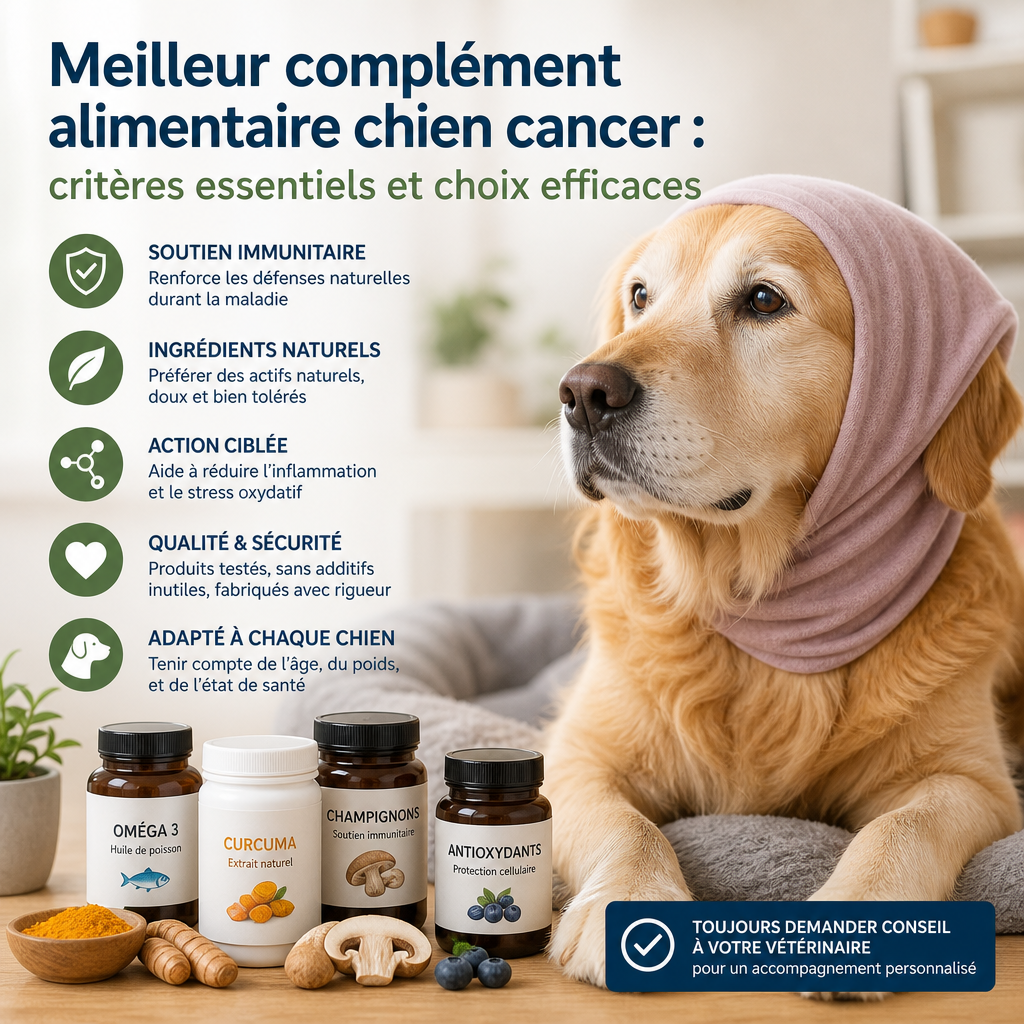
In practice, the choice may depend on several criteria: palatability, ease of administration, clear composition, traceability of ingredients, absence of unnecessary additives, and compatibility with ongoing treatments. A simple product, well tolerated and consistent with the daily ration, is often preferable to a formula that is too complex.
It is also useful to distinguish between supplements intended for general support and those that claim to have a direct anticancer action. In the first case, the goal is to help the body better cope with the disease. In the second, claims should be examined with caution, as they do not always rely on solid data in dogs.
For readers who wish to compare different solutions before discussing them with the veterinarian, it is often preferable to start from a clear source focused on tolerance, composition, and actual use. This avoids confusing simple nutritional support with a product wrongly presented as a treatment.
When a supplement can be useful on a daily basis
Un complément sarcome chien may be relevant after surgery, during a period of decreased appetite, or when the dog needs an easier-to-integrate intake into its diet. It can also help during recovery phases when meals are less regular and the body needs to recover energy.
In other situations, the veterinarian may prefer to wait. If the dog is vomiting, refusing to eat, or has liver or kidney disease, adding a new product can complicate management. Hence the importance of validating each step with a professional who knows the animal's medical history.
The dietary supplement sarcoma dog the most useful is often the one that addresses a clearly observed difficulty. For example, a dog that is losing weight may benefit from a strategy focused on calories and proteins, while a dog with digestive sensitivity will rather need a well-tolerated product, easy to administer, and suitable for its general condition.
Some owners also seek support to maintain appetite. Again, the choice must be cautious. An appetizing formula can encourage food intake, but it should not mask pain, nausea, or greater discomfort. If the dog is eating less, the cause should be investigated rather than compensating solely with a complementary product.
The limits of commercial promises
Advertising messages can give the impression that a supplement will act quickly and directly on the tumor. In reality, a complément sarcome chien does not have this purpose in the majority of cases. Its interest is mainly to support the body, not to replace care validated by veterinary medicine.
That is why it is better to be wary of overly absolute arguments. Formulations like «acts on cancer,» «destroys tumor cells,» or «replaces chemotherapy» should raise alarms. A serious product is part of a care plan, with a specific place, precautions, and measurable objectives.
To navigate, it is useful to check the manufacturer's transparency, the presence of a clear instruction manual, and safety indications. A quality supplement should be able to be explained simply: why it is used, with which dog, at what dose, and for how long.
The owner also benefits from asking how to monitor the effectiveness of the product. Better weight stability, a more regular appetite, fewer digestive issues, or improved overall comfort can be useful indicators. However, the absence of visible change in the tumor should not be interpreted alone as a failure or success of the support.
Finally, it should not be forgotten that quality of life often depends on very concrete elements: hydration, rest, pain control, gentle activity, and monitoring of side effects. The complément sarcome chien takes its place in this whole, but it is only part of it.
Les questions essentielles à poser au vétérinaire
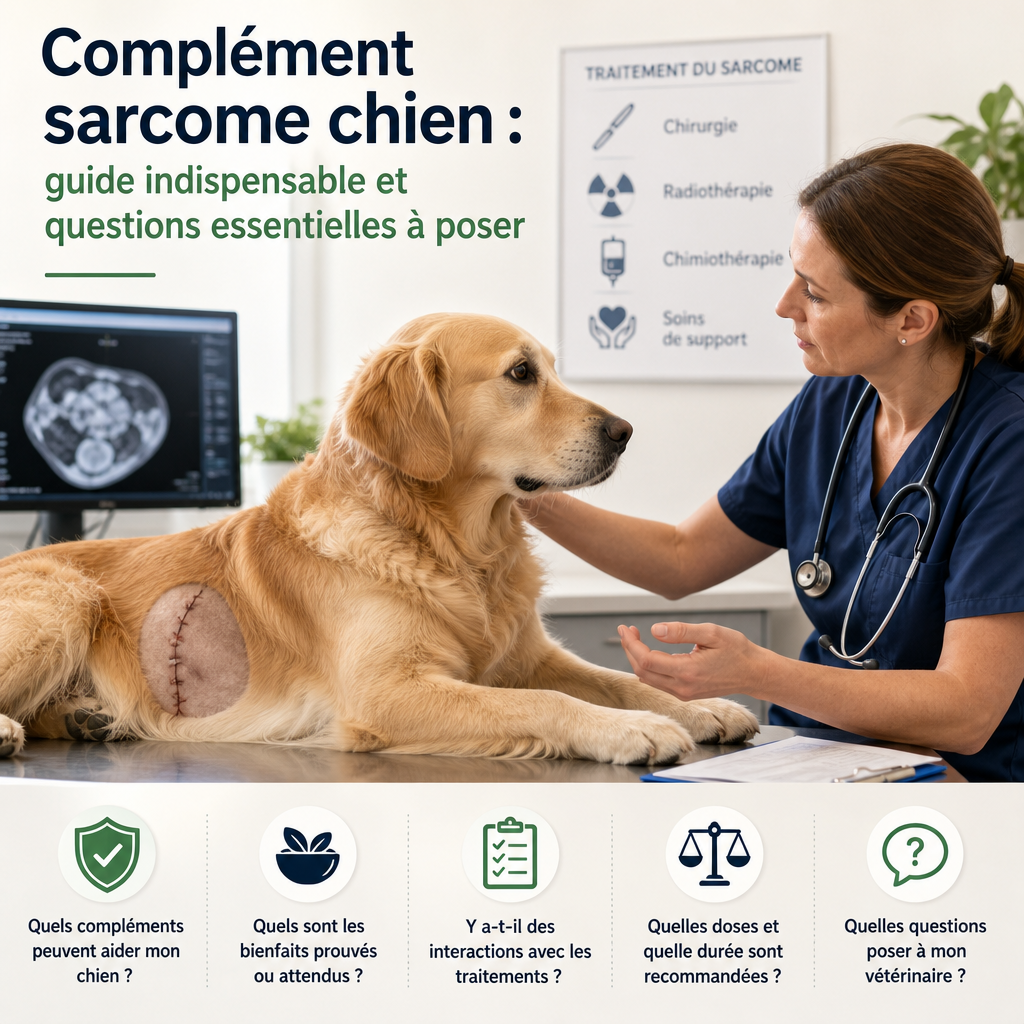
Avant de commencer un complément, plusieurs questions permettent de prendre une décision éclairée :
- Quel est le type exact de sarcome et quel est son grade ?
- La tumeur a-t-elle été retirée complètement ou des marges persistent-elles ?
- Le complément répond-il à un besoin précis chez mon chien ?
- Peut-il interagir avec la chimiothérapie, la radiothérapie, les anti-inflammatoires ou les antidouleurs ?
- Quelle dose convient à son poids, son âge et ses éventuels problèmes de foie ou de reins ?
- Quels signes doivent conduire à interrompre le produit ?
- Comment mesurer son bénéfice : poids, appétit, énergie, masse musculaire ou confort ?
- Existe-t-il des données fiables sur cet ingrédient chez le chien ?
- Le produit est-il contrôlé, traçable et adapté aux animaux ?
Ces questions aident à distinguer un soutien raisonnable d’une promesse thérapeutique non démontrée.
Le vétérinaire peut aussi préciser si le complément sarcome chien est pertinent à ce stade du traitement ou s’il vaut mieux attendre une phase plus stable. Dans certains cas, la priorité est d’abord de restaurer l’appétit, de limiter les nausées ou de sécuriser la cicatrisation avant d’introduire un nouveau produit.
Si la maladie évolue ou si le chien suit plusieurs traitements, il peut être judicieux de revoir régulièrement la stratégie de soutien. Un produit bien toléré au départ peut devenir moins adapté après une chirurgie, un changement de protocole ou une baisse de fonction rénale ou hépatique.
It is also useful to prepare for the consultation with a few simple observations: meal frequency, amount eaten, changes in transit, unusual fatigue, and weight variations. These elements help the veterinarian decide whether nutritional support should be increased, decreased, or replaced with another option.
If in doubt about the ingredients, it may be helpful to request a verification of the composition, especially if the dog is already taking other products. This avoids duplicates and risky combinations. Clear dialogue with the care team greatly reduces the risk of error.
Example of information to note before the appointment
Before discussing a dietary supplement sarcoma dog, the owner can note the current weight, ongoing medications, episodes of vomiting, stool quality, and any changes in appetite. This little follow-up facilitates medical decisions and makes the exchange more efficient.
It may also be helpful to specify whether the dog easily accepts tablets, capsules, powders, or oils. The galenic form sometimes influences adherence as much as the composition itself. A good product, poorly accepted, quickly becomes useless in daily life.
Useful resources for better understanding the disease
For general information on soft tissue sarcomas, a reference resource like the MSD Veterinary Manual peut aider à mieux comprendre les bases du diagnostic et de la prise en charge. Il ne remplace pas le suivi de votre vétérinaire, mais il offre un cadre médical utile pour préparer les questions à poser.
Cette lecture peut compléter l’échange clinique, surtout si vous souhaitez comprendre les grandes étapes du bilan, les objectifs du traitement et la place possible d’un complément sarcome chien dans la stratégie globale.
Les erreurs à éviter
La première erreur consiste à retarder les soins vétérinaires en espérant qu’un complément fasse disparaître la tumeur. Un sarcome doit être évalué et traité selon son comportement biologique. La chirurgie est souvent le traitement principal lorsque la localisation et l’état du chien le permettent. D’autres traitements peuvent être proposés en complément.
Il faut également éviter de cumuler plusieurs produits contenant les mêmes vitamines, minéraux ou plantes. Cette pratique augmente le risque de surdosage sans améliorer nécessairement les résultats. Les compléments destinés aux humains ne sont pas toujours adaptés aux chiens et peuvent contenir des substances dangereuses, des édulcorants ou des doses inappropriées.
Enfin, il est important de ne pas modifier brutalement l’alimentation. Une transition progressive limite les troubles digestifs. Le suivi du poids, de l’appétit, des selles, de la mobilité et du comportement fournit des informations utiles au vétérinaire.
Une autre erreur fréquente consiste à multiplier les conseils trouvés en ligne sans vérifier leur compatibilité avec le dossier médical de l’animal. Un dietary supplement sarcoma dog peut sembler inoffensif, mais certains ingrédients peuvent poser problème en cas de traitement simultané ou de terrain fragile. La prudence reste donc essentielle.
De la même façon, il faut se méfier des produits qui promettent un effet spectaculaire en quelques jours. En oncologie vétérinaire, les bénéfices recherchés sont souvent modestes, progressifs et mesurés sur l’état général plutôt que sur une disparition visible de la tumeur. Un soutien utile agit dans la durée, avec cohérence et régularité.
Il est également préférable d’éviter les changements successifs sans période d’observation. Si vous introduisez un nouveau produit, gardez une certaine stabilité alimentaire pendant quelques jours ou semaines, lorsque cela est possible, afin d’identifier clairement ce qui aide vraiment votre chien.
Un autre point important concerne la qualité du fabricant. Les produits peu documentés, sans traçabilité claire ou sans dosage précis exposent à davantage d’incertitude. Pour un chien malade, cette incertitude n’est pas anodine. Mieux vaut un soutien simple, vérifiable et discuté avec le vétérinaire.
Un accompagnement fondé sur le confort et la qualité de vie
The primary objective is to preserve the dog's quality of life. A relevant supplement can support nutritional status, but it is part of a set of measures: palatable and balanced diet, pain management, appropriate rest, gentle activity, monitoring of the scar, and regular medical check-ups.
The owner can keep a simple notebook indicating the meals consumed, weight, energy level, any vomiting, stools, and medications administered. This data facilitates the assessment of progress and allows for quick identification of deterioration.
In summary, the complément sarcome chien can have a place in a support strategy, provided it is chosen for a specific reason and validated by a professional. The right product is not the one that promises to cure the tumor, but the one that meets a real need, has an acceptable safety profile, and integrates safely into the established treatment.
To better frame this choice, it is useful to remember that good support is not limited to the content of a capsule or tablet. It is a whole: diet, digestive tolerance, clinical monitoring, daily comfort, and adaptation to the dog's rhythm. In this logic, the complément sarcome chien must remain a support tool, not an autonomous solution.
If your dog is being monitored for a soft tissue tumor, regular discussion with the veterinary team remains the best way to protect its health. Monitoring allows for timely adjustments to care, checking product tolerance, and avoiding unnecessary combinations. It is often this cautious, personalized, and continuous approach that offers the best daily benefit.
When looking for a complément sarcome chien, it is therefore preferable to prioritize consistency, simplicity, and safety rather than a quick promise. With veterinary oversight, nutritional support can truly contribute to the animal's well-being and help navigate the various stages of treatment more serenely.
In practice, this complément sarcome chien is always part of a global approach: it complements care, never replaces it, and must remain adapted to the stage of the disease, the dog's general condition, and the objectives set with the veterinarian.