
par TCMVET | Août 24, 2026 | Recherche et actualités
Vieux chien cancer que faire : face à l’annonce d’un cancer chez un compagnon âgé, il est normal de se sentir démuni. Pourtant, des décisions adaptées peuvent améliorer son confort et préserver sa qualité de vie. Le diagnostic ne signifie pas nécessairement qu’il faut renoncer à tout traitement : chaque situation dépend du type de tumeur, de son évolution, de l’état général du chien et des objectifs de sa famille. L’essentiel consiste à avancer avec le vétérinaire, en privilégiant une approche à la fois médicale, réaliste et profondément bienveillante.
Vieux chien cancer que faire dès l’annonce du diagnostic ?
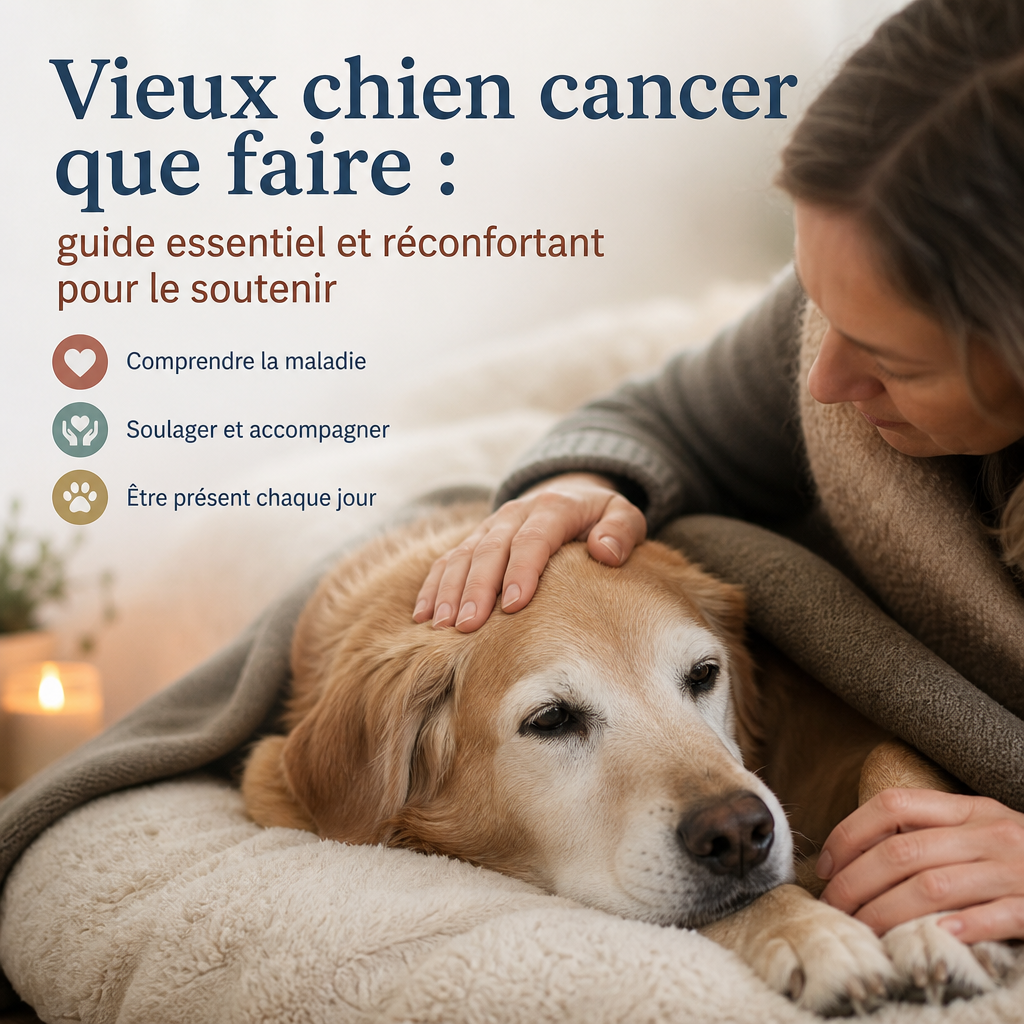
La première étape consiste à obtenir des informations précises. Demandez au vétérinaire quel est le type de cancer suspecté ou confirmé, où il se situe, s’il s’est propagé et quelles analyses sont nécessaires. Une biopsie, une radiographie, une échographie ou un scanner peuvent parfois être proposés afin de mieux évaluer la situation.
Il est également utile de demander :
– Quelle est l’évolution probable de la maladie ?
– Le chien souffre-t-il actuellement ?
– Quels traitements sont possibles ?
– Quels bénéfices peut-on espérer ?
– Quels effets secondaires sont envisageables ?
– Quel sera le coût et le rythme des soins ?
– Que peut-on faire si la maladie progresse ?
These questions allow for an informed decision, without being guided solely by fear. In an older dog, the goal is not always to prolong life at all costs. It may be preferable to seek a balance between duration and quality of life.
In this phase, it is also important to note the small changes in daily life. A dog that sleeps more, hesitates to get into the car, eats more slowly, or is less playful may already be expressing discomfort. These details, sometimes subtle, help to better understand the progression of the disease and adjust the support.
Assessing the quality of life of your older dog
Quality of life is an essential indicator for knowing how to support a dog with cancer. Some animals continue to enjoy their walks, meals, and family time despite the illness. Others quickly show significant fatigue or difficult-to-control pain.
Regularly observe several elements:
– Appetite and ability to drink normally; ;
– Weight and muscle condition; ;
– Mobility and ease of getting up; ;
– Breathing; ;
– Sleep and rest; ;
– Interest in interactions and usual activities; ;
– Presence of pain, nausea, or discomfort; ;
– The frequency of difficult days compared to pleasant days.
Keeping a small notebook can be very helpful. Note the meals, medications, symptoms, and general mood. This concrete observation helps the veterinarian adjust the treatment and allows for spotting a sometimes gradual deterioration.
To make this assessment simpler, some owners use a very practical homemade scale. For example, they assign a score of 1 to 5 for appetite, mobility, comfort at rest, and desire for contact. This method does not replace medical advice, but it allows for clearer tracking of progress and making better decisions at the right time.
A dog can have good days and more difficult days. What matters is the overall trend. If the bad days become more numerous, if the animal withdraws, no longer enjoys simple stimuli, or seems constantly uncomfortable, it is important to talk to the veterinarian quickly. It is often at this stage that the discussion about care goals becomes essential.
Elderly dog cancer support: relieve without being relentless
The support for an elderly dog with cancer often relies on palliative care. This does not mean abandoning the animal. It aims to reduce pain, nausea, anxiety, breathing difficulties, or any other distressing symptoms.
The veterinarian can prescribe painkillers, suitable anti-inflammatories, anti-nausea medications, or treatments to stimulate appetite. Never give aspirin, ibuprofen, paracetamol, or any other human medication without veterinary advice: some are toxic to dogs, even in small doses.
At home, a few simple adjustments can improve their daily life:
- Install a thick, warm, and easily accessible bed; ;
- Use non-slip mats on slippery floors; ;
- Place bowls at a comfortable height; ;
- Limit stairs and unnecessary movements; ;
- Maintain a calm and predictable routine; ;
- Offer several short outings rather than one long walk; ;
- Respect their rest periods.
Human presence is also a major support. A soft voice, gentle petting if appreciated, and a familiar environment can reduce their stress.
The impact of thermal comfort should not be underestimated either. An elderly and sick dog can quickly be bothered by the cold, especially if they sleep longer or lose muscle mass. An appropriate blanket, a bed placed away from drafts, and a quiet resting place often significantly improve their well-being.
Le repos est parfois confondu avec l’abandon des activités. Ce n’est pas le cas. Un animal malade peut encore bénéficier de moments brefs mais agréables : quelques minutes dehors, une odeur intéressante, une friandise adaptée, un contact rassurant. Ces instants comptent, car ils soutiennent le moral autant que le corps.
Alimentation et complément chien âgé cancer
L’alimentation doit être adaptée à l’état du chien et à ses éventuels symptômes. Certains animaux perdent l’appétit, tandis que d’autres maigrissent malgré une alimentation correcte. Le vétérinaire peut recommander une nourriture plus énergétique, plus appétente ou formulée pour accompagner certaines fonctions de l’organisme.
Proposez des repas en petites quantités, plusieurs fois par jour, dans un endroit tranquille. Réchauffée légèrement, la nourriture peut dégager davantage d’arômes et devenir plus attirante. Toutefois, évitez les changements brusques qui pourraient provoquer des troubles digestifs.
La question du complément pour chien âgé atteint de cancer revient fréquemment. Des produits contenant des oméga-3, des antioxydants ou certains nutriments peuvent parfois être envisagés, mais leur intérêt dépend du cancer, du traitement et de l’état des reins ou du foie. Un complément n’est jamais anodin : il peut interagir avec une chimiothérapie, modifier la coagulation ou surcharger un organisme déjà fragile.
Avant d’utiliser un complément, vérifiez avec le vétérinaire :
– La composition exacte et le dosage ;
– La compatibilité avec les médicaments prescrits ;
– L’état rénal et hépatique du chien ;
– La présence éventuelle d’allergies ou de troubles digestifs ;
– L’objectif réel du produit.
A supplement is never trivial, even when it seems natural, and it does not replace either veterinary treatment or a balanced diet. If you are looking for more precise guidelines, also consult this practical guide on the dog cancer dietary supplement: 7 powerful tips for effective and positive support.
Beware of promises of quick healing or products presented as capable of replacing conventional care. For reliable general advice on nutrition and animal health, you can also refer to the recommendations of the’Association américaine des hôpitaux pour animaux.
If your dog is losing weight, further splitting meals may help. Some dogs tolerate three or four small portions better than one large meal. Others may accept a slightly warmed diet or a softer texture better. These simple adjustments can make a real difference when appetite fluctuates.
Possible treatments for the elderly dog
Depending on the diagnosis, several options may be proposed: surgery, chemotherapy, radiotherapy, targeted treatment, or simple monitoring. Age alone is not enough to exclude treatment. An elderly but fit dog can sometimes tolerate it well, while a younger and very weakened animal may be a poor candidate.
La chimiothérapie vétérinaire est généralement pensée pour préserver la qualité de vie plutôt que provoquer des effets secondaires sévères. Néanmoins, chaque protocole comporte des contraintes et des risques. La chirurgie peut être pertinente lorsque la tumeur est localisée et que l’intervention offre un bénéfice réel. Dans d’autres cas, une prise en charge palliative sera plus douce et plus adaptée.
Le choix doit tenir compte du tempérament du chien, de sa capacité à supporter les déplacements, de ses antécédents et des possibilités de la famille. Il n’existe pas une solution universelle : la meilleure décision est celle qui respecte à la fois ses besoins et ses limites.
Le vétérinaire peut aussi proposer un suivi en plusieurs étapes. Parfois, on commence par stabiliser la douleur et l’état général, puis on réévalue l’intérêt d’un traitement plus lourd. Cette approche graduelle aide à éviter des décisions précipitées et permet d’observer comment le chien réagit aux premières mesures.
Avant d’accepter un protocole, demandez clairement ce qui est attendu : prolonger la survie, réduire la taille de la tumeur, diminuer la douleur ou simplement améliorer le confort. Un objectif précis rend la décision plus lisible et aide à mesurer si le traitement reste pertinent avec le temps.
Pour comparer les approches de soutien nutritionnel selon les situations, il peut aussi être utile de lire le dossier meilleur complément alimentaire chien cancer : 7 choix efficaces et rassurants.
Adapter les soins quotidiens à un chien malade
Quand un cancer touche un chien âgé, les gestes du quotidien deviennent souvent plus importants que de grands changements. L’objectif est de rendre chaque journée plus simple, plus paisible et plus prévisible.
Voici quelques habitudes utiles :
– Préparer un coin repos toujours identique ;
– Éviter les manipulations brusques ;
– Surveiller l’hydratation ;
– Nettoyer délicatement les yeux, la bouche ou la peau si nécessaire ;
– Aider le chien à se lever si cela est recommandé par le vétérinaire ;
– Réduire les stimulations trop intenses ;
– Prévoir des sorties courtes mais fréquentes.
Le toilettage peut aussi devenir un moment de soin et de connexion. Un brossage doux, sans insister sur une zone douloureuse, permet parfois de maintenir un contact agréable tout en surveillant la peau, les masses visibles ou les changements de texture du pelage. Il ne s’agit pas d’un détail : repérer tôt une plaie, une rougeur ou une grosseur qui change d’aspect peut orienter rapidement la suite de la prise en charge.
Si le chien a du mal à se déplacer, installez des passages dégagés entre ses lieux de repos, l’eau et l’extérieur. Moins il doit fournir d’efforts inutiles, plus il conserve d’énergie pour ce qui lui fait du bien.
La présence de la famille compte aussi beaucoup.
Reconnaître une urgence
Some signs require quickly contacting a veterinarian or an emergency service :
– Significant difficulties breathing ;
– Intense or persistent pain ;
– Collapse, extreme weakness or loss of consciousness ;
– Heavy bleeding ;
– Repeated vomiting or inability to keep water down ;
– Suddenly swollen abdomen ;
– Seizures ;
– Total refusal to drink and eat accompanied by a very depressed state.
Do not wait several days when the general condition deteriorates sharply. Quick intervention can sometimes provide effective relief, even when healing is not possible.
For reliable guidelines on warning signs in veterinary oncology, you can also consult the reference information from the’Manuel vétérinaire Merck.
If you are unsure whether to observe a little longer or consult right away, it is better to call. A simple phone conversation with the clinic can already help distinguish an expected evolution from a real alarm signal. When an animal is suffering, every hour counts more than one might imagine.
Accompanying the end of life with gentleness
When difficult days become more numerous than pleasant days, it is important to speak openly with the veterinarian. The decision for euthanasia can be one of the most painful, but it can also prevent unnecessary suffering. It should be considered as an act of protection when pain, anxiety, or inability to live with dignity can no longer be controlled.
Take the time to discuss the timing, the process, and the possibilities at home or in the clinic. Surrounding your dog with calm, presence, and familiarity can make this step more peaceful. The grief that follows is normal and deserves to be welcomed: losing an elderly companion after having accompanied them with care represents a profound ordeal, but also the testimony of a bond built over the years.
When the diagnosis is confirmed, ask yourself vieux chien cancer que faire revient surtout à choisir ce qui protège le mieux son confort, sa dignité et sa sérénité. Dans bien des cas, la bonne réponse n’est pas de tout faire, mais de faire juste, au bon moment.
Pour aller plus loin, gardez en tête qu’un accompagnement réussi repose sur trois repères simples : observer, ajuster et communiquer. Observer les signes du quotidien, ajuster les soins avec le vétérinaire et communiquer tôt quand quelque chose change permet souvent de mieux vivre chaque étape. Dans cette logique, vieux chien cancer que faire devient moins une question de panique qu’une démarche de soutien attentive, régulière et apaisante.
Un dernier point important concerne le moral du chien. Même âgé, même malade, il peut encore apprécier des gestes simples, un panier confortable, une promenade courte au soleil ou une friandise adaptée. Préserver ces petits plaisirs aide souvent à maintenir une dynamique positive. Lorsqu’on se demande vieux chien cancer que faire, il est donc utile de penser autant au soulagement physique qu’aux repères émotionnels qui rassurent l’animal au quotidien.
Enfin, n’hésitez jamais à demander une réévaluation si vous sentez que la situation évolue. Les besoins d’un chien âgé peuvent changer vite, et une prise en charge efficace est souvent celle qui s’adapte au bon moment. Avec un suivi attentif, des gestes simples et des décisions partagées, vieux chien cancer que faire trouve une réponse plus humaine, plus claire et plus sereine.

par TCMVET | Août 23, 2026 | Recherche et actualités
Cancer chien métastases soutien : accompagner un chien atteint d’un cancer avec des métastases demande des informations fiables, une communication régulière avec l’équipe vétérinaire et une attention particulière au confort quotidien. Lorsque la maladie s’est propagée, les décisions peuvent sembler difficiles, mais poser les bonnes questions aide à mieux comprendre la situation et à choisir des soins adaptés aux besoins de l’animal et de sa famille.
Dans cette situation, l’objectif n’est pas seulement de prolonger le temps, mais de préserver la qualité des journées. Un bon accompagnement tient compte de la douleur, de l’appétit, de la respiration, de l’énergie et du lien affectif. C’est souvent ce regard global qui rend le cancer chien métastases soutien plus humain, plus clair et plus utile pour les propriétaires.
Comprendre le cancer chien propagé
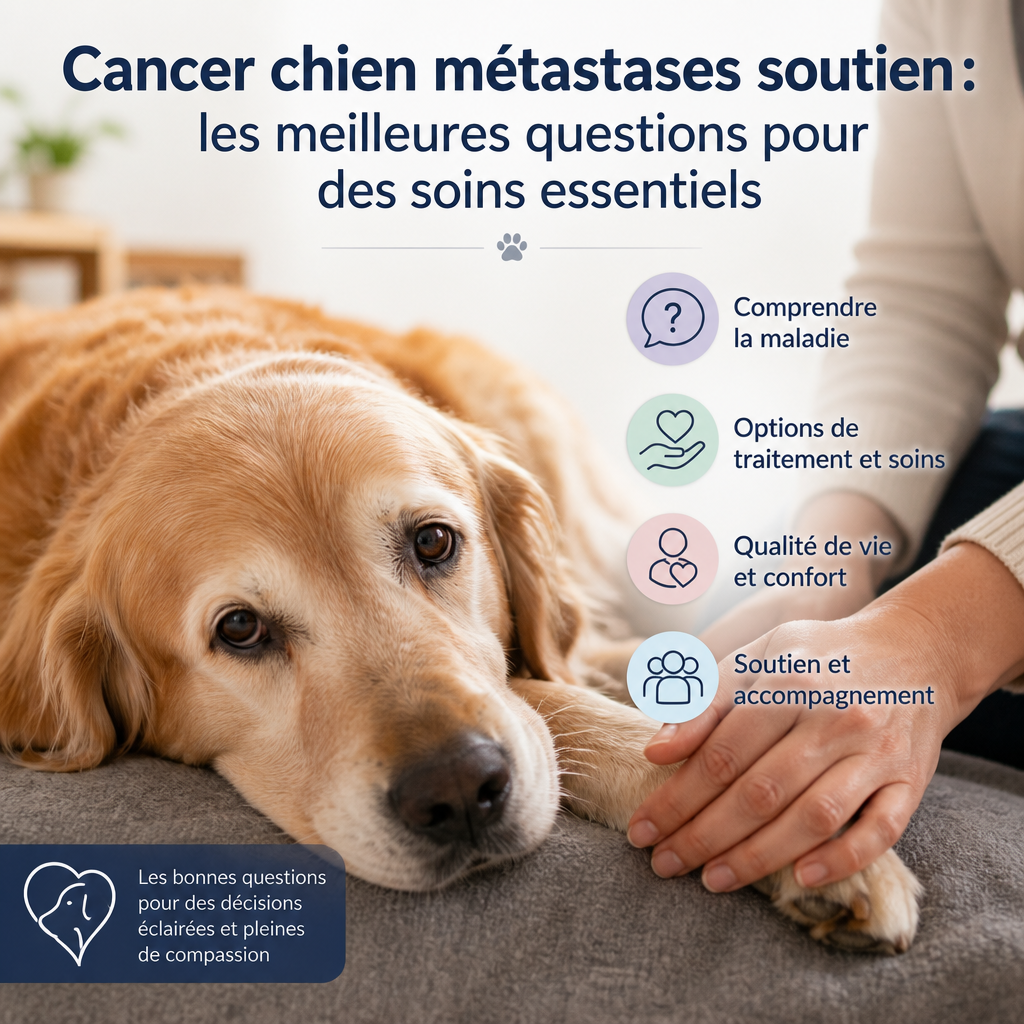
Un cancer chien propagé signifie que des cellules tumorales ont quitté leur emplacement initial pour atteindre d’autres organes ou tissus. Cette extension, appelée métastase, peut concerner les poumons, le foie, les ganglions lymphatiques, les os ou d’autres parties de l’organisme. Les signes observés varient selon la localisation des métastases : fatigue, perte d’appétit, amaigrissement, toux, difficultés respiratoires, douleur, troubles digestifs ou baisse générale de la mobilité.
La présence de métastases ne permet pas toujours de prévoir précisément l’évolution. Chaque chien réagit différemment selon son âge, son état général, le type de tumeur et les organes touchés. Le vétérinaire peut proposer des examens complémentaires, comme des analyses sanguines, des radiographies, une échographie, un scanner ou une biopsie. Ces informations servent à évaluer l’étendue de la maladie et à déterminer les options possibles.
Dans de nombreux cas, le propriétaire a besoin de comprendre non seulement le diagnostic, mais aussi son impact concret sur la vie quotidienne. Cette étape est essentielle dans un parcours de cancer chien métastases soutien, car elle permet de relier les résultats médicaux aux symptômes observés à la maison. Une explication claire aide à décider si l’on vise un contrôle de la maladie, un soulagement des symptômes, ou les deux à la fois.
Quelles questions poser sur le diagnostic ?
Pour mieux comprendre la situation, il peut être utile de demander :
– Quel est le type exact de cancer ?
– Où se trouvent les métastases ?
– Quels organes sont concernés ?
– La maladie évolue-t-elle rapidement ?
– Quels examens sont indispensables et lesquels peuvent être évités pour limiter le stress ou les dépenses ?
– Quels signes indiquent une aggravation de l’état de santé ?
Asking for an explanation in simple terms is perfectly legitimate. It is also helpful to take notes or to come accompanied during appointments, as the amount of information can be significant.
If you wish to compare the information with a reference source, the information page of the’American Veterinary Medical Association on cancer in dogs provides a useful general overview. It does not replace your veterinarian's advice, but it can help prepare for discussions.
Dog cancer metastasis support: what care options?
When healing is not possible, care often aims to slow the progression of the disease, reduce symptoms, and preserve quality of life. Depending on the type of cancer, the veterinarian may discuss surgery, chemotherapy, radiation therapy, certain targeted treatments, or only palliative care.
Veterinary chemotherapy does not have exactly the same goal or effects as in humans. It is generally designed to preserve the animal's well-being while controlling the disease. Side effects may include nausea, temporary fatigue, or decreased appetite, but they do not occur in all dogs.
Palliative care may include pain medications, anti-inflammatories, anti-nausea treatments, nutritional support, and environmental adjustments. They do not mean abandoning care: on the contrary, they seek to make each day more comfortable. In this context, good dog cancer metastasis support often relies on simple, regular adjustments that are reassessed with the veterinarian.
Depending on the situation, some dogs benefit more from a very targeted strategy than from a heavy protocol. The choice depends on the location of the metastases, current comfort, rate of progression, and what the family can implement at home. It is therefore useful to ask the veterinarian what will bring the most concrete benefits, and not just what is theoretically possible.
Essential questions about treatment
Before starting a protocol, it is relevant to ask:
- What is the goal of the treatment: to slow the disease, reduce a tumor, or relieve a symptom?
- What benefits can we reasonably expect?
- What are the possible side effects?
- How long should we wait before assessing effectiveness?
- Is there a less burdensome solution for the dog?
- What symptoms require urgent consultation?
- What will be the overall cost, including check-ups and medications?
An appropriate decision relies on a balance between life expectancy, comfort, treatment constraints, and family values. The veterinarian should be able to clearly explain the advantages and limitations of each option.
Il est aussi utile de demander ce qui peut être ajusté si le chien tolère mal le traitement. Parfois, un changement de rythme, une modification de dose ou l’ajout d’un médicament de soutien suffit à améliorer nettement le quotidien. Dans un parcours de cancer chien métastases soutien, ces ajustements font souvent une grande différence.
Évaluer la qualité de vie au quotidien
La qualité de vie est un élément central dans le cancer chien métastases soutien. Il est conseillé d’observer plusieurs indicateurs : appétit, hydratation, sommeil, respiration, mobilité, douleur, intérêt pour les promenades et interaction avec la famille. Un carnet de suivi peut aider à repérer les tendances plutôt qu’à se fier à une seule bonne ou mauvaise journée.
Certains propriétaires notent chaque soir une note concernant l’appétit, la douleur apparente, l’énergie et le plaisir. Cette méthode facilite les échanges avec le vétérinaire et permet de détecter une dégradation progressive. Elle aide aussi à voir ce qui soulage réellement le chien et ce qui, au contraire, lui demande trop d’efforts.
You can rely on simple markers: is the dog eating with interest? Is he sleeping peacefully? Does he get up without help? Is he still seeking contact? These questions are very concrete and provide a more accurate picture than vague impressions. They are particularly useful when the cancer dog metastases support primarily aims at day-to-day well-being.
You should consult quickly in case of respiratory difficulties, intense pain, repeated vomiting, inability to get up, significant bleeding, seizures, or complete refusal to drink. An emergency should not wait for the next appointment, especially when metastases affect essential organs.
For some owners, it can be difficult to know if a change is “normal” or truly concerning. The best thing to do is to note the evolution over several days: if fatigue sets in, if breathing becomes shorter at rest, or if the dog is withdrawing more and more, it should be discussed with the veterinarian without delay.
Alimentation et complément chien cancer
Nutrition can play a role in maintaining energy, muscle mass, and digestive comfort. A dog with cancer may have different needs depending on its illness, treatment, and appetite. The veterinarian or a specialist in animal nutrition may recommend a more palatable, more energetic diet or one suited to an associated condition.
The question of dog cancer supplements often comes up. Some supplements contain omega-3 fatty acids, antioxidants, vitamins, or herbs. However, natural does not automatically mean safe. Some products can alter the absorption of medications, increase the risk of bleeding, or overload the liver and kidneys.
Before administering a supplement, it is therefore necessary to check:
– Its exact composition and dosage ;
– Its compatibility with the prescribed treatment ;
– The reliability of the manufacturer ;
– Any potential contraindications ;
– The real necessity of this product for the concerned dog.
A supplement never replaces chemotherapy, surgery, pain treatment, or a balanced diet. It should only be considered as a potential complementary support validated by the veterinarian.
When appetite decreases, small adjustments can help: splitting meals, slightly warming food, offering a softer texture, or varying protein sources if compatible with the dog's health. These simple adjustments are often more useful than a radical diet change. They fit well into a dog cancer metastasis support approach focused on comfort and stability.
Aménager l’environnement et soutenir le chien
A calm environment can reduce fatigue and anxiety. Providing a comfortable bed, avoiding stairs, placing water and food nearby, and using non-slip mats are simple and helpful measures. Walks should be adapted to the dog's energy: short, regular outings without excessive effort.
The presence of family remains important. Speaking softly, maintaining familiar routines, and offering enjoyable activities can contribute to well-being. However, it is essential to respect rest periods and avoid forcing a dog showing signs of pain or exhaustion.
Accompanying a dog with metastatic cancer is an emotional ordeal. Relying on an available veterinary team, seeking a second opinion if necessary, and accepting help allows for calmer decision-making. The primary goal remains the same: to provide the dog with maximum comfort, dignity, and pleasant moments, day after day.
Support is not limited to medical care. It also involves anticipating practical difficulties: organizing transportation, preparing medications in advance, planning an accessible resting space, and distributing responsibilities among household members. The simpler the logistics, the calmer the dog can remain, and the more sustainable the dog cancer metastasis support becomes for the whole family.
Concrete gestures at home
Here are some gestures often useful in daily life:
- protect slippery areas with mats or non-slip blankets ;
- slightly elevate the bowls if the dog has difficulty bending down ;
- keep a clean and easy-to-wash blanket ;
- offer several short rest periods throughout the day ;
- monitor the room temperature to avoid discomfort ;
- limit visits or overly intense stimuli if the dog becomes overwhelmed quickly.
These simple adjustments often help maintain a reassuring routine. They are particularly valuable when the dog's strength diminishes, as they reduce the effort required for the most ordinary activities.
Questions pratiques à poser au vétérinaire
To keep a clear course, it is helpful to prepare a list of questions before each consultation. In a context of dog cancer metastases support, these questions help avoid misunderstandings and better prioritize needs.
You can for example ask:
– What is the purpose of today’s appointment?
– What changes should alert me at home?
– Which medication is a priority if the dog refuses to take multiple treatments?
– Should doses be adjusted according to appetite, weight, or fatigue?
– How can I tell if the pain is sufficiently controlled?
– When should the care plan be reconsidered?
These exchanges are all the more useful as some signs can be subtle. A dog that isolates itself, sleeps more, or moves less may already show significant discomfort. The veterinarian can then propose a pain assessment and gradual adjustments.
It is also legitimate to discuss the limits of treatment. Asking what can be hoped for, but also what should be avoided, allows for more peaceful decision-making. In many cases, the best answer is not “do more,” but “do just what is necessary” for the dog.
Recognizing small changes
Daily monitoring helps to spot discreet evolutions. For example, a decrease in interest in meals, faster breathing at rest, difficulty getting on the couch, or less desire to play can signal that the general condition is deteriorating. Noting these changes over several days is often more useful than relying on an isolated impression.
This type of monitoring is particularly valuable when dog cancer metastases support mainly relies on comfort. It allows for anticipation, earlier relief, and better adaptation of care to the reality experienced by the dog.
If the dog still enjoys certain activities, they should not be removed without reason. A short walk, a moment of cuddling, or a calm game can still hold significant value. The goal is not to overprotect, but to balance gentleness, safety, and pleasure.
Quand réévaluer rapidement la situation ?
In an advanced cancer journey, the situation can change quickly. It is therefore useful to know when to contact the veterinarian again to review the care plan. A quick reassessment is indicated if the dog refuses multiple meals, seems painful despite treatment, breathes faster than usual, becomes confused, or shows no interest in what it previously enjoyed.
– Sa composition exacte et son dosage ;.
– Sa compatibilité avec le traitement prescrit ;.
Ressources utiles et repères fiables
– La fiabilité du fabricant ;.
For example, the information page of the’American Veterinary Medical Association on cancer in dogs provides a useful overview of diagnostic and management issues. This type of resource does not replace a clinical opinion, but it can help ask better questions.
In practice, the most important thing remains to build a realistic, flexible plan centered on the animal's well-being. Effective metastatic dog cancer support is not limited to medication: it also includes monitoring, environment, nutrition, pain, fatigue, and the quality of shared moments.
With clear questions, attentive follow-up, and regular communication with the veterinary team, it becomes easier to choose truly appropriate care. The goal is to best preserve comfort, limit suffering, and respect the dog's pace until the end.
Ultimately, every decision must be based on what the dog is actually experiencing on a daily basis. When observing attentively, exchanging freely with the veterinarian, and adjusting care flexibly, metastatic dog cancer support can remain focused on what matters: dignity, relief, and presence with the animal.
par TCMVET | Août 22, 2026 | Recherche et actualités
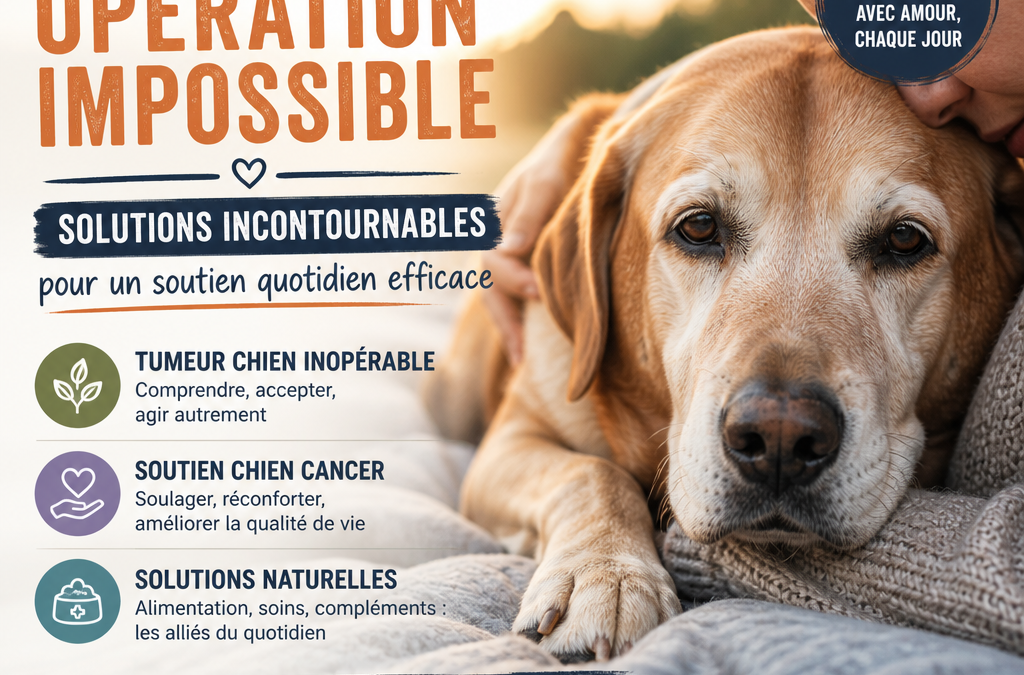
Face à un cancer chien opération impossible, le diagnostic bouleverse toute la famille. Pourtant, une intervention irréalisable ne signifie pas qu’il n’existe plus de solutions. Les soins vétérinaires peuvent encore soulager la douleur, ralentir l’évolution de la maladie et préserver le confort de l’animal. L’objectif devient alors d’adapter l’accompagnement à chaque chien, en tenant compte de son âge, de son état général, du type de tumeur et de sa qualité de vie.
Dans certaines situations, un complément alimentaire peut aussi être discuté avec le vétérinaire pour renforcer le confort et l’appétit. Pour aller plus loin, vous pouvez consulter ce guide pratique sur le complément alimentaire chien cancer.
Comprendre une tumeur chien inopérable

Une tumeur chien inopérable peut l’être pour plusieurs raisons. Elle peut être située près d’un organe vital, infiltrer des tissus difficiles à séparer ou être déjà trop étendue. Dans certains cas, l’état général du chien ne permet pas de supporter une anesthésie ou une opération lourde. La décision repose généralement sur des examens comme l’imagerie, la biopsie, les analyses sanguines et l’évaluation clinique globale.
The veterinarian does not limit himself to determining whether a mass can be removed. He also seeks to understand how the disease progresses, what symptoms it causes, and what options may improve daily life. An inoperable tumor is therefore not necessarily synonymous with a lack of treatment. Radiotherapy, certain medications, chemotherapy, or palliative care may be considered depending on the situation.
In practice, it is often useful to ask what the priorities are: reducing pain, slowing tumor growth, limiting inflammation, or preserving appetite. This discussion helps the family understand the care plan and participate in decisions calmly. The clearer the framework, the more cancer chien opération impossible it becomes a manageable situation on a daily basis, even if it remains emotionally difficult.
It is also important to keep in mind that some cancers progress slowly while others progress rapidly. The monitoring frequency may therefore vary depending on the type of tumor and the dog's response to treatment. Regular monitoring allows for early detection of new pain, loss of appetite, or changes in behavior, before the situation becomes more difficult to correct.
Les traitements possibles lorsque la chirurgie est exclue
Treatment depends on the type of cancer and its location. Chemotherapy may be proposed to slow progression or reduce certain symptoms. In dogs, it is often tailored to preserve comfort rather than seek significant side effects. Veterinary protocols are not always comparable to those used in humans.
Radiotherapy can also represent a solution when the tumor is localized, painful, or responsible for compression. It can help reduce tumor volume and relieve certain neurological or respiratory signs. However, access depends on available equipment, the number of necessary sessions, and the dog's ability to tolerate them.
In other situations, the veterinarian prescribes a medical treatment aimed at controlling symptoms. Pain relievers, anti-inflammatories, antiemetics, or medications intended to stimulate appetite can significantly improve comfort. It is essential to strictly adhere to prescribed doses and never give a human medication without veterinary validation.
Beyond the main treatments, supportive care is extremely important. Some dogs cope better with their care when they benefit from a stable routine, sufficient rest, and constant attention to pain. The cancer chien opération impossible impose souvent d’alterner médecine, observation et ajustements pratiques pour que les journées restent les plus douces possible.
Pour les familles qui cherchent des conseils concrets sur l’accompagnement nutritionnel, ce dossier complémentaire sur le better dog cancer dietary supplement peut aussi aider à comparer les options avec plus de sérénité.
Soutien chien cancer : soulager la douleur au quotidien
The soutien chien cancer commence par une observation attentive. La douleur ne se manifeste pas toujours par des gémissements. Un chien peut devenir plus distant, haleter au repos, changer de position fréquemment, refuser les escaliers, perdre l’envie de jouer ou présenter une irritabilité inhabituelle. Une diminution du toilettage, une posture voûtée ou des difficultés à se coucher doivent également être signalées.
Pour favoriser le bien-être, aménagez un espace calme, chaud et facilement accessible. Un matelas suffisamment épais peut réduire la pression sur les articulations et les zones sensibles. Les gamelles doivent être placées à une hauteur confortable, notamment si le chien souffre du cou ou de difficultés à se pencher.
Les promenades restent intéressantes, mais elles doivent être courtes et adaptées à son énergie. Plusieurs sorties tranquilles peuvent être préférables à une longue balade. Il faut éviter les efforts forcés, les escaliers répétés et les sols glissants. Des tapis antidérapants dans la maison peuvent prévenir les chutes et rassurer un animal affaibli.
Adapter les gestes du quotidien
Un animal malade supporte souvent mieux des routines simples et prévisibles. Garder les horaires habituels, limiter les changements brusques et parler doucement peuvent réduire le stress. Si le chien a besoin d’aide pour monter dans la voiture ou franchir une marche, un harnais de soutien ou une rampe peut préserver son autonomie tout en évitant les douleurs inutiles.
La présence humaine compte énormément. Beaucoup de chiens ressentent un apaisement réel lorsqu’ils restent près de leurs repères et de leurs proches. Le contact, les caresses et une attention régulière participent aussi au bien-être émotionnel.
Il est également utile de préparer la maison pour les jours plus difficiles. Placer l’eau à plusieurs endroits, éviter les obstacles dans les couloirs et réserver un coin de repos calme peuvent faciliter les déplacements. Dans un cancer chien opération impossible, ces petits aménagements ont souvent un effet très concret sur la qualité de vie et sur le niveau de stress de l’animal.
Certains chiens apprécient aussi des moments courts mais fréquents de stimulation douce : renifler dans le jardin, recevoir une friandise autorisée, suivre leur humain dans la maison ou profiter d’une présence tranquille. L’idée n’est pas d’en faire trop, mais de conserver des plaisirs simples sans fatiguer inutilement l’organisme.
Cancer chien opération impossible : mieux gérer le quotidien
Quand un cancer chien opération impossible cannot be removed, daily life becomes the heart of care. It is no longer just about treating the illness, but about organizing each day to reduce discomfort. Split meals, longer rest periods, and a secure environment can already make a real difference.
It is helpful to maintain stable reference points, especially if the dog seems tired or disoriented. A reassuring routine limits stress and can improve adherence to care. In this context, a cancer chien opération impossible often requires simple but regular adjustments to maintain the animal's balance and soothe the whole family.
Follow-up can also include daily notes. Some owners observe appetite, sleep, mobility, desire to go out, and level of interaction with the family. This logbook allows to see if the care provides real benefits or if the strategy needs to be reassessed with the veterinarian. This is particularly useful when the clinical picture evolves in small steps rather than abruptly.
One must not underestimate the emotional impact of this situation. A dog with difficult-to-operate cancer may have uneven days, with moments when everything seems almost normal and others more concerning. Accepting this fluctuation often helps the family maintain a realistic view, without dramatizing every dip in condition or minimizing the signs that require adjustment.
Maintenir l’alimentation et l’hydratation
Loss of appetite is common in dogs with cancer.
Any dietary changes should ideally be discussed with the veterinarian, especially in the presence of vomiting, diarrhea, kidney disease, or marked weight loss. Dietary supplements do not replace treatment and some may interact with medications. For background information on this topic, the National Cancer Institute provides useful information on supportive care and symptom management: official resources on complementary approaches.
Hydration should also be monitored. Several bowls of fresh water can be placed in areas where the dog rests. A significant decrease in consumption, dry gums, or sudden fatigue requires professional advice.
Monitor appetite without pressure
Forcing a dog to eat can sometimes worsen its stress. It is better to test different textures, offer smaller meals, and respect its pace. In some cases, the veterinarian may recommend temporary medication support to improve appetite or limit nausea.
If the dog refuses several meals in a row, it is important not to conclude too quickly that it is simply being stubborn. In a cancer chien opération impossible, decreased appetite may signal inadequately controlled pain, digestive discomfort, or disease progression. A consultation can then help distinguish between temporary discomfort and a genuine need for therapeutic adjustment.
The taste and smell of food also play an important role. Soft textures, warm foods, or more aromatic rations can sometimes help. The veterinarian may suggest a diet more suited to the dog's overall condition, in order to best maintain its weight and energy. Each change should remain gradual to avoid further disturbing an already fragile organism.
Surveiller la qualité de vie
In the context of a cancer chien opération impossible, quality of life becomes an essential benchmark. It can be helpful to note daily appetite, mobility, sleep, pain, interactions, and moments of pleasure. This tracking helps identify trends and provides the veterinarian with more precise information than a simple momentary feeling.
A dog generally maintains an acceptable quality of life when it can still eat or drink enough, rest comfortably, interact with its loved ones, and enjoy certain activities. Conversely, persistent pain, respiratory distress, repeated vomiting, or an inability to move should be taken very seriously.
Veterinary emergencies are necessary in cases of difficulty breathing, collapse, significant bleeding, uncontrollable pain, a suddenly bloated abdomen, or total inability to drink. A quick consultation can sometimes adjust treatment and avoid unnecessary suffering.
When monitoring becomes more complex, it may be helpful to ask the veterinarian for a simple assessment grid. This tool helps objectify the progression of the disease and decide more calmly on the next steps.
Il est souvent rassurant de se poser quelques questions concrètes : le chien se lève-t-il encore volontiers ? Cherche-t-il le contact ? Mange-t-il avec intérêt ? Peut-il se reposer sans agitation ? Ces repères ne remplacent pas un examen médical, mais ils aident à mieux lire ce que le chien exprime au quotidien. Dans une situation de cancer chien opération impossible, cette lecture régulière évite de rester dans le flou et facilite les décisions.
Quand consulter rapidement en cas de cancer chien opération impossible
Certains signes exigent une réaction rapide, surtout si un cancer chien opération impossible est déjà connu. Une respiration anormale, une faiblesse marquée, des vomissements répétés, un refus total de boire ou une douleur qui s’intensifie doivent alerter. Plus la prise en charge est précoce, plus il est possible d’ajuster les soins avant que l’état général ne se dégrade.
Il est aussi important de consulter si le chien devient soudainement confus, s’isole complètement ou cesse de s’intéresser à ses repères habituels. Ces changements peuvent traduire une aggravation de la maladie ou un effet secondaire des traitements. Dans tous les cas, mieux vaut demander l’avis du vétérinaire trop tôt que trop tard.
D’autres situations méritent également une vigilance accrue : difficulté à uriner, saignement anormal, perte de poids rapide, toux persistante ou déséquilibre inhabituel.
In practice, families are often surprised to see that an adjustment in pain or appetite significantly improves things within a few days. That’s why it is essential to report any changes, even subtle ones, so that the veterinarian can intervene at the right time.
Accompagner les décisions avec le vétérinaire
Dialogue with the veterinarian is essential to define a realistic plan. Ask what the treatment goals are, the expected benefits, possible side effects, and the signs that should lead to a consultation. It is also relevant to address palliative care early enough, as it does not mean abandoning care.
When the disease progresses, the veterinary team can help evaluate options with compassion and objectivity. The decision to end an animal's suffering is extremely difficult, but it can sometimes be the last act of protection and love. It should be made with a professional, based on the actual condition of the dog rather than guilt or fear.
The veterinarian's role is also to support the family over time, not just during emergency consultations. In a cancer chien opération impossible, follow-up appointments allow for dose adjustments, discussions of new symptoms, and choosing the best approach at the right time. This gradual support often reduces anxiety and gives the feeling of acting consistently.
It can also be helpful to address practical questions: what to do if the animal stops eating? When to call the clinic? What signs indicate an emergency? What options exist if pain becomes difficult to control? The more these points are clarified in advance, the more the family feels ready to react without panic.
Even when surgery is impossible, presence, gentleness, and daily attention remain valuable. A stable environment, appropriate care, and regular follow-up can offer the dog more comfortable days and preserve the moments of companionship that matter most. In a cancer chien opération impossible, these simple gestures often make a big difference in daily life.
With appropriate care, regular dialogue with the veterinarian, and simple adjustments at home, it is often possible to maintain more comfort than one imagines at the time of diagnosis. The key is to move forward step by step, with clarity and kindness, to provide the dog with the best possible support.
par TCMVET | Août 17, 2026 | Recherche et actualités
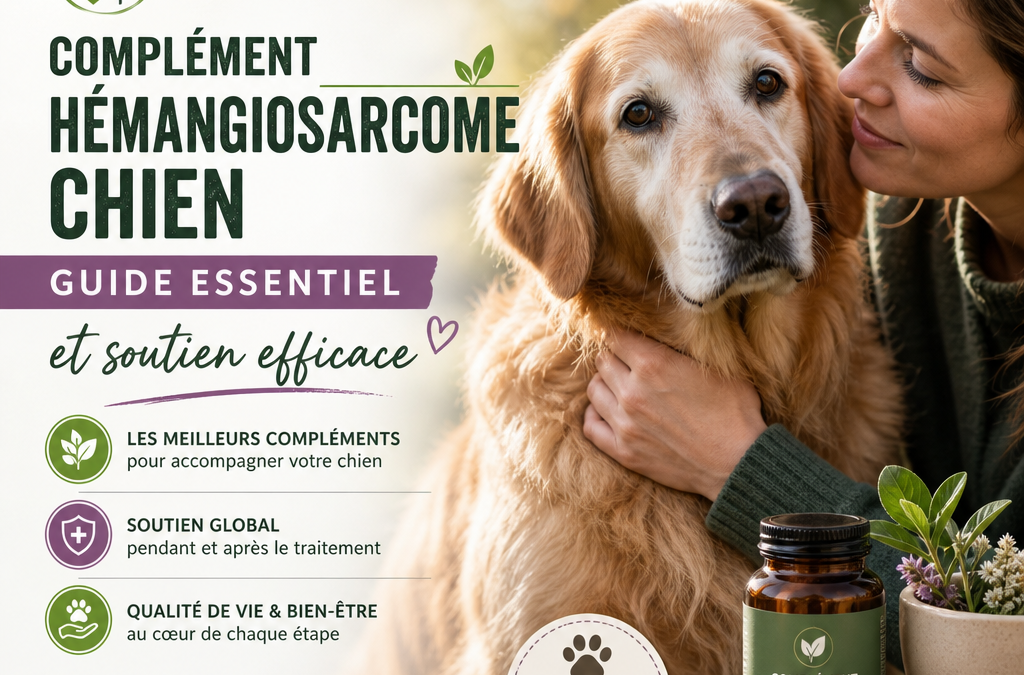
Complément hémangiosarcome chien : lorsqu’un compagnon reçoit ce diagnostic, chaque décision compte et les propriétaires cherchent naturellement des moyens de l’aider au quotidien. L’hémangiosarcome est une tumeur agressive qui se développe à partir des vaisseaux sanguins, souvent au niveau de la rate, du cœur, du foie ou de la peau. Sa prise en charge nécessite un suivi vétérinaire rigoureux, mais une alimentation adaptée, un confort renforcé et certains compléments peuvent parfois soutenir l’organisme. Ils ne remplacent toutefois jamais la chirurgie, la chimiothérapie ou les traitements prescrits par le vétérinaire.
Comprendre l’hémangiosarcome chez le chien
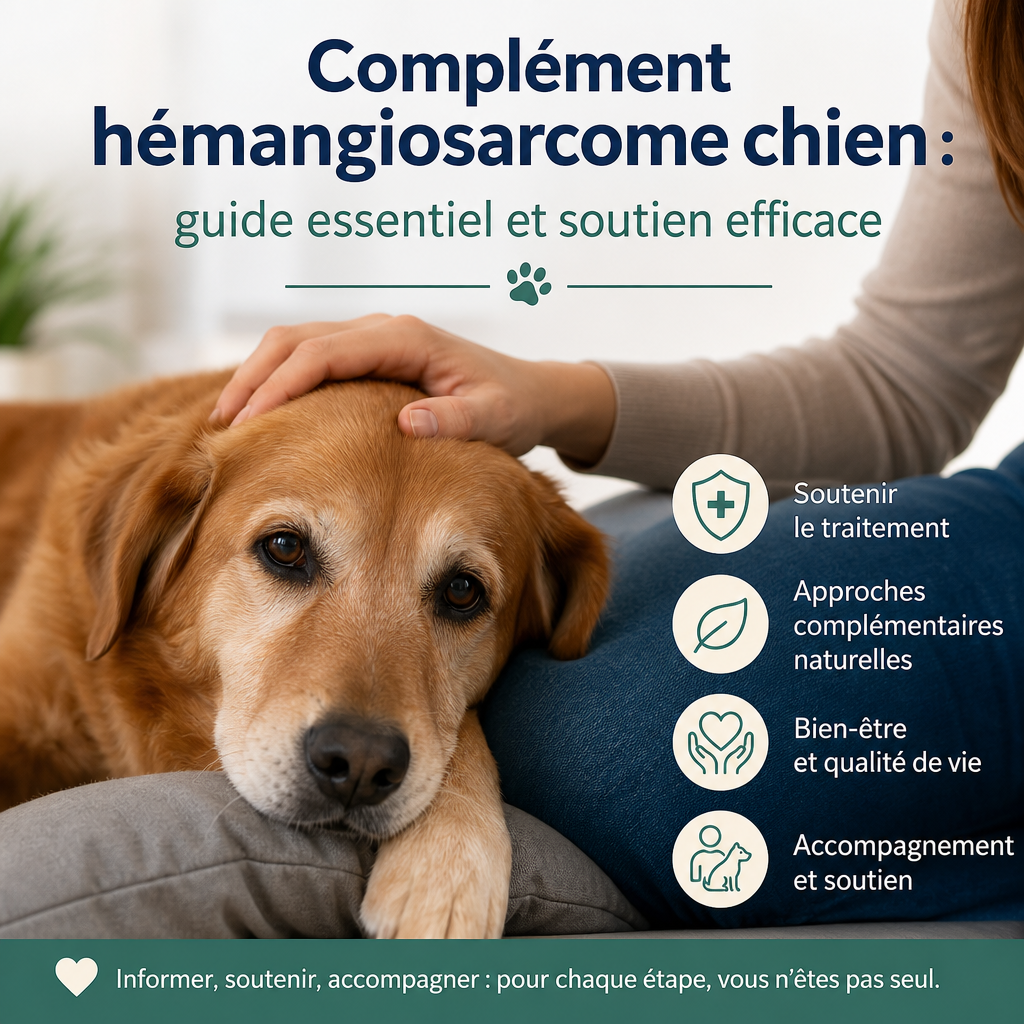
L’hémangiosarcome peut évoluer rapidement et rester discret pendant longtemps. Certains chiens présentent une fatigue inhabituelle, une baisse d’appétit, une perte de poids, des muqueuses pâles, une respiration accélérée ou un abdomen distendu. Dans les formes viscérales, une rupture tumorale peut provoquer une hémorragie interne, ce qui constitue une urgence absolue.
The diagnosis generally relies on a clinical examination, blood tests, and imaging studies such as abdominal ultrasound or echocardiography. Depending on the location and the general condition of the animal, the veterinarian may recommend surgery, chemotherapy, palliative care, or a combination of several approaches.
The prognosis depends notably on the stage of the disease, the affected organ, and the response to treatment. This reality makes daily support particularly important, while requiring realistic expectations.
What can be the role of a hemangiosarcoma supplement for dogs?
A dietary supplement does not destroy a tumor and should not be presented as a cancer treatment. Its potential interest lies rather in supporting certain functions: maintaining nutritional status, providing essential fatty acids, digestive support, or aiding in overall recovery.
In a dog with hemangiosarcoma, the priorities are often as follows:
- preserve appetite and body weight; ;
- limit digestive disturbances related to the disease or treatments; ;
- promote good hydration; ;
- support comfort and mobility; ;
- monitor signs of fatigue or bleeding.
La pertinence d’un complément dépend de l’âge, du poids, de la fonction hépatique et rénale, des médicaments utilisés et des éventuels troubles de la coagulation. Un produit approprié pour un chien en bonne santé peut être déconseillé chez un animal souffrant d’une maladie tumorale.
Pour mieux comprendre la manière dont certaines tumeurs se propagent, vous pouvez aussi consulter cet article utile sur la métastase chez le chien et la progression tumorale.
Les compléments parfois envisagés
Les acides gras oméga-3, notamment l’EPA et le DHA issus d’huiles marines, sont souvent étudiés dans le cadre du soutien nutritionnel des chiens atteints de cancer.
Ils peuvent contribuer à la qualité de la peau, à la santé générale et à l’équilibre de la réponse inflammatoire.
Toutefois, leur dosage doit être validé par le vétérinaire, surtout en présence d’un risque hémorragique ou d’un traitement affectant la coagulation.
Les probiotiques peuvent être proposés lorsque le chien souffre de selles molles, de diarrhées ou d’un déséquilibre digestif.
Ils ne traitent pas l’hémangiosarcome, mais peuvent aider à préserver le confort intestinal chez certains animaux, notamment pendant certaines chimiothérapies. complément alimentaire chien cancer Des vitamines ou minéraux peuvent être utiles en cas de carence confirmée.
Il est cependant déconseillé d’administrer des doses élevées sans analyse préalable.
Soutien quotidien et surveillance
Un excès de certains nutriments peut surcharger le foie ou les reins, ou interagir avec le traitement.
Les compléments destinés au soutien articulaire peuvent également améliorer le confort d’un chien âgé ou affaibli, mais ils doivent être choisis en tenant compte de la tolérance digestive et du risque de saignement.
Dans certains cas, les propriétaires cherchent aussi un.
adapté à l’appétit, à la digestion et au niveau d’énergie de leur animal. Le choix doit toujours rester individualisé. Un complément hémangiosarcome chien peut aussi être envisagé sous forme d’oméga-3, de soutien digestif ou de formule de récupération, à condition de rester cohérent avec l’état clinique du chien.
Un Le choix doit toujours rester individualisé. Le soutien ne repose pas uniquement sur les compléments.
Précautions indispensables
De nombreux produits présentés comme « naturels » peuvent être dangereux. Certaines plantes ont des effets anticoagulants, sédatifs ou hépatiques. D’autres peuvent modifier l’absorption ou l’efficacité d’une chimiothérapie. La curcumine, l’ail, le ginkgo, le ginseng ou certaines préparations concentrées doivent notamment être envisagés avec prudence, car leur innocuité dépend de la dose et du contexte médical.
Avant d’utiliser un complément cancer chien, il est important de transmettre au vétérinaire la liste complète des produits envisagés, leur composition et leur dosage. Il faut privilégier les produits formulés pour les chiens, provenant de fabricants transparents et indiquant clairement les concentrations. Les compléments humains peuvent contenir des édulcorants, des plantes ou des doses inadaptées.
Pour des repères fiables sur les tumeurs des vaisseaux sanguins, une ressource médicale reconnue comme le Manuel vétérinaire Merck peut aider à mieux comprendre les options de prise en charge et les précautions générales à connaître.
La qualité du produit compte également : une traçabilité insuffisante ou une composition imprécise augmente le risque d’erreur. Le vétérinaire peut aider à choisir un complément réellement pertinent et à déterminer la durée d’utilisation.
Lorsqu’un Le choix doit toujours rester individualisé. est envisagé, la priorité reste la sécurité : mieux vaut un produit simple, bien dosé et contrôlé qu’une formule riche en ingrédients non vérifiés.
Préserver la qualité de vie
Dans les maladies avancées, l’objectif principal peut devenir le confort plutôt que la recherche d’une guérison. La gestion de la douleur, des nausées, de l’anxiété et des difficultés respiratoires doit alors être réévaluée régulièrement. Les soins palliatifs ne signifient pas l’abandon : ils visent à préserver les moments agréables et la dignité de l’animal.
L’observation de la qualité de vie peut s’appuyer sur plusieurs critères : capacité à manger et boire, intérêt pour la famille, mobilité, sommeil, absence de douleur importante et équilibre entre les bonnes et les mauvaises journées. Un dialogue régulier avec l’équipe vétérinaire aide à prendre des décisions adaptées, sans se fier uniquement aux promesses commerciales des compléments.
In summary, a Le choix doit toujours rester individualisé. peut parfois accompagner la prise en charge globale, mais il doit rester un soutien secondaire et personnalisé. Le suivi vétérinaire, la surveillance des signes d’urgence, une alimentation adaptée et une attention constante au confort constituent les bases les plus sûres pour accompagner un chien atteint d’hémangiosarcome.
With a cautious and realistic approach, the Le choix doit toujours rester individualisé. can be integrated into a useful support strategy, without creating false hopes. The goal remains the same: to protect quality of life, reduce discomfort, and accompany the animal with kindness.
In practice, a Le choix doit toujours rester individualisé. is only valuable if it truly helps the dog eat better, tolerate its treatment better, and remain more comfortable on a daily basis.
