von TCMVET | 8. Feb. 2026 | Krebs und Tumore bei Hunden
Was “Spindelzelle” bei Hunden bedeutet
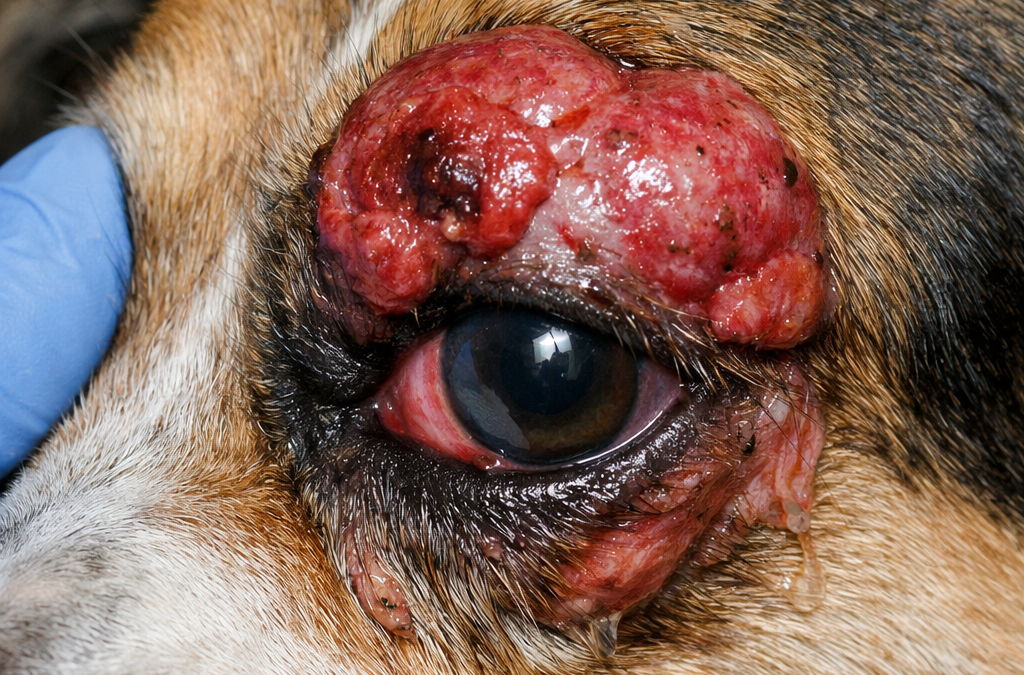
“Spindelzelle” beschreibt normalerweise, wie Tumorzellen unter dem Mikroskop aussehen – lang, spitz zulaufend und faserig – anstatt einen einzelnen Krebs-Typ zu benennen. Bei Hunden überschneidet sich diese Beschreibung oft mit Weichgewebesarkomen (STS) und verwandten Sarkom-Tumoren, die für ihre lokale Invasivität bekannt sind: Sie können mikroskopisch über das hinauswachsen, was man sehen oder fühlen kann. Dieses Wachstumsverhalten ist ein großer Grund, warum lokale Rückfälle eine wichtige Sorge darstellen.
Wie selten ist ein Spindelzelltumor in der Nähe des Auges?
Es hängt davon ab, ob die Masse ein oberflächliches Augenlidwachstum oder einen tiefer liegenden periokularen/orbitalen Tumor ist.
Viele canine Augenlidtumoren sind häufig und oft gutartig, was in der täglichen Augenpraxis beruhigend ist. Ein bösartiger Spindelzellen-/Sarkom-Tumor, der schnell wächst oder tief um das Auge liegt, ist jedoch ein anderes Szenario. Orbital- und retrobulbäre Erkrankungen (Erkrankungen in der Augenhöhle oder hinter dem Augapfel) sind seltener als einfache Augenlidwölbungen und erfordern typischerweise eine komplexere Planung.
Symptome, die Besitzer häufig bemerken
Ein Tumor “über dem Auge” kann wie ein fester Knoten oder eine Schwellung in der Nähe der Augenbraue oder der Augenlider aussehen, aber tiefere Erkrankungen können sich durch Funktionsänderungen zeigen. Hunde können blinzeln, übermäßig tränen, anhaltenden Ausfluss entwickeln, am Auge oder Gesicht reiben oder schüchtern wirken. Wenn die Augenhöhle betroffen ist, können klassische Anzeichen Exophthalmus (ein hervorstehendes Auge), Protrusion des dritten Augenlids und Schmerzen um das Auge umfassen.
Schmerz und Leiden: wie sehr tut es weh?
Der Schmerz variiert stark und wird durch das, was der Tumor lokal tut, bestimmt.
Eine Masse kann sehr unangenehm werden, wenn sie die Position des Augenlids verzerrt oder chronische Hornhautirritationen beim Blinzeln verursacht. Die Richtlinien der tierärztlichen Ophthalmologie weisen darauf hin, dass Augenlidmassen im Laufe der Zeit oft wachsen und die Augenoberfläche reizen können, was den Komfort und die Lebensqualität beeinträchtigt. Orbitalerkrankungen können ebenfalls schmerzhaft sein – insbesondere wenn Schwellungen, Druck oder Entzündungen vorhanden sind – und Schmerzen werden häufig unter den klinischen Anzeichen bei orbitalen Erkrankungen erwähnt.
Warum die Behandlung in der Nähe des Auges so herausfordernd ist
Bei Sarkom-Tumoren ist das Ziel normalerweise eine starke lokale Kontrolle, da mikroskopische Tumor “Finger” über das hinauswachsen können, was abnormal aussieht. Am Rumpf oder an den Gliedmaßen streben Chirurgen oft breitere Ränder an, um diese unsichtbaren Erweiterungen zu entfernen. Rund um das Auge können breite Ränder schwer zu erreichen sein, ohne kritische Strukturen zu schädigen, weshalb Ärzte vorsichtig bezüglich Garantien klingen können.
Behandlungsoptionen: was typischerweise in Betracht gezogen wird
Die meisten Behandlungspläne drehen sich um lokale Kontrolle und Komfort und kombinieren oft mehrere Ansätze.
Chirurgie ist häufig das Fundament, wenn möglich, sowohl um die Tumorlast zu entfernen als auch um eine definitive Pathologie zu erhalten. Bei canine Weichgewebesarkomen beeinflusst die Vollständigkeit der Exzision stark die Ergebnisse; Übersichten betonen, dass unvollständig excidierte Tumoren ein höheres Risiko für lokale Rückfälle tragen. In einigen Fällen können Chirurgen radikalere Verfahren empfehlen, um die Kontrolle an schwierigen Stellen zu erreichen (einschließlich Operationen, die die Augenhöhle betreffen), da bestimmte Sarkome radikale Ansätze erfordern können, wenn die Anatomie die Breite des Randes einschränkt.
Strahlentherapie wird oft diskutiert, wenn die Ränder eng oder unvollständig sind oder wenn die Anatomie eine breite Exzision unmöglich macht. Sie wird mit der Absicht eingesetzt, mikroskopische Restzellen zu kontrollieren und die Chance auf ein Wiederwachstum zu verringern, obwohl die Ergebnisse je nach Tumorverhalten, Dosisplanung und den Einzelheiten jedes Falls variieren.
Rückfallrisiko: worauf die Forschung immer wieder hinweist
In der Literatur zu canine STS tauchen immer wieder zwei Faktoren auf: histologischer Grad und Randstatus.
Eine Übersicht über unvollständig oder eng excidierte canine STS berichtet von veröffentlichten Rückfallraten, die in Studien ungefähr im Bereich von 17%–37% liegen, was veranschaulicht, warum “saubere Ränder” so wichtig sind. Eine andere weit verbreitete Übersicht weist darauf hin, dass bei vollständiger Exzision lokale Rückfälle bei Hunden sehr niedrig sein können und unvollständige Ränder das Rückfallrisiko erheblich erhöhen.
Überlebensprognose und “Überlebenszeitlinie”: der praktische Weg, um über Prognosen nachzudenken
Da “Spindelzelltumor” mehrere Tumorarten repräsentieren kann, kann die Überlebenszeit nicht zuverlässig mit einer Zahl zusammengefasst werden. Eine verlässlichere Möglichkeit, die Prognose zu verstehen, besteht darin, die Erwartungen an das zu verankern, was das Verhalten am stärksten vorhersagt:
Ein Tumor niedrigerer Gradierung, der lokal vollständig kontrolliert werden kann, hat im Allgemeinen eine bessere Prognose als ein Tumor höherer Gradierung oder einer, der aufgrund der Lage nicht vollständig entfernt werden kann. Bei canine STS wird das metastatische Risiko häufig als gradabhängig beschrieben, wobei Tumoren höherer Gradierung eine bedeutend höhere Chance auf Streuung im Verlauf der Krankheit haben. Bei periokularen Tumoren wird “wie gut die lokale Erkrankung kontrolliert werden kann” oft zum dominierenden Faktor, der sowohl die Lebensqualität als auch das Gesamtergebnis prägt.
Was Besitzer frühzeitig tun können, was oft wichtig ist (ohne sich in Details zu verlieren)
Die nützlichsten Fokuspunkte zu Beginn sind die Bestätigung des tatsächlichen Ausmaßes der Erkrankung und der Schutz des Komforts.
Fortgeschrittene Bildgebung wie CT oder MRT wird häufig in orbitalen/periokularen Fällen empfohlen, da routinemäßige Untersuchungen nicht immer zeigen können, was hinter dem Auge passiert, und Bildgebung hilft, die Chirurgie und die Strahlentherapie zu planen. Komfort ist ebenfalls zentral: periokulare Tumoren können Hornhautreizungen und Entzündungen auslösen, und die Reduzierung von Reibung/Trauma sowie die Behandlung von Augenoberflächenreizungen können einen bedeutenden Unterschied im täglichen Wohlbefinden ausmachen.
FAQ: schnelle Antworten, nach denen Tierbesitzer suchen
Ist jeder Tumor in der Nähe des Augenlids bösartig?
Nein. Augenlidtumoren sind bei Hunden häufig und viele verhalten sich auf eine gutartige Weise, obwohl jede schnell wachsende, ulzerierte, blutende oder schmerzhafte Masse eine umgehende Bewertung benötigt.
Warum würde ein Tierarzt empfehlen, das Auge zu entfernen?
Wenn ein Tumor tief invasiv ist oder die Ränder nicht sicher erreicht werden können, kann eine aggressivere lokale Chirurgie empfohlen werden, um die lokale Kontrolle in einem Bereich zu verbessern, in dem der Platz begrenzt ist.
Warum können Chirurgie und Strahlentherapie nicht garantieren, dass es nicht zurückkommt?
Sarkomartige Tumoren können mikroskopisch ausdehnen, und rund um das Auge kann es schwierig sein, genügend umgebendes Gewebe zu entfernen. Unvollständig excidierte STS hat in mehreren Studien ein dokumentiertes Rückfallrisiko.
Was sagt am stärksten die Prognose voraus?
Der pathologische Grad und ob der Tumor mit sauberen Rändern entfernt wurde, werden wiederholt als Hauptfaktoren für das Rückfall- und Streuungsrisiko bei canine STS hervorgehoben.
Wie Baituxiao als unterstützende Pflege helfen kann
Perioculare Spindelzelltumoren werden normalerweise zuerst mit lokaler Kontrolle behandelt – am häufigsten durch Chirurgie und manchmal durch Strahlentherapie –, da diese Tumoren lokal invasiv sein können und der Augenbereich breite Ränder einschränkt. In diesem Zusammenhang ziehen viele Besitzer auch integrative unterstützende Pflege in Betracht, um den Komfort, den Appetit und die allgemeine Lebensqualität neben dem primären Behandlungsplan aufrechtzuerhalten.
Baituxiao ist eine TCVM-Pflanzenformel, die vom Hersteller für Hunde und Katzen mit “Tumoren und Beulen” positioniert wird, und sie wird typischerweise als ergänzende Option und nicht als eigenständige Lösung diskutiert. Da pflanzliche Formeln mit Medikamenten interagieren können, die rund um Chirurgie, Schmerzmanagement, Entzündungen oder onkologische Pflege verwendet werden, ist es am besten, sie als Teil eines koordinierten Plans mit dem Veterinärteam zu verwenden.
von TCMVET | 14. Jan. 2026 | Krebs und Tumore bei Hunden
Schwanzgeschwülste bei Hunden können für jeden Haustierbesitzer beunruhigend sein, insbesondere wenn besorgniserregende Gedanken über Tumore der Analdrüsen aufkommen. Zu verstehen, was diese Geschwülste bedeuten könnten – und wie man achtsam und verantwortungsbewusst handelt – kann Beruhigung bringen und das Wohlbefinden Ihres Haustieres unterstützen. Dieser umfassende Leitfaden untersucht mögliche Ursachen für Schwanzgeschwülste bei Hunden, Anzeichen, auf die man achten sollte, wie Tierärzte Analdrüsentumore bewerten, Tipps zur täglichen Pflege und wie man proaktiv für den Komfort und die Lebensqualität Ihres Hundes sorgt.
—
Verständnis von Schwanzgeschwülsten bei Hunden
Schwanzgeschwülste können aus verschiedenen Gründen entstehen, von gutartigen Wucherungen bis hin zu ernsthafteren Bedenken. Während einige Geschwülste klein und harmlos bleiben, benötigen andere möglicherweise tierärztliche Aufmerksamkeit, um ihre Beschaffenheit zu bewerten.
Mögliche Ursachen für Schwanzgeschwülste
– Talgdrüsenzysten: Kleine, langsam wachsende Säcke, die ölige Substanz enthalten.
– Lipome: Fettige Tumore, die häufig bei älteren Hunden vorkommen, normalerweise weich und beweglich.
– Hautinfektionen oder Abszesse: Entstanden durch Verletzungen oder blockierte Follikel.
– Mit Analdrüsen verbundene Massen: Massen, die von Drüsen in der Nähe des Anus stammen.
– Andere Tumore oder Knoten: Könnten aus verschiedenen Gewebearten entstehen.
Nicht jede Geschwulst ist gefährlich, aber es ist wichtig, alle Veränderungen im Laufe der Zeit, insbesondere in der Nähe des Schwanzansatzes, zu verfolgen.
—
Tumore der Analdrüsen: Was Haustierbesitzer wissen sollten
Tumore der Analdrüsen sind Wucherungen, die aus den Analbeuteln stammen, die sich auf beiden Seiten des Anus befinden. Diese Tumore können von gutartig bis bösartig reichen, und eine frühzeitige tierärztliche Bewertung ist entscheidend, um ihre Natur und den besten Handlungsverlauf zu bestimmen.
Warum die Analdrüsen wichtig sind
– Standort: Unter dem Schwanz gelegen, können die Drüsen Anomalien entwickeln, die sich als Geschwülste oder Schwellungen zeigen.
– Funktion: Sie setzen einen Duft frei, der zur Kommunikation zwischen Hunden verwendet wird.
– Risiken: Entzündungen, strukturelle Veränderungen oder Tumore können Unbehagen, Geruch oder andere Komplikationen verursachen.
Gemeinsame Beobachtungen
– Schwierigkeiten, bequem zu sitzen
– Rutschen oder Lecken im Analbereich
– Schwellung oder Festigkeit in der Nähe des Anus
– Schwanzzucken oder Widerwillen zu wedeln
Wann immer neue oder anhaltende Anzeichen auftreten, vereinbaren Sie einen Termin bei einem Tierarzt. Eine professionelle Bewertung verhindert Fehlinterpretationen von Symptomen und hilft festzustellen, ob weitere Tests erforderlich sind.
—
Schwanzgeschwülste bei Hunden: Frühe Anzeichen erkennen
Da Schwanzgeschwülste bei Hunden allmählich auftreten können, hilft es, aufmerksam zu bleiben, um Probleme frühzeitig zu erkennen. Versuchen Sie, den Schwanzbereich Ihres Hundes während der Pflege sanft zu untersuchen und dabei auf Veränderungen in Größe oder Textur zu achten.
Anzeichen, die es wert sind, notiert zu werden
– Anhaltende Schwellung: Besonders wenn sie fest oder wachsend sind.
– Hautveränderungen: Rötung, Haarausfall oder raue Textur.
– Unbehagen: Reaktion, wenn der Bereich berührt wird.
– Verhaltensänderungen: Verminderte Energie, schlechter Appetit oder ungewöhnliches Verstecken.
Diese Anzeichen deuten nicht automatisch auf Tumoren der Analdrüse hin, rechtfertigen jedoch einen Besuch beim Tierarzt für Klarheit und Seelenfrieden.
—
Wie Tierärzte Schwanzgeschwülste bewerten
Tierärztliche Fachkräfte verwenden verschiedene Tests, um Geschwülste zu bewerten und die nächsten Schritte zu bestimmen. Der genaue Ansatz hängt vom Alter Ihres Hundes, der medizinischen Vorgeschichte und den Eigenschaften der Geschwulst ab.
Typische diagnostische Schritte
1. Physical examination: Überprüfung von Größe, Lage und Konsistenz.
2. Feinnadelaspiration oder Biopsie: Entnahme von Zellen oder Gewebe zur Analyse.
3. Bildgebung: Ultraschall, Röntgen oder CT-Scan zur Bewertung innerer Strukturen.
4. Blutuntersuchung: Bietet Einblicke in die allgemeine Gesundheit.
Besprechen Sie den Prozess offen mit Ihrem Tierarzt und bitten Sie um verständliche Erklärungen darüber, was jeder Test offenbaren kann. Haustiereltern, die engagiert und informiert bleiben, fühlen sich oft sicherer, ihren Hund während der Bewertung zu unterstützen.
—
Unterstützung von Hunden bei der Pflege von Tumoren der Analdrüse
Wenn ein Tierarzt Tumoren der Analdrüse identifiziert, wird ein durchdachter Plan basierend auf der einzigartigen Situation des Hundes erstellt. Da medizinische Anweisungen in einem klinischen Umfeld gehören, können Tierbesitzer sich darauf konzentrieren, eine ruhige häusliche Umgebung zu schaffen und die professionellen Empfehlungen genau zu befolgen.
Praktische Tipps zur Unterstützung zu Hause
– Führe ein Tagebuch: Beobachtungen aufzeichnen, einschließlich Appetit, Energieniveau und Stuhlqualität.
– Körperzustand überwachen: Ein gesundes Gewicht halten, um zusätzliche Belastungen zu reduzieren.
– Sorgen Sie für sanfte Bewegung: Leichte Spaziergänge oder geistig anregende Spiele halten Ihren Hund beschäftigt.
– Bieten Sie bequeme Ruheplätze an: Weiche Betten helfen, Druck auf empfindliche Bereiche zu verringern.
– Aktuell bei Untersuchungen bleiben: Nachuntersuchungen ermöglichen es Tierärzten, den Fortschritt zu verfolgen und Pflegepläne anzupassen.
Indem sie sich auf Komfort, Konsistenz und tierärztliche Anleitung konzentrieren, können Besitzer ihren Hunden helfen, sich während ihrer Pflegereise sicher zu fühlen.
—
Ernährungs- und Naturheilkunde-Überlegungen
Während Nahrung und Ergänzungen keine schweren Erkrankungen diagnostizieren oder heilen können, unterstützt eine gesunde Ernährung die allgemeine Vitalität. Fragen Sie Ihren Tierarzt nach ausgewogenen Diäten, die auf das Alter, die Rasse und das Aktivitätsniveau Ihres Hundes abgestimmt sind.
Allgemeine Ernährungsinformationen
– Ausgewogene Proteine und Fette: Unterstützen die Muskelgesundheit und Energie.
– Ballaststoffquellen: Fördern die Verdauung und regelmäßige Ausscheidung.
– Omega-Fettsäuren: Können helfen, die Hautgesundheit und ein glänzendes Fell zu erhalten.
– Flüssigkeitszufuhr: Stellen Sie ständigen Zugang zu frischem Wasser sicher.
Natürliche Wellnessansätze – wie ruhige Umgebungen, sanfte Pflege und bereichernde Aktivitäten – können ebenfalls ein Gefühl von Sicherheit fördern. Konsultieren Sie immer Ihren Tierarzt, bevor Sie neue diätetische Änderungen oder Ergänzungen einführen.
—
Präventions- und Früherkennungspraktiken
Obwohl nicht alle Schwanzgeschwülste verhindert werden können, machen routinemäßige Beobachtungen und präventive tierärztliche Betreuung einen erheblichen Unterschied.
Hilfreiche Gewohnheiten
– Regelmäßige Pflege: Hilft Ihnen, neue Geschwülste frühzeitig zu erkennen.
– Konsistenter Badeplan: Hält die Haut sauber und ermöglicht es Ihnen, nach Problemen zu suchen.
– Regelmäßige Tierarztbesuche: Gesundheitsuntersuchungen erfassen subtile Veränderungen.
– Training und Handhabung: Bringen Sie Ihrem Hund bei, das Handling von Schwanz und Hinterteil zu tolerieren, damit die Untersuchungen einfacher sind.
Diese Gewohnheiten fördern eine kooperative Beziehung zu Ihrem Tierarzt und halten Ihr Haustier komfortabel.
—
Fragen an Ihren Tierarzt
Wissen befähigt Hundebesitzer, informierte Entscheidungen zu treffen. Erwägen Sie, eine Liste von Fragen zu den Terminen mitzubringen.
Gesprächsanfänge
– Welche Art von Geschwulst hat mein Hund und welche Tests bestätigen dies?
– Gibt es Lebensstiländerungen, die meinen Hund komfortabel halten könnten?
– Wie häufig sollte ich die Geschwulst überwachen?
– Welche Anzeichen deuten darauf hin, dass ich einen dringenden Folgetermin vereinbaren sollte?
Aktive Kommunikation stellt sicher, dass Sie jeden Schritt im Pflegeplan Ihres Hundes verstehen.
—
Emotionale Unterstützung für Haustierbesitzer
Das Entdecken einer Geschwulst am Schwanz Ihres Hundes kann emotional herausfordernd sein. Nehmen Sie sich Zeit, um Informationen zu verarbeiten, und suchen Sie Unterstützung, wenn nötig.
Bewältigungsstrategien
– Verlassen Sie sich auf Ihr Tierarztteam: Sie können Ergebnisse und nächste Schritte klären.
– Verbinden Sie sich mit unterstützenden Gemeinschaften: Online-Foren oder lokale Gruppen können hilfreiche Erfahrungen teilen.
– Praktiziere Selbstfürsorge: Ausgewogene Mahlzeiten, Ruhe und Zeit im Freien stärken die Resilienz.
– Feiere alltägliche Momente: Sanfte Spaziergänge, Kuschelzeit und Spielen stärken eure Bindung.
Geerdet und hoffnungsvoll zu bleiben hilft dir, ein ruhiger Pfeiler der Unterstützung für dein Haustier zu sein.
—
Informiert bleiben über Analsacktumoren
Zuverlässige Informationen formen verantwortungsvolle Entscheidungen. Konzentriere dich auf evidenzbasierte Ressourcen wie von Fachärzten zertifizierte Tierärzte, begutachtete Artikel und seriöse Organisationen für Tiergesundheit.
Bewertung von Informationsquellen
– Überprüfe die Qualifikationen: Suche nach lizenzierten Tierärzten oder anerkannten Institutionen.
– Vorsicht vor schnellen Lösungen: Vermeide unbestätigte Behauptungen oder Behandlungen.
– Frage deinen Tierarzt: Sie können vertrauenswürdige Lektüre oder Spezialisten empfehlen.
Wählerisch mit Informationen umzugehen, hält das Wohlbefinden deines Hundes auf Kurs und vermeidet Missverständnisse.
—
Eine ganzheitliche Denkweise für das Wohlbefinden von Hunden
Ganzheitliche Pflege bedeutet, körperlichen Komfort, emotionales Wohlbefinden und eine friedliche Umgebung zu berücksichtigen. Weiche Betten, konsistente Routinen, sanfte Pflege und ruhige Interaktionen tragen alle zu einem allgemeinen Sicherheitsgefühl bei.
Einfache ganzheitliche Praktiken
– Achtsame Spaziergänge: Ruhige Spaziergänge ermöglichen Schnüffeln und Erkundung.
– Massage und sanfte Berührung: Wenn von deinem Tierarzt genehmigt, kann eine leichte Massage helfen, die Muskeln zu entspannen.
– Beschäftigungsspielzeuge: Puzzle-Futterspender, langsame Schnüffelspiele und weiche Kauspielzeuge halten den Geist aktiv.
– Musik und Aromatherapie: Beruhigende Klänge oder vom Tierarzt genehmigte Düfte können eine ruhige Stimmung schaffen.
Achten Sie immer auf die Reaktionen Ihres Hundes und stellen Sie alles ein, was Unbehagen verursacht.
—
Fazit: Unterstützung der natürlichen Gesundheit durch Pflege
Jeder Hund verdient mitfühlende Aufmerksamkeit, insbesondere wenn neue Beulen Fragen aufwerfen. Indem Sie aufmerksam bleiben, mit Tierärzten zusammenarbeiten und eine beruhigende häusliche Umgebung schaffen, können Sie mit Zuversicht und Fürsorge mit Schwanzbeulen umgehen. Denken Sie daran, jeden Schritt mit Geduld anzugehen, die Kommunikation mit dem Betreuungsteam Ihres Haustiers offen zu halten und weiterhin sanfte natürliche Wellness-Praktiken zu erkunden, die das allgemeine Gleichgewicht Ihres Hundes fördern.
von TCMVET | 14. Jan. 2026 | Krebs und Tumore bei Hunden
Kräuter für ältere Hunde können eine sanfte, unterstützende Rolle in den goldenen Jahren Ihres Hundes spielen und bieten natürlichen Komfort neben der regulären tierärztlichen Versorgung. Wenn Hunde älter werden, ändern sich ihre Bedürfnisse – die Mobilität verlangsamt sich, die Verdauung verändert sich und das allgemeine Wohlbefinden erfordert mehr Aufmerksamkeit. Viele Haustiereltern suchen nach ganzheitlichen Optionen wie Kräutern und Lebensstiländerungen als Teil eines ausgewogenen Pflegeplans. Dieser Leitfaden untersucht, wie man Kräuter für ältere Hunde durchdacht einsetzen kann, was zu beachten ist und wie man den Komfort Ihres alternden Begleiters durch praktische Strategien und achtsame Pflege verbessern kann.
—
Das Verständnis des Alterns bei älteren Hunden
Hunde erreichen typischerweise im Alter von etwa sieben Jahren ihre Seniorenjahre, obwohl dies je nach Rasse und Größe variiert. Wenn der Stoffwechsel langsamer wird und die Organe reifen, werden Hunde empfindlicher gegenüber Stress, Ernährung, Aktivitätsniveaus und Umweltveränderungen. Altersbedingte Veränderungen können Folgendes umfassen:
– Niedrigere Energieniveaus
– Empfindliche Verdauung oder verminderten Appetit
– Gelenksteifheit oder Widerwillen zu bewegen
– Verhaltensänderungen wie erhöhte Lautäußerungen, Verwirrung oder Unruhe
– Erhöhter Bedarf an Wärme, Routine und Vertrautheit
Das Verständnis dieser Übergänge hilft Ihnen, Ihren Hund mit Geduld und Mitgefühl zu unterstützen, während Sie mit einem Tierarzt zusammenarbeiten und sanfte, pflanzenbasierte Komfortstrategien erkunden.
—
Was sind Kräuter für ältere Hunde?
Kräuter für ältere Hunde sind Pflanzenstoffe, die häufige Herausforderungen des Alterns auf sichere, dosierte Weise lindern können. Kräuter können getrocknet, frisch oder in Form von Formeln (Kapseln, Pulvern, Tees oder Tinkturen) vorliegen. Sie stammen aus traditionellen Praktiken weltweit – von der Ayurveda- bis zur westlichen Kräuterkunde – wo natürliche Pflanzen zur Unterstützung des Wohlbefindens verwendet wurden.
Wichtige Prinzipien sind:
– Vitalität unterstützen, nicht Symptome unterdrücken
– Tierärztliche Versorgung ergänzen, anstatt sie zu ersetzen
– Auf die Reaktionen Ihres Hundes auf Kräuter hören und bei Bedarf anpassen
Kräuter haben unterschiedliche Eigenschaften, wie beruhigend, verdauungsfördernd oder allgemeine Nährstoffversorgung, die während der Seniorenjahre von Vorteil sein können. Konsultieren Sie immer einen Tierarzt, idealerweise einen, der Erfahrung mit pflanzlicher oder integrativer Pflege hat, bevor Sie neue Pflanzenstoffe einführen.
—
Kräuter für ältere Hunde, die für Komfort erkundet werden können
Kamille und ihr beruhigender Einfluss
Das sanfte Aroma der Kamille tröstet oft ängstliche oder unruhige Hunde. Es kann hilfreich sein, wenn ein älterer Hund nachts umherläuft, leichte Verdauungsprobleme hat oder ein allgemeines Unbehagen verspürt. Kamille wird häufig als Tee-Infusion angeboten, die Sie zu Futter oder Wasser hinzufügen können, oder als getrocknete Kräuter, die mit den Mahlzeiten gemischt werden. Da Kamille mild ist, vertragen viele Hunde sie gut, aber die Überwachung auf Allergien bleibt wichtig.
Skullcap zur Entspannung
Skullcap ist ein Kraut, das für seine entspannenden Eigenschaften ohne starke Sedierung geschätzt wird. Es kann hilfreich sein für ältere Hunde, die angespannt, reaktiv oder empfindlich auf Lärm und Veränderungen reagieren. In Kombination mit Lebensstiländerungen (konstante Routinen, ruhige Räume, vorhersehbare Fütterungszeiten) kann Skullcap das emotionale Gleichgewicht unterstützen.
Mariendistel für sanfte Leberunterstützung
Die Leber spielt eine zentrale Rolle im Stoffwechsel und in der Entgiftung, und ältere Hunde profitieren oft von sanfter Leberunterstützung. Mariendistel, reich an Silymarin, wird von Praktikern häufig wegen ihrer antioxidativen Eigenschaften und potenziellen schützenden Effekte verwendet. Viele Tierhalter integrieren Mariendistel in Rotation oder gelegentliche Kurse, anstatt sich kontinuierlich darauf zu verlassen. Wiederum sollte ein Tierarzt die Dauer und Eignung leiten, insbesondere wenn Ihr Hund Medikamente einnimmt.
Kurkuma und seine antioxidativen Eigenschaften
Kurkuma enthält Curcumin, eine Verbindung mit weitreichend untersuchten antioxidativen und beruhigenden Eigenschaften. Ältere Hunde könnten kurkuma-infused Mahlzeiten für allgemeinen Komfort schätzen, obwohl es mit Fetten wie Kokosöl oder Fischöl kombiniert werden sollte, um die Absorption zu verbessern. Da Kurkuma mit einigen Medikamenten oder Verdauungszuständen interagieren kann, konsultieren Sie Ihren Tierarzt, bevor Sie es regelmäßig verwenden.
Weißdorn für Herz- und Kreislaufunterstützung
Weißdornbeeren und -blätter werden seit langem zur Unterstützung des Kreislaufwohlbefindens verwendet. Einige integrative Tierärzte führen Weißdorn für ältere Hunde ein, die Anzeichen eines alternden Herz-Kreislauf-Systems zeigen, obwohl sorgfältige Aufsicht unerlässlich ist. Es ist oft Teil eines umfassenderen Protokolls, das Ernährung, kontrollierte Bewegung und routinemäßige Untersuchungen umfasst.
Spirulina und Luzerne für Nährstoffbooster
Spirulina und Luzerne sind nährstoffreiche pflanzliche Ergänzungen, die zusätzliche pflanzenbasierte Unterstützung für Energie und Immunresilienz bieten können. Spirulina ist reich an Chlorophyll und Aminosäuren, während Luzerne Vitamine, Mineralien und unterstützende Ballaststoffe enthält. Diese in moderaten Mengen zur Ernährung eines älteren Hundes hinzuzufügen, kann helfen, ernährungsbedingte Lücken zu schließen.
—
Wichtige Überlegungen bei der Auswahl von Kräutern für ältere Hunde
1. Consultation: Ein Tierarzt, der mit pflanzlicher Medizin vertraut ist, kann geeignete Kräuter empfehlen, gefährliche Wechselwirkungen vermeiden helfen und den Fortschritt überwachen.
2. Qualität: Wählen Sie Kräuter aus seriösen Quellen, die transparente Beschaffung und Drittanbieter-Tests auf Verunreinigungen anbieten.
3. Bilden: Entscheiden Sie sich zwischen Pulvern, Kapseln, Tinkturen oder Tees. Einige Hunde bevorzugen Kräuter, die mit feuchtem Futter gemischt sind; andere kommen mit Kapseln besser zurecht.
4. Allergien: Führen Sie jeweils ein Kraut in kleinen Mengen ein und achten Sie auf Anzeichen von Unverträglichkeit wie Juckreiz, Erbrechen oder Durchfall.
5. Consistency: Kräuter wirken in der Regel allmählich. Konsistente, dosierte Anwendung funktioniert oft besser als sporadische Dosierung.
—
Tipps für den Umgebungskomfort für ältere Hunde
Kräuter passen am besten zu praktischen, alltäglichen Komfortstrategien. Berücksichtigen Sie die folgenden Möglichkeiten, um Ihrem älteren Hund ein sicheres, unterstütztes und zufriedenes Gefühl zu geben:
– Gemütliche Betten: Orthopädische Betten, erhöhte Ränder oder beheizte Matten (für Haustiere konzipiert) können steife Gelenke beruhigen und Wärme spenden.
– Rutschfeste Oberflächen: Matten oder Läufer minimieren das Ausrutschen auf Holzböden, reduzieren den Stress auf die Gelenke und steigern das Selbstvertrauen.
– Zugängliches Wasser und Futter: Stellen Sie Schalen auf rutschfeste Matten und ziehen Sie leicht erhöhte Futterstationen in Betracht.
– Regelmäßige Pflege: Regelmäßiges Bürsten und sanfte Massagen verbessern die Durchblutung und bieten Zeit für Bindung.
– Ruhige Rückzugsorte: Ein ausgewiesener Ruhebereich, der von Haushaltsgeräuschen entfernt ist, hilft Hunden, sich zu entspannen und sich sicher zu fühlen.
– Sanfte Beleuchtung in der Nacht: Gedämpftes Licht oder Nachtlichter leiten ältere Hunde, die eine eingeschränkte Sicht oder nächtliche Angst haben.
—
Ernährung und Verdauungsunterstützung
Bedeutung einer ausgewogenen Ernährung
Ältere Hunde profitieren oft von nährstoffreichen, leicht verdaulichen Diäten. Während kommerzielle Seniorenformeln existieren, konsultieren Sie einen Tierarzt oder einen Hundenahrungsberater, um sicherzustellen, dass das Futter Ihres Hundes den individuellen Bedürfnissen entspricht. Das Rotieren von Proteinen, das Einbeziehen von weich gekochtem Gemüse und das Hinzufügen von gesunden Fetten kann das Interesse an den Mahlzeiten aufrechterhalten und ein gesundes Gewicht unterstützen.
Kräuter, die die Verdauung unterstützen
– Ingwer: Bekannt dafür, Magenbeschwerden zu lindern, kann Ingwer Hunden helfen, die gelegentlich Übelkeit erleben. Sparsam verwenden und tierärztlichen Rat einholen für Hunde, die blutverdünnende Medikamente einnehmen.
– Löwenzahnwurzel: Manchmal zur Unterstützung der Verdauung und Leberfunktion verwendet, kann Löwenzahnwurzel in kleinen Mengen zu den Mahlzeiten hinzugefügt werden.
– Fenchel: Kann bei milden Blähungen oder Völlegefühl beruhigen. Sein lakritzartiger Geschmack wird von Hunden in der Regel gut vertragen.
Flüssigkeitszufuhr
Ältere Hunde sollten immer Zugang zu frischem Wasser haben. Sie können die Hydration verbessern, indem Sie feuchtigkeitshaltige Lebensmittel wie Knochenbrühe, püriertes Gemüse oder wasserreiche Futterzusätze einbeziehen.
—
Aktivität und Mobilität
Sanfte Bewegung für ältere Hunde
Selbst ältere Hunde profitieren von Bewegung, die die Muskeln stark und die Gelenke flexibel hält. Streben Sie kleine, häufige Spaziergänge an, anstatt einen langen Marsch zu machen. Überwachen Sie das Tempo Ihres Hundes und erlauben Sie Schnüffelzeiten – mentale Stimulation ist ebenso wichtig wie körperliche.
Mobilitätsfokussierte Kräuter
Einige Kräuter unterstützen den Komfort und die Flexibilität der Gelenke:
– Boswellia: Wird oft in traditionellen Wellness-Plänen zur Unterstützung der Gelenke aufgrund seiner harzigen Verbindungen verwendet.
– Teufelskralle: Wird typischerweise von ganzheitlichen Praktikern zur Gelenkpflege empfohlen; sollte jedoch bei Hunden mit bestimmten Gesundheitszuständen vermieden werden.
Besprechen Sie Kombinationen oder die langfristige Anwendung mit Ihrem Tierarzt, um die Sicherheit zu gewährleisten.
Komplementäre Therapien
Akupunktur, Massage, Hydrotherapie oder physiotherapeutische Übungen können Spannungen abbauen und Bewegung fördern. Diese Modalitäten sollten von qualifizierten Fachleuten geleitet werden, die Erfahrung im Umgang mit älteren Hunden haben.
—
Emotionale Gesundheit und Verhalten
Emotionale Veränderungen erkennen
Ältere Hunde können kognitive Veränderungen oder Angstzustände erleben. Anzeichen sind Herumwandern, nächtliches Wachsein, Lautäußerungen oder erhöhte Anhänglichkeit. Geduld und konsequente Beruhigung sind in diesen Lebensphasen entscheidend.
Kräuterbasierte Beruhigungsunterstützung
– Baldrianwurzel: Wird oft zur gelegentlichen Stresslinderung verwendet. Führen Sie es schrittweise ein, da sein erdiger Geruch stark sein kann.
– Passionsblume: Ein sanftes Kraut, das Unruhe verringern und das emotionale Gleichgewicht unterstützen kann.
Die Kombination dieser mit Lebensstiländerungen (sanfte Musik, Aromatherapie-Diffusoren mit hundesicheren Düften, vorhersehbare Routinen) kann Entspannung fördern.
—
Erstellung eines Kräuterwerkzeugs für ältere Hunde
Überlegen Sie, Ihre Kräuterprodukte und unterstützenden Artikel an einem Ort zu organisieren:
1. Behälter beschriften mit dem Namen des Krauts, dem beabsichtigten Zweck und etwaigen Anmerkungen.
2. Nutzung verfolgen in einem Journal, Verhaltensweisen, Appetit und etwaige Veränderungen notieren.
3. Planen Sie regelmäßige Kontrollen mit Ihrem Tierarzt, um den Kräuterplan zu überprüfen und sicherzustellen, dass er weiterhin zu dem Gesundheitsprofil Ihres Hundes passt.
4. Kräuter rotieren wenn angemessen, Pausen einlegen, um eine Überabhängigkeit zu vermeiden.
—
Zusammenarbeit mit Veterinärmedizinern
Tierärzte, die in der Kräutermedizin, integrativer Pflege oder Traditioneller Chinesischer Veterinärmedizin (TCVM) ausgebildet sind, können maßgeschneiderte Protokolle entwerfen. Sie werden bewerten:
– Alter, Rasse und allgemeine Gesundheit
– Aktuelle Medikamente oder Ergänzungen
– Nahrungsaufnahme und Aktivitätsniveau
– Verhaltensindikatoren
Dieser kollaborative Ansatz stellt sicher, dass Kräuter eine Ergänzung zu regelmäßigen tierärztlichen Untersuchungen, Blutuntersuchungen, Zahnpflege und allen erforderlichen Diagnosen sind.
—
Kräuter für ältere Hunde und Sicherheit
Sicherheit muss oberste Priorität haben:
– Wissen Sie um Kontraindikationen: Einige Kräuter sind möglicherweise nicht für Hunde mit Nieren-, Leber- oder Herzkrankheiten geeignet.
– Vermeiden Sie ätherische Öle innerlich: Viele Öle, selbst wenn sie aus Kräutern gewonnen werden, sind nicht sicher für die Einnahme.
– Kräuter richtig lagern: Halten Sie sie fern von Feuchtigkeit, Sonnenlicht und neugierigen Haustieren.
– Beobachten Sie Ihren Hund genau: Wenn Sie Veränderungen im Stuhl, Appetit, Atmung oder Verhalten bemerken, setzen Sie das Kraut ab und konsultieren Sie Ihren Tierarzt.
—
Routine und Stabilität ehren
Senioren Hunde gedeihen in Vorhersehbarkeit. Kombinieren Sie pflanzliche Unterstützung mit achtsamen Routinen:
– Konsistente Wach-, Essens- und Spazierzeiten
– Minimale Störungen in den Schlafbereichen
– Langsame Vorstellungen, wenn Besucher kommen
– Vertraute Düfte, Spielzeuge und Decken
Diese Schritte reduzieren Stress und erleichtern es Ihrem Hund, sich an subtile Veränderungen anzupassen.
—
Natürliche Gesundheit über Kräuter hinaus
Neben Kräutern für Senioren Hunde sollten Sie umfassendere Strategien für natürliche Gesundheit in Betracht ziehen:
– Nahrhafte Leckereien: Wählen Sie weiche Kaustücke oder sanft dehydrierte Leckereien, die zahnfreundlich sind.
– Achtsame Körperpflege: Verwenden Sie warme Handtücher, sanfte Bürsten und beruhigende Streicheleinheiten.
– Zeit im Freien: Sonnenlichtexposition (bei geeignetem Wetter) hilft, Schlaf und Stimmung zu regulieren.
– Geistige Anregung: Puzzle-Futterspender, Duftspiele oder kurze Trainingseinheiten halten den Geist aktiv.
Natürliche Gesundheit bedeutet, das gesamte Wesen Ihres Hundes zu fördern – Körper, Geist und Herz.
—
Kleine Momente feiern
Jeder Senioren Hund hat einzigartige Bedürfnisse und Freuden. Feiern Sie die kleinen Siege: ein bequemer Schlaf, ein wedelnder Schwanz oder ein ruhiger Abend an Ihrer Seite. Pflanzliche Unterstützung, kombiniert mit Geduld, Verständnis und tierärztlicher Anleitung, schafft eine nährende Umgebung für die späteren Jahre Ihres Hundes.
—
Abschluss
Kräuter für Senioren Hunde, wenn sie durchdacht eingesetzt werden, bieten sanften Trost als Teil eines umfassenden Gesundheitsplans. Indem Sie mit Ihrem Tierarzt zusammenarbeiten, hochwertige Botanicals auswählen und konsistente Routinen aufrechterhalten, können Sie Ihrem Hund helfen, mit Würde und Leichtigkeit zu altern. Beobachten Sie weiterhin die Bedürfnisse Ihres Begleiters, passen Sie die Pflegepraktiken an und genießen Sie die Zeit, die Sie teilen. Natürliche Ansätze, die auf Mitgefühl und Wissen basieren, können Ihrem Senioren Hund Bereicherung und Harmonie bringen.
von TCMVET | 14. Jan. 2026 | Krebs und Tumore bei Hunden
Chemotherapie natürliche Unterstützung wird ein wichtiges Thema für Hundebesitzer, wenn ihre Haustiere sich einer Chemotherapie unterziehen. Emotionen können hochkochen, und es ist natürlich, nach sanften Wegen zu suchen, um Ihren Begleiter komfortabel zu halten, während Sie sich an die tierärztlichen Ratschläge halten. Zu verstehen, was “natürliche Unterstützung” wirklich bedeutet – nahrhafte Routinen, emotionalen Komfort und durchdachte Lebensstiländerungen – hilft Ihnen, informierte Entscheidungen zu treffen, die sowohl die Wissenschaft als auch die einzigartigen Bedürfnisse Ihres Hundes respektieren.
Warum unterstützende Pflege während der Chemotherapie wichtig ist
Chemotherapie kann eine erhebliche Herausforderung für jeden Hund sein und betrifft alles, von Energielevel bis Appetit. Während Tierärzte den medizinischen Plan überwachen, spielen Haustierbesitzer eine große Rolle dabei, eine ruhige, nährende Umgebung zu Hause zu schaffen. Unterstützende Pflege ersetzt keine Medikamente oder professionelle Anleitung; stattdessen verbessert sie das allgemeine Wohlbefinden Ihres Hundes durch konsistente Routinen, geistige Beschäftigung und sorgfältige Beobachtung.
Grundlagen der Chemotherapie natürlichen Unterstützung
Den Rahmen für die chemotherapeutische natürliche Unterstützung zu schaffen, bedeutet, sich auf drei Säulen zu konzentrieren: Ernährung, Stressmanagement und alltäglicher Komfort. Jede Säule arbeitet zusammen, um Ihrem Hund während der Behandlung Sicherheit und Fürsorge zu bieten. Kleine Veränderungen – wie das Bereitstellen eines ruhigen Ruheplatzes oder das Anbieten von Beschäftigungspuzzles – können einen spürbaren Unterschied machen.
Überlegungen zu Ernährung und Hydration
Eine ausgewogene Ernährung gibt Ihrem Hund die Bausteine für Stärke. Während Sie immer die Empfehlungen Ihres Tierarztes befolgen sollten, können einige grundlegende Ideen Ihnen helfen, Ihre Entscheidungen zu leiten:
– Ausgewogene Mahlzeiten: Suchen Sie nach Lebensmitteln, die mageres Eiweiß, komplexe Kohlenhydrate und gesunde Fette bieten, um eine gleichmäßige Energie aufrechtzuerhalten.
– Sanfte Zutaten: Leicht verdauliche Optionen – wie gekochtes Gemüse oder einfache Proteine – können hilfreich sein, wenn der Magen Ihres Hundes empfindlich zu sein scheint.
– Fokus auf Hydration: Frisches Wasser sollte häufig gewechselt werden. Einige Hunde genießen aromatisierte Eiswürfel oder verdünnte natriumarme Brühen zur Abwechslung.
– Kleine, häufige Portionen: Kleinere Portionen häufiger zu servieren, kann das Essen anregen, wenn der Appetit schwankt.
– Reaktionen überwachen: Führen Sie ein einfaches Ernährungstagebuch, um Änderungen im Stuhl, Energie oder Interesse an bestimmten Lebensmitteln zu notieren. Teilen Sie Ihre Beobachtungen mit Ihrem Tierarzt.
Emotionaler Komfort und konsistente Routinen
Hunde ziehen oft Sicherheit aus vorhersehbaren Zeitplänen. Das Beibehalten vertrauter Rituale – Morgen Spaziergänge, abendliche Kuschelstunden oder sanfte Pflegesitzungen – beruhigt Ihren Begleiter, dass das Leben weiterhin Komfort und Stabilität bietet.
– Ruhige Zonen: Schaffen Sie einen gemütlichen Ruhebereich, der von Haushaltsgeräuschen entfernt ist, ausgestattet mit Decken und Lieblingsspielzeugen.
– Sensorische Bereicherung: Bieten Sie sanfte Musik, geruchsfreie Räume oder diffuses natürliches Licht an, um Überstimulation zu verringern.
– Achtsame Interaktion: Achten Sie auf die Signale Ihres Hundes. An manchen Tagen könnte er Zuneigung wünschen; an anderen Tagen möchte er vielleicht mehr persönlichen Raum.
Sanfte Aktivitäts- und Mobilitätsunterstützung
Leichte Bewegung hält die Gelenke geschmiert und die Muskeln aktiv. Besprechen Sie angemessene Aktivitätsniveaus mit Ihrem Tierarzt und passen Sie diese bei Bedarf an:
– Kurze Spaziergänge: Kurze Spaziergänge auf weichen Oberflächen können für Pfoten und Gelenke einfacher sein.
– Puzzlespielzeug: Mentale Übungen, wie z.B. Leckerli-spendende Spielzeuge, beschäftigen den Geist, ohne anstrengende körperliche Anstrengung zu erfordern.
– Komfortable Bettwäsche: Orthopädische Betten oder unterstützende Matten helfen, empfindliche Bereiche zu polstern und eine angemessene Ruhe zu fördern.
Zusammenarbeit mit Ihrem Veterinärteam
Offene Kommunikation mit Ihrem tierärztlichen Onkologen oder Allgemeinarzt ist zentral für die natürliche Unterstützung während der Chemotherapie. Sie können den Zeitpunkt für Kontrollen vorschlagen, Warnzeichen kennzeichnen und Ihnen helfen, Verhaltensänderungen zu interpretieren. Erwägen Sie, ein Protokoll zu führen über:
– Essgewohnheiten
– Wasseraufnahme
– Spiel- oder Ruhevorlieben
– Reaktionen auf Beruhigungstechniken
– Alle neuen Verhaltensweisen, die zwischen den Terminen auftreten
Das Teilen dieser Beobachtungen ermöglicht es Ihrem Tierarzt, Empfehlungen speziell auf die Erfahrungen Ihres Hundes abzustimmen.
Ganzheitliche Berührungspunkte ohne medizinische Ansprüche
Einige Halter erkunden sanfte Wellness-Praktiken wie Aromatherapie mit haustiersicheren ätherischen Ölen (immer verdünnt und von einem Tierarzt genehmigt), langsame Massagetechniken oder beaufsichtigte Zeit in der Sonne. Diese Ansätze konzentrieren sich auf Entspannung statt auf Behandlung. Denken Sie daran:
– Die Genehmigung des Tierarztes ist entscheidend: Selbst natürliche Produkte können mit Medikamenten interagieren.
– Weniger ist mehr: Führen Sie jeweils ein neues Element ein, damit Sie beobachten können, wie Ihr Hund reagiert.
– Komfort zuerst: Wenn Ihr Hund Desinteresse oder Unbehagen zeigt, brechen Sie diese Praxis ab und kehren Sie zu vertrauten Annehmlichkeiten zurück.
Praktische Tipps für die tägliche Unterstützung
Tägliche Routinen können mit einer Reihe von bewährten Strategien einfacher zu bewältigen sein:
1. Planen Sie die Essensvorbereitung im Voraus: Das Vorportionieren von Futter kann an hektischen Tagen Stress reduzieren.
2. Stellen Sie Erinnerungsalarme ein: Verwenden Sie Telefonalarme für Medikamentenzeiten, frische Wasserüberprüfungen oder kurze Bewegungseinheiten.
3. Rotationsanreicherung: Halten Sie eine kleine Auswahl an Spielzeugen bereit und rotieren Sie diese wöchentlich, um das Interesse aufrechtzuerhalten.
4. Sanfte Pflegewerkzeuge verwenden: Weiche Bürsten oder Pflegehandschuhe können helfen, lose Haare ohne Reizung zu entfernen.
5. Überwachen Sie die Energie im Haushalt: Bitten Sie Familienmitglieder, die Geräuschpegel niedrig zu halten und plötzliche Änderungen in der Routine zu vermeiden.
Die Signale Ihres Hundes lesen
Die Körpersprache von Hunden verrät viel über das Komfortniveau. Da Chemotherapie die Empfindlichkeit erhöhen kann, achten Sie auf Hinweise:
– Entspannte Haltung: Zeigt Zufriedenheit.
– Gähnen oder Lippenlecken: Kann milden Stress signalisieren.
– Unruhe oder Rastlosigkeit: Könnte Unbehagen oder die Notwendigkeit einer ruhigen Pause bedeuten.
– Zuneigung suchen: Viele Hunde lehnen sich mehr an ihre Besitzer, wenn sie Bestätigung brauchen.
Reagieren Sie, indem Sie die Umgebung anpassen – dimmen Sie das Licht, reduzieren Sie den Lärm oder bieten Sie eine sanfte Streicheleinheit an, wenn Ihr Hund Berührung mag.
Integration von natürlichen Wellness-Perspektiven
Natürliche Wellness betont die Harmonie zwischen physischen Bedürfnissen und emotionalem Gleichgewicht. Für Hunde in Chemotherapie könnte das Folgendes bedeuten:
– Frischluftpausen: Kurze Zeiträume im Freien können neue Düfte und sanfte Stimulation bieten.
– Achtsame Begleitung: Einfach neben Ihrem Hund zu sitzen, zu lesen oder leise zu sprechen, fördert die Verbindung, ohne Energie zu verlangen.
– Saubere Wohnräume: Waschen Sie regelmäßig Bettwäsche, Schalen und Spielzeug mit milden, haustiersicheren Reinigungsmitteln, um die Hygiene aufrechtzuerhalten.
– Positive Verstärkung: Feiern Sie kleine Erfolge – eine Mahlzeit beenden, den Garten erkunden oder mit einem Spielzeug spielen.
Optimismus mit realistischen Erwartungen ausbalancieren
Es ist natürlich, auf das Beste zu hoffen, aber geerdet zu bleiben hilft Ihnen, effektiv zu reagieren. Vertrauen Sie auf die Expertise Ihres Tierarztes und seien Sie während des gesamten Prozesses freundlich zu sich selbst. Einige Tage können herausfordernd erscheinen; andere könnten herzerwärmende Überraschungen bringen. Lehnen Sie sich an die Unterstützung von Familie, Freunden oder Haustierpflegegemeinschaften, wenn Sie Ermutigung benötigen.
Abschluss
Einen Hund durch Chemotherapie zu unterstützen, erfordert Geduld, Beobachtung und einen stetigen Fokus auf Komfort. Durch die Integration von natürlichen Unterstützungspraktiken bei Chemotherapie – ausgewogene Ernährung, ruhige Umgebungen, sanfte Aktivitäten und enge Kommunikation mit Ihrem Tierarzt – schaffen Sie beruhigende Routinen, die die Bedürfnisse Ihres Hundes ehren. Jede achtsame Entscheidung trägt zu einem liebevollen, geerdeten Ansatz für natürliche Wellness bei.
von TCMVET | 14. Jan. 2026 | Krebs und Tumore bei Hunden
Kavalierrisiken für Krebs, frühe Tumorsymptome bei Cavaliers und häufige Krebserkrankungen dieser Rasse sind Themen, nach denen viele liebevolle Besitzer schließlich suchen, wenn ihre Hunde älter werden. Cavalier King Charles Spaniels werden für ihr sanftes Wesen, ihre ausdrucksvollen Augen und ihre Liebe zur menschlichen Gesellschaft geschätzt – aber wie alle Rassen stehen sie vor bestimmten gesundheitlichen Herausforderungen, einschließlich Tumoren und Krebs. Zu verstehen, wofür Ihr Cavalier anfällig sein könnte, wie man frühe Warnzeichen erkennt und wie man sie in ihren Seniorenjahren unterstützt, kann einen echten Unterschied in der Lebensqualität machen.
—
A. Rasseübersicht
Cavalier King Charles Spaniels sind kleine Begleithunde, die typischerweise 13–18 Pfund wiegen. Sie sind liebevoll, menschenorientiert und werden oft als “Klettverschluss-Hunde” beschrieben, weil sie gerne in der Nähe ihrer Familien bleiben. Ihr Temperament ist im Allgemeinen:
– Sanft und freundlich
– Gut mit Kindern und anderen Haustieren
– Anpassungsfähig sowohl an das Leben in einer Wohnung als auch in einem Haus, vorausgesetzt, sie erhalten tägliche Interaktion und moderate Bewegung
Ihre durchschnittliche Lebensdauer liegt bei etwa 10–14 Jahren, obwohl dies je nach Genetik, Umgebung und allgemeiner Gesundheitsversorgung variieren kann.
Cavaliers sind bekannt für spezifische erbliche Probleme, insbesondere:
– Herzkrankheiten (insbesondere Mitralklappenerkrankungen)
– Neurologische Probleme wie Chiari-ähnliche Malformation und Syringomyelie
– Orthopädische Probleme wie luxierende Patellen
Obwohl sie nicht allgemein als “Hochrisiko-Krebs”-Rasse wie einige Riesenrassen gelten, erleben viele Cavaliers im Alter Tumoren und Krebs. Einige Arten sind häufig bei kleinen Hunderassen zu sehen und wurden auch häufig bei Cavaliers berichtet, insbesondere Haut- und Weichgewebstumoren sowie bestimmte blutbezogene Krebserkrankungen.
—
B. Verständnis der Krebsrisiken bei Cavaliers, frühe Tumorsymptome bei Cavaliers, häufige Krebserkrankungen dieser Rasse
Nicht jeder Cavalier wird Krebs entwickeln, aber sich der Muster bewusst zu sein, die bei der Rasse zu sehen sind, hilft Ihnen, proaktiv zu bleiben. Die folgenden Tumor- und Krebsarten werden häufig bei Cavaliers und ähnlichen kleinen Rassen berichtet:
1. Mastzelltumoren (MCTs)
Mastzelltumoren gehören zu den häufigsten Hautkrebsarten bei Hunden und werden relativ häufig bei Cavaliers gesehen. Sie erscheinen normalerweise als:
– Hautlumps oder -beulen, die wachsen, schrumpfen oder sich plötzlich verändern können
– Läsionen, die juckend, rot oder entzündet sein können
Bei kleinen Rassen können diese Tumoren zunächst als kleine “Insektenstich”-ähnliche Beulen bemerkt werden, die nicht verschwinden. Da Mastzelltumoren von niedriggradig (langsam wachsend) bis sehr aggressiv reichen können, ist eine umgehende tierärztliche Untersuchung eines neuen Knotens unerlässlich.
2. Lipome und Weichgewebstumoren
Gutartige Fettgeschwülste (Lipome) sind häufig bei mittelalten und älteren Hunden, einschließlich Cavaliers. Diese fühlen sich normalerweise an:
– Weich, beweglich und direkt unter der Haut
– Schmerzlos bei Berührung
Allerdings ist nicht jeder “fettig fühlende” Knoten gutartig. Einige Weichgewebesarkome können in Gefühl und Aussehen Lipome nachahmen. Aus diesem Grund sollte jeder Knoten überprüft werden, anstatt als harmlos angenommen zu werden, insbesondere bei einem älteren Cavalier.
3. Lymphom (Lymphosarkom)
Lymphom ist eine Krebsart des lymphatischen Systems (Lymphknoten und verwandte Organe). Cavaliers, wie viele Rassen, können betroffen sein. Besitzer bemerken möglicherweise zuerst:
– Feste, vergrößerte Lymphknoten unter dem Kiefer, vor den Schultern oder hinter den Knien
– Allgemeine Schwellungen, Lethargie oder Gewichtsverlust
Lymphom ist behandelbar, und eine frühzeitige Diagnose bietet mehr Optionen, weshalb regelmäßige Körperuntersuchungen und Tierarztbesuche wichtig sind, insbesondere nach dem mittleren Alter.
4. Hämangiosarkom (HSA)
Hemangiosarkom ist ein bösartiger Krebs der Blutgefäßzellen, der oft die Milz, die Leber oder das Herz betrifft. Es ist bekannter bei großen Rassen, kann aber auch bei kleineren Hunden wie Cavaliers auftreten. Es ist oft “still”, bis es innere Blutungen verursacht. Anzeichen können sein:
– Plötzliche Schwäche oder Zusammenbruch
– Blasses Zahnfleisch
– Aufgeblähter Bauch
Da die Anzeichen bis zum fortgeschrittenen Stadium subtil sein können, können regelmäßige Gesundheitsuntersuchungen und Blutuntersuchungen bei älteren Tieren manchmal verwandte Probleme früher erkennen.
5. Hirn- oder Rückenmarkstumoren
Cavaliers haben bereits eine Rasseveranlagung für neurologische Probleme, die nicht mit Krebs zusammenhängen, sodass es besonders schwierig sein kann, zu erkennen, was vor sich geht, wenn neue neurologische Anzeichen auftreten. Tumoren im Gehirn oder Rückenmark können verursachen:
– Neue Krampfanfälle
– Plötzliche Verhaltensänderungen
– Schwierigkeiten beim Gehen, Kreisen oder Kopfneigung
Jedes neue oder sich verschlechternde neurologische Symptom bei einem Cavalier sollte ernst genommen und mit einem Tierarzt besprochen werden, da mehrere Erkrankungen (nicht nur Krebs) beteiligt sein könnten.
Warum Cavaliers möglicherweise gefährdet sind
Mehrere Faktoren beeinflussen das Krebsrisiko bei dieser Rasse:
– Größe und Langlebigkeit: Kleinere Rassen leben oft länger, sodass sie mehr Jahre haben, in denen Krebs sich entwickeln kann.
– Genetische Flaschenhälse: Beliebte Rassehunde wie Cavaliers können Gene teilen, die zu bestimmten Krankheiten prädisponieren.
– Körperzustand: Wie alle Hunde können Cavaliers, die übergewichtig oder fettleibig sind, ein höheres Risiko für einige Tumoren haben und es schwerer haben, mit Krankheiten umzugehen.
Sich dieser Tendenzen bewusst zu sein, ermöglicht es den Besitzern, wachsam zu sein, ohne alarmiert zu sein.
—
C. Frühwarnzeichen, auf die Besitzer achten sollten
Ein Tumor frühzeitig zu erkennen, kann Ihrem Hund mehr Optionen und eine bessere Chance auf Komfort geben. Achten Sie auf:
1. Haut- und subkutane Veränderungen
– Neue Knoten oder Beulen
– Bestehende Knoten, die wachsen, die Farbe ändern oder fest werden
– Wunden, die nicht heilen
– Haarausfall über einem lokalisierten Bereich
Führen Sie eine sanfte “monatliche Körperuntersuchung” durch:
1. Führen Sie Ihre Hände langsam über den gesamten Körper Ihres Cavaliers, einschließlich Achselhöhlen, Leiste, Brust, Bauch und Schwanzansatz.
2. Notieren Sie neue Beulen oder Veränderungen in Größe/Textur bestehender Beulen.
3. Führen Sie ein Protokoll mit Daten und ungefähren Größen (z. B. “erbsengroß”, “traubengroß”) .
Suchen Sie einen Tierarzt auf, wenn:
– Eine Beule ist neu und bleibt länger als 2–4 Wochen bestehen.
– Eine Beule wächst schnell, wird schmerzhaft oder ulzeriert.
– Es erscheinen mehrere Beulen über einen kurzen Zeitraum.
2. Allgemeine gesundheitliche Veränderungen
– Gewichtsverlust ohne Ernährungsumstellung
– Verminderter Appetit oder wählerisches Essverhalten
– Vermehrtes Trinken oder Wasserlassen
– Lethargie, geringeres Interesse an Spaziergängen oder Spielen
Diese Anzeichen können aus vielen Erkrankungen resultieren, nicht nur aus Krebs, sollten jedoch immer einen Tierarztbesuch nach sich ziehen.
3. Mobilität, Schmerzen und Verhaltensänderungen
– Steifheit, Hinken oder Widerwillen, auf Möbel zu springen
– Schreien, wenn er in bestimmten Bereichen hochgehoben oder berührt wird
– Plötzlich Treppen oder Lieblingsaktivitäten meiden
Da Cavaliers stoisch sind und auch anfällig für Gelenk- und neurologische Probleme, verdient jedes neue oder sich verschlechternde Mobilitätsproblem eine umgehende Bewertung.
4. Atmung, Blutungen und andere Warnzeichen
– Anhaltender Husten
– Atembeschwerden oder beschleunigte Atmung in Ruhe
– Nasenbluten oder unerklärliche Blutergüsse
– Geschwollener Bauch, insbesondere wenn er plötzlich auftritt
Jedes dieser Symptome sollte als dringend behandelt werden, was sofortige tierärztliche Versorgung oder eine Notfallbewertung rechtfertigt.
—
D. Überlegungen zur Seniorenbetreuung für Cavaliers
Wenn Cavaliers in ihre Seniorenjahre eintreten (häufig ab einem Alter von 8 Jahren und älter), steigt ihr Risiko für Tumore und andere Krankheiten. Durchdachte Seniorenpflege kann die allgemeine Gesundheit unterstützen und helfen, Probleme früher zu erkennen.
1. Ernährung und Körperkondition
Cavaliers lieben Essen und können leicht an Gewicht zunehmen, was ihr Herz und ihre Gelenke belastet und das Krebsmanagement komplizieren kann.
– Streben Sie eine sichtbare Taille und leicht fühlbare Rippen an (ohne scharfe Hervorhebung).
– Erwägen Sie eine vom Tierarzt empfohlene Senioren- oder Gewichtsreduktionsdiät, die auf den Gesundheitszustand Ihres Hundes abgestimmt ist.
– Überwachen Sie das Gewicht alle 1–2 Monate zu Hause oder in der Klinik.
Änderungen in der Ernährung sollten mit Ihrem Tierarzt besprochen werden, insbesondere wenn Ihr Hund an Herzkrankheiten oder anderen chronischen Erkrankungen leidet.
2. Anpassungen des Trainings- und Aktivitätsprogramms
Ältere Cavaliers profitieren weiterhin von täglicher Bewegung:
– Kurze, häufige Spaziergänge sind oft besser als lange, intensive Ausflüge.
– Sanftes Spielen und geistige Anreicherung (Schnüffelspiele, Puzzlespielzeug) helfen, das allgemeine Wohlbefinden aufrechtzuerhalten.
– Vermeiden Sie Überanstrengung, insbesondere bei heißem Wetter oder wenn Ihr Hund Herz- oder Atemprobleme hat.
3. Gelenkpflege und Schmerzmanagement
Mit dem Alter können Arthritis und Wirbelsäulenprobleme auftreten:
– Wo möglich, sollten weiche Bettwaren und rutschfeste Bodenbeläge verwendet werden.
– Verwenden Sie Rampen oder Stufen, um das Springen auf und von Möbeln zu reduzieren.
– Besprechen Sie Gelenkunterstützungsergänzungen, Medikamente oder andere Schmerzmanagementstrategien mit Ihrem Tierarzt – beginnen oder ändern Sie niemals Schmerzmedikamente ohne professionelle Anleitung.
4. Tierärztliche Untersuchungen und Vorsorgeuntersuchungen
Für einen gesunden erwachsenen Cavalier werden jährliche Untersuchungen normalerweise empfohlen. Für Senioren raten viele Tierärzte:
– Gesundheitsuntersuchungen alle 6 Monate
– Regelmäßige Blutuntersuchungen und Urintests
– Blutdruckmessungen und Herzbewertungen (besonders wichtig bei dieser Rasse)
– Periodische Bildgebung (z. B. Röntgen oder Ultraschall), wenn dies aufgrund klinischer Anzeichen angezeigt ist
Diese Besuche ermöglichen es Ihrem Tierarzt, subtile Veränderungen frühzeitig zu erkennen, einschließlich potenzieller Tumorentwicklung.
—
E. Allgemeine Tumorprävention und Gesundheitsförderung
Keine Strategie kann Krebs vollständig verhindern, aber die Unterstützung der allgemeinen Gesundheit Ihres Cavaliers kann einige Risikofaktoren reduzieren und die Widerstandsfähigkeit verbessern.
1. Ein gesundes Gewicht halten
– Verwenden Sie abgemessene Mahlzeiten anstatt Futter zur freien Verfügung.
– Begrenzen Sie kalorienreiche Leckereien und teilen Sie kleine Portionen gesunder Optionen (wie einfache Gemüse), wenn Ihr Tierarzt zustimmt.
– Kombinieren Sie Kalorienkontrolle mit täglicher Bewegung, die auf den Zustand Ihres Hundes abgestimmt ist.
2. Ausgewogene Ernährung und Flüssigkeitszufuhr
– Füttern Sie eine vollständige, ausgewogene Ernährung, die auf die Lebensphase und medizinischen Bedürfnisse Ihres Hundes abgestimmt ist.
– Stellen Sie sicher, dass stets frisches Wasser zur Verfügung steht.
– Wenn Sie an hausgemachten oder spezialisierten Diäten interessiert sind, arbeiten Sie mit Ihrem Tierarzt oder einem zertifizierten Tierernährungsberater zusammen, um ernährungsbedingte Lücken zu vermeiden.
3. Regelmäßige körperliche und geistige Aktivität
– Tägliche Spaziergänge, angemessenes Spielen und Anreicherungsspiele helfen, Muskeln, Gelenke und das Immunsystem in besserer Form zu halten.
– Mentale Stimulation reduziert Stress, was indirekt die allgemeine Gesundheit unterstützen kann.
4. Umweltrisiken nach Möglichkeit minimieren
– Vermeiden Sie den Kontakt mit Tabakrauch.
– Verwenden Sie haustiersichere Reinigungsprodukte und vermeiden Sie es, Ihren Hund auf Rasenflächen laufen zu lassen, die gerade mit Chemikalien behandelt wurden, bis sie vollständig trocken und gemäß den Produktanweisungen sicher sind.
– Schützen Sie Ihren Cavalier vor übermäßiger Sonneneinstrahlung auf leicht pigmentierten Bereichen, um das Risiko einiger Hautkrebsarten zu reduzieren.
5. Sorgfältiger Einsatz von Nahrungsergänzungsmitteln und integrativer Unterstützung
Einige Besitzer erkunden:
– Omega-3-Fettsäuren zur allgemeinen Unterstützung von Gelenken und Haut
– Antioxidantienreiche Ernährung oder Nahrungsergänzungsmittel
– Kräuter- oder pilzbasierten Produkte, die für “Immunsupport” beworben werden”
Die Beweise für diese Produkte variieren, und sie sind kein Ersatz für medizinische Versorgung. Immer:
– Besprechen Sie jegliche Nahrungsergänzungsmittel vor Beginn mit Ihrem Tierarzt.
– Informieren Sie Ihren tierärztlichen Onkologen, wenn Ihr Hund eine Krebsbehandlung erhält, da einige Ergänzungen mit Medikamenten oder Therapien interagieren können.
—
F. Optionale Integrative Pflege Sektion: Ergänzende Ansätze für Cavaliers
Integrative oder ganzheitliche Ansätze können eine unterstützende Rolle für Cavaliers spielen, die mit Tumoren oder Krebs leben, wenn sie neben der standardmäßigen tierärztlichen Versorgung eingesetzt werden.
Manche Familien erkunden Folgendes:
– Akupunktur zur Unterstützung von Wohlbefinden und Beweglichkeit
– Massage oder sanfte Physiotherapie zur Entspannung und Unterstützung der Gelenke
– TCM-inspirierte oder pflanzliche Formulierungen, die darauf abzielen, Vitalität und Widerstandsfähigkeit zu unterstützen
Diese Methoden sind keine Heilmittel und sollten niemals Operationen, Chemotherapie, Strahlentherapie oder andere empfohlene Behandlungen ersetzen. Wenn Sie an diesen Optionen interessiert sind:
– Suchen Sie einen Tierarzt, der in integrativer Medizin ausgebildet ist.
– Stellen Sie sicher, dass alle Praktiker mit Ihrem Haupttierarzt oder tierärztlichen Onkologen koordinieren.
– Vermeiden Sie jedes Produkt oder jede Therapie, die behauptet, Krebs zu “heilen” oder medizinische Behandlungen zu ersetzen.
—
Abschluss
Cavaliers sind vielen der gleichen Tumor- und Krebsrisiken wie andere Hunde ausgesetzt, wobei Haut- und Weichgewebetumoren, Lymphome und innere Krebserkrankungen zu den häufigeren Problemen gehören, die bei dieser Rasse auftreten. Das Erlernen der frühen Warnzeichen und das Achten auf subtile Veränderungen im Verhalten, Appetit oder der Mobilität Ihres Hundes können zu einer früheren Erkennung und besseren Optionen führen. Mit durchdachter Seniorenpflege, regelmäßigen tierärztlichen Untersuchungen und einem proaktiven, rassebewussten Ansatz für das Wohlbefinden können Sie Ihrem Cavalier helfen, so viele angenehme, glückliche Jahre mit Ihnen wie möglich zu genießen.
von TCMVET | 14. Jan. 2026 | Krebs und Tumore bei Hunden
Das Tumorwachstum bei Hunden kann eine der belastendsten Entdeckungen für jeden Haustierbesitzer sein, und es wirft oft viele Fragen darüber auf, was es für das langfristige Wohlbefinden ihres Begleiters bedeutet. Während nicht jeder Knoten gefährlich ist, ist es natürlich, Klarheit, hilfreiche Einblicke und zuverlässige Anleitung zu wünschen, wie man reagieren sollte. Dieser umfassende Leitfaden untersucht, was Hundebesitzer über die Tumorentwicklung wissen müssen, die Faktoren, die das Krebswachstum potenziell beeinflussen, und die praktischen Schritte, die eine unterstützende Pflege während der Gesundheitsreise fördern.
—
Tumorwachstum bei Hunden verstehen
Die Bedeutung von Hundeknoten erkennen
Knoten können von gutartigen Fettgeschwülsten bis hin zu besorgniserregenden Tumoren reichen. Wenn ein neuer Knoten auftaucht, ist das ein Signal, aufmerksam zu sein – ohne das Schlimmste anzunehmen. Faktoren wie Textur, Größe, Lage und Wachstumsrate helfen Tierärzten, eine genauere Einschätzung vorzunehmen.
– Gutartige Knoten kann langsam wachsen und lokal bleiben.
– Bösartige Tumoren kann sich auf umliegendes Gewebe ausbreiten.
Während eine körperliche Untersuchung und diagnostische Tests vom Tierarzt notwendig sind, um zu bestätigen, was passiert, sorgt die regelmäßige Überwachung des Körpers eines Hundes dafür, dass Veränderungen frühzeitig erkannt werden.
Die Rolle des Krebswachstums
Das Krebswachstum bezieht sich darauf, wie schnell sich abnormale Zellen replizieren und in andere Gewebe oder Organe eindringen. Da jeder Tumor einzigartig ist, kann dieses Wachstum bei einem Hund langsam und bei einem anderen schnell sein. Alter, Rasseneigenschaften, Immunstatus und allgemeiner Lebensstil spielen alle eine Rolle. Obwohl Hundebesitzer viele biologische Variablen nicht kontrollieren können, hilft Bewusstsein und zeitnahe tierärztliche Beteiligung, einen informierteren Weg nach vorne zu gestalten.
—
Warum einige Hunde Tumoren entwickeln
Genetische und Umweltfaktoren
Bestimmte Rassen, wie Golden Retriever und Boxer, haben eine höhere Neigung zu bestimmten Tumoren. Eine genetische Prädisposition garantiert keinen Krebs, erfordert jedoch eine wachsame Beobachtung und routinemäßige tierärztliche Betreuung. Umweltfaktoren – wie längere Sonneneinstrahlung oder enger Kontakt mit Toxinen – können die Tumorentwicklung beeinflussen, daher ist es sinnvoll, diese zu minimieren.
Hormonelle und Immun-System-Dynamik
Hormone können das Verhalten bestimmter Tumoren beeinflussen, insbesondere derjenigen, die mit Fortpflanzungsorganen verbunden sind. Dies ist ein Grund, warum das Kastrieren oder Sterilisieren unter tierärztlicher Anleitung empfohlen werden kann. Das Immunsystem spielt eine entscheidende Rolle bei der Erkennung abnormer Zellen. Während eine robuste Immunantwort nicht immer die Tumorentwicklung stoppt, kann die Unterstützung der Immun Gesundheit durch einen ausgewogenen Lebensstil Vorteile haben.
—
Im Fokus: “Tumorwachstum bei Hunden” im Alltag
Routinemäßige Beobachtung und Dokumentation
Die Früherkennung kann zu Hause beginnen. Viele Haustierbesitzer streichen während der Pflege leicht über den Körper ihres Hundes und achten besonders auf Bereiche, in denen häufig Knoten auftreten:
– Brust und Bauch
– Gliedmaßen und Gelenke
– Hals und Kopf
Veränderungen – wie eine plötzliche Größenzunahme oder neue Knoten – zu dokumentieren, erleichtert es, präzise Informationen an Ihren Tierarzt weiterzugeben.
Veterinärdiagnostik
Wenn ein Knoten entdeckt wird, empfehlen Tierärzte oft Tests, wie:
– Feinnadelaspirationen: Zellen werden entfernt und unter einem Mikroskop untersucht.
– Biopsien: Kleine Gewebeproben werden umfassender analysiert.
– Bildgebung: Röntgenaufnahmen, Ultraschall oder CT-Scans zeigen das Ausmaß eines Tumors.
Diese Ansätze helfen, die Art des Wachstums zu bestimmen und leiten die Entscheidungsfindung über die nächsten Schritte, ob das Überwachung, nicht-chirurgische Behandlung oder andere Interventionen umfasst.
—
Wie Lebensstil den Krebsverlauf beeinflusst
Ganzheitliche Faktoren
Obwohl keine Lebensstiländerung die Tumorbildung vollständig stoppt, können unterstützende Gewohnheiten ein gesünderes Terrain im Körper schaffen:
– Ausgewogene Ernährung: Konzentrieren Sie sich auf hochwertige Zutaten und stellen Sie sicher, dass das Futter den ernährungsphysiologischen Anforderungen Ihres Hundes in jeder Lebensphase entspricht.
– Regelmäßige Bewegung: Halten Sie angemessene Aktivitätsniveaus ohne Überanstrengung aufrecht, um die Muskeln stark und das Gewicht im Gleichgewicht zu halten.
– Stressreduzierung: Hunde empfinden ebenfalls Stress. Bieten Sie beruhigende Routinen, stetige Gesellschaft und sanftes Training an, um Angst zu reduzieren.
Gewichtsmanagement
Ein gesundes Gewicht zu halten ist entscheidend. Fettleibigkeit kann die Hormonspiegel und Stoffwechselprozesse beeinflussen, was möglicherweise das Verhalten von Tumoren beeinflusst. Arbeiten Sie mit Ihrem Tierarzt zusammen, um sicherzustellen, dass die Diät und der Trainingsplan Ihres Hundes mit seinen Energiebedürfnissen übereinstimmen.
—
Praktische Tipps zur Überwachung von Knoten beim Hund
1. Führen Sie ein Knoten-Tagebuch: Notieren Sie das Entdeckungsdatum, die ungefähre Größe und alle Veränderungen im Laufe der Zeit.
2. Holen Sie sich professionelle Anleitung: Vereinbaren Sie regelmäßige tierärztliche Untersuchungen und besprechen Sie neue Beobachtungen umgehend.
3. Sanfte Handhabung annehmen: Halten Sie beim Untersuchen eines empfindlichen Bereichs einen ruhigen, beruhigenden Kontakt aufrecht, um Unbehagen zu vermeiden.
4. Achten Sie auf sekundäre Symptome: Veränderungen im Appetit, Energieniveau oder in der Mobilität könnten darauf hindeuten, dass eine medizinische Bewertung erforderlich ist.
—
Zusammenarbeit mit Ihrem Tierarzt
Kommunikation zählt
Teilen Sie so viele Details wie möglich mit – wann der Knoten zum ersten Mal aufgetreten ist, ob er sich verändert hat, ob Ihr Hund ähnliche Probleme hatte und alle anderen Gesundheitsbedenken. Eine vollständige Übersicht ermöglicht es Ihrem Tierarzt, diagnostische Pläne anzupassen.
Optionen erkunden
Tierärzte können je nach Situation unterschiedliche Ansätze vorschlagen, wie z. B. die Überwachung kleiner gutartiger Knoten oder die Erwägung einer chirurgischen Entfernung. Der Schlüssel ist, potenzielle Vorteile, damit verbundene Risiken und das Beste für den Komfort und die Lebensqualität des Hundes zu bewerten.
—
Berücksichtigung der natürlichen Gesundheit
Unterstützende Maßnahmen
Natürliche Gesundheit dreht sich darum, den Körper durch sanfte, ausgewogene Gewohnheiten zu fördern, anstatt schnelle Lösungen zu suchen. Denken Sie an:
– Optimierung der Ernährung: Arbeiten Sie mit Ihrem Tierärzteteam zusammen, um Lebensmittel mit unterstützenden Inhaltsstoffen auszuwählen.
– Flüssigkeitszufuhr: Eine angemessene Wasseraufnahme hilft, die allgemeine Gesundheit aufrechtzuerhalten.
– Entspannungsstrategien: Massage, Aromatherapie (nur hundesichere Düfte) oder ruhige Bindungszeit können ein ruhiges Verhalten fördern.
Zusammenarbeit mit Fachleuten
Wenn Sie natürliche Gesundheitsprodukte erkunden möchten, besprechen Sie diese mit Ihrem Tierarzt, um die Verträglichkeit mit dem Gesamtpflegeplan Ihres Hundes sicherzustellen. Es ist wichtig, die Sicherheit von Nahrungsergänzungsmitteln oder ganzheitlichen Hilfsmitteln zu überprüfen, bevor Sie sie in die Routine Ihres Hundes aufnehmen.
—
Emotionale Unterstützung für Hundebesitzer
Gemeinschaft suchen
Die Pflege eines Hundes mit einem Tumor kann isolierend wirken. Verbinden Sie sich mit lokalen oder Online-Selbsthilfegruppen für Tiereltern, die ähnliche Herausforderungen meistern. Erfahrungen und Tipps auszutauschen, kann Trost und praktische Einblicke bringen.
Sich mit Wissen stärken
Verlassen Sie sich auf seriöse Quellen und tierärztliche Beratung. Seien Sie wachsam gegenüber gut gemeinten, aber nicht verifizierten Ratschlägen im Internet. Informierte Entscheidungen sind oft die mitfühlendsten Entscheidungen.
—
Blick in die Zukunft
Der Umgang mit Tumorwachstum bei Hunden erfordert Beobachtung, Geduld und starke Beziehungen zu Tierärzten. Durch die Überwachung von Veränderungen, das rechtzeitige Einholen medizinischer Bewertungen und die Annahme von Lebensstilpraktiken, die das Wohlbefinden des gesamten Körpers unterstützen, schaffen Tierbesitzer eine Umgebung der Fürsorge und Aufmerksamkeit. Selbst wenn die Ergebnisse ungewiss bleiben, kann ein stetiger, nährender Ansatz das tägliche Leben für unsere vierbeinigen Begleiter sicherer und angenehmer gestalten.
Denken Sie daran, dass die Reise jedes Hundes einzigartig ist, und das Achten auf kleine Veränderungen kann bedeutungsvolle Einblicke bieten. Natürliche Gesundheit – einschließlich hochwertiger Ernährung, einer ruhigen Wohnumgebung und regelmäßiger körperlicher Aktivität – kann sanfte Unterstützung auf dem Weg nach vorne bieten.
