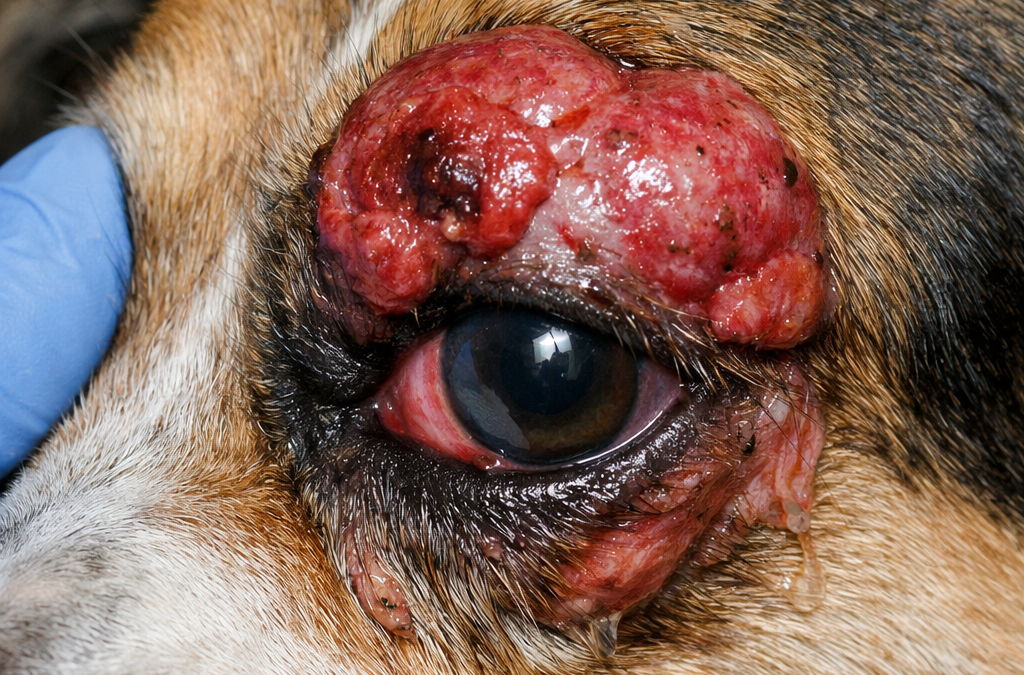
por TCMVE | 8 de febrero de 2026 | Cáncer y tumores en perros
Lo que significa “célula de huso” en perros
“Célula de huso” generalmente describe cómo se ven las células tumorales bajo el microscopio—largas, afiladas y fibrosas—en lugar de nombrar un solo tipo de cáncer. En perros, esta descripción a menudo se superpone con sarcomas de tejidos blandos (STS) y tumores de tipo sarcoma relacionados, que son conocidos por su invasividad local: pueden extenderse microscópicamente más allá de lo que puedes ver o sentir. Ese patrón de crecimiento es una gran razón por la cual la recurrencia local se convierte en una preocupación clave.
¿Qué tan raro es un tumor de célula de huso cerca del ojo?
Depende de si la masa es un crecimiento superficial del párpado o un tumor periocular/orbital más profundo.
Muchos tumores de párpado caninos son comunes y a menudo benignos, lo que es tranquilizador en la práctica ocular diaria. Sin embargo, un tumor maligno de tipo célula de huso/sarcoma que crece rápidamente o que es profundo alrededor del ojo es un escenario diferente. La enfermedad orbital y retrobulbar (enfermedad en la cuenca ocular o detrás del globo) es menos común que los bultos simples en los párpados y típicamente requiere una planificación más compleja.
Síntomas que los dueños suelen notar
Un tumor “sobre el ojo” puede parecer un bulto firme o hinchazón cerca de la ceja o los párpados, pero una enfermedad más profunda puede manifestarse a través de cambios en la función. Los perros pueden entrecerrar los ojos, llorar en exceso, desarrollar secreción persistente, frotarse el ojo o la cara, o parecer tímidos con la cabeza. Si la órbita está involucrada, los signos clásicos pueden incluir exoftalmos (un ojo abultado), protrusión del tercer párpado y dolor alrededor del ojo.
Dolor y sufrimiento: ¿cuánto duele?
El dolor varía ampliamente y está determinado por lo que el tumor está haciendo localmente.
Una masa puede volverse muy incómoda si distorsiona la posición del párpado o causa irritación crónica de la córnea al parpadear. La guía de oftalmología veterinaria señala que las masas en los párpados a menudo aumentan de tamaño con el tiempo y pueden irritar la superficie ocular, afectando la comodidad y la calidad de vida. La enfermedad orbital también puede ser dolorosa—especialmente cuando hay hinchazón, presión o inflamación presente—y el dolor se menciona frecuentemente entre los signos clínicos en condiciones orbitales.
Por qué el tratamiento cerca del ojo es tan desafiante
Para los tumores de tipo sarcoma, el objetivo suele ser un fuerte control local, porque los “dedos” tumorales microscópicos pueden extenderse más allá de lo que parece anormal. En el tronco o las extremidades, los cirujanos a menudo buscan márgenes más amplios para eliminar esas extensiones invisibles. Alrededor del ojo, los márgenes amplios pueden ser difíciles de lograr sin dañar estructuras críticas, razón por la cual los médicos pueden sonar cautelosos sobre las garantías.
Opciones de tratamiento: lo que se considera típicamente
La mayoría de los planes de tratamiento giran en torno al control local y la comodidad, a menudo combinando múltiples enfoques.
La cirugía es comúnmente la piedra angular cuando es factible, tanto para eliminar la carga tumoral como para obtener patología definitiva. Para los sarcomas de tejidos blandos caninos, la completitud de la excisión influye fuertemente en los resultados; las revisiones enfatizan que los tumores excisados de manera incompleta tienen un mayor riesgo de recurrencia local. En algunos casos, los cirujanos pueden recomendar procedimientos más radicales para lograr control en ubicaciones difíciles (incluyendo cirugías que involucran la órbita) porque ciertos sarcomas pueden requerir enfoques radicales cuando la anatomía limita el ancho del margen.
La radioterapia a menudo se discute cuando los márgenes son cercanos o incompletos, o cuando la anatomía hace que la excisión amplia sea imposible. Se utiliza con la intención de controlar las células residuales microscópicas y reducir la posibilidad de rec crecimiento, aunque los resultados varían según el comportamiento del tumor, la planificación de dosis y los detalles de cada caso.
Riesgo de recurrencia: a qué apunta repetidamente la investigación
En la literatura sobre STS caninos, dos factores aparecen una y otra vez: el grado histológico y el estado del margen.
Una revisión sobre STS caninos excisados de manera incompleta o estrecha informa tasas de recurrencia publicadas aproximadamente en el rango de 17%–37% a través de estudios, ilustrando por qué los “márgenes limpios” son tan importantes. Otra visión general ampliamente citada señala que con la excisión completa, la recurrencia local en perros puede ser muy baja, y los márgenes incompletos aumentan sustancialmente el riesgo de recurrencia.
Perspectiva de supervivencia y “línea de tiempo de supervivencia”: la forma práctica de pensar sobre el pronóstico
Debido a que “tumor de células en huso” puede representar múltiples tipos de tumores, el tiempo de supervivencia no se puede resumir de manera confiable con un solo número. Una forma más confiable de entender el pronóstico es anclar las expectativas a lo que predice más fuertemente el comportamiento:
Un tumor de menor grado que puede ser completamente controlado localmente generalmente tiene una mejor perspectiva que un tumor de mayor grado o uno que no puede ser completamente extirpado debido a su ubicación. En el STS canino, el riesgo metastásico se describe comúnmente como dependiente del grado, con tumores de mayor grado que tienen una probabilidad significativamente mayor de diseminación a lo largo de la enfermedad. En tumores perioculares específicamente, “qué tan bien se puede controlar la enfermedad local” a menudo se convierte en el factor dominante que moldea tanto la calidad de vida como el resultado general.
Lo que los dueños pueden hacer temprano que a menudo importa (sin perderse en detalles)
Los puntos de enfoque más útiles al principio son confirmar la verdadera extensión de la enfermedad y proteger el confort.
La imagenología avanzada como la TC o la RM se recomienda con frecuencia en casos orbitarios/perioculares porque los exámenes de rutina no siempre pueden mostrar lo que está sucediendo detrás del ojo, y la imagenología ayuda a guiar la cirugía y la planificación de radiación. El confort también es central: los tumores perioculares pueden provocar irritación e inflamación corneal, y reducir el roce/trauma y abordar la irritación de la superficie ocular puede hacer una diferencia significativa en el bienestar diario.
FAQ: respuestas rápidas que los dueños de mascotas buscan
¿Es maligno cada tumor cerca del párpado?
No. Los tumores de párpado son comunes en los perros y muchos se comportan de manera benigna, aunque cualquier masa que crezca rápidamente, esté ulcerada, sangrante o sea dolorosa necesita una evaluación rápida.
¿Por qué un veterinario recomendaría extirpar el ojo?
Cuando un tumor es profundamente invasivo o no se pueden lograr márgenes de manera segura, se puede recomendar una cirugía local más agresiva para mejorar el control local en una región donde el espacio es limitado.
¿Por qué la cirugía y la radiación no pueden garantizar que no volverá?
Los tumores tipo sarcoma pueden extenderse microscópicamente, y alrededor del ojo puede ser difícil extirpar suficiente tejido circundante. El STS no completamente extirpado tiene un riesgo documentado de recurrencia en múltiples estudios.
¿Qué predice más fuertemente el pronóstico?
El grado patológico y si el tumor fue extirpado con márgenes limpios se destacan repetidamente como los principales impulsores del riesgo de recurrencia y diseminación en el STS canino.
Cómo Baituxiao puede ayudar como cuidado de apoyo
Los tumores de células en huso perioculares generalmente se manejan primero con control local—más a menudo cirugía, y a veces radiación—porque estos tumores pueden ser localmente invasivos y la región ocular limita márgenes amplios. En ese contexto, muchos dueños también consideran el cuidado de apoyo integrativo para ayudar a mantener el confort, el apetito y la calidad de vida general junto con el plan de tratamiento principal.
Baituxiao es una fórmula botánica de TCVM posicionada por el fabricante para perros y gatos con “tumores y bultos”, y se discute típicamente como una opción complementaria en lugar de una solución independiente. Debido a que las fórmulas botánicas pueden interactuar con medicamentos utilizados alrededor de la cirugía, control del dolor, inflamación o cuidado oncológico, es mejor utilizarla como parte de un plan coordinado con el equipo veterinario.
por TCMVE | Ene 14, 2026 | Cáncer y tumores en perros
Los bultos en la cola de los perros pueden ser inquietantes para cualquier guardián de mascotas, especialmente cuando surgen pensamientos preocupantes sobre tumores de glándulas anales. Comprender lo que estos bultos podrían indicar—y cómo tomar medidas responsables y conscientes—puede brindar tranquilidad mientras se apoya el bienestar de tu mascota. Esta guía completa explora las posibles causas de los bultos en la cola de los perros, signos a los que estar atento, formas en que los veterinarios evalúan los tumores de glándulas anales, consejos de cuidado diario y cómo mantenerse proactivo con el confort y la calidad de vida de tu perro.
—
Comprendiendo los bultos en la cola de los perros
Los bultos en la cola pueden desarrollarse por varias razones, que van desde crecimientos benignos hasta preocupaciones más serias. Mientras que algunos bultos permanecen pequeños e inofensivos, otros pueden requerir atención veterinaria para evaluar su naturaleza.
Posibles causas de bultos en la cola
– Quistes sebáceos: Sacos pequeños y de crecimiento lento que contienen material oleoso.
– Lipomas: Tumores grasos que a menudo se encuentran en perros mayores, generalmente suaves y móviles.
– Infecciones de piel o abscesos: Resultantes de lesiones o folículos bloqueados.
– Masas relacionadas con glándulas anales: Masas que se originan en glándulas cerca del ano.
– Otros tumores o nódulos: Podrían desarrollarse a partir de varios tipos de tejido.
No todos los bultos son peligrosos, pero es esencial rastrear cualquier cambio a lo largo del tiempo, especialmente cerca de la base de la cola.
—
Tumores de glándulas anales: Lo que los dueños de mascotas deben saber
Los tumores de glándulas anales son crecimientos que se originan en los sacos anales ubicados a cada lado del ano. Estos tumores pueden variar desde benignos hasta malignos, y la evaluación veterinaria temprana es crítica para determinar su naturaleza y el mejor curso de acción.
Por qué importan las glándulas anales
– Ubicación: Situadas debajo de la cola, las glándulas pueden desarrollar anomalías que se manifiestan como bultos o hinchazón.
– Función: Liberan un aroma utilizado para la comunicación entre perros.
– Riesgos: La inflamación, cambios estructurales o tumores pueden causar incomodidad, olor u otras complicaciones.
Observaciones Comunes
– Dificultad para sentarse cómodamente
– Arrastrarse o lamer el área anal
– Hinchazón o firmeza cerca del ano
– Movimientos de cola o renuencia a moverla
Siempre que aparezcan signos nuevos o persistentes, programa un examen con un veterinario. La evaluación profesional previene la mala interpretación de los síntomas y ayuda a identificar si se necesitan pruebas adicionales.
—
Bultos en la Cola de los Perros: Reconociendo Signos Temprano
Debido a que los bultos en la cola que experimentan los perros pueden surgir gradualmente, mantenerse alerta ayuda a detectar problemas temprano. Intenta examinar suavemente el área de la cola de tu perro durante las sesiones de aseo, observando cualquier cambio en tamaño o textura.
Signos que Vale la Pena Notar
– Hinchazón persistente: Especialmente si es firme o está creciendo.
– Cambios en la piel: Enrojecimiento, pérdida de pelo o textura áspera.
– Malestar: Reacción al tocar el área.
– Cambios de comportamiento: Disminución de energía, mal apetito o comportamiento inusual de esconderse.
Estos signos no apuntan automáticamente a tumores de glándulas anales, pero justifican una visita al veterinario para claridad y tranquilidad.
—
Cómo Evaluan los Veterinarios los Bultos en la Cola
Los profesionales veterinarios utilizan diversas pruebas para evaluar bultos y determinar los próximos pasos. El enfoque exacto depende de la edad de su perro, su historial médico y las características del bulto.
Pasos diagnósticos típicos
1. Physical examination: Comprobando tamaño, ubicación y consistencia.
2. Aspiración con aguja fina o biopsia: Recolección de células o tejido para análisis.
3. Imágenes: Ecografía, radiografía o tomografía computarizada para evaluar estructuras internas.
4. Análisis de sangre: Proporciona información sobre la salud general.
Discuta el proceso abiertamente con su veterinario, pidiendo explicaciones comprensibles sobre lo que cada prueba puede revelar. Los dueños de mascotas que se mantienen comprometidos e informados a menudo se sienten más seguros apoyando a su perro durante la evaluación.
—
Apoyando a los perros a través del cuidado de tumores de glándulas anales
Cuando un veterinario identifica tumores de glándulas anales, se diseña un plan reflexivo basado en la situación única del perro. Dado que la instrucción médica pertenece a un entorno clínico, los dueños de mascotas pueden centrarse en proporcionar un ambiente hogareño tranquilo y seguir de cerca las recomendaciones profesionales.
Consejos prácticos para el apoyo en casa
– Lleve un diario: Registre observaciones, incluyendo apetito, nivel de energía y calidad de las heces.
– Monitorizar la condición corporal: Mantenga un peso saludable para reducir la tensión adicional.
– Proporcione ejercicio suave: Paseos ligeros o juegos mentalmente estimulantes mantienen a su perro comprometido.
– Ofrezca lugares de descanso cómodos: La ropa de cama suave ayuda a aliviar la presión en áreas sensibles.
– Manténgase al día con los chequeos: Las visitas de seguimiento permiten a los veterinarios rastrear el progreso y ajustar los planes de atención.
Al centrarse en la comodidad, la consistencia y la orientación veterinaria, los dueños pueden ayudar a los perros a sentirse seguros durante su viaje de atención.
—
Consideraciones sobre nutrición y bienestar natural
Aunque los alimentos y suplementos no pueden diagnosticar o curar condiciones graves, una nutrición saludable apoya la vitalidad general. Pregunte a su veterinario sobre dietas equilibradas adecuadas para la edad, raza y nivel de actividad de su perro.
Perspectivas generales sobre nutrición
– Proteínas y grasas equilibradas: Apoyan la salud muscular y la energía.
– Fuentes de fibra: Fomentan la digestión y la eliminación regular.
– Ácidos grasos omega: Pueden ayudar a mantener la salud de la piel y un pelaje brillante.
– Hidratación: Asegúrese de que haya acceso constante a agua fresca.
Enfoques de bienestar natural—como entornos tranquilos, cuidado suave y actividades de enriquecimiento—también pueden promover un sentido de seguridad. Siempre consulte a su veterinario antes de introducir cambios dietéticos o suplementos nuevos.
—
Prácticas de prevención y detección temprana
Aunque no todos los bultos en la cola se pueden prevenir, la observación rutinaria y la atención veterinaria preventiva marcan una diferencia significativa.
Hábitos útiles
– Aseo regular: Le ayuda a detectar nuevos bultos temprano.
– Programa de baño consistente: Mantiene la piel limpia y le permite revisar problemas.
– Visitas veterinarias de rutina: Los exámenes de bienestar detectan cambios sutiles.
– Entrenamiento y manejo: Enseña a tu perro a tolerar el manejo de la cola y la parte trasera para que las inspecciones sean más fáciles.
Establecer estos hábitos fomenta una relación colaborativa con tu veterinario y mantiene a tu mascota cómoda.
—
Preguntas para hacerle a su veterinario
El conocimiento empodera a los dueños de perros para tomar decisiones informadas. Considera llevar una lista de preguntas a las citas.
Iniciadores de discusión
– ¿Qué tipo de bulto tiene mi perro y qué pruebas lo verifican?
– ¿Hay ajustes en el estilo de vida que podrían mantener a mi perro cómodo?
– ¿Con qué frecuencia debo monitorear el bulto?
– ¿Qué señales indican que debo programar un seguimiento urgente?
La comunicación activa asegura que entiendas cada paso en el plan de cuidado de tu perro.
—
Apoyo emocional para dueños de mascotas
Descubrir un bulto en la cola de tu perro puede ser emocionalmente desafiante. Tómate el tiempo para procesar la información y busca apoyo cuando lo necesites.
Estrategias de afrontamiento
– Apóyate en tu equipo veterinario: Ellos pueden aclarar los hallazgos y los próximos pasos.
– Conéctate con comunidades de apoyo: Los foros en línea o los grupos locales pueden compartir experiencias útiles.
– Practique el autocuidado: Comidas balanceadas, descanso y tiempo al aire libre refuerzan la resiliencia.
– Celebra los momentos cotidianos: Paseos suaves, tiempo de abrazos y juegos fortalecen tu vínculo.
Mantenerse centrado y esperanzado te ayuda a seguir siendo un pilar de apoyo calmado para tu mascota.
—
Manteniéndose informado sobre los tumores de glándulas anales
La información confiable da forma a decisiones responsables. Enfócate en recursos basados en evidencia, como especialistas veterinarios certificados por la junta, artículos revisados por pares y organizaciones de salud animal de renombre.
Evaluación de Fuentes de Información
– Verifica credenciales: Busca veterinarios licenciados o instituciones reconocidas.
– Cuidado con soluciones rápidas: Evita afirmaciones o tratamientos no verificados.
– Pregunta a tu veterinario: Ellos pueden recomendar materiales de lectura o especialistas de confianza.
Ser selectivo con la información mantiene el bienestar de tu perro en buen camino y evita malentendidos.
—
Una Mentalidad Holística para el Bienestar Canino
El cuidado holístico significa considerar el confort físico, el bienestar emocional y un ambiente pacífico. La ropa de cama suave, las rutinas consistentes, el aseo suave y las interacciones calmadas contribuyen a una sensación general de seguridad.
Prácticas Holísticas Simples
– Paseos conscientes: Paseos tranquilos permiten olfatear y explorar.
– Masaje y tacto suave: Cuando lo apruebe tu veterinario, un masaje ligero puede ayudar a relajar los músculos.
– Juguetes de enriquecimiento: Comederos de rompecabezas, juegos de olfateo lento y juguetes de masticar suaves mantienen las mentes activas.
– Música y aromaterapia: Sonidos suaves o aromas aprobados por el veterinario pueden crear un ambiente tranquilo.
Siempre observa las reacciones de tu perro y descontinúa cualquier cosa que cause incomodidad.
—
Conclusión: Apoyando el Bienestar Natural con Cuidado
Cada perro merece atención compasiva, especialmente cuando nuevos bultos generan preguntas. Al mantenerte observador, asociarte con profesionales veterinarios y crear un ambiente hogareño reconfortante, puedes navegar los bultos en la cola con confianza y cuidado. Recuerda abordar cada paso con paciencia, mantener una comunicación abierta con el equipo de cuidado de tu mascota y seguir explorando prácticas de bienestar natural suaves que nutran el sentido general de equilibrio de tu perro.
por TCMVE | Ene 14, 2026 | Cáncer y tumores en perros
Las hierbas para perros mayores pueden desempeñar un papel suave y de apoyo en los años dorados de su perro, ofreciendo comodidad natural junto con el cuidado veterinario regular. A medida que los perros envejecen, sus necesidades cambian: la movilidad se ralentiza, la digestión se altera y el bienestar general requiere más atención. Muchos dueños de mascotas buscan opciones holísticas como hierbas y cambios en el estilo de vida como parte de un plan de cuidado equilibrado. Esta guía explora cómo usar las hierbas para perros mayores de manera reflexiva, qué considerar y cómo mejorar la comodidad de su compañero envejecido a través de estrategias prácticas y cuidado consciente.
—
Comprendiendo el Envejecimiento en Perros Mayores
Los perros generalmente entran en sus años senior alrededor de los siete años, aunque esto varía según la raza y el tamaño. A medida que el metabolismo se ralentiza y los órganos maduran, los perros se vuelven más sensibles al estrés, la dieta, los niveles de actividad y los cambios ambientales. Los cambios relacionados con la edad pueden incluir:
– Niveles de energía más bajos
– Digestión sensible o apetito reducido
– Rigidez articular o renuencia a moverse
– Cambios de comportamiento como aumento de vocalización, confusión o inquietud
– Mayor necesidad de calor, rutina y familiaridad
Comprender estas transiciones le ayuda a apoyar a su perro con paciencia y compasión, mientras colabora con un veterinario y explora estrategias de comodidad suaves basadas en hierbas.
—
¿Qué Son las Hierbas para Perros Mayores?
Las hierbas para perros mayores son botánicos que pueden aliviar los desafíos comunes del envejecimiento de manera segura y medida. Las hierbas pueden estar secas, frescas o en forma de fórmula (cápsulas, polvos, tés o tinturas). Surgieron de prácticas tradicionales en todo el mundo, desde la Ayurveda hasta la herbolaria occidental, donde se utilizaban plantas naturales para apoyar el bienestar.
Los principios clave incluyen:
– Apoyar la vitalidad, no suprimir los síntomas
– Complementar el cuidado veterinario en lugar de reemplazarlo
– Escuchar las respuestas de su perro a las hierbas y ajustar según sea necesario
Las hierbas vienen con diversas propiedades, como calmantes, digestivas o de nutrición general, que pueden ser beneficiosas durante los años senior. Siempre consulte a un veterinario, idealmente uno con experiencia en cuidado herbal o integrativo, antes de introducir nuevos botánicos.
—
Hierbas para Perros Mayores para Explorar para la Comodidad
Manzanilla y Su Influencia Calmante
El suave aroma de la manzanilla a menudo consuela a los perros ansiosos o inquietos. Puede ayudar cuando un perro mayor experimenta inquietud nocturna, leve malestar digestivo o una sensación general de incomodidad. La manzanilla se ofrece comúnmente como una infusión de té que puede agregar a la comida o agua, o como una hierba seca mezclada con las comidas. Dado que la manzanilla es suave, muchos perros la toleran bien, pero es importante monitorear posibles alergias.
Skullcap para la Relajación
La escutelaria es una hierba venerada por sus propiedades relajantes sin sedación pesada. Puede ser útil para perros mayores que parecen tensos, reactivos o sensibles al ruido y al cambio. En combinación con modificaciones en el estilo de vida (rutinas consistentes, espacios tranquilos, horarios de alimentación predecibles), la escutelaria puede apoyar el equilibrio emocional.
Cardo mariano para un suave apoyo hepático
El hígado juega un papel central en el metabolismo y la desintoxicación, y los perros mayores a menudo se benefician de un suave apoyo hepático. El cardo mariano, rico en silimarina, es comúnmente utilizado por los profesionales por sus cualidades antioxidantes y efectos protectores potenciales. Muchos cuidadores de mascotas incorporan el cardo mariano en rotación o en cursos ocasionales, en lugar de depender de él continuamente. Nuevamente, un veterinario debe guiar la duración y la idoneidad, especialmente si su perro toma medicamentos.
Cúrcuma y sus cualidades antioxidantes
La cúrcuma contiene curcumina, un compuesto con propiedades antioxidantes y calmantes ampliamente estudiadas. Los perros mayores pueden apreciar las comidas infusionadas con cúrcuma para mayor comodidad general, aunque debe combinarse con grasas como el aceite de coco o el aceite de pescado para mejorar la absorción. Debido a que la cúrcuma puede interactuar con algunos medicamentos o condiciones digestivas, consulte a su veterinario antes de usarla regularmente.
Espino para apoyo cardíaco y circulatorio
Las bayas y hojas de espino se han utilizado durante mucho tiempo para apoyar el bienestar circulatorio. Algunos veterinarios integrativos introducen espino para perros mayores que muestran signos de envejecimiento en los sistemas cardiovasculares, aunque es esencial una supervisión cuidadosa. A menudo es parte de un protocolo más amplio que incluye dieta, ejercicio controlado y chequeos de rutina.
Espirulina y alfalfa para un impulso de nutrientes
La espirulina y la alfalfa son suplementos herbales densos en nutrientes que pueden proporcionar apoyo adicional basado en plantas para la energía y la resistencia inmunológica. La espirulina es rica en clorofila y aminoácidos, mientras que la alfalfa contiene vitaminas, minerales y fibra de apoyo. Agregar estas en cantidades moderadas a la dieta de un perro mayor puede ayudar a llenar los vacíos nutricionales.
—
Consideraciones clave al seleccionar hierbas para perros mayores
1. Consultation: Un veterinario familiarizado con la medicina herbal puede recomendar hierbas apropiadas, ayudar a evitar interacciones peligrosas y monitorear el progreso.
2. Calidad: Elija hierbas de fuentes reputables que ofrezcan un abastecimiento transparente y pruebas de terceros para contaminantes.
3. Forma: Decida entre polvos, cápsulas, tinturas o tés. Algunos perros prefieren hierbas mezcladas con comida húmeda; otros manejan mejor las cápsulas.
4. Alergias: Introduzca una hierba a la vez en pequeñas cantidades, observando signos de intolerancia como picazón, vómitos o diarrea.
5. Consistency: Las hierbas suelen actuar de manera gradual. El uso consistente y medido a menudo funciona mejor que la dosificación esporádica.
—
Consejos de comodidad ambiental para perros mayores
Las hierbas combinan mejor con estrategias prácticas de comodidad diaria. Considere las siguientes formas de ayudar a su perro mayor a sentirse seguro, apoyado y contento:
– Cama acogedora: Las camas ortopédicas, los bordes elevados o las almohadillas calefaccionadas (diseñadas para mascotas) pueden calmar las articulaciones rígidas y proporcionar calor.
– Superficies antideslizantes: Las alfombrillas o corredores minimizan el deslizamiento en pisos de madera, reduciendo el estrés en las articulaciones y aumentando la confianza.
– Agua y comida accesibles: Coloca los cuencos sobre alfombrillas antideslizantes y considera estaciones de alimentación ligeramente elevadas.
– Cuidado rutinario: El cepillado regular y el masaje suave mejoran la circulación y ofrecen tiempo de unión.
– Retiro tranquilo: Un área de descanso designada lejos del ruido del hogar ayuda a los perros a relajarse y sentirse seguros.
– Iluminación suave por la noche: Las luces tenues o las luces nocturnas guían a los perros mayores que tienen visión reducida o ansiedad nocturna.
—
Dieta y soporte digestivo
Importancia de la nutrición equilibrada
Los perros mayores a menudo se benefician de dietas ricas en nutrientes y fácilmente digeribles. Si bien existen fórmulas comerciales para perros mayores, consulta a un veterinario o nutricionista canino para asegurarte de que la comida de tu perro satisfaga sus necesidades individuales. Rotar proteínas, incorporar verduras cocidas suavemente e incluir grasas saludables puede mantener el interés en las comidas y apoyar un peso saludable.
Hierbas que apoyan la digestión
– Jengibre: Conocido por aliviar el malestar estomacal, el jengibre puede ayudar a los perros que experimentan náuseas ocasionales. Úsalo con moderación y busca consejo veterinario para perros que toman medicamentos anticoagulantes.
– Raíz de diente de león: A veces se usa para apoyar la digestión y la función hepática, la raíz de diente de león se puede agregar a las comidas en pequeñas cantidades.
– Hinojo: Puede aliviar gases o hinchazón leves. Su sabor similar al regaliz suele ser bien tolerado por los perros.
Hidratación
Los perros mayores siempre deben tener acceso a agua fresca. Puedes mejorar la hidratación incorporando alimentos ricos en humedad como caldo de huesos, verduras en puré o toppers de croquetas con agua.
—
Actividad y movilidad
Ejercicio Suave para Perros Mayores
Incluso los perros mayores se benefician del movimiento, que mantiene los músculos fuertes y las articulaciones flexibles. Apunta a paseos cortos y frecuentes en lugar de una sola caminata larga. Monitorea el ritmo de tu perro y permite tiempo para olfatear; la estimulación mental es tan importante como la física.
Hierbas Enfocadas en la Movilidad
Algunas hierbas apoyan la comodidad y flexibilidad de las articulaciones:
– Boswellia: A menudo se utiliza en planes de bienestar tradicionales para el soporte de las articulaciones debido a sus compuestos resinosos.
– Garra del Diablo: Típicamente recomendada por practicantes holísticos para el cuidado de las articulaciones; sin embargo, debe evitarse en perros con ciertas condiciones de salud.
Discute combinaciones o el uso a largo plazo con tu veterinario para garantizar la seguridad.
Terapias complementarias
La acupuntura, el masaje, la hidroterapia o los ejercicios de fisioterapia pueden aliviar la tensión y fomentar el movimiento. Estas modalidades deben ser guiadas por profesionales acreditados con experiencia en el trabajo con perros mayores.
—
Bienestar Emocional y Comportamiento
Reconociendo Cambios Emocionales
Los perros mayores pueden experimentar cambios cognitivos o ansiedad. Los signos incluyen caminar de un lado a otro, vigilia nocturna, vocalización o mayor apego. La paciencia y la reafirmación constante son cruciales durante estas etapas de la vida.
Soporte Calmante a Base de Hierbas
– Raíz de valeriana: A menudo se utiliza para el alivio ocasional del estrés. Introdúcelo gradualmente, ya que su olor terroso puede ser fuerte.
– Flor de la pasión: Una hierba suave que puede disminuir la inquietud y apoyar el equilibrio emocional.
Combinar estas con ajustes en el estilo de vida (música suave, difusores de aromaterapia con fragancias seguras para perros, rutinas predecibles) puede fomentar la relajación.
—
Creando un Kit de Hierbas para Perros Mayores
Considera organizar tus productos herbales y artículos de apoyo en un solo lugar:
1. Etiqueta los contenedores con el nombre de la hierba, el propósito previsto y cualquier nota.
2. Registra el uso en un diario, anotando comportamientos, apetito y cualquier cambio.
3. Programa chequeos con tu veterinario para revisar el plan herbal y asegurarte de que aún se ajuste al perfil de salud de tu perro.
4. Rota las hierbas cuando sea apropiado, dando descansos para evitar la dependencia excesiva.
—
Trabajar con profesionales veterinarios
Los veterinarios capacitados en medicina herbal, atención integrativa o Medicina Veterinaria Tradicional China (TCVM) pueden diseñar protocolos personalizados. Evaluarán:
– Edad, raza y salud general
– Medicamentos o suplementos actuales
– Ingesta nutricional y nivel de actividad
– Indicadores de comportamiento
Este enfoque colaborativo asegura que las hierbas sean un complemento a los chequeos veterinarios regulares, análisis de sangre, cuidado dental y cualquier diagnóstico necesario.
—
Hierbas para perros mayores y seguridad
La seguridad debe seguir siendo la máxima prioridad:
– Conoce las contraindicaciones: Algunas hierbas pueden no ser apropiadas para perros con condiciones renales, hepáticas o cardíacas.
– Evita los aceites esenciales internamente: Muchos aceites, incluso los derivados de hierbas, no son seguros para la ingestión.
– Almacena las hierbas adecuadamente: Mantenlas alejadas de la humedad, la luz solar y las mascotas curiosas.
– Observa a tu perro de cerca: Si notas cambios en las heces, el apetito, la respiración o el comportamiento, interrumpe el uso de la hierba y consulta a tu veterinario.
—
Honrando la Rutina y la Estabilidad
Los perros mayores prosperan en la previsibilidad. Combina el apoyo herbal con rutinas conscientes:
– Horarios consistentes de despertar, comidas y paseos
– Mínima interrupción en las áreas de descanso
– Introducciones lentas cuando vengan visitantes
– Aromas, juguetes y mantas familiares
Estos pasos reducen el estrés y facilitan que tu perro se adapte a cambios sutiles.
—
Bienestar Natural Más Allá de las Hierbas
Además de las hierbas para perros mayores, considera estrategias de bienestar natural más amplias:
– Golosinas nutritivas: Opta por masticables suaves o golosinas deshidratadas suavemente que sean fáciles para los dientes.
– Cuidado personal consciente: Usa toallas tibias, cepillos suaves y caricias tranquilizadoras.
– Tiempo al aire libre: La exposición a la luz solar (durante el clima apropiado) ayuda a regular el sueño y el estado de ánimo.
– Estimulación mental: Comederos de rompecabezas, juegos de olores o sesiones de entrenamiento cortas mantienen la mente activa.
El bienestar natural se trata de nutrir el ser completo de tu perro: cuerpo, mente y corazón.
—
Celebrando pequeños momentos
Cada perro mayor tiene necesidades y alegrías únicas. Celebra las pequeñas victorias: una siesta cómoda, una cola que se mueve o una tranquila tarde a tu lado. El apoyo herbal, combinado con paciencia, comprensión y orientación veterinaria, crea un entorno nutritivo para los últimos años de tu perro.
—
Conclusión
Las hierbas para perros mayores, cuando se utilizan de manera reflexiva, ofrecen un suave consuelo como parte de un plan integral de bienestar. Al asociarte con tu veterinario, elegir botánicos de alta calidad y mantener rutinas consistentes, puedes ayudar a tu perro a envejecer con dignidad y facilidad. Continúa observando las necesidades de tu compañero, ajustando las prácticas de cuidado y saboreando el tiempo que comparten. Los enfoques naturales, basados en la compasión y el conocimiento, pueden aportar enriquecimiento y armonía a la vida de tu perro mayor.
por TCMVE | Ene 14, 2026 | Cáncer y tumores en perros
El apoyo natural para quimioterapia se convierte en un tema importante para los guardianes de perros cuando sus mascotas están atravesando quimioterapia. Las emociones pueden estar a flor de piel, y es natural buscar formas suaves de mantener a tu compañero cómodo mientras te alineas con el consejo veterinario. Entender lo que realmente significa “apoyo natural”: rutinas nutritivas, confort emocional y ajustes de estilo de vida reflexivos, te ayuda a tomar decisiones informadas que respeten tanto la ciencia como las necesidades únicas de tu perro.
Por qué el cuidado de apoyo es importante durante la quimioterapia
La quimioterapia puede ser una tarea significativa para cualquier perro, afectando todo, desde los niveles de energía hasta el apetito. Mientras los veterinarios supervisan el plan médico, los guardianes de mascotas juegan un papel enorme en la creación de un entorno tranquilo y nutritivo en casa. El cuidado de apoyo no reemplaza los medicamentos o la orientación profesional; en cambio, mejora el bienestar general de tu perro a través de rutinas consistentes, compromiso mental y observación cuidadosa.
Fundamentos del apoyo natural para quimioterapia
Construir un marco para el apoyo natural de quimioterapia significa centrarse en tres pilares: nutrición, manejo del estrés y comodidad diaria. Cada pilar trabaja en conjunto para ayudar a tu perro a sentirse seguro y cuidado durante el tratamiento. Pequeños cambios, como proporcionar un lugar de descanso tranquilo o ofrecer rompecabezas de enriquecimiento, pueden hacer una diferencia notable.
Consideraciones sobre nutrición e hidratación
Una dieta equilibrada le da a tu perro los bloques de construcción para la fuerza. Si bien siempre debes seguir las recomendaciones de tu veterinario, algunas ideas fundamentales pueden ayudar a guiar tus elecciones:
– Comidas equilibradas: Busca alimentos que ofrezcan proteínas magras, carbohidratos complejos y grasas beneficiosas para mantener una energía constante.
– Ingredientes suaves: Opciones de fácil digestión, como verduras cocidas o proteínas simples, pueden ser útiles si el estómago de tu perro parece sensible.
– Enfoque en la hidratación: Los cambios de agua fresca deben ser frecuentes. Algunos perros disfrutan de cubitos de hielo con sabor o caldos bajos en sodio diluidos para variar.
– Porciones pequeñas y frecuentes: Servir porciones más pequeñas con más frecuencia puede alentar a comer cuando el apetito fluctúa.
– Monitorea las reacciones: Lleva un diario de alimentos simple para anotar cualquier cambio en las heces, energía o interés en ciertos alimentos. Comparte observaciones con tu veterinario.
Confort emocional y rutinas consistentes
Los perros a menudo obtienen seguridad de horarios predecibles. Mantener rituales familiares—paseos matutinos, abrazos por la tarde o sesiones de acicalamiento suaves—tranquiliza a tu compañero de que la vida aún ofrece confort y estabilidad.
– Zonas tranquilas: Crea un área de descanso acogedora lejos del ruido del hogar, completa con mantas y juguetes favoritos.
– Enriquecimiento sensorial: Ofrece música suave, espacios sin olores o iluminación natural difusa para aliviar la sobreestimulación.
– Interacción consciente: Presta atención a las señales de tu perro. Algunos días pueden desear afecto; otros días pueden querer más espacio personal.
Actividad suave y apoyo a la movilidad
El movimiento ligero mantiene las articulaciones lubricadas y los músculos activos. Habla sobre los niveles de actividad apropiados con tu veterinario, luego adapta según sea necesario:
– Paseos cortos: Paseos breves sobre superficies suaves pueden ser más fáciles para las patas y las articulaciones.
– Juguetes de rompecabezas: El ejercicio mental, como los juguetes dispensadores de golosinas, involucra la mente sin requerir un esfuerzo físico agotador.
– Ropa de cama cómoda: Las camas ortopédicas o los tapetes de soporte ayudan a amortiguar áreas sensibles y fomentan un descanso adecuado.
Colaborando con tu equipo veterinario
La comunicación abierta con tu oncólogo veterinario o médico general es fundamental para el apoyo natural durante la quimioterapia. Ellos pueden sugerir momentos para chequeos, señalar signos de advertencia y ayudarte a interpretar cambios de comportamiento. Considera llevar un registro de:
– Hábitos de alimentación
– Ingesta de agua
– Preferencias de juego o descanso
– Respuestas a técnicas de calma
– Cualquier nuevo comportamiento que surja entre las citas
Compartir estas observaciones permite a su veterinario adaptar las recomendaciones específicamente a la experiencia de su perro.
Puntos de contacto holísticos sin reclamos médicos
Algunos guardianes exploran prácticas de bienestar suaves como la aromaterapia con aceites esenciales seguros para mascotas (siempre diluidos y aprobados por un veterinario), técnicas de masaje lento o tiempo supervisado al sol. Estos enfoques se centran en la relajación en lugar de en el tratamiento. Recuerde:
– La aprobación del veterinario es clave: Incluso los productos naturales pueden interactuar con medicamentos.
– Menos es más: Introduzca un nuevo elemento a la vez para que pueda observar cómo responde su perro.
– Comodidad primero: Si su perro muestra desinterés o incomodidad, interrumpa esa práctica y regrese a las comodidades familiares.
Consejos prácticos para el apoyo diario
Las rutinas diarias pueden volverse más fáciles de navegar con un conjunto de estrategias de referencia:
1. Planifique la preparación de las comidas con anticipación: Pre-porcionar la comida puede reducir el estrés en días ocupados.
2. Establezca alertas de recordatorio: Use alarmas en el teléfono para los horarios de medicación, chequeos de agua fresca o sesiones cortas de ejercicio.
3. Rote el enriquecimiento: Mantenga una pequeña selección de juguetes y rótelos semanalmente para mantener el interés.
4. Utilice herramientas de aseo suaves: Cepillos suaves o guantes de aseo pueden ayudar a eliminar el pelo suelto sin irritación.
5. Monitoree la energía del hogar: Pida a los miembros de la familia que mantengan bajos los niveles de ruido y eviten cambios repentinos en la rutina.
Leyendo las señales de su perro
El lenguaje corporal canino revela mucho sobre los niveles de comodidad. Debido a que la quimioterapia puede aumentar la sensibilidad, busque señales:
– Postura relajada: Indica satisfacción.
– Bostezar o lamerse los labios: Puede señalar estrés leve.
– Caminar de un lado a otro o inquietud: Podría significar incomodidad o la necesidad de un descanso tranquilo.
– Búsqueda de afecto: Muchos perros se apoyan más en sus guardianes cuando necesitan seguridad.
Responda ajustando el entorno: atenúe las luces, reduzca el ruido o ofrezca un suave masaje si a su perro le gusta el contacto.
Integrando perspectivas de bienestar natural
El bienestar natural enfatiza la armonía entre las necesidades físicas y el equilibrio emocional. Para los perros en quimioterapia, esto podría significar:
– Descansos al aire libre: Cortos períodos afuera pueden proporcionar nuevos olores y estimulación suave.
– Compañía consciente: Simplemente sentarse al lado de su perro, leyendo o hablando suavemente, fomenta la conexión sin exigir energía.
– Espacios de vida limpios: Lave regularmente la ropa de cama, los cuencos y los juguetes con limpiadores suaves y seguros para mascotas para mantener la higiene.
– Refuerzo positivo: Celebre pequeñas victorias: terminar una comida, explorar el jardín o jugar con un juguete.
Equilibrando el optimismo con expectativas realistas
Es natural esperar lo mejor, pero mantenerse con los pies en la tierra te ayuda a responder de manera efectiva. Confía en la experiencia de tu equipo veterinario y sé amable contigo mismo a lo largo del proceso. Algunos días pueden sentirse desafiantes; otros pueden traer sorpresas conmovedoras. Apóyate en el respaldo de familiares, amigos o comunidades de cuidado de mascotas cuando necesites ánimo.
Conclusión
Apoyar a un perro durante la quimioterapia implica paciencia, observación y un enfoque constante en el confort. Al integrar prácticas de apoyo natural a la quimioterapia—nutrición equilibrada, entornos tranquilos, actividades suaves y comunicación cercana con tu veterinario—creas rutinas reconfortantes que honran las necesidades de tu perro. Cada elección consciente contribuye a un enfoque amoroso y equilibrado hacia el bienestar natural.
por TCMVE | Ene 14, 2026 | Cáncer y tumores en perros
Los riesgos de cáncer en Cavalier, signos tempranos de tumores en Cavaliers, cánceres comunes en esta raza son temas que muchos dueños amorosos eventualmente buscan a medida que sus perros envejecen. Los Cavalier King Charles Spaniels son apreciados por su naturaleza gentil, ojos expresivos y amor por la compañía humana—pero como todas las razas, enfrentan ciertos desafíos de salud, incluidos tumores y cáncer. Comprender a qué puede ser propenso tu Cavalier, cómo detectar signos de advertencia temprana y cómo apoyarlos en sus años senior puede marcar una verdadera diferencia en la calidad de vida.
—
A. Descripción general de la raza
Los Cavalier King Charles Spaniels son perros de compañía pequeños, que típicamente pesan entre 13 y 18 libras. Son afectuosos, orientados a las personas y a menudo se les describe como “perros de velcro” porque les gusta estar cerca de sus familias. Su temperamento es generalmente:
– Gentil y amigable
– Bueno con niños y otras mascotas
– Adaptable tanto a la vida en apartamentos como en casas, siempre que reciban interacción diaria y ejercicio moderado
Su esperanza de vida promedio es de alrededor de 10 a 14 años, aunque esto puede variar según la genética, el entorno y la atención médica general.
Los Cavaliers son conocidos por problemas hereditarios específicos, particularmente:
– Enfermedad cardíaca (especialmente enfermedad de la válvula mitral)
– Problemas neurológicos como malformación tipo Chiari y syringomielia
– Problemas ortopédicos como luxación de rótulas
Si bien no se consideran universalmente una raza de “alto riesgo de cáncer” como algunas razas gigantes, muchos Cavaliers experimentan tumores y cáncer a medida que envejecen. Algunos tipos se ven comúnmente en perros de razas pequeñas y también se han reportado con frecuencia en Cavaliers, especialmente tumores de piel y de tejidos blandos, así como ciertos cánceres relacionados con la sangre.
—
B. Comprendiendo los riesgos de cáncer en Cavalier, signos tempranos de tumores en Cavaliers, cánceres comunes en esta raza
No todos los Cavaliers desarrollarán cáncer, pero estar al tanto de los patrones observados en la raza te ayuda a mantenerte proactivo. Los siguientes tipos de tumores y cánceres se informan a menudo en Cavaliers y razas pequeñas similares:
1. Tumores de mastocitos (MCT)
Los tumores de células madre son uno de los cánceres de piel más comunes en perros y se ven relativamente a menudo en Cavaliers. Por lo general, aparecen como:
– Bultos o protuberancias en la piel que pueden crecer, encogerse o cambiar repentinamente
– Lesiones que pueden ser picazón, rojas o inflamadas
En razas pequeñas, estos tumores pueden notarse primero como pequeños bultos similares a “picaduras de insectos” que no desaparecen. Debido a que los tumores de células madre pueden variar desde de bajo grado (de crecimiento lento) hasta muy agresivos, la evaluación veterinaria rápida de cualquier nuevo bulto es esencial.
2. Lipomas y Tumores de Tejido Blando
Los tumores benignos de grasa (lipomas) son comunes en perros de mediana edad y mayores, incluidos los Cavaliers. Estos generalmente se sienten:
– Suaves, móviles y justo debajo de la piel
– No dolorosos al tacto
Sin embargo, no todos los bultos que se sienten “grasos” son benignos. Algunos sarcomas de tejido blando pueden imitar los lipomas en sensación y apariencia. Por esta razón, cualquier bulto debe ser revisado en lugar de asumir que es inofensivo, particularmente en un Cavalier senior.
3. Linfoma (linfosarcoma)
El linfoma es un cáncer del sistema linfático (ganglios linfáticos y órganos relacionados). Los Cavaliers, como muchas razas, pueden verse afectados. Los dueños pueden notar primero:
– Ganglios linfáticos firmes y agrandados debajo de la mandíbula, delante de los hombros o detrás de las rodillas
– Hinchazón generalizada, letargo o pérdida de peso
El linfoma es tratable, y un diagnóstico temprano ofrece más opciones, haciendo que los chequeos corporales regulares y las visitas al veterinario sean importantes, especialmente después de la mediana edad.
4. Hemangiosarcoma (HSA)
El hemangiosarcoma es un cáncer maligno de las células de los vasos sanguíneos, que a menudo afecta el bazo, el hígado o el corazón. Es más famoso en razas grandes, pero también puede ocurrir en perros más pequeños como los Cavaliers. A menudo es “silencioso” hasta que causa sangrado interno. Los signos pueden incluir:
– Debilidad repentina o colapso
– Encías pálidas
– Abdomen distendido
Debido a que los signos pueden ser sutiles hasta que están avanzados, los exámenes de bienestar regulares y los análisis de sangre en seniors pueden a veces detectar problemas relacionados antes.
5. Tumores Cerebrales o de Médula Espinal
Los Cavaliers ya tienen una predisposición de raza a problemas neurológicos no relacionados con el cáncer, por lo que puede ser especialmente complicado saber qué está sucediendo cuando aparecen nuevos signos neurológicos. Los tumores en el cerebro o la médula espinal pueden causar:
– Nuevas convulsiones
– Cambios repentinos en el comportamiento
– Dificultad para caminar, dar vueltas o inclinación de la cabeza
Cualquier síntoma neurológico nuevo o que empeore en un Cavalier debe tomarse en serio y discutirse con un veterinario, ya que múltiples condiciones (no solo cáncer) podrían estar involucradas.
Por qué los Cavaliers pueden estar en riesgo
Varios factores influyen en el riesgo de cáncer en esta raza:
– Tamaño y longevidad: Las razas más pequeñas a menudo viven más tiempo, por lo que tienen más años en los que el cáncer puede desarrollarse.
– Cuellos de botella genéticos: Las razas puras populares como los Cavaliers pueden compartir genética que los predispone a ciertas enfermedades.
– Condición corporal: Al igual que todos los perros, los Cavaliers que tienen sobrepeso u obesidad pueden estar en mayor riesgo de algunos tumores y tener más dificultades para sobrellevar enfermedades.
Ser consciente de estas tendencias permite a los dueños estar alerta sin alarmarse.
—
C. Señales de alerta temprana que los propietarios deben tener en cuenta
Detectar un tumor a tiempo puede darle a su perro más opciones y una mejor oportunidad de comodidad. Esté atento a:
1. Cambios en la piel y subcutáneos
– Nuevos bultos o protuberancias
– Bultos existentes que crecen, cambian de color o se vuelven firmes
– Llagas que no cicatrizan
– Pérdida de pelo en un área localizada
Realice un “chequeo corporal suave una vez al mes”:
1. Pase sus manos lentamente por todo el cuerpo de su Cavalier, incluyendo las axilas, la ingle, el pecho, el abdomen y la base de la cola.
2. Anote cualquier bulto nuevo o cambios en el tamaño/textura de los existentes.
3. Mantenga un registro con fechas y tamaño aproximado (por ejemplo, “del tamaño de un guisante”, “del tamaño de una uva”).
Busque atención veterinaria si:
– Un bulto es nuevo y persiste más de 2 a 4 semanas.
– Un bulto crece rápidamente, se vuelve doloroso o ulcerado.
– Aparecen múltiples bultos en un corto período.
2. Cambios generales en la salud
– Pérdida de peso sin cambios en la dieta
– Disminución del apetito o volverse exigente con la comida
– Aumento del consumo de alcohol o de la micción
– Letargo, menos interés en caminar o jugar.
Estos signos pueden resultar de muchas condiciones, no solo cáncer, pero siempre deben provocar una visita al veterinario.
3. Movilidad, dolor y cambios de comportamiento
– Rigidez, cojera o renuencia a saltar sobre los muebles
– Gritar al ser levantado o tocado en áreas específicas
– Evitar repentinamente escaleras o actividades favoritas
Debido a que los Cavaliers son estoicos y también propensos a problemas articulares y neurológicos, cualquier nuevo problema de movilidad o empeoramiento merece una evaluación rápida.
4. Respiración, sangrado y otras señales de alerta
– Tos persistente
– Dificultad para respirar o respiración rápida en reposo
– Hemorragias nasales o hematomas inexplicables
– Abdomen hinchado, especialmente si es repentino
Cualquiera de estos síntomas debe ser tratado como urgente, lo que justifica atención veterinaria inmediata o evaluación de emergencia.
—
D. Consideraciones de cuidado para ancianos para Cavaliers
A medida que los Cavaliers entran en sus años senior (a menudo alrededor de los 8 años o más), su riesgo de tumores y otras enfermedades aumenta. Un cuidado senior reflexivo puede apoyar la salud general y ayudar a detectar problemas más temprano.
1. Nutrición y condición corporal
A los Cavaliers les encanta la comida y pueden ganar peso fácilmente, lo que estresa su corazón y articulaciones y puede complicar el manejo del cáncer.
– Apunta a una cintura visible y costillas que se sientan fácilmente (sin prominencia aguda).
– Considera una dieta recomendada por el veterinario para seniors o control de peso adecuada al estado de salud de tu perro.
– Monitorea el peso cada 1–2 meses en casa o en la clínica.
Cualquier cambio dietético debe ser discutido con tu veterinario, particularmente si tu perro tiene enfermedad cardíaca u otras condiciones crónicas.
2. Ajustes de ejercicio y actividad
Los Cavaliers mayores aún se benefician del movimiento diario:
– Paseos cortos y frecuentes son a menudo mejores que salidas largas e intensas.
– El juego suave y el enriquecimiento mental (juegos de olfato, juguetes de rompecabezas) ayudan a mantener el bienestar general.
– Evita el sobreesfuerzo, especialmente en clima caluroso o si tu perro tiene problemas cardíacos o respiratorios.
3. Cuidado de las articulaciones y manejo del dolor
Con la edad, pueden desarrollarse artritis y problemas espinales:
– Proporcionar ropa de cama suave y suelo antideslizante siempre que sea posible.
– Usa rampas o escalones para reducir el salto dentro y fuera de los muebles.
– Discute suplementos para las articulaciones, medicamentos u otras estrategias de manejo del dolor con tu veterinario; nunca comiences o cambies medicamentos para el dolor sin orientación profesional.
4. Chequeos y exámenes veterinarios
Para un Cavalier adulto saludable, generalmente se recomiendan chequeos anuales. Para seniors, muchos veterinarios aconsejan:
– Exámenes de bienestar cada 6 meses
– Análisis de sangre y pruebas de orina regulares
– Chequeos de presión arterial y evaluaciones cardíacas (especialmente importantes en esta raza)
– Imágenes periódicas (por ejemplo, radiografías o ultrasonido) si se indica según los signos clínicos
Estas visitas permiten a tu veterinario detectar cambios sutiles temprano, incluyendo el desarrollo potencial de tumores.
—
E. Prevención general de tumores y apoyo para el bienestar
Ninguna estrategia puede prevenir completamente el cáncer, pero apoyar la salud general de tu Cavalier puede reducir algunos factores de riesgo y mejorar la resiliencia.
1. Mantener un peso saludable
– Utilice comidas medidas en lugar de alimentación libre.
– Limita los premios altos en calorías y comparte pequeñas porciones de opciones saludables (como verduras simples) si tu veterinario lo aprueba.
– Combina el control de calorías con ejercicio diario adaptado a la condición de tu perro.
2. Dieta equilibrada e hidratación
– Alimenta con una dieta completa y equilibrada formulada para la etapa de vida y necesidades médicas de tu perro.
– Garantizar el acceso constante a agua fresca.
– Si estás interesado en dietas caseras o especializadas, trabaja con tu veterinario o un nutricionista veterinario certificado para evitar deficiencias nutricionales.
3. Actividad física y mental regular
– Paseos diarios, juegos apropiados y juegos de enriquecimiento ayudan a mantener los músculos, las articulaciones y el sistema inmunológico en mejor forma.
– La estimulación mental reduce el estrés, lo que puede apoyar indirectamente la salud general.
4. Minimizar los riesgos ambientales siempre que sea posible
– Evitar la exposición al humo del tabaco.
– Usa productos de limpieza seguros para mascotas y evita permitir que tu perro camine sobre céspedes recién tratados con químicos hasta que estén completamente secos y seguros según las instrucciones del producto.
– Protege a tu Cavalier del sol excesivo en áreas ligeramente pigmentadas para reducir el riesgo de algunos cánceres de piel.
5. Uso reflexivo de suplementos y apoyo integral
Algunos propietarios exploran:
– Ácidos grasos omega-3 para el apoyo general de las articulaciones y la piel
– Dietas o suplementos ricos en antioxidantes
– Productos a base de hierbas o hongos anunciados para “apoyo inmunológico”
La evidencia para estos productos varía, y no son un sustituto de la atención médica. Siempre:
– Hable sobre cualquier suplemento con su veterinario antes de comenzar.
– Informa a tu oncólogo veterinario si tu perro está recibiendo tratamiento contra el cáncer, ya que algunos suplementos pueden interactuar con medicamentos o terapias.
—
F. Sección de Cuidado Integrativo Opcional: Enfoques Complementarios para Cavaliers
Los enfoques integrativos u holísticos pueden desempeñar un papel de apoyo para los Cavaliers que viven con tumores o cáncer, cuando se utilizan junto con la atención veterinaria estándar.
Algunas familias exploran:
– Acupuntura para favorecer la comodidad y la movilidad.
– Masaje o fisioterapia suave para la relajación y el apoyo articular
– Formulaciones inspiradas en la MTC o a base de hierbas destinadas a apoyar la vitalidad y la resiliencia
Estos métodos no son curas y nunca deben reemplazar la cirugía, la quimioterapia, la radiación u otros tratamientos recomendados. Si estás interesado en estas opciones:
– Busca un veterinario capacitado en medicina integrativa.
– Asegúrate de que todos los profesionales coordinen con tu veterinario principal o oncólogo veterinario.
– Evita cualquier producto o terapia que afirme “curar” el cáncer o reemplazar el tratamiento médico.
—
Conclusión
Los Cavaliers enfrentan muchos de los mismos riesgos de tumores y cáncer que otros perros, con tumores de piel y tejidos blandos, linfoma y cánceres internos entre los problemas más comunes que se ven en esta raza.
por TCMVE | Ene 14, 2026 | Cáncer y tumores en perros
El crecimiento de tumores en perros puede ser uno de los descubrimientos más angustiosos para cualquier dueño de mascota, y a menudo plantea muchas preguntas sobre lo que significa para el bienestar a largo plazo de su compañero. Aunque no todos los bultos son peligrosos, es natural querer claridad, información útil y orientación confiable sobre cómo responder. Esta guía extensa explora lo que los dueños de perros necesitan saber sobre el desarrollo de tumores, los factores que potencialmente influyen en la progresión del cáncer y los pasos prácticos que fomentan un cuidado de apoyo a lo largo del viaje de salud.
—
Comprender el crecimiento tumoral en perros
Reconociendo la Importancia de los Bultos en Perros
Los bultos pueden variar desde masas grasas benignas hasta tumores más preocupantes. Cuando aparece un nuevo bulto, es una señal para prestar atención, sin asumir lo peor. Factores como la textura, el tamaño, la ubicación y la tasa de crecimiento ayudan a los veterinarios a hacer una evaluación más precisa.
– bultos benignos puede crecer lentamente y permanecer localizado.
– Tumores malignos puede extenderse a los tejidos circundantes.
Si bien un examen físico y pruebas diagnósticas de un veterinario son necesarios para confirmar lo que está sucediendo, monitorear el cuerpo de un perro regularmente asegura que los cambios se detecten temprano.
El Papel de la Progresión del Cáncer
La progresión del cáncer se refiere a qué tan rápido las células anormales se replican y se mueven a otros tejidos u órganos. Debido a que cada tumor se comporta de manera única, esta progresión puede ser lenta en un perro y rápida en otro. La edad, las tendencias de raza, el estado inmunológico y el estilo de vida en general juegan un papel. Aunque los dueños de perros no pueden controlar muchas variables biológicas, la conciencia y la intervención veterinaria rápida ayudan a dar forma a un camino más informado hacia adelante.
—
Por Qué Algunos Perros Desarrollan Tumores
Consideraciones Genéticas y Ambientales
Ciertas razas, como los Golden Retrievers y los Boxers, tienen predisposiciones más altas para tumores específicos. La predisposición genética no garantiza cáncer, pero justifica una observación vigilante y atención veterinaria de rutina. Los factores ambientales, como la exposición prolongada al sol o el contacto cercano con toxinas, pueden influir en el desarrollo de tumores, por lo que minimizar estos es un paso preventivo significativo.
Dinámicas Hormonales y del Sistema Inmunológico
Las hormonas pueden influir en el comportamiento de ciertos tumores, especialmente aquellos relacionados con los órganos reproductivos. Esta es una de las razones por las que se puede recomendar la esterilización o castración bajo la guía veterinaria. El sistema inmunológico juega un papel crítico en el reconocimiento de células anormales. Si bien una respuesta inmunológica robusta no siempre detiene el desarrollo de tumores, apoyar la salud inmunológica a través de un estilo de vida bien equilibrado puede tener beneficios.
—
Enfoque en “crecimiento de tumores en perros” en la Vida Diaria
Observación de Rutina y Registro
La detección temprana puede comenzar en casa. Muchos dueños de mascotas pasan suavemente sus manos sobre el cuerpo de su perro en el momento del aseo, prestando especial atención a las áreas donde a menudo aparecen bultos:
– Pecho y abdomen
– Extremidades y articulaciones
– Cuello y cabeza
Registrar cambios, como un aumento repentino en el tamaño o nuevos bultos, facilita proporcionar información precisa a su veterinario.
Diagnóstico veterinario
Cuando se descubre un bulto, los profesionales veterinarios a menudo recomiendan pruebas, como:
– Aspiraciones con aguja fina: las células se eliminan y se examinan bajo un microscopio.
– Biopsias: se analizan muestras de tejido pequeñas de manera más extensa.
– Imágenes: las radiografías, ultrasonidos o tomografías computarizadas revelan la extensión de un tumor.
Estos enfoques ayudan a determinar el tipo de crecimiento y guían la toma de decisiones sobre los próximos pasos, ya sea que eso implique monitoreo, manejo no quirúrgico u otras intervenciones.
—
Cómo el estilo de vida influye en la progresión del cáncer
Factores holísticos
Aunque ningún cambio en el estilo de vida detiene la formación de tumores por completo, los hábitos de apoyo pueden crear un terreno más saludable dentro del cuerpo:
– Nutrición equilibrada: Concéntrate en ingredientes de alta calidad y asegúrate de que la comida cumpla con los requisitos nutricionales de tu perro en cada etapa de la vida.
– Ejercicio regular: Mantén niveles de actividad apropiados sin sobreesfuerzo, manteniendo los músculos fuertes y el peso bajo control.
– Reducción de estrés: Los perros también sienten estrés. Proporciona rutinas calmantes, compañía constante y entrenamiento suave para reducir la ansiedad.
Gestión del peso
Mantener un peso saludable es esencial. La obesidad puede influir en los niveles hormonales y los procesos metabólicos, afectando potencialmente el comportamiento del tumor. Colabora con tu veterinario para asegurarte de que la dieta y el plan de ejercicio de tu perro se alineen con sus necesidades energéticas.
—
Consejos prácticos para monitorear bultos en perros
1. Lleva un diario de bultos: Anota la fecha en que se descubrió, el tamaño aproximado y cualquier cambio a lo largo del tiempo.
2. Obtén orientación profesional: Programa chequeos veterinarios regulares y discute cualquier nueva observación de inmediato.
3. Adopta un manejo suave: Al examinar un área sensible, mantén un contacto calmado y tranquilizador para evitar molestias.
4. Observa síntomas secundarios: Cambios en el apetito, niveles de energía o movilidad podrían señalar que se necesita una evaluación médica.
—
Trabajando con su veterinario
La comunicación cuenta
Comparta tantos detalles como sea posible: cuándo apareció por primera vez el bulto, si ha cambiado, si su perro ha tenido problemas similares antes y cualquier otra preocupación de salud. Una visión completa permite a su veterinario adaptar los planes de diagnóstico.
Explorando opciones
Los veterinarios pueden sugerir diferentes enfoques según la situación, como monitorear pequeños bultos benignos o considerar la extirpación quirúrgica. La clave es evaluar los beneficios potenciales, los riesgos asociados y lo que es mejor para la comodidad y calidad de vida del perro.
—
Considerando el bienestar natural
Medidas de apoyo
El bienestar natural gira en torno a nutrir el cuerpo a través de hábitos suaves y equilibrados en lugar de buscar soluciones rápidas. Considere:
– Optimización de la nutrición: Trabaje con su equipo veterinario para seleccionar alimentos con ingredientes de apoyo.
– Hidratación: La ingesta adecuada de agua ayuda a mantener la salud general.
– Estrategias de relajación: El masaje, la aromaterapia (solo olores seguros para perros) o el tiempo de unión tranquilo pueden promover un comportamiento calmado.
Colaboración con Profesionales
Si desea explorar productos de bienestar natural, discútalos con su veterinario para asegurar la compatibilidad con el plan de cuidado general de su perro. Es esencial verificar la seguridad de cualquier suplemento o herramienta holística antes de agregarlo a la rutina de su perro.
—
Apoyo emocional para dueños de perros
Buscando comunidad
Cuidar a un perro con un tumor puede sentirse aislante. Conéctese con grupos de apoyo locales o en línea para padres de mascotas que enfrentan desafíos similares. Compartir experiencias y consejos puede brindar consuelo y perspectivas prácticas.
Empoderándose con conocimiento
Confíe en fuentes reputadas y en la orientación veterinaria. Manténgase alerta ante consejos bien intencionados pero no verificados en línea. Las decisiones informadas son a menudo las más compasivas.
—
Mirando hacia adelante
Afrontar el crecimiento de tumores en perros requiere observación, paciencia y relaciones sólidas con profesionales veterinarios. Al monitorear cambios, buscar evaluación médica oportuna y adoptar prácticas de estilo de vida que apoyen el bienestar integral, los dueños de mascotas crean un ambiente de cuidado y atención. Incluso cuando los resultados siguen siendo inciertos, un enfoque constante y nutritivo puede hacer que la vida cotidiana se sienta más segura y cómoda para nuestros compañeros caninos.
Recuerde que el viaje de cada perro es único, y estar atento a pequeños cambios puede proporcionar información significativa. El bienestar natural, que incluye nutrición de alta calidad, un ambiente hogareño tranquilo y actividad física regular, puede ofrecer un apoyo suave en el camino por delante.
