
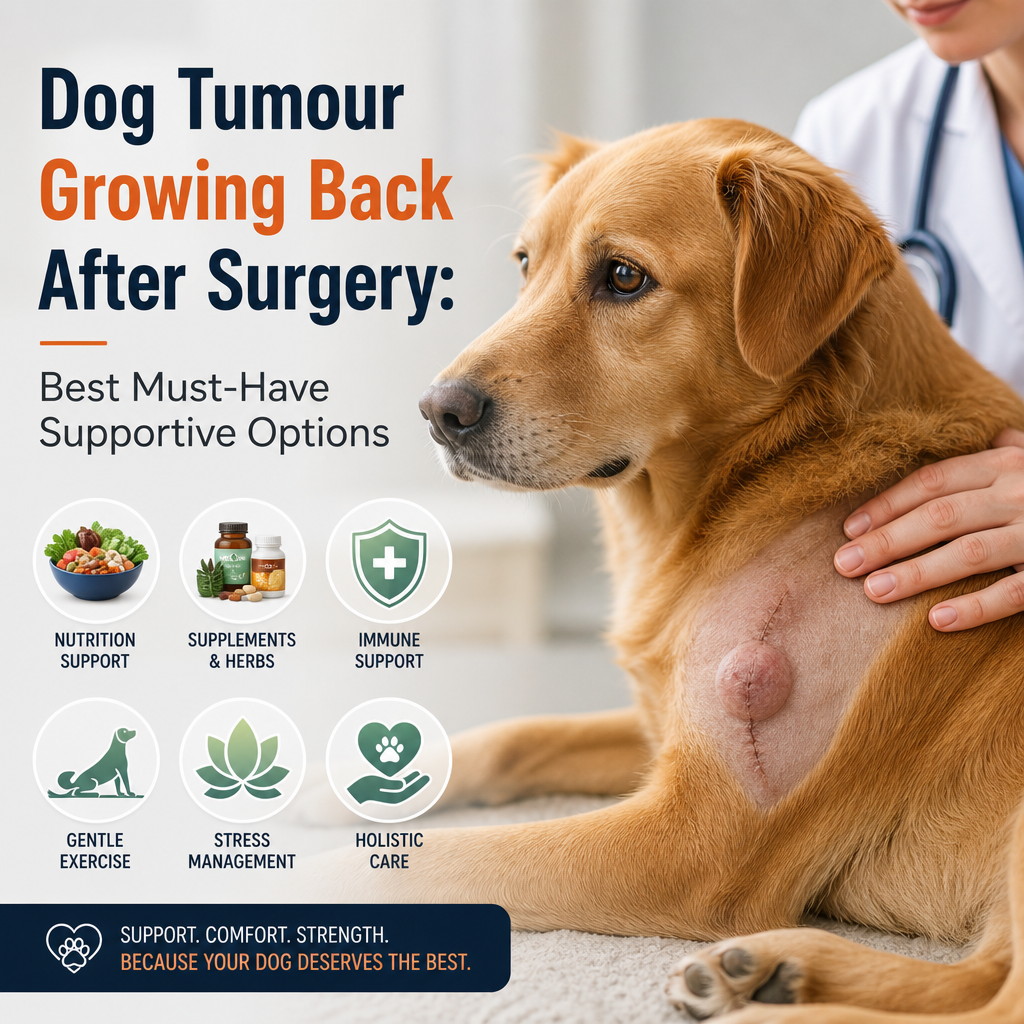
Dog Tumour Growing Back After Surgery can be frightening, but recurrence does not always mean that treatment options have run out. A returning mass may be local regrowth, a new tumour, or a different type of tissue change, so the first priority is obtaining an accurate diagnosis. With prompt veterinary care, appropriate monitoring, nutritional support, and attention to comfort, many dogs can receive meaningful help after a tumour returns.
Table des matières
Understanding a Dog Tumour Growing Back After Surgery
Tumours may recur for several reasons. Some cancer cells can remain microscopic around the original surgical site, even when the visible mass has been removed. Other tumours may spread to nearby lymph nodes or distant organs before surgery. In some cases, the new lump is unrelated to the original cancer and may be a benign growth, scar tissue, inflammation, or an infection.
The appearance of a mass alone cannot determine what is happening. A veterinarian may recommend a fine-needle aspiration, biopsy, blood tests, X-rays, ultrasound, or advanced imaging such as a CT scan. The tumour’s type, grade, location, margins from the original surgery, and evidence of spread all influence the next step.
Avoid squeezing, puncturing, or applying unapproved creams to the lump. These actions can cause irritation, bleeding, infection, or changes that make examination more difficult. In a case of dog tumour growing back after surgery, preserving the site until a professional assessment is especially important because even small changes can affect diagnosis.
For broader background on treatment choices and cost-sensitive options, some owners also review dog cancer supplements and practical buying tips for UK pet owners before making decisions with their vet.
It is also helpful to remember that not every lump is a straightforward recurrence. A dog tumour growing back after surgery may actually be a separate growth in the same area, especially in dogs that are prone to certain benign or malignant skin tumours. That is one reason why veterinary testing matters more than guesswork or online comparisons.
When owners first notice a change, they often look for clues such as firmness, redness, heat, or a difference in the skin surface. Those observations can be useful, but they do not replace an exam. If your dog tumour growing back after surgery is located where the original incision was made, the veterinarian may want to compare the current finding with the original pathology report and surgery notes.
What to Do When a Tumour Returns
Arrange a veterinary appointment promptly, especially if the mass is growing quickly or causing discomfort. Bring the original pathology report and surgical records if they are available. These documents can help the veterinary team understand the tumour’s behaviour and determine whether further surgery, chemotherapy, radiation therapy, targeted treatment, or palliative care may be appropriate.
A specialist referral may be useful. Veterinary oncologists can review the original diagnosis, assess recurrence risk, discuss staging tests, and explain the likely benefits and side effects of treatment. The best plan depends on the individual dog’s age, general health, tumour type, and quality of life.
Important changes to record include:
- The size and location of the lump
- How quickly it appears to be growing
- Changes in colour, texture, or temperature
- Bleeding, discharge, odour, or ulceration
- Licking, scratching, or sensitivity
- Changes in appetite, weight, thirst, energy, or breathing
- Vomiting, diarrhoea, coughing, limping, or difficulty urinating
Seek urgent veterinary attention if the mass bleeds heavily, becomes severely painful, produces a foul discharge, interferes with breathing or eating, or is accompanied by collapse, extreme weakness, pale gums, or repeated vomiting.
It can help to write down when the change first appeared and whether the mass has altered after exercise, rest, or grooming. These notes give the clinic a clearer picture of dog tumour growing back after surgery than memory alone. A short timeline can also make it easier to see whether the problem is stable, slow-moving, or aggressive.
Do not delay because the dog still seems bright or interested in food. Some tumours grow with very few outward signs at first. A prompt check may not only confirm whether the mass is a recurrence, but also rule out infection, seroma, abscess, or scar tissue that can look similar from the outside.
If the veterinary team suggests waiting and rechecking, ask what changes should trigger an earlier visit. Clear instructions matter because dog tumour growing back after surgery can evolve quickly in some patients, while others remain stable for weeks or months. Knowing the threshold for action reduces stress and prevents unnecessary delay.
Recurrent Dog Tumour Support at Home
Recurrent dog tumour support should complement veterinary treatment rather than replace it. A comfortable home environment can help reduce stress and preserve daily wellbeing. Provide a soft, clean bed in a quiet area and make food, water, and outdoor access easy to reach. Dogs with weakness or mobility problems may benefit from non-slip rugs, ramps, or assistance on stairs.
Protect the tumour site from excessive licking and scratching. Depending on its location, a recovery collar, protective shirt, or veterinary-approved dressing may be appropriate. Dressings should never be applied tightly, and any bandage should be checked regularly for swelling, moisture, odour, or skin damage.
Pain control is another important part of supportive care. Dogs often hide discomfort, so subtle signs matter. Restlessness, trembling, panting at rest, reduced interaction, reluctance to move, hunched posture, or changes in sleeping habits may indicate pain. Never give human painkillers unless specifically instructed by a veterinarian, because medicines such as ibuprofen, naproxen, and acetaminophen can be dangerous for dogs.
Keeping a simple quality-of-life diary can make decisions clearer. Track appetite, hydration, mobility, interest in family, enjoyment of normal activities, toileting, pain, and the number of good days compared with difficult days. For a dog tumour growing back after surgery, that diary can be one of the most useful tools during follow-up conversations.
Try to keep daily routines calm and predictable. Dogs often cope better when meal times, walks, and rest periods happen in a familiar pattern. If the tumour is in a place that rubs against bedding or harnesses, adapt the environment so the area is not continually irritated. Small practical adjustments can make recurrent dog tumour support feel more effective and less overwhelming.
Owners who are comparing supportive products in different countries may also find it useful to review regional guidance such as K9 Immunity / K9 Immunity Plus alternative dog tumour supplements in Denmark when discussing safe options with their veterinarian.
If your dog is having trouble getting comfortable at night, check whether the sleeping surface is too firm, too warm, or difficult to access. Changing the bed setup, reducing stairs, or keeping water bowls in multiple rooms can make a real difference. These small changes do not treat cancer itself, but they can reduce strain while you manage dog tumour growing back after surgery with your vet.
Some dogs benefit from short, gentle walks instead of long outings. Light movement may help mood and stiffness, but avoid pushing activity if it causes panting, limping, or fatigue. The goal is comfort, not fitness milestones. A slower pace often works better when a dog tumour growing back after surgery is affecting energy levels.
Nutrition and Dog Cancer Supplements After Surgery
Good nutrition helps maintain muscle, energy, immune function, and recovery capacity. Some dogs with recurrent cancer lose weight because of reduced appetite, nausea, pain, or increased metabolic demands. Ask the veterinarian whether the current diet provides enough calories and protein, and whether a veterinary therapeutic diet would be suitable.
Offer small, frequent meals if large portions are unappealing. Warming food slightly can improve its smell, but avoid sudden dietary changes unless advised. Never force-feed a dog that is nauseated or has difficulty swallowing.
Dog cancer supplements after surgery should be selected carefully. Supplements are not proven substitutes for surgery, chemotherapy, radiation, or other cancer treatments. Some products may also interact with anaesthetic drugs, chemotherapy, steroids, blood thinners, or anti-inflammatory medicines. Certain supplements can affect bleeding, liver function, kidney function, or drug metabolism.
Before giving any supplement, provide the veterinarian with the product name, ingredient list, dose, and manufacturer. Common products discussed in canine cancer care may include veterinary omega-3 fatty acid formulations, digestive support products, or specific nutritional additions, but suitability varies widely. “Natural” does not automatically mean safe, and concentrated herbal products can be particularly unpredictable.
Avoid unverified claims that a supplement can dissolve tumours or cure cancer. Reliable supportive products should have clear ingredients, appropriate dosing information, quality-control standards, and a role that can be explained within the dog’s overall treatment plan. That is especially important when a dog tumour growing back after surgery has already required major decisions, because false promises can waste time and create risk.
As a general veterinary reference for cancer warning signs and ongoing monitoring, the American Veterinary Medical Association provides useful guidance at AVMA’s cancer in pets resource.
When appetite falls, ask whether nausea control, pain relief, or a diet change would be more useful than adding more supplements. In many dogs, the best nutrition plan is the simplest one that the dog will actually eat consistently. For a dog tumour growing back after surgery, steady calorie intake is often more valuable than a long list of products.
Owners sometimes want to start several supplements at once, but that makes it difficult to know what helps or harms. Introduce only one change at a time if your veterinarian approves a new product. That approach is safer and makes it easier to trace any side effects, which matters when recurrent dog tumour support is already complex.
Surveillance et soins de suivi
Regular follow-up appointments are essential after recurrence. The veterinary team may measure the tumour, repeat imaging, check lymph nodes, monitor bloodwork, or assess organ function. Keeping consistent records at home helps reveal changes that may not be obvious during a short clinic visit.
Photographs can be useful for tracking a visible mass, provided they are taken from a similar distance and angle. A ruler placed beside the tumour may help document size, but measurements should not replace professional examinations.
Ask the veterinarian what signs should trigger an earlier visit and how often reassessment is needed. Some tumours progress slowly, while others can change rapidly. Early attention may allow better control of pain, infection, bleeding, or other complications.
Lorsqu'il s'agit de discuter des horaires de suivi, de nombreuses familles trouvent utile de garder un plan écrit pour le timing des médicaments, les dates de contrôle, les coordonnées d'urgence et des notes sur tout changement dans l'appétit ou l'énergie du chien.
Les soins de suivi aident également la clinique à voir si le plan actuel fonctionne. Si la masse est stable, plus petite ou moins douloureuse, c'est une information utile. Si elle s'agrandit ou change de forme, l'équipe peut recommander une approche différente. La réapparition d'une tumeur chez le chien après une chirurgie n'est pas une situation où “observer et espérer” devrait remplacer une surveillance structurée.
Certains chiens ont besoin d'analyses de sang de routine pour vérifier si le foie, les reins et les cellules sanguines tolèrent bien le traitement. D'autres peuvent avoir besoin de radiographies thoraciques répétées ou d'une échographie abdominale pour rechercher une propagation. Ces tests peuvent être stressants, mais ils fournissent une image plus claire que l'apparence seule. Lorsqu'une réapparition de tumeur chez le chien après une chirurgie est suspectée, le staging et les tests de contrôle peuvent guider à la fois le traitement et les attentes.
Il est également raisonnable de demander si une nouvelle biopsie est nécessaire. Dans certains cas, le vétérinaire peut vouloir confirmer si la nouvelle croissance correspond au diagnostic original. Cette distinction peut être importante si la première tumeur était un type de cancer et que la nouvelle masse se comporte différemment.
Soutenir la qualité de vie
Les soins contre le cancer ne consistent pas seulement à prolonger le temps ; il s'agit également de préserver le confort et la connexion. Des promenades douces, un toilettage tranquille, des aliments préférés approuvés par l'équipe vétérinaire et des moments détendus en famille peuvent apporter un enrichissement précieux. Ajustez les activités à l'énergie du chien et évitez les efforts qui causent douleur ou épuisement.
Lorsque le traitement est peu susceptible de contrôler la tumeur, les soins palliatifs peuvent se concentrer sur le confort, l'appétit, les nausées, la mobilité, l'anxiété et le repos. Le soutien en soins palliatifs peut aider les familles à se préparer à des besoins changeants et à prendre des décisions compatissantes en fonction de la qualité de vie du chien.
Une tumeur récurrente est compréhensiblement troublante, mais un soutien pratique et des conseils vétérinaires opportuns peuvent rendre la situation plus gérable. Un diagnostic précis, un traitement coordonné, une nutrition soignée, une supplémentation sûre, un contrôle de la douleur et une surveillance régulière donnent au chien la meilleure chance de confort et de bien-être.
Si vous explorez des produits de soutien au-delà de votre marché local, vous voudrez peut-être également comparer les conseils régionaux tels que Ocoxin Pets options alternatives pour les chiens en Espagne lorsque vous parlez avec votre vétérinaire de ce qui est approprié et sûr.
Dans de nombreux cas, la réapparition d'une tumeur chez le chien après une chirurgie n'est pas la fin de la conversation ; c'est le point où un plan plus adapté commence. Avec la bonne équipe vétérinaire, une surveillance claire à domicile et des objectifs réalistes, les familles peuvent se concentrer sur le confort, la dignité et la meilleure vie quotidienne possible pour leur chien.
Pour les propriétaires qui souhaitent rester proactifs, il peut être utile de revoir le diagnostic initial, de demander si les marges étaient nettes et de confirmer si la récidive est vraiment la même tumeur ou une croissance différente. Cette distinction est importante car une nouvelle masse peut nécessiter une approche différente, et la tumeur du chien qui revient après la chirurgie ne suit pas toujours le même schéma que le premier diagnostic.
Certains vétérinaires peuvent également suggérer de vérifier à nouveau le site chirurgical à intervalles réguliers même lorsque le chien semble bien. Un examen précoce peut détecter des changements avant qu'ils ne deviennent douloureux ou difficiles à traiter, ce qui est particulièrement important lorsque la tumeur du chien qui revient après la chirurgie est une préoccupation dans les mois suivant la récupération.
Si votre chien a encore un bon appétit, utilisez cette période pour soutenir l'état corporel. Maintenir le poids et les muscles peut rendre les procédures futures plus faciles et peut améliorer la résilience. En termes pratiques, la tumeur du chien qui revient après la chirurgie nécessite souvent les mêmes bases de manière répétée : des repas cohérents, une observation attentive et une communication rapide avec l'équipe vétérinaire.
Lorsque les signes sont subtils, même de petits changements comptent. Une légère boiterie, une nouvelle fatigue, une réduction du jeu ou un changement dans la façon dont le chien dort peuvent être les premiers indices que la tumeur du chien qui revient après la chirurgie mérite un nouvel examen. Notez ces observations afin que la clinique puisse voir des tendances plutôt que des moments isolés.
Les familles demandent parfois si les suppléments seuls peuvent aider. La réponse la plus sûre est que la nutrition de soutien peut être utile, mais les suppléments contre le cancer chez le chien après la chirurgie devraient faire partie d'un plan plus large, et non du plan lui-même. Discutez toujours de tout produit avec votre vétérinaire avant de le commencer.
En fin de compte, la tumeur du chien qui revient après la chirurgie nécessite une action calme, pas de panique. L'objectif est de comprendre ce qui a changé, de réduire l'inconfort et de choisir le chemin le plus sûr pour le confort et la qualité de vie de votre chien.
Un dernier point mérite d'être répété : si vous êtes confronté à la tumeur du chien qui revient après la chirurgie, demandez un résumé écrit clair après chaque visite. Une courte note sur le diagnostic, les prochaines étapes, les changements de médicaments et le calendrier de vérification facilite le suivi du plan à domicile et réduit la confusion par la suite. Des dossiers clairs sont une partie simple mais puissante des soins de soutien.
Les familles ressentent souvent la pression d'agir immédiatement, mais la meilleure prochaine étape est généralement la plus informée. Une conversation mesurée avec le vétérinaire peut clarifier si la chirurgie, la surveillance, les médicaments ou les soins axés sur le confort sont le bon chemin. Cette conversation devient plus facile lorsque vous apportez des photos, des dates, des notes sur l'appétit et toutes les questions que vous avez sur la tumeur du chien qui revient après la chirurgie.
Le soutien inclut également des soins émotionnels pour le foyer. Il est normal de se sentir inquiet, frustré ou triste lorsque une tumeur revient. De nombreux propriétaires trouvent utile de se concentrer sur un jour à la fois : un repas, une promenade, un contrôle, et une décision de confort à la fois. Cette approche ne minimise pas la gravité du problème ; elle rend simplement le processus plus gérable pendant que vous répondez à la tumeur du chien qui revient après la chirurgie avec patience et soin.