par TCMVET | Fév 8, 2026 | Cancer et tumeurs du chien
Ce que signifie “cellule fusiforme” chez les chiens
“Cellule fusiforme” décrit généralement l'apparence des cellules tumorales sous le microscope—longues, effilées et fibreuses—plutôt que de nommer un type de cancer unique. Chez les chiens, cette description chevauche souvent les sarcomes des tissus mous (STS) et les tumeurs de type sarcome apparentées, qui sont connues pour leur invasivité locale : elles peuvent s'étendre microscopiquement au-delà de ce que vous pouvez voir ou sentir. Ce schéma de croissance est une grande raison pour laquelle la récidive locale devient une préoccupation clé.
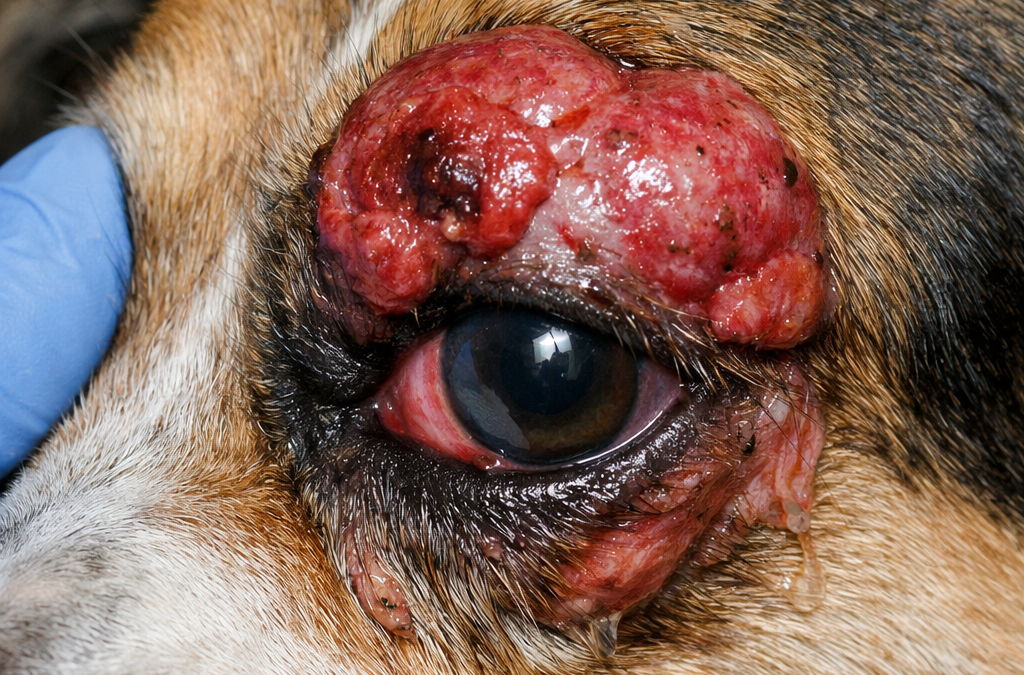
Quelle est la rareté d'une tumeur à cellules fusiformes près de l'œil ?
Cela dépend de savoir si la masse est une croissance superficielle de la paupière ou une tumeur périorbitaire/orbitaire plus profonde.
De nombreuses tumeurs de la paupière canine sont courantes et souvent bénignes, ce qui est rassurant dans la pratique quotidienne des yeux. Cependant, une tumeur maligne de type cellule fusiforme/sarcome qui est à croissance rapide ou profonde autour de l'œil est un scénario différent. La maladie orbitaire et rétrobulbaire (maladie dans l'orbite ou derrière le globe) est moins courante que de simples bosses de paupière et nécessite généralement une planification plus complexe.
Symptômes que les propriétaires remarquent couramment
Une tumeur “au-dessus de l'œil” peut ressembler à une masse ferme ou un gonflement près du sourcil ou des paupières, mais une maladie plus profonde peut se manifester par des changements de fonction. Les chiens peuvent plisser les yeux, pleurer excessivement, développer un écoulement persistant, se frotter l'œil ou le visage, ou sembler timides de la tête. Si l'orbite est impliquée, les signes classiques peuvent inclure l'exophtalmie (un œil proéminent), la protrusion de la troisième paupière et la douleur autour de l'œil.
Douleur et souffrance : combien cela fait-il mal ?
La douleur varie considérablement et est déterminée par ce que la tumeur fait localement.
Une masse peut devenir très inconfortable si elle déforme la position de la paupière ou cause une irritation cornéenne chronique avec le clignement. Les conseils en ophtalmologie vétérinaire notent que les masses de la paupière ont souvent tendance à s'agrandir avec le temps et peuvent irriter la surface oculaire, affectant le confort et la qualité de vie. La maladie orbitaire peut également être douloureuse—surtout en présence de gonflement, de pression ou d'inflammation—et la douleur est fréquemment mentionnée parmi les signes cliniques dans les conditions orbitales.
Pourquoi le traitement près de l'œil est si difficile
Pour les tumeurs de type sarcome, l'objectif est généralement un contrôle local fort, car les “doigts” tumoraux microscopiques peuvent s'étendre au-delà de ce qui semble anormal. Sur le tronc ou les membres, les chirurgiens visent souvent des marges plus larges pour retirer ces extensions invisibles. Autour de l'œil, il peut être difficile d'obtenir de larges marges sans endommager des structures critiques, c'est pourquoi les médecins peuvent sembler prudents quant aux garanties.
Options de traitement : ce qui est généralement considéré
La plupart des plans de traitement tournent autour du contrôle local et du confort, combinant souvent plusieurs approches.
La chirurgie est souvent la pierre angulaire lorsque cela est possible, à la fois pour retirer la charge tumorale et pour obtenir une pathologie définitive. Pour les sarcomes des tissus mous canins, la complétude de l'excision influence fortement les résultats ; les revues soulignent que les tumeurs excisées de manière incomplète présentent un risque de récidive locale plus élevé. Dans certains cas, les chirurgiens peuvent recommander des procédures plus radicales pour obtenir un contrôle dans des emplacements difficiles (y compris des chirurgies impliquant l'orbite) car certains sarcomes peuvent nécessiter des approches radicales lorsque l'anatomie limite la largeur des marges.
La radiothérapie est souvent discutée lorsque les marges sont proches ou incomplètes, ou lorsque l'anatomie rend l'excision large impossible. Elle est utilisée dans le but de contrôler les cellules résiduelles microscopiques et de réduire le risque de régénération, bien que les résultats varient selon le comportement de la tumeur, la planification des doses et les spécificités de chaque cas.
Risque de récidive : ce que la recherche souligne à plusieurs reprises
Dans la littérature sur les STS canins, deux facteurs apparaissent encore et encore : le grade histologique et l'état des marges.
Une revue sur les STS canins excisés de manière incomplète ou étroite rapporte des taux de récidive publiés d'environ 17%–37% dans les études, illustrant pourquoi les “marges propres” sont si importantes. Un autre aperçu largement cité note qu'avec une excision complète, la récidive locale chez les chiens peut être très faible, et des marges incomplètes augmentent considérablement le risque de récidive.
Perspectives de survie et “ chronologie de survie ” : la manière pratique de penser au pronostic
Parce que “ tumeur à cellules fusiformes ” peut représenter plusieurs types de tumeurs, le temps de survie ne peut pas être résumé de manière fiable par un seul chiffre. Une manière plus fiable de comprendre le pronostic est d'ancrer les attentes à ce qui prédit le comportement de manière la plus forte :
Une tumeur de grade inférieur qui peut être complètement contrôlée localement a généralement un meilleur pronostic qu'une tumeur de grade supérieur ou une tumeur qui ne peut pas être complètement retirée en raison de son emplacement. Dans les STS canins, le risque métastatique est souvent décrit comme dépendant du grade, les tumeurs de grade supérieur ayant une chance significativement plus élevée de propagation au cours de la maladie. Dans les tumeurs périoculaires spécifiquement, “ la manière dont la maladie locale peut être contrôlée ” devient souvent le facteur dominant façonnant à la fois la qualité de vie et le résultat global.
Ce que les propriétaires peuvent faire tôt et qui compte souvent (sans se perdre dans les détails)
Les points de focalisation les plus utiles au début sont de confirmer l'étendue réelle de la maladie et de protéger le confort.
L'imagerie avancée telle que le CT ou l'IRM est fréquemment recommandée dans les cas orbitaires/périoculaires car les examens de routine ne peuvent pas toujours montrer ce qui se passe derrière l'œil, et l'imagerie aide à guider la planification chirurgicale et de radiothérapie. Le confort est également central : les tumeurs périoculaires peuvent provoquer une irritation et une inflammation de la cornée, et réduire les frottements/traumatismes et traiter l'irritation de la surface oculaire peut faire une différence significative dans le bien-être quotidien.
FAQ : réponses rapides que recherchent les propriétaires d'animaux
Chaque tumeur près de la paupière est-elle maligne ?
Non. Les tumeurs de la paupière sont courantes chez les chiens et beaucoup se comportent de manière bénigne, bien que toute masse à croissance rapide, ulcérée, saignante ou douloureuse nécessite une évaluation rapide.
Pourquoi un vétérinaire recommanderait-il de retirer l'œil ?
Lorsqu'une tumeur est profondément invasive ou que des marges ne peuvent pas être obtenues en toute sécurité, une chirurgie locale plus agressive peut être recommandée pour améliorer le contrôle local dans une région où l'espace est limité.
Pourquoi la chirurgie et la radiothérapie ne peuvent-elles pas garantir qu'elle ne reviendra pas ?
Les tumeurs de type sarcome peuvent s'étendre de manière microscopique, et autour de l'œil, il peut être difficile de retirer suffisamment de tissu environnant. Les STS incomplètement excisées ont un risque de récidive documenté dans plusieurs études.
Qu'est-ce qui prédit le pronostic de manière la plus forte ?
Le grade pathologique et le fait que la tumeur ait été retirée avec des marges saines sont régulièrement soulignés comme des moteurs majeurs du risque de récidive et de propagation dans les STS canins.
Comment Baituxiao peut aider en tant que soin de soutien
Les tumeurs à cellules fusiformes périoculaires sont généralement gérées d'abord par un contrôle local - le plus souvent par chirurgie, et parfois par radiothérapie - car ces tumeurs peuvent être localement invasives et la région de l'œil limite les larges marges. Dans ce contexte, de nombreux propriétaires envisagent également des soins de soutien intégratifs pour aider à maintenir le confort, l'appétit et la qualité de vie globale en parallèle du plan de traitement principal.
Baituxiao est une formule botanique TCVM positionnée par le fabricant pour les chiens et les chats avec des “ tumeurs et des masses ”, et elle est généralement discutée comme une option complémentaire plutôt qu'une solution autonome. Parce que les formules botaniques peuvent interagir avec les médicaments utilisés autour de la chirurgie, du contrôle de la douleur, de l'inflammation ou des soins oncologiques, il est préférable de l'utiliser dans le cadre d'un plan coordonné avec l'équipe vétérinaire.
par TCMVET | 14 janv. 2026 | Cancer et tumeurs du chien
Les bosses de la queue chez les chiens peuvent être perturbantes pour tout gardien d'animal de compagnie, surtout lorsque des pensées inquiétantes sur les tumeurs des glandes anales surgissent. Comprendre ce que ces bosses pourraient indiquer — et comment agir de manière réfléchie et responsable — peut apporter une tranquillité d'esprit tout en soutenant le bien-être de votre animal. Ce guide complet explore les causes potentielles des bosses de la queue chez les chiens, les signes à surveiller, les façons dont les vétérinaires évaluent les tumeurs des glandes anales, des conseils de soins quotidiens et comment rester proactif pour le confort et la qualité de vie de votre chien.
—
Comprendre les bosses de la queue chez les chiens
Les bosses de la queue peuvent se développer pour plusieurs raisons, allant des croissances bénignes à des préoccupations plus graves. Bien que certaines bosses restent petites et inoffensives, d'autres peuvent nécessiter une attention vétérinaire pour évaluer leur nature.
Causes possibles des bosses de la queue
– Kystes sébacés : Petits sacs à croissance lente contenant un matériau huileux.
– Lipomes : Tumeurs graisseuses souvent trouvées chez les chiens plus âgés, généralement molles et mobiles.
– Infections cutanées ou abcès : Résultant de blessures ou de follicules obstrués.
– Masses liées aux glandes anales : Masses provenant des glandes près de l'anus.
– Autres tumeurs ou nodules : Pourraient se développer à partir de divers types de tissus.
Toutes les bosses ne sont pas dangereuses, mais il est essentiel de suivre tout changement au fil du temps, surtout près de la base de la queue.
—
Tumeurs des glandes anales : Ce que les propriétaires d'animaux doivent savoir
Les tumeurs des glandes anales sont des croissances qui proviennent des sacs anaux situés de chaque côté de l'anus. Ces tumeurs peuvent aller de bénignes à malignes, et une évaluation vétérinaire précoce est cruciale pour déterminer leur nature et la meilleure marche à suivre.
Pourquoi les glandes anales sont importantes
– Emplacement: Situées sous la queue, les glandes peuvent développer des anomalies qui se manifestent sous forme de bosses ou de gonflements.
– Fonction : Elles libèrent un parfum utilisé pour la communication entre les chiens.
– Des risques: L'inflammation, les changements structurels ou les tumeurs peuvent causer de l'inconfort, une odeur ou d'autres complications.
Observations courantes
– Difficulté à s'asseoir confortablement
– Glisser ou lécher la zone anale
– Gonflement ou fermeté près de l'anus
– Tremblement de la queue ou réticence à remuer
Chaque fois que de nouveaux signes apparaissent ou persistent, prenez rendez-vous pour un examen chez un vétérinaire. Une évaluation professionnelle évite une mauvaise interprétation des symptômes et aide à déterminer si des tests supplémentaires sont nécessaires.
—
Bosses de queue chez les chiens : reconnaître les signes tôt
Parce que les bosses de queue que les chiens peuvent éprouver peuvent apparaître progressivement, rester vigilant aide à détecter les problèmes tôt. Visez à examiner doucement la zone de la queue de votre chien pendant les séances de toilettage, en observant tout changement de taille ou de texture.
Signes à noter
– Gonflement persistant : Surtout s'ils sont fermes ou en croissance.
– Modifications cutanées : Rougeur, perte de poils ou texture rugueuse.
– Inconfort: Réaction lorsque la zone est touchée.
– Changements de comportement : Diminution de l'énergie, mauvaise appétit ou cachette inhabituelle.
Ces signes ne pointent pas automatiquement vers des tumeurs des glandes anales, mais ils justifient une visite chez le vétérinaire pour plus de clarté et de tranquillité d'esprit.
—
Comment les vétérinaires évaluent les bosses de queue
Les professionnels vétérinaires utilisent divers tests pour évaluer les bosses et déterminer les prochaines étapes. L'approche exacte dépend de l'âge de votre chien, de ses antécédents médicaux et des caractéristiques de la bosse.
Étapes de diagnostic typiques
1. Physical examination: Vérification de la taille, de l'emplacement et de la consistance.
2. Aspiration à l'aiguille fine ou biopsie : Collecte de cellules ou de tissus pour analyse.
3. Imagerie : Échographie, radiographie ou scanner pour évaluer les structures internes.
4. Analyses sanguines : Fournit des informations sur la santé globale.
Discutez du processus ouvertement avec votre vétérinaire, en demandant des explications compréhensibles sur ce que chaque test peut révéler. Les propriétaires d'animaux qui restent engagés et informés se sentent souvent plus confiants pour soutenir leur chien tout au long de l'évaluation.
—
Soutenir les chiens à travers les soins des tumeurs des glandes anales
Lorsqu'un vétérinaire identifie des tumeurs des glandes anales, un plan réfléchi est conçu en fonction de la situation unique du chien. Étant donné que les instructions médicales appartiennent à un cadre clinique, les propriétaires d'animaux peuvent se concentrer sur la création d'un environnement domestique calme et suivre de près les recommandations professionnelles.
Conseils pratiques pour le soutien à domicile
– Tenez un journal : Enregistrez les observations, y compris l'appétit, le niveau d'énergie et la qualité des selles.
– Surveillez l'état corporel : Maintenez un poids santé pour réduire la pression supplémentaire.
– Fournissez un exercice doux : De courtes promenades ou des jeux mentalement stimulants gardent votre chien engagé.
– Offrez des endroits de repos confortables : Une literie douce aide à soulager la pression sur les zones sensibles.
– Restez à jour sur les examens : Les visites de suivi permettent aux vétérinaires de suivre les progrès et d'ajuster les plans de soins.
En se concentrant sur le confort, la cohérence et les conseils vétérinaires, les propriétaires peuvent aider les chiens à se sentir en sécurité pendant leur parcours de soins.
—
Considérations relatives à la nutrition et au bien-être naturel
Bien que la nourriture et les suppléments ne puissent pas diagnostiquer ou guérir des conditions graves, une nutrition saine soutient la vitalité globale. Demandez à votre vétérinaire des régimes équilibrés adaptés à l'âge, à la race et au niveau d'activité de votre chien.
Informations générales sur la nutrition
– Protéines et graisses équilibrées : Soutiennent la santé musculaire et l'énergie.
– Sources de fibres : Encourage la digestion et l'élimination régulière.
– Acides gras oméga : Peut aider à maintenir la santé de la peau et un pelage brillant.
– Hydratation : Assurez-vous d'un accès constant à de l'eau fraîche.
Les approches de bien-être naturel—comme des environnements calmes, un toilettage doux et des activités d'enrichissement—peuvent également promouvoir un sentiment de sécurité. Consultez toujours votre vétérinaire avant d'introduire des changements alimentaires ou des suppléments.
—
Pratiques de prévention et de détection précoce
Bien que tous les bosses de queue ne puissent pas être prévenues, l'observation régulière et les soins vétérinaires préventifs font une différence significative.
Habitudes utiles
– Toilettage régulier : Vous aide à repérer les nouvelles bosses tôt.
– Horaire de bain régulier : Garde la peau propre et vous permet de vérifier les problèmes.
– Visites vétérinaires de routine : Les examens de bien-être détectent les changements subtils.
– Formation et manipulation : Apprenez à votre chien à tolérer la manipulation de la queue et de l'arrière-train afin que les inspections soient plus faciles.
Établir ces habitudes favorise une relation collaborative avec votre vétérinaire et garde votre animal à l'aise.
—
Questions à poser à votre vétérinaire
La connaissance permet aux propriétaires de chiens de prendre des décisions éclairées. Envisagez d'apporter une liste de questions aux rendez-vous.
Sujets de discussion
– Quel type de bosse mon chien a-t-il, et quels tests le vérifient ?
– Y a-t-il des ajustements de style de vie qui pourraient garder mon chien à l'aise ?
– À quelle fréquence devrais-je surveiller la bosse ?
– Quels signes indiquent que je devrais planifier un suivi urgent ?
Une communication active garantit que vous comprenez chaque étape du plan de soins de votre chien.
—
Soutien émotionnel pour les propriétaires d'animaux
Découvrir une masse sur la queue de votre chien peut être émotionnellement difficile. Prenez le temps de traiter l'information et demandez du soutien si nécessaire.
Stratégies d'adaptation
– Comptez sur votre équipe vétérinaire : Ils peuvent clarifier les résultats et les prochaines étapes.
– Connectez-vous avec des communautés de soutien : Les forums en ligne ou les groupes locaux peuvent partager des expériences utiles.
– Prenez soin de vous : Des repas équilibrés, du repos et du temps à l'extérieur renforcent la résilience.
– Célébrez les moments quotidiens : Des promenades douces, des moments de câlins et des jeux renforcent votre lien.
Rester ancré et plein d'espoir vous aide à rester un pilier de soutien calme pour votre animal.
—
Rester informé sur les tumeurs des glandes anales
Des informations fiables façonnent des décisions responsables. Concentrez-vous sur des ressources basées sur des preuves telles que des spécialistes vétérinaires certifiés, des articles évalués par des pairs et des organisations de santé animale réputées.
Évaluation des sources d'information
– Vérifiez les références : Recherchez des vétérinaires agréés ou des institutions reconnues.
– Méfiez-vous des solutions rapides : Évitez les affirmations ou traitements non vérifiés.
– Demandez à votre vétérinaire : Ils peuvent recommander des documents de lecture ou des spécialistes de confiance.
Être sélectif quant à l'information maintient le bien-être de votre chien sur la bonne voie et évite les malentendus.
—
Une mentalité holistique pour le bien-être des chiens
Les soins holistiques signifient prendre en compte le confort physique, le bien-être émotionnel et un environnement paisible. Des literies douces, des routines cohérentes, des soins doux et des interactions calmes contribuent tous à un sentiment général de sécurité.
Pratiques holistiques simples
– Promenades conscientes : Des promenades tranquilles permettent de renifler et d'explorer.
– Massage et toucher doux : Lorsque cela est approuvé par votre vétérinaire, un léger massage peut aider à détendre les muscles.
– Jouets d'enrichissement : Les distributeurs de puzzles, les jeux de reniflement lents et les jouets à mâcher doux gardent l'esprit actif.
– Musique et aromathérapie : Des sons apaisants ou des senteurs approuvées par le vétérinaire peuvent créer une ambiance tranquille.
Observez toujours les réactions de votre chien et arrêtez tout ce qui cause de l'inconfort.
—
Conclusion : Soutenir le bien-être naturel avec soin
Chaque chien mérite une attention compatissante, surtout lorsque de nouvelles bosses soulèvent des questions. En restant observateur, en collaborant avec des professionnels vétérinaires et en créant un environnement domestique réconfortant, vous pouvez naviguer dans les bosses de la queue avec confiance et soin. N'oubliez pas d'aborder chaque étape avec patience, de maintenir une communication ouverte avec l'équipe de soins de votre animal et de continuer à explorer des pratiques de bien-être naturel douces qui nourrissent le sentiment d'équilibre général de votre chien.
par TCMVET | 14 janv. 2026 | Cancer et tumeurs du chien
Les herbes pour chiens âgés peuvent jouer un rôle doux et de soutien dans les années dorées de votre chien, offrant un confort naturel aux côtés des soins vétérinaires réguliers. À mesure que les chiens vieillissent, leurs besoins changent : la mobilité ralentit, la digestion évolue et le bien-être général nécessite plus d'attention. De nombreux propriétaires d'animaux se tournent vers des options holistiques comme les herbes et les changements de mode de vie dans le cadre d'un plan de soins équilibré. Ce guide explore comment utiliser judicieusement les herbes pour chiens âgés, ce qu'il faut considérer et comment améliorer le confort de votre compagnon vieillissant grâce à des stratégies pratiques et à des soins attentifs.
—
Comprendre le vieillissement chez les chiens âgés
Les chiens entrent généralement dans leurs années séniores vers l'âge de sept ans, bien que cela varie selon la race et la taille. À mesure que le métabolisme ralentit et que les organes mûrissent, les chiens deviennent plus sensibles au stress, à l'alimentation, aux niveaux d'activité et aux changements environnementaux. Les changements liés à l'âge peuvent inclure :
– Niveaux d'énergie plus faibles
– Digestion sensible ou appétit réduit
– Raideur articulaire ou réticence à bouger
– Changements de comportement comme une vocalisation accrue, de la confusion ou de l'agitation
– Besoin accru de chaleur, de routine et de familiarité
Comprendre ces transitions vous aide à soutenir votre chien avec patience et compassion, tout en collaborant avec un vétérinaire et en explorant des stratégies de confort douces à base d'herbes.
—
Qu'est-ce que les herbes pour chiens âgés ?
Les herbes pour chiens âgés sont des plantes qui peuvent atténuer les défis courants du vieillissement de manière sûre et mesurée. Les herbes peuvent être sèches, fraîches ou sous forme de formules (capsules, poudres, thés ou teintures). Elles proviennent de pratiques traditionnelles dans le monde entier - de l'Ayurveda à l'herboristerie occidentale - où des plantes naturelles étaient utilisées pour soutenir le bien-être.
Les principes clés incluent :
– Soutenir la vitalité, sans supprimer les symptômes
– Compléter les soins vétérinaires plutôt que de les remplacer
– Écouter les réponses de votre chien aux herbes et ajuster si nécessaire
Les herbes possèdent des propriétés diverses, telles que calmantes, apaisantes pour la digestion ou nourrissantes en général, qui peuvent être bénéfiques pendant les années séniores. Consultez toujours un vétérinaire, idéalement un expérimenté en soins à base de plantes ou intégratifs, avant d'introduire de nouvelles plantes.
—
Herbes pour chiens âgés à explorer pour le confort
Camomille et son influence apaisante
L'arôme doux de la camomille réconforte souvent les chiens anxieux ou agités. Elle peut aider lorsqu'un chien âgé éprouve des allées et venues nocturnes, un léger dérangement digestif ou un sentiment général d'inquiétude. La camomille est souvent proposée sous forme d'infusion de thé que vous pouvez ajouter à la nourriture ou à l'eau, ou comme herbe séchée mélangée aux repas. Étant donné que la camomille est douce, de nombreux chiens la tolèrent bien, mais il est important de surveiller les allergies.
Scutellaire pour la relaxation
La scutellaire est une herbe vénérée pour ses propriétés relaxantes sans sédation lourde. Elle peut être utile pour les chiens plus âgés qui semblent tendus, réactifs ou sensibles au bruit et au changement. En combinaison avec des modifications de mode de vie (routines cohérentes, espaces calmes, heures de repas prévisibles), la scutellaire peut soutenir l'équilibre émotionnel.
Chardon-Marie pour un soutien doux du foie
Le foie joue un rôle central dans le métabolisme et la détoxification, et les chiens âgés bénéficient souvent d'un soutien doux du foie. Le chardon-Marie, riche en silymarine, est couramment utilisé par les praticiens pour ses qualités antioxydantes et ses effets protecteurs potentiels. De nombreux propriétaires d'animaux intègrent le chardon-Marie en rotation ou en cours occasionnels, plutôt que de s'y fier en continu. Encore une fois, un vétérinaire devrait guider la durée et la pertinence, surtout si votre chien prend des médicaments.
Curcuma et ses qualités antioxydantes
Le curcuma contient de la curcumine, un composé aux propriétés antioxydantes et apaisantes largement étudiées. Les chiens âgés peuvent apprécier des repas infusés au curcuma pour un confort général, bien qu'il doive être associé à des graisses comme l'huile de coco ou l'huile de poisson pour améliorer l'absorption. Étant donné que le curcuma peut interagir avec certains médicaments ou conditions digestives, consultez votre vétérinaire avant de l'utiliser régulièrement.
Aubépine pour le soutien cardiaque et circulatoire
Les baies et les feuilles d'aubépine sont utilisées depuis longtemps pour soutenir le bien-être circulatoire. Certains vétérinaires intégratifs introduisent l'aubépine pour les chiens âgés montrant des signes de vieillissement des systèmes cardiovasculaires, bien qu'une surveillance attentive soit essentielle. Elle fait souvent partie d'un protocole plus large incluant l'alimentation, l'exercice contrôlé et les examens de routine.
Spiruline et luzerne pour des apports en nutriments
La spiruline et la luzerne sont des suppléments à base de plantes riches en nutriments qui peuvent fournir un soutien supplémentaire d'origine végétale pour l'énergie et la résilience immunitaire. La spiruline est riche en chlorophylle et en acides aminés, tandis que la luzerne contient des vitamines, des minéraux et des fibres de soutien. Ajouter ces éléments en quantités modérées à l'alimentation d'un chien âgé peut aider à combler les lacunes nutritionnelles.
—
Considérations clés lors de la sélection des herbes pour chiens âgés
1. Consultation: Un vétérinaire familiarisé avec la médecine à base de plantes peut recommander des herbes appropriées, aider à éviter les interactions dangereuses et surveiller les progrès.
2. Qualité: Choisissez des herbes provenant de sources réputées qui offrent une transparence sur l'approvisionnement et des tests tiers pour les contaminants.
3. Formulaire: Décidez entre poudres, capsules, teintures ou thés. Certains chiens préfèrent les herbes mélangées à de la nourriture humide ; d'autres gèrent mieux les capsules.
4. Allergies : Introduisez une herbe à la fois en petites quantités, en surveillant les signes d'intolérance comme des démangeaisons, des vomissements ou de la diarrhée.
5. Consistency: Les herbes agissent généralement progressivement. Une utilisation cohérente et mesurée fonctionne souvent mieux qu'un dosage sporadique.
—
Conseils de confort environnemental pour les chiens âgés
Les herbes se marient mieux avec des stratégies de confort pratiques et quotidiennes. Considérez les façons suivantes d'aider votre chien âgé à se sentir en sécurité, soutenu et content :
– Literie confortable : Les lits orthopédiques, les bords surélevés ou les coussins chauffants (conçus pour les animaux) peuvent apaiser les articulations raides et fournir de la chaleur.
– Surfaces antidérapantes : Les tapis ou les couloirs minimisent les glissades sur les sols en bois dur, réduisant le stress sur les articulations et renforçant la confiance.
– Eau et nourriture accessibles : Placez les bols sur des tapis antidérapants et envisagez des stations d'alimentation légèrement surélevées.
– Soins personnels de routine : Un brossage régulier et un massage doux améliorent la circulation et offrent du temps de lien.
– Retraites tranquilles : Une zone de repos désignée loin du bruit domestique aide les chiens à se détendre et à se sentir en sécurité.
– Éclairage doux la nuit : Des lumières tamisées ou des veilleuses guident les chiens âgés qui ont une vision réduite ou de l'anxiété nocturne.
—
Alimentation et soutien digestif
Importance d'une nutrition équilibrée
Les chiens âgés bénéficient souvent de régimes riches en nutriments et facilement digestibles. Bien que des formules commerciales pour seniors existent, consultez un vétérinaire ou un nutritionniste canin pour vous assurer que la nourriture de votre chien répond à ses besoins individuels. Faire tourner les protéines, incorporer des légumes cuits doucement et inclure des graisses saines peut maintenir l'intérêt pour les repas et soutenir un poids sain.
Herbes qui soutiennent la digestion
– Gingembre : Connu pour apaiser l'inconfort gastrique, le gingembre peut aider les chiens qui éprouvent des nausées occasionnelles. À utiliser avec parcimonie et demander l'avis d'un vétérinaire pour les chiens sous médicaments anticoagulants.
– Racine de pissenlit : Parfois utilisée pour soutenir la digestion et la fonction hépatique, la racine de pissenlit peut être ajoutée aux repas en petites quantités.
– Fenouil : Peut soulager les gaz légers ou le ballonnement. Son goût semblable à celui de la réglisse est généralement bien toléré par les chiens.
Hydratation
Les chiens âgés doivent toujours avoir accès à de l'eau fraîche. Vous pouvez améliorer l'hydratation en incorporant des aliments riches en humidité comme le bouillon d'os, les légumes en purée ou des garnitures de croquettes riches en eau.
—
Activité et mobilité
Exercice doux pour les chiens âgés
Même les chiens plus âgés bénéficient du mouvement, qui maintient les muscles forts et les articulations flexibles. Visez de petites promenades fréquentes plutôt qu'une seule longue randonnée. Surveillez le rythme de votre chien et laissez-lui du temps pour renifler—la stimulation mentale est aussi importante que l'exercice physique.
Herbes axées sur la mobilité
Certaines herbes soutiennent le confort et la flexibilité des articulations :
– Boswellia : Souvent utilisée dans les plans de bien-être traditionnels pour le soutien des articulations en raison de ses composés résineux.
– Griffe du diable : Recommandée par les praticiens holistiques pour le soin des articulations ; cependant, elle doit être évitée chez les chiens ayant certaines conditions de santé.
Discutez des combinaisons ou de l'utilisation à long terme avec votre vétérinaire pour garantir la sécurité.
Thérapies complémentaires
L'acupuncture, le massage, l'hydrothérapie ou les exercices de physiothérapie peuvent soulager la tension et encourager le mouvement. Ces modalités doivent être guidées par des professionnels qualifiés ayant de l'expérience avec les chiens âgés.
—
Bien-être émotionnel et comportement
Reconnaître les changements émotionnels
Les chiens âgés peuvent connaître des changements cognitifs ou de l'anxiété. Les signes incluent le fait de tourner en rond, l'éveil nocturne, le vocalise ou une augmentation de l'attachement. La patience et une réassurance constante sont cruciales durant ces étapes de la vie.
Soutien calmant à base d'herbes
– Racine de valériane : Souvent utilisée pour un soulagement occasionnel du stress. Introduisez-la progressivement, car son odeur terreuse peut être forte.
– Passiflore : Une herbe douce qui peut diminuer l'agitation et soutenir l'équilibre émotionnel.
Combiner cela avec des ajustements de style de vie (musique douce, diffuseurs d'aromathérapie utilisant des senteurs sûres pour les chiens, routines prévisibles) peut favoriser la relaxation.
—
Créer une trousse à herbes pour chiens âgés
Envisagez d'organiser vos produits à base d'herbes et vos articles de soutien en un seul endroit :
1. Étiquetez les contenants avec le nom de l'herbe, l'objectif prévu et toutes notes.
2. Suivez l'utilisation dans un journal, en notant les comportements, l'appétit et tout changement.
3. Planifiez des bilans avec votre vétérinaire pour revoir le plan à base d'herbes et vous assurer qu'il correspond toujours au profil de santé de votre chien.
4. Alternez les herbes lorsque cela est approprié, en faisant des pauses pour éviter la dépendance excessive.
—
Collaborer avec des professionnels vétérinaires
Les vétérinaires formés en médecine herbacée, en soins intégratifs ou en Médecine Vétérinaire Traditionnelle Chinoise (MVTC) peuvent concevoir des protocoles sur mesure. Ils évalueront :
– L'âge, la race et la santé générale
– Les médicaments ou suppléments actuels
– L'apport nutritionnel et le niveau d'activité
– Les indicateurs comportementaux
Cette approche collaborative garantit que les herbes sont un complément aux examens vétérinaires réguliers, aux analyses de sang, aux soins dentaires et à tout diagnostic nécessaire.
—
Herbes pour chiens âgés et sécurité
La sécurité doit rester la priorité absolue :
– Connaître les contre-indications : Certaines herbes peuvent ne pas être appropriées pour les chiens ayant des problèmes rénaux, hépatiques ou cardiaques.
– Évitez les huiles essentielles en interne : De nombreuses huiles, même lorsqu'elles sont dérivées d'herbes, ne sont pas sûres à ingérer.
– Conservez les herbes correctement : Gardez-les à l'abri de l'humidité, de la lumière du soleil et des animaux curieux.
– Observez votre chien de près : Si vous remarquez des changements dans les selles, l'appétit, la respiration ou le comportement, arrêtez l'herbe et consultez votre vétérinaire.
—
Honorer la routine et la stabilité
Les chiens âgés prospèrent grâce à la prévisibilité. Associez le soutien herbacé à des routines réfléchies :
– Horaires de réveil, de repas et de promenade constants
– Perturbation minimale des zones de sommeil
– Introductions lentes lorsque des visiteurs viennent
– Odeurs familières, jouets et couvertures
Ces étapes réduisent le stress et facilitent l'adaptation de votre chien aux changements subtils.
—
Bien-être naturel au-delà des herbes
En plus des herbes pour chiens âgés, envisagez des stratégies de bien-être naturel plus larges :
– Friandises nourrissantes : Optez pour des friandises molles ou légèrement déshydratées qui sont douces pour les dents.
– Soins personnels en pleine conscience : Utilisez des serviettes chaudes, des brosses douces et des caresses apaisantes.
– Temps à l'extérieur : L'exposition au soleil (par temps approprié) aide à réguler le sommeil et l'humeur.
– Stimulation mentale : Les distributeurs de nourriture à puzzle, les jeux de senteurs ou les courtes séances d'entraînement gardent l'esprit actif.
Le bien-être naturel consiste à nourrir l'ensemble de l'être de votre chien : corps, esprit et cœur.
—
Célébrer les petits moments
Chaque chien âgé a des besoins et des joies uniques. Célébrez les petites victoires : une sieste confortable, une queue qui remue ou une soirée calme à vos côtés. Le soutien à base de plantes, combiné à de la patience, de la compréhension et des conseils vétérinaires, crée un environnement nourrissant pour les dernières années de votre chien.
—
Conclusion
Les herbes pour chiens âgés, lorsqu'elles sont utilisées avec réflexion, offrent un confort doux dans le cadre d'un plan de bien-être complet. En collaborant avec votre vétérinaire, en choisissant des plantes de haute qualité et en maintenant des routines cohérentes, vous pouvez aider votre chien à vieillir avec dignité et aisance. Continuez à observer les besoins de votre compagnon, à ajuster les pratiques de soins et à savourer le temps que vous partagez. Les approches naturelles, ancrées dans la compassion et les connaissances, peuvent apporter enrichissement et harmonie à la vie de votre chien âgé.
par TCMVET | 14 janv. 2026 | Cancer et tumeurs du chien
Le soutien naturel en chimiothérapie devient un sujet important pour les gardiens de chiens lorsque leurs animaux traversent une chimiothérapie. Les émotions peuvent être intenses, et il est naturel de chercher des moyens doux pour garder votre compagnon à l'aise tout en restant en accord avec les conseils vétérinaires. Comprendre ce que signifie vraiment “soutien naturel” — routines nutritives, confort émotionnel et ajustements de style de vie réfléchis — vous aide à faire des choix éclairés qui respectent à la fois la science et les besoins uniques de votre chien.
Pourquoi les soins de soutien sont importants pendant la chimiothérapie
La chimiothérapie peut être une entreprise significative pour n'importe quel chien, touchant tout, des niveaux d'énergie à l'appétit. Alors que les vétérinaires supervisent le plan médical, les gardiens d'animaux jouent un rôle énorme dans la création d'un environnement calme et nourrissant à la maison. Les soins de soutien ne remplacent pas les médicaments ou les conseils professionnels ; au contraire, ils améliorent le bien-être général de votre chien grâce à des routines cohérentes, à un engagement mental et à une observation attentive.
Les bases du soutien naturel en chimiothérapie
Construire un cadre pour le soutien naturel en chimiothérapie signifie se concentrer sur trois piliers : nutrition, gestion du stress et confort quotidien. Chaque pilier travaille ensemble pour aider votre chien à se sentir en sécurité et pris en charge tout au long du traitement. De petits changements — comme fournir un endroit calme pour se reposer ou offrir des puzzles d'enrichissement — peuvent faire une différence notable.
Considérations sur la nutrition et l'hydratation
Un régime équilibré fournit à votre chien les éléments nécessaires à sa force. Bien que vous deviez toujours suivre les recommandations de votre vétérinaire, quelques idées fondamentales peuvent vous aider à orienter vos choix :
– Repas équilibrés : Recherchez des aliments qui offrent des protéines maigres, des glucides complexes et des graisses bénéfiques pour maintenir une énergie constante.
– Ingrédients doux : Des options facilement digestibles—comme des légumes cuits ou des protéines simples—peuvent être utiles si l'estomac de votre chien semble sensible.
– Accent sur l'hydratation : Les changements d'eau fraîche doivent être fréquents. Certains chiens apprécient les glaçons aromatisés ou les bouillons faibles en sodium dilués pour varier.
– Petites portions fréquentes : Servir des portions plus petites plus souvent peut encourager à manger lorsque l'appétit fluctue.
– Surveillez les réactions : Tenez un simple journal alimentaire pour noter tout changement dans les selles, l'énergie ou l'intérêt pour certains aliments. Partagez vos observations avec votre vétérinaire.
Confort émotionnel et routines cohérentes
Les chiens tirent souvent de la sécurité des horaires prévisibles. Maintenir des rituels familiers—promenades matinales, câlins du soir ou séances de toilettage douces—rassure votre compagnon que la vie offre encore confort et stabilité.
– Zones de calme : Créez un espace de repos confortable loin du bruit domestique, avec des couvertures et des jouets préférés.
– Enrichissement sensoriel : Offrez de la musique douce, des espaces sans odeur ou un éclairage naturel diffus pour apaiser la surstimulation.
– Interaction consciente : Faites attention aux signaux de votre chien. Certains jours, ils peuvent désirer de l'affection ; d'autres jours, ils peuvent vouloir plus d'espace personnel.
Soutien aux activités douces et à la mobilité
Un mouvement léger garde les articulations lubrifiées et les muscles engagés. Discutez des niveaux d'activité appropriés avec votre vétérinaire, puis adaptez-vous si nécessaire :
– Promenades courtes : Des promenades brèves sur des surfaces douces peuvent être plus faciles pour les pattes et les articulations.
– Jeux de puzzle : L'exercice mental, comme les jouets distributeurs de friandises, stimule l'esprit sans nécessiter d'effort physique intense.
– Literie confortable : Les lits orthopédiques ou les tapis de soutien aident à amortir les zones sensibles et encouragent un repos adéquat.
Collaborer avec votre équipe vétérinaire
Une communication ouverte avec votre oncologue vétérinaire ou votre médecin généraliste est essentielle pour le soutien naturel à la chimiothérapie. Ils peuvent suggérer des moments pour des contrôles, signaler des signes d'alerte et vous aider à interpréter les changements de comportement. Envisagez de tenir un journal de :
– Habitudes de repas
– Apport en eau
– Préférences de jeu ou de repos
– Réponses aux techniques de relaxation
– Tout nouveau comportement qui apparaît entre les rendez-vous
Partager ces observations permet à votre vétérinaire d'adapter les recommandations spécifiquement à l'expérience de votre chien.
Points de contact holistiques sans revendications médicales
Certains gardiens explorent des pratiques de bien-être douces telles que l'aromathérapie avec des huiles essentielles sûres pour les animaux (toujours diluées et approuvées par un vétérinaire), des techniques de massage lentes ou du temps supervisé au soleil. Ces approches se concentrent sur la relaxation plutôt que sur le traitement. N'oubliez pas :
– L'approbation du vétérinaire est essentielle : Même les produits naturels peuvent interagir avec des médicaments.
– Moins c'est plus : Introduisez un nouvel élément à la fois afin de pouvoir observer comment votre chien réagit.
– Le confort d'abord : Si votre chien montre de l'indifférence ou de l'inconfort, cessez cette pratique et revenez à des conforts familiers.
Conseils pratiques pour un soutien quotidien
Les routines quotidiennes peuvent devenir plus faciles à naviguer avec un ensemble de stratégies de référence :
1. Planifiez la préparation des repas à l'avance : Pré-portionner les aliments peut réduire le stress les jours chargés.
2. Définissez des alertes de rappel : Utilisez des alarmes sur votre téléphone pour les heures de médication, les vérifications d'eau fraîche ou les courtes séances d'exercice.
3. Enrichissement par rotation : Gardez une petite sélection de jouets et faites-les tourner chaque semaine pour maintenir l'intérêt.
4. Utilisez des outils de toilettage doux : Des brosses douces ou des gants de toilettage peuvent aider à enlever les poils lâches sans irritation.
5. Surveillez la consommation d'énergie du foyer : Demandez aux membres de la famille de garder le niveau de bruit bas et d'éviter les changements soudains de routine.
Lire les signaux de votre chien
Le langage corporel canin révèle beaucoup sur les niveaux de confort. Comme la chimiothérapie peut augmenter la sensibilité, recherchez des indices :
– Posture détendue : Indique un contentement.
– Bailler ou lécher les lèvres : Peut signaler un léger stress.
– Faire les cent pas ou agitation : Pourrait signifier un inconfort ou le besoin d'une pause tranquille.
– Recherche d'affection : Beaucoup de chiens s'appuient davantage sur leurs gardiens lorsqu'ils ont besoin de réassurance.
Répondez en ajustant l'environnement : tamisez les lumières, réduisez le bruit ou offrez un doux massage si votre chien aime le contact.
Intégrer des perspectives de bien-être naturel
Le bien-être naturel met l'accent sur l'harmonie entre les besoins physiques et l'équilibre émotionnel. Pour les chiens sous chimiothérapie, cela peut signifier :
– Pauses à l'air frais : De courtes périodes à l'extérieur peuvent fournir de nouvelles odeurs et une stimulation douce.
– Compagnie attentive : Simplement s'asseoir à côté de votre chien, lire ou parler doucement, favorise la connexion sans exiger d'énergie.
– Espaces de vie propres : Lavez régulièrement la literie, les bols et les jouets avec des nettoyants doux et sûrs pour les animaux afin de maintenir l'hygiène.
– Renforcement positif : Célébrez les petites victoires : finir un repas, explorer le jardin ou jouer avec un jouet.
Équilibrer l'optimisme avec des attentes réalistes
Il est naturel d'espérer le meilleur, mais rester ancré vous aide à répondre efficacement. Faites confiance à l'expertise de votre équipe vétérinaire et soyez bienveillant envers vous-même tout au long du processus. Certains jours peuvent sembler difficiles ; d'autres peuvent apporter des surprises réconfortantes. Comptez sur le soutien de la famille, des amis ou des communautés de soins pour animaux lorsque vous avez besoin d'encouragement.
Conclusion
Soutenir un chien pendant la chimiothérapie implique de la patience, de l'observation et une concentration constante sur le confort. En intégrant des pratiques de soutien naturel à la chimiothérapie - nutrition équilibrée, environnements calmes, activités douces et communication étroite avec votre vétérinaire - vous créez des routines rassurantes qui honorent les besoins de votre chien. Chaque choix attentif contribue à une approche aimante et ancrée du bien-être naturel.
par TCMVET | 14 janv. 2026 | Cancer et tumeurs du chien
Les risques de cancer chez les Cavalier, les signes précoces de tumeurs chez les Cavaliers, les cancers courants dans cette race sont des sujets que de nombreux propriétaires aimants recherchent finalement à mesure que leurs chiens vieillissent. Les Cavalier King Charles Spaniels sont appréciés pour leur nature douce, leurs yeux expressifs et leur amour de la compagnie humaine - mais comme toutes les races, ils font face à certains défis de santé, y compris les tumeurs et le cancer. Comprendre à quoi votre Cavalier peut être prédisposé, comment repérer les signes d'alerte précoces et comment les soutenir dans leurs années de senior peut faire une réelle différence dans la qualité de vie.
—
A. Aperçu de la race
Les Cavalier King Charles Spaniels sont de petits chiens de compagnie, pesant généralement entre 13 et 18 livres. Ils sont affectueux, orientés vers les gens et souvent décrits comme des “chiens velcro” car ils aiment rester proches de leurs familles. Leur tempérament est généralement :
– Doux et amical
– Bon avec les enfants et les autres animaux
– Adaptable à la vie en appartement et en maison, à condition qu'ils aient une interaction quotidienne et un exercice modéré
Leur espérance de vie moyenne est d'environ 10 à 14 ans, bien que cela puisse varier en fonction de la génétique, de l'environnement et des soins de santé globaux.
Les Cavaliers sont connus pour des problèmes héréditaires spécifiques, en particulier :
– Maladie cardiaque (en particulier la maladie de la valve mitrale)
– Problèmes neurologiques comme la malformation de type Chiari et la syringomyélie
– Problèmes orthopédiques tels que les patelles luxées
Bien qu'ils ne soient pas universellement considérés comme une race à “ risque élevé de cancer ” comme certaines races géantes, de nombreux Cavaliers développent des tumeurs et des cancers en vieillissant. Certains types sont couramment observés chez les chiens de petite race et ont également été fréquemment signalés chez les Cavaliers, en particulier les tumeurs cutanées et des tissus mous, ainsi que certains cancers liés au sang.
—
B. Comprendre les risques de cancer chez les Cavaliers, les signes précoces de tumeurs chez les Cavaliers, les cancers courants dans cette race
Tous les Cavaliers ne développeront pas de cancer, mais être conscient des schémas observés dans la race vous aide à rester proactif. Les types de tumeurs et de cancers suivants sont souvent signalés chez les Cavaliers et les races similaires de petite taille :
1. Tumeurs mastocytaires (TMC)
Les tumeurs des mastocytes sont l'un des cancers cutanés les plus courants chez les chiens et sont relativement fréquentes chez les Cavaliers. Elles apparaissent généralement comme :
– Des bosses ou des protubérances cutanées qui peuvent croître, rétrécir ou changer soudainement
– Des lésions qui peuvent être prurigineuses, rouges ou enflammées
Chez les petites races, ces tumeurs peuvent d'abord être remarquées comme de petites bosses ressemblant à des “ piqûres d'insectes ” qui ne disparaissent pas. Comme les tumeurs des mastocytes peuvent varier de bas grade (à croissance lente) à très agressives, une évaluation vétérinaire rapide de toute nouvelle bosse est essentielle.
2. Lipomes et tumeurs des tissus mous
Les tumeurs graisseuses bénignes (lipomes) sont courantes chez les chiens d'âge moyen et âgés, y compris les Cavaliers. Celles-ci se sentent généralement :
– Douces, mobiles et juste sous la peau
– Non douloureuses au toucher
Cependant, toutes les bosses “ à sensation graisseuse ” ne sont pas bénignes. Certains sarcomes des tissus mous peuvent imiter les lipomes en sensation et en apparence. Pour cette raison, toute bosse doit être vérifiée plutôt que supposée inoffensive, en particulier chez un Cavalier senior.
3. Lymphome (lymphosarcome)
Le lymphome est un cancer du système lymphatique (ganglions lymphatiques et organes associés). Les Cavaliers, comme de nombreuses races, peuvent être affectés. Les propriétaires peuvent d'abord remarquer :
– Ganglions lymphatiques fermes et hypertrophiés sous la mâchoire, devant les épaules ou derrière les genoux
– Un gonflement généralisé, de la léthargie ou une perte de poids
Le lymphome est traitable, et un diagnostic précoce offre plus d'options, rendant les contrôles corporels réguliers et les visites chez le vétérinaire importants, surtout après l'âge moyen.
4. Hémangiosarcome (HSA)
L'hémangiosarcome est un cancer malin des cellules des vaisseaux sanguins, affectant souvent la rate, le foie ou le cœur. Il est plus connu chez les grandes races, mais peut également survenir chez des chiens plus petits comme les Cavaliers. Il est souvent “ silencieux ” jusqu'à ce qu'il provoque des saignements internes. Les signes peuvent inclure :
– Faiblesse ou effondrement soudain
– Gommes pâles
– Abdomen distendu
Parce que les signes peuvent être subtils jusqu'à un stade avancé, des examens de bien-être réguliers et des analyses de sang chez les seniors peuvent parfois détecter des problèmes connexes plus tôt.
5. Tumeurs cérébrales ou de la moelle épinière
Les Cavaliers ont déjà une prédisposition raciale aux problèmes neurologiques non liés au cancer, il peut donc être particulièrement difficile de déterminer ce qui se passe lorsque de nouveaux signes neurologiques apparaissent. Les tumeurs dans le cerveau ou la moelle épinière peuvent causer :
– Nouvelles saisies
– Changements soudains de comportement
– Difficulté à marcher, à tourner en rond ou inclinaison de la tête
Tout nouveau symptôme neurologique ou aggravation chez un Cavalier doit être pris au sérieux et discuté avec un vétérinaire, car plusieurs conditions (pas seulement le cancer) pourraient être impliquées.
Pourquoi les Cavaliers peuvent être à risque
Plusieurs facteurs influencent le risque de cancer dans cette race :
– Taille et durée de vie : Les races plus petites vivent souvent plus longtemps, donc elles ont plus d'années durant lesquelles le cancer peut se développer.
– Goulots d'étranglement génétiques : Les races pures populaires comme les Cavaliers peuvent partager des gènes qui prédisposent à certaines maladies.
– État corporel : Comme tous les chiens, les Cavaliers en surpoids ou obèses peuvent être à un risque plus élevé pour certains tumeurs et avoir plus de difficultés à faire face à la maladie.
Être conscient de ces tendances permet aux propriétaires d'être vigilants sans être alarmés.
—
C. Signes avant-coureurs que les propriétaires doivent surveiller
Détecter une tumeur tôt peut donner à votre chien plus d'options et une meilleure chance de confort. Surveillez :
1. Changements cutanés et sous-cutanés
– Nouvelles bosses ou excroissances
– Bosses existantes qui grossissent, changent de couleur ou deviennent fermes
– Des plaies qui ne guérissent pas
– Perte de poils sur une zone localisée
Effectuez un “ contrôle corporel doux une fois par mois ” :
1. Passez vos mains lentement sur tout le corps de votre Cavalier, y compris les aisselles, l'aine, la poitrine, le ventre et la base de la queue.
2. Notez toute nouvelle bosse ou changement de taille/texture des bosses existantes.
3. Tenez un journal avec des dates et une taille approximative (par exemple, “ taille d'un pois ”, “ taille d'un raisin ”).
Consultez un vétérinaire si :
– Une bosse est nouvelle et persiste plus de 2 à 4 semaines.
– Une bosse grossit rapidement, devient douloureuse ou s'ulcère.
– Plusieurs bosses apparaissent sur une courte période.
2. Changements généraux de santé
– Perte de poids sans changements alimentaires
– Diminution de l'appétit ou devenir difficile avec la nourriture
– Augmentation de la consommation d'alcool ou des mictions
– Léthargie, moins d'intérêt pour les promenades ou le jeu
Ces signes peuvent résulter de nombreuses conditions, pas seulement du cancer, mais ils devraient toujours inciter à une visite vétérinaire.
3. Mobilité, Douleur et Changements Comportementaux
– Raideur, boiterie ou réticence à sauter sur les meubles
– Crier lorsqu'il est pris ou touché dans des zones spécifiques
– Éviter soudainement les escaliers ou les activités préférées
Parce que les Cavaliers sont stoïques et également sujets à des problèmes articulaires et neurologiques, tout nouveau problème de mobilité ou aggravation mérite une évaluation rapide.
4. Difficultés respiratoires, saignements et autres signes d'alerte
– Toux persistante
– Difficultés respiratoires ou respiration rapide au repos
– Saignements de nez ou ecchymoses inexpliquées
– Ventre gonflé, surtout s'il est soudain
Chacun de ces symptômes doit être traité comme urgent, nécessitant des soins vétérinaires immédiats ou une évaluation d'urgence.
—
D. Considérations relatives aux soins des personnes âgées chez les Cavaliers King Charles
À mesure que les Cavaliers entrent dans leurs années senior (souvent autour de 8 ans et plus), leur risque de tumeurs et d'autres maladies augmente. Un soin senior réfléchi peut soutenir la santé globale et aider à détecter les problèmes plus tôt.
1. Nutrition et condition physique
Les Cavaliers aiment la nourriture et peuvent prendre du poids facilement, ce qui met leur cœur et leurs articulations sous pression et peut compliquer la gestion du cancer.
– Visez une taille visible et des côtes facilement palpables (sans saillie marquée).
– Envisagez un régime senior ou de contrôle du poids recommandé par un vétérinaire adapté à l'état de santé de votre chien.
– Surveillez le poids tous les 1 à 2 mois à la maison ou à la clinique.
Tout changement alimentaire doit être discuté avec votre vétérinaire, en particulier si votre chien a une maladie cardiaque ou d'autres conditions chroniques.
2. Ajustements des exercices et des activités
Les Cavaliers plus âgés bénéficient toujours d'un mouvement quotidien :
– Des promenades courtes et fréquentes sont souvent meilleures que de longues sorties intenses.
– Un jeu doux et un enrichissement mental (jeux de flair, jouets de puzzle) aident à maintenir le bien-être général.
– Évitez le surmenage, surtout par temps chaud ou si votre chien a des problèmes cardiaques ou respiratoires.
3. Soins articulaires et gestion de la douleur
Avec l'âge, l'arthrite et des problèmes vertébraux peuvent se développer :
– Prévoir, si possible, une literie moelleuse et un revêtement de sol antidérapant.
– Utilisez des rampes ou des marches pour réduire les sauts sur et hors des meubles.
– Discutez des suppléments de soutien articulaire, des médicaments ou d'autres stratégies de gestion de la douleur avec votre vétérinaire—ne commencez jamais ou ne changez jamais de médicaments contre la douleur sans conseils professionnels.
4. Examens et dépistages vétérinaires
Pour un Cavalier adulte en bonne santé, des examens annuels sont généralement recommandés. Pour les seniors, de nombreux vétérinaires conseillent :
– Examens de santé tous les 6 mois
– Des analyses de sang et des tests d'urine réguliers
– Des contrôles de la pression artérielle et des évaluations cardiaques (surtout importants dans cette race)
– Des imageries périodiques (par exemple, des radiographies ou des échographies) si indiqué en fonction des signes cliniques
Ces visites permettent à votre vétérinaire de détecter tôt des changements subtils, y compris le développement potentiel de tumeurs.
—
E. Prévention générale des tumeurs et soutien au bien-être
Aucune stratégie ne peut complètement prévenir le cancer, mais soutenir la santé globale de votre Cavalier peut réduire certains facteurs de risque et améliorer la résilience.
1. Maintenir un poids santé
– Privilégiez les repas mesurés plutôt que l’alimentation à volonté.
– Limitez les friandises riches en calories et partagez de petites portions d'options saines (comme des légumes nature) si votre vétérinaire l'approuve.
– Combinez le contrôle des calories avec un exercice quotidien adapté à l'état de votre chien.
2. Alimentation équilibrée et hydratation
– Donnez une alimentation complète et équilibrée formulée pour l'étape de vie et les besoins médicaux de votre chien.
– Assurer un accès constant à l’eau potable.
– Si vous êtes intéressé par des régimes cuisinés maison ou spécialisés, travaillez avec votre vétérinaire ou un nutritionniste vétérinaire certifié pour éviter les lacunes nutritionnelles.
3. Activité physique et mentale régulière
– Des promenades quotidiennes, des jeux appropriés et des jeux d'enrichissement aident à maintenir les muscles, les articulations et le système immunitaire en meilleure forme.
– La stimulation mentale réduit le stress, ce qui peut indirectement soutenir la santé globale.
4. Minimiser les risques environnementaux autant que possible
– Évitez l’exposition à la fumée du tabac.
– Utilisez des produits de nettoyage sûrs pour les animaux de compagnie et évitez de laisser votre chien marcher sur des pelouses récemment traitées avec des produits chimiques jusqu'à ce qu'elles soient complètement sèches et sûres selon les instructions du produit.
– Protégez votre Cavalier du soleil excessif sur les zones légèrement pigmentées pour réduire le risque de certains cancers de la peau.
5. Utilisation réfléchie des suppléments et soutien intégratif
Certains propriétaires explorent :
– Acides gras oméga-3 pour un soutien général des articulations et de la peau
– Régimes alimentaires ou compléments riches en antioxydants
– Produits à base de plantes ou de champignons annoncés pour le “ soutien immunitaire ”
Les preuves pour ces produits varient, et ils ne remplacent pas les soins médicaux. Toujours :
– Discutez de tout complément alimentaire avec votre vétérinaire avant de commencer.
– Informez votre oncologue vétérinaire si votre chien reçoit un traitement contre le cancer, car certains suppléments peuvent interagir avec des médicaments ou des thérapies.
—
F. Section de soins intégratifs optionnels : Approches complémentaires pour les Cavaliers
Les approches intégratives ou holistiques peuvent jouer un rôle de soutien pour les Cavaliers vivant avec des tumeurs ou un cancer, lorsqu'elles sont utilisées en complément des soins vétérinaires standards.
Certaines familles explorent :
– L’acupuncture pour favoriser le confort et la mobilité
– Massage ou physiothérapie douce pour la relaxation et le soutien des articulations
– Formulations inspirées de la MTC ou à base de plantes visant à soutenir la vitalité et la résilience
Ces méthodes ne sont pas des traitements et ne doivent jamais remplacer la chirurgie, la chimiothérapie, la radiothérapie ou d'autres traitements recommandés. Si vous êtes intéressé par ces options :
– Consultez un vétérinaire formé en médecine intégrative.
– Assurez-vous que tous les praticiens coordonnent avec votre vétérinaire principal ou oncologue vétérinaire.
– Évitez tout produit ou thérapie qui prétend “guérir” le cancer ou remplacer un traitement médical.
—
Conclusion
Les Cavaliers font face à de nombreux risques de tumeurs et de cancers similaires à ceux des autres chiens, avec des tumeurs cutanées et des tumeurs des tissus mous, des lymphomes et des cancers internes parmi les problèmes les plus courants observés dans cette race. Apprendre à reconnaître les signes d'alerte précoces et rester attentif aux changements subtils dans le comportement, l'appétit ou la mobilité de votre chien peut conduire à une détection plus précoce et à de meilleures options. Avec des soins attentifs pour les seniors, des examens vétérinaires réguliers et une approche proactive et consciente de la race en matière de bien-être, vous pouvez aider votre Cavalier à profiter d'autant d'années confortables et heureuses avec vous que possible.
par TCMVET | 14 janv. 2026 | Cancer et tumeurs du chien
La croissance des tumeurs chez les chiens peut être l'une des découvertes les plus inquiétantes pour tout parent d'animal de compagnie, et cela soulève souvent de nombreuses questions sur ce que cela signifie pour le bien-être à long terme de leur compagnon. Bien que toutes les bosses ne soient pas dangereuses, il est naturel de vouloir des éclaircissements, des informations utiles et des conseils fiables sur la manière de réagir. Ce guide détaillé explore ce que les propriétaires de chiens doivent savoir sur le développement des tumeurs, les facteurs qui peuvent influencer la progression du cancer et les étapes pratiques qui favorisent des soins de soutien tout au long du parcours de santé.
—
Comprendre la croissance tumorale chez le chien
Reconnaître l'importance des bosses chez les chiens
Les bosses peuvent varier de masses graisseuses bénignes à des tumeurs plus préoccupantes. Lorsqu'une nouvelle bosse apparaît, c'est un signal pour prêter attention—sans supposer le pire. Des facteurs tels que la texture, la taille, l'emplacement et le taux de croissance aident les vétérinaires à faire une évaluation plus précise.
– Tumeurs bénignes peut croître lentement et rester localisé.
– Tumeurs malignes peut se propager aux tissus environnants.
Bien qu'un examen physique et des tests diagnostiques par un vétérinaire soient nécessaires pour confirmer ce qui se passe, surveiller régulièrement le corps d'un chien permet de détecter les changements tôt.
Le rôle de la progression du cancer
La progression du cancer fait référence à la rapidité avec laquelle les cellules anormales se répliquent et se déplacent vers d'autres tissus ou organes. Comme chaque tumeur se comporte de manière unique, cette progression peut être lente chez un chien et rapide chez un autre. L'âge, les tendances de race, l'état immunitaire et le mode de vie global jouent tous un rôle. Bien que les propriétaires de chiens ne puissent pas contrôler de nombreuses variables biologiques, la sensibilisation et l'implication rapide d'un vétérinaire aident à façonner un chemin plus éclairé à suivre.
—
Pourquoi certains chiens développent des tumeurs
Considérations génétiques et environnementales
Certaines races, comme les Golden Retrievers et les Boxers, ont des prédispositions plus élevées pour des tumeurs spécifiques. La prédisposition génétique ne garantit pas le cancer, mais elle justifie une observation vigilante et des soins vétérinaires réguliers. Les facteurs environnementaux—comme l'exposition prolongée au soleil ou le contact étroit avec des toxines—peuvent influencer le développement des tumeurs, donc minimiser ces facteurs est une étape préventive significative.
Dynamiques hormonales et du système immunitaire
Les hormones peuvent influencer le comportement de certaines tumeurs, en particulier celles liées aux organes reproducteurs. C'est une des raisons pour lesquelles la stérilisation ou la castration peut être recommandée sous la direction d'un vétérinaire. Le système immunitaire joue un rôle critique dans la reconnaissance des cellules anormales. Bien qu'une réponse immunitaire robuste ne stoppe pas toujours le développement des tumeurs, soutenir la santé immunitaire grâce à un mode de vie bien équilibré peut avoir des avantages.
—
Mise en lumière sur “la croissance des tumeurs chez les chiens” dans la vie quotidienne
Observation de routine et tenue de dossiers
La détection précoce peut commencer à la maison. De nombreux propriétaires d'animaux passent légèrement leurs mains sur le corps de leur chien au moment du toilettage, en prêtant une attention particulière aux zones où les bosses apparaissent souvent :
– Poitrine et abdomen
– Membres et articulations
– Cou et tête
Enregistrer les changements—comme une augmentation soudaine de taille ou de nouvelles bosses—facilite la fourniture d'informations précises à votre vétérinaire.
Diagnostic vétérinaire
Lorsqu'une bosse est découverte, les professionnels vétérinaires recommandent souvent des tests, tels que :
– Aspirations à l'aiguille fine: des cellules sont retirées et examinées au microscope.
– Biopsies: de petits échantillons de tissu sont analysés plus en profondeur.
– Imagerie: des radiographies, des échographies ou des tomodensitométries révèlent l'étendue d'une tumeur.
Ces approches aident à déterminer le type de croissance et guident la prise de décision concernant les prochaines étapes, que cela implique une surveillance, une gestion non chirurgicale ou d'autres interventions.
—
Comment le mode de vie influence la progression du cancer
Facteurs holistiques
Bien qu'aucun changement de mode de vie n'arrête complètement la formation de tumeurs, des habitudes de soutien peuvent créer un terrain plus sain à l'intérieur du corps :
– Une alimentation équilibrée: Concentrez-vous sur des ingrédients de haute qualité et assurez-vous que la nourriture répond aux besoins nutritionnels de votre chien à chaque étape de sa vie.
– Exercice régulier: Maintenez des niveaux d'activité appropriés sans surmenage, en gardant les muscles forts et le poids sous contrôle.
– Réduction du stress: Les chiens ressentent aussi le stress. Fournissez des routines apaisantes, une compagnie stable et un entraînement doux pour réduire l'anxiété.
Gestion du poids
Maintenir un poids santé est essentiel. L'obésité peut influencer les niveaux d'hormones et les processus métaboliques, affectant potentiellement le comportement des tumeurs. Collaborez avec votre vétérinaire pour vous assurer que le régime alimentaire et le plan d'exercice de votre chien correspondent à ses besoins énergétiques.
—
Conseils pratiques pour la surveillance des grosseurs chez le chien
1. Tenez un journal des masses: Notez la date de découverte, la taille approximative et tout changement au fil du temps.
2. Obtenez des conseils professionnels: Planifiez des examens vétérinaires réguliers et discutez rapidement de toute nouvelle observation.
3. Adoptez une manipulation douce: Lors de l'examen d'une zone sensible, maintenez un contact calme et rassurant pour éviter l'inconfort.
4. Surveillez les symptômes secondaires: Des changements d'appétit, de niveaux d'énergie ou de mobilité pourraient signaler qu'une évaluation médicale est nécessaire.
—
Travailler avec votre vétérinaire
La communication compte
Partagez autant de détails que possible : quand la masse est apparue pour la première fois, si elle a changé, si votre chien a déjà eu des problèmes similaires et toute autre préoccupation de santé. Un aperçu complet permet à votre vétérinaire d'adapter les plans de diagnostic.
Explorer les options
Les vétérinaires peuvent suggérer différentes approches en fonction de la situation, comme surveiller de petites masses bénignes ou envisager une ablation chirurgicale. L'essentiel est d'évaluer les avantages potentiels, les risques associés et ce qui est le mieux pour le confort et la qualité de vie du chien.
—
Prendre en compte le bien-être naturel
Mesures de soutien
Le bien-être naturel tourne autour de la prise en charge du corps par des habitudes douces et équilibrées plutôt que de rechercher des solutions rapides. Considérez :
– Optimisation de la nutrition: Travaillez avec votre équipe vétérinaire pour sélectionner des aliments avec des ingrédients bénéfiques.
– Hydratation: Une consommation d'eau adéquate aide à maintenir la santé globale.
– Stratégies de relaxation: Le massage, l'aromathérapie (uniquement des senteurs sûres pour les chiens) ou des moments de liaison tranquilles peuvent favoriser un comportement calme.
Collaboration avec des professionnels
Si vous souhaitez explorer des produits de bien-être naturel, discutez-en avec votre vétérinaire pour garantir leur compatibilité avec le plan de soins global de votre chien. Il est essentiel de vérifier la sécurité de tout complément ou outil holistique avant de l'ajouter à la routine de votre chien.
—
Soutien émotionnel pour les propriétaires de chiens
Rechercher une communauté
Prendre soin d'un chien avec une tumeur peut sembler isolant. Connectez-vous avec des groupes de soutien locaux ou en ligne pour les propriétaires d'animaux faisant face à des défis similaires. Partager des expériences et des conseils peut apporter du réconfort et des idées pratiques.
S'autonomiser par la connaissance
Comptez sur des sources fiables et des conseils vétérinaires. Restez vigilant face aux conseils bien intentionnés mais non vérifiés en ligne. Des décisions éclairées sont souvent les décisions les plus compatissantes.
—
Regarder vers l'avenir
Faire face à la croissance des tumeurs chez les chiens nécessite observation, patience et relations solides avec des professionnels vétérinaires. En surveillant les changements, en recherchant une évaluation médicale en temps opportun et en adoptant des pratiques de vie qui soutiennent le bien-être global, les propriétaires d'animaux créent un environnement de soin et d'attention. Même lorsque les résultats restent incertains, une approche constante et bienveillante peut rendre la vie quotidienne plus sûre et plus confortable pour nos compagnons canins.
N'oubliez pas que le parcours de chaque chien est unique, et rester attentif aux petits changements peut fournir des informations significatives. Le bien-être naturel—y compris une nutrition de haute qualité, un environnement domestique calme et une activité physique régulière—peut offrir un soutien doux sur la route à venir.
