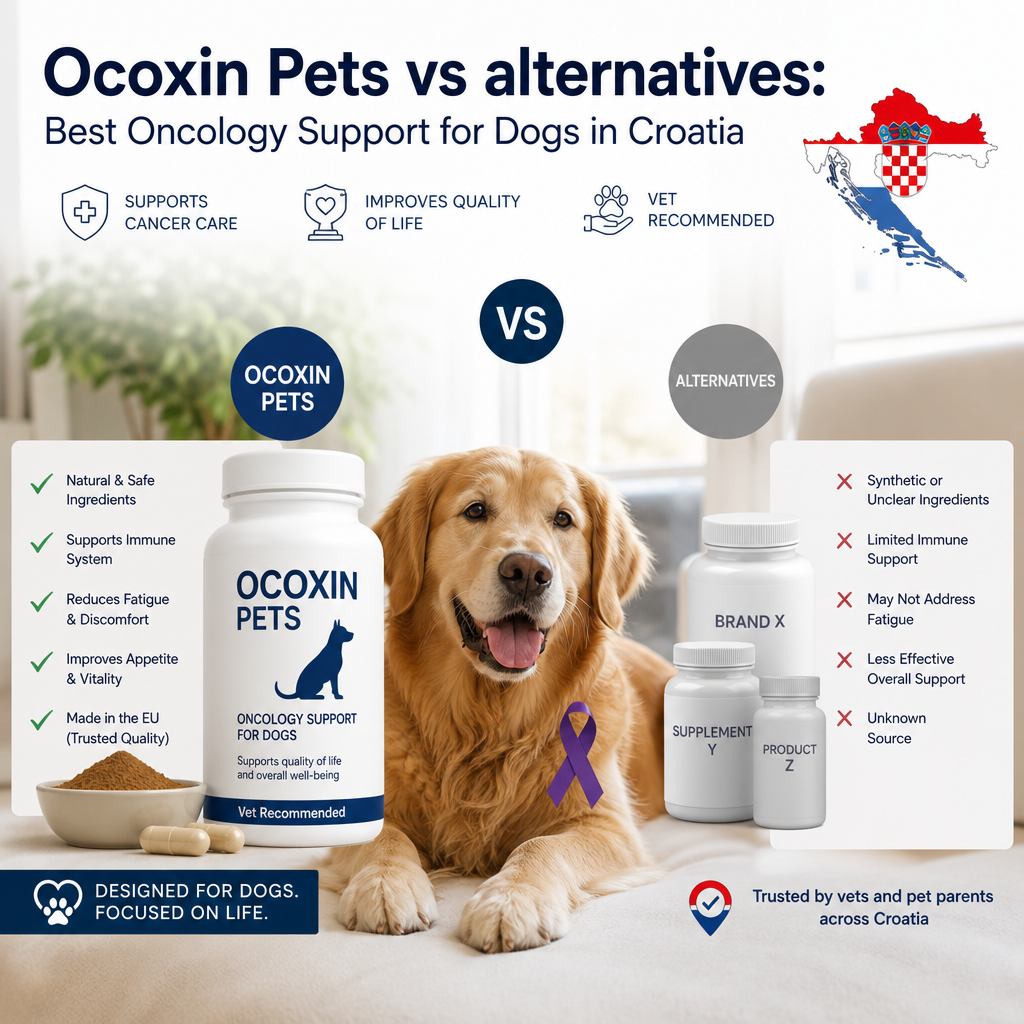
Ocoxin Pets vs alternatives is an important comparison for Croatian dog owners looking for safe, evidence-informed ways to support a pet during cancer treatment. Nutritional supplements cannot replace surgery, chemotherapy, radiation therapy, or veterinary monitoring, but they may help maintain appetite, body condition, hydration, and general wellbeing when used appropriately. The best choice depends on the dog’s diagnosis, treatment plan, current symptoms, medications, and overall health.

Understanding oncology nutritional support for dogs

Ocoxin Pets 與替代品插圖

Cancer can affect a dog’s body in several ways. Some tumors increase energy demands, while others cause inflammation, digestive problems, pain, or reduced appetite. Treatment may also lead to nausea, fatigue, diarrhea, or changes in taste and smell. As a result, maintaining adequate nutrition can become difficult. In practical terms, Ocoxin Pets vs alternatives often comes down to which option helps the dog eat better and stay more stable during treatment.

Oncology nutritional support aims to help a dog receive enough calories, protein, fluids, and essential nutrients during illness. It may include:

  • A complete veterinary therapeutic diet
  • High-quality protein and energy-dense foods
  • Omega-3 fatty acids, particularly EPA and DHA
  • Carefully selected vitamins and minerals
  • Appetite and digestive support prescribed by a veterinarian
  • Supplements designed specifically for dogs undergoing cancer care

A supplement should be viewed as one part of a wider plan. Before adding any product, the veterinarian should review the dog’s blood tests, kidney and liver function, medications, and treatment schedule. For broader background on diagnosis and care, readers can also review 狗癌症要點:有用的寵物腫瘤學指南.

Good supportive care is rarely about one ingredient alone. It usually includes feeding strategies, symptom control, and regular follow-up. When owners compare Ocoxin Pets vs alternatives, they should also think about how easy it will be to keep the dog eating, hydrated, and comfortable over time. Small practical details, such as how the product tastes, how often it must be given, and whether it fits the dog’s meal routine, can matter as much as the ingredient list.

For many dogs, supportive nutrition is most useful when it is started early. Waiting until a dog has already lost significant weight can make recovery harder. That is why discussions about Ocoxin Pets vs alternatives are best held before appetite drops sharply, not after the dog has already become weak. A proactive plan gives the veterinary team more room to adjust the diet and supplement approach safely.

Ocoxin Pets 是什麼?

Ocoxin Pets is marketed as a complementary nutritional product for dogs and cats, commonly used as supportive care alongside conventional veterinary oncology. Its formulation may include plant-derived ingredients, antioxidants, vitamins, minerals, and other nutritional compounds. The precise composition can vary by product version and market, so owners should read the current label and follow veterinary guidance.

The intended role of Ocoxin Pets is supportive rather than curative. It may be considered when a dog needs help maintaining food intake, condition, or general vitality during a demanding period. However, the product should not be presented as a treatment that destroys tumors or replaces proven cancer therapy.

Potential advantages include its veterinary-oriented formulation and convenient use. Possible limitations include cost, variable response between individual dogs, palatability issues, and uncertainty about how its ingredients interact with particular chemotherapy protocols. Even natural substances can influence drug metabolism, blood clotting, blood pressure, or immune activity.

That is why Ocoxin Pets vs alternatives should always be reviewed with the oncology team rather than chosen on marketing claims alone.

Some owners want a supplement that sounds comprehensive, but a broad formula is not automatically better. Dogs with cancer may need a targeted approach based on what is actually happening in the body. If the main issue is appetite loss, a palatable calorie-dense diet may be more useful than a complex supplement. If the main issue is digestive upset, a different supportive option may be more appropriate. In other words, Ocoxin Pets vs alternatives should be judged by the dog’s needs, not by how many nutrients a label lists.

The best way to think about Ocoxin Pets is as a possible helper in a larger care plan. It may fit some cases well, but it should be matched against the rest of the dog’s treatment and support strategy. That is especially important in oncology, where timing, dose, and medication interactions can change what is safe.

Ocoxin Pets vs alternatives: key factors to compare

When comparing Ocoxin Pets with other dog tumor support options, owners should look beyond advertising claims. The following factors are especially important. A clear Ocoxin Pets vs alternatives review usually starts with the dog’s nutritional needs, not the brand name.

成分透明度

A product should clearly list its active ingredients, amounts per serving, administration instructions, storage requirements, and warnings. Transparent labeling makes it easier for a veterinarian to assess whether the supplement is appropriate.

Scientific support

Evidence for veterinary cancer supplements varies widely. Some ingredients have research suggesting potential nutritional or metabolic benefits, but laboratory findings do not automatically prove that a supplement improves survival or treats cancer in dogs. Products supported by veterinary research, quality-control information, and responsible claims are generally preferable to products promising dramatic cures.

個別犬隻的適用性

A supplement suitable for a healthy adult dog may be inappropriate for a dog with kidney disease, liver dysfunction, diabetes, pancreatitis, bleeding problems, or a sensitive stomach. The dog’s size, age, tumor type, treatment protocol, and current diet all matter.

Tolerance and palatability

Even a well-formulated product has limited value if the dog refuses it or develops vomiting and diarrhea. Introduce any new supplement gradually when the veterinarian agrees, and monitor appetite, stool quality, energy, and hydration.

與治療的兼容性

Antioxidant-rich products require particular care during chemotherapy or radiation therapy. The effect depends on the type, timing, and dose of treatment, as well as the specific ingredients involved. Owners should provide the oncology team with a complete list of supplements, including herbal products and fish oils.

For general evidence-based advice on cancer in pets, see the ASPCA overview of cancer in dogs.

When people search for Ocoxin Pets vs alternatives, they are often trying to answer a few practical questions: Will the product help my dog feel better? Is it safe with current medication? Can I give it every day? Will it work alongside food changes and treatment? Those are the right questions to ask because they focus on daily care rather than promises.

It also helps to compare how each option is monitored. Some products require careful observation of stool quality, appetite, or energy for the first week. Others are mostly food-based and can be adjusted more easily. In a real clinic setting, the best choice is often the one that fits the dog’s routine and can be tracked clearly over time.

Common alternatives to Ocoxin Pets

There is no single best supplement for every dog. In an Ocoxin Pets vs alternatives comparison, the right choice may depend on whether the dog needs calories, digestive support, or a more complete therapeutic diet. Alternatives may be chosen according to the dog’s most urgent nutritional needs.

治療性獸醫飲食

Prescription oncology or recovery diets can provide concentrated calories, high-quality protein, and controlled levels of fat and fiber. These foods are often more useful than a general supplement when weight loss or poor appetite is the main concern. A veterinary nutritionist can help select a diet for dogs with pancreatitis, kidney disease, or digestive complications.

Omega-3脂肪酸

Fish oil containing EPA and DHA is frequently discussed in canine cancer nutrition. These fatty acids may support skin, immune, and inflammatory processes, and they can contribute calories to the diet. Product quality is important because oils can become rancid or contain contaminants. The dose should be calculated by the veterinarian, particularly if the dog has gastrointestinal disease or takes medication affecting blood clotting.

High-calorie nutritional gels and recovery formulas

Energy-dense gels, liquid diets, and recovery foods may help dogs that cannot eat normal portions. They can be useful for short-term support, but they are not always complete diets and should not be used indefinitely without professional advice.

益生菌和消化支持

Some dogs develop diarrhea or altered bowel habits during illness or treatment. A veterinary probiotic may help support normal intestinal function in selected cases. However, persistent diarrhea, vomiting, blood in the stool, or dehydration requires prompt veterinary assessment rather than supplement-only management.

Individual ingredients

Veterinarians sometimes consider ingredients such as medicinal mushrooms, turmeric-derived compounds, amino acids, or specific antioxidants. The quality and evidence differ substantially between products. “Natural” does not automatically mean safe, and concentrated extracts can interact with prescribed medication.

Many owners find it helpful to compare each option against core priorities such as appetite, digestibility, and treatment compatibility. In that sense, Ocoxin Pets vs alternatives is less about one “best” brand and more about matching the right support to the dog’s current needs.

Some dogs need a single focused product, while others do better with a combination approach. For example, a prescription diet may be paired with omega-3s, or a recovery formula may be paired with a probiotic when the stomach is sensitive. The point is not to stack as many products as possible. The point is to choose the fewest effective tools that support nutrition without increasing the risk of side effects.

Owners should also remember that supplements are not all equal in quality control. Products made for pets and sold through veterinary channels are generally easier for a clinician to evaluate. That does not make every veterinary product ideal, but it does make review and monitoring more straightforward.

Choosing the right approach in Croatia

Availability in Croatia can vary between veterinary clinics, pharmacies, pet shops, and online retailers. Owners should check that products are intended for animals, have clear labeling, and come from a reputable manufacturer. Imported supplements may have different formulations, serving recommendations, or regulatory information depending on the market.

A Croatian veterinarian, veterinary oncologist, or veterinary nutritionist can help compare Ocoxin Pets with locally available alternatives. Ask for a practical plan covering the dog’s daily calorie target, preferred food, supplement dose, treatment timing, monitoring schedule, and signs that require immediate attention.

Cost is also a realistic consideration. A less expensive complete therapeutic diet may provide more meaningful support than an expensive supplement added to an inadequate feeding plan. The priority should always be maintaining nutrition, comfort, and treatment safety.

Owners researching Ocoxin Pets vs alternatives should also consider whether a product is easy to buy consistently, because switching products too often can make it harder to judge what is actually helping.

In Croatia, as in any country, practical access matters. If a product is difficult to obtain regularly, the dog may miss doses or experience unnecessary changes in routine. A consistent plan is usually better than a theoretically excellent product that cannot be sourced reliably. That is another reason Ocoxin Pets vs alternatives should be reviewed with the local veterinary team.

It can help to write down the following before making a decision:

  • The dog’s current weight and recent weight changes
  • What the dog is eating now and how much
  • Any vomiting, diarrhea, or constipation
  • All medications and treatment dates
  • Any history of kidney, liver, pancreas, or clotting problems
  • How easy the product is to buy again in the same form

That simple checklist often makes the discussion more productive and helps narrow Ocoxin Pets vs alternatives to the options that are actually practical for the household.

Warning signs that need veterinary attention

Contact a veterinarian promptly if a dog refuses food for an extended period, repeatedly vomits, develops severe diarrhea, loses weight quickly, appears painful, becomes unusually weak, or has difficulty breathing. Sudden changes in thirst or urination may indicate kidney or metabolic problems. Supplement use should never delay investigation of these symptoms.

It is especially important to stop self-directed experimentation when symptoms change quickly. Even if a supplement seemed useful at first, the dog’s condition may require a different approach. If you are still comparing Ocoxin Pets vs alternatives at this point, the pet’s symptoms should guide the next step more than the product label.

Watch for subtle changes too. A dog that is less interested in meals, hides more than usual, or sleeps much more can be signaling discomfort before more obvious illness appears. Early veterinary input can prevent a small problem from becoming a major setback.

Owners should not assume that a natural supplement will be gentle enough to continue through every phase of treatment. Some products can worsen nausea or interfere with another medication. When in doubt, pause the product and ask the clinician for advice rather than guessing.

A balanced decision

The best oncology nutritional support is not necessarily the product with the longest ingredient list. It is the strategy that fits the dog’s medical condition, supports adequate nutrition, does not interfere with treatment, and can be monitored safely. Ocoxin Pets may be a reasonable complementary option for some dogs, while others may benefit more from a therapeutic diet, omega-3 supplementation, digestive support, or a carefully designed combination.

For Croatian pet owners, the most reliable path is a personalized plan developed with the veterinary oncology team. Supplements can contribute to comfort and nutritional care, but successful cancer management depends on accurate diagnosis, appropriate treatment, regular monitoring, and attention to the dog’s quality of life. If you are weighing Ocoxin Pets vs alternatives, the most useful question is which option best supports your dog today and remains safe alongside the full treatment plan.

To keep the decision grounded, focus on three goals: help the dog eat enough, avoid unnecessary side effects, and preserve the ability to continue prescribed cancer care. When those goals are met, supportive nutrition becomes more than a product choice. It becomes part of a thoughtful, humane care plan that can be adjusted as the disease changes.

For readers researching broader care strategies, it can also help to review related guidance on canine cancer support and nutrition. One useful starting point is 罹患癌症狗狗的最佳補充品:7個英國必備照護建議, which provides additional context on supportive options for dogs undergoing oncology treatment. Used together with local veterinary advice, that background can make Ocoxin Pets vs alternatives easier to evaluate in a practical way.

帶有TCMVET的綠色陰陽標誌
隱私概覽

本網站使用 cookies,以便我們能夠為您提供最佳的用戶體驗。Cookie 資訊儲存在您的瀏覽器中,並執行一些功能,例如在您返回我們的網站時識別您,並幫助我們的團隊了解您認為最有趣和有用的網站部分。.