
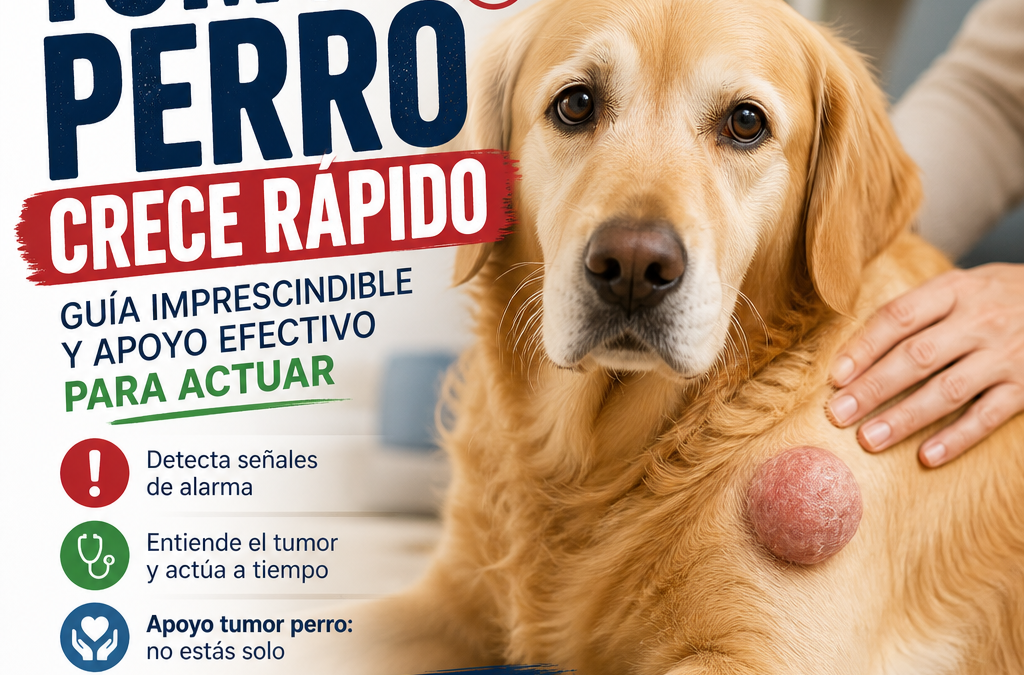
Un tumor perro crece rápido puede generar mucha inquietud, sobre todo cuando la masa cambia de tamaño en pocos días o semanas. Aun así, la velocidad de crecimiento por sí sola no permite saber si se trata de una lesión benigna, maligna, inflamatoria o infecciosa. La respuesta más segura es observar los cambios con atención y acudir pronto al veterinario para obtener un diagnóstico fiable.
Tabla de contenidos
- ¿Qué significa que un tumor en un perro crezca rápido?
- Señales de alarma que requieren una consulta rápida
- Cómo se diagnostica una masa de crecimiento rápido
- Tratamientos posibles según el diagnóstico
- Apoyo tumor perro: cuidados responsables en casa
- Cuándo pedir una segunda opinión
- Seguimiento y calidad de vida
- Preguntas frecuentes
¿Qué significa que un tumor en un perro crezca rápido?
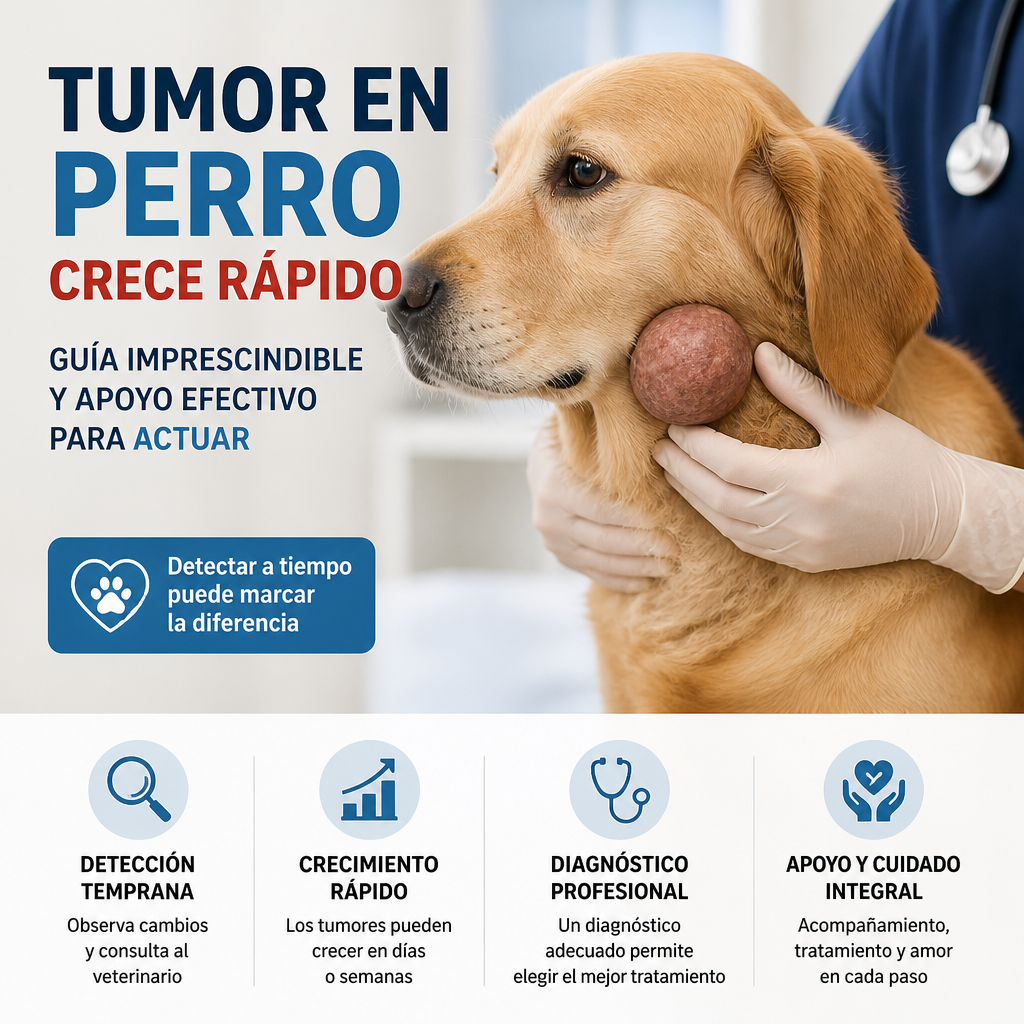
La expresión “tumor perro crecimiento rápido” describe una masa que aumenta de volumen de manera evidente en un periodo corto. Puede aparecer en la piel, debajo de ella, en las mamas, en la boca, en las extremidades o en otras zonas del cuerpo. Algunas masas crecen rápidamente porque tienen un comportamiento agresivo, pero otras aumentan debido a inflamación, acumulación de líquido, infección, traumatismo o sangrado interno.
Entre las causas posibles se encuentran los lipomas, quistes, abscesos, mastocitomas, sarcomas de tejidos blandos y tumores mamarios. También existen lesiones cutáneas que pueden parecer pequeñas al principio y cambiar de forma, color o textura con el tiempo. Por eso, palpar una masa no es suficiente para determinar su naturaleza.
Rapid growth warrants veterinary attention, especially if accompanied by pain, ulceration, bleeding, hair loss, foul odor, or changes in the animal's behavior. In this phase, clear thinking helps more than trying to guess the origin of the problem.
It is worth remembering that a recent lump does not always behave the same as a lesion that has been unchanged for months. The dog's age, location, consistency to the touch, and the speed at which the volume changes provide important clues, but none of them replace clinical evaluation. Therefore, in the face of a tumor perro crece rápido, the priority must be to confirm what type of tissue is involved and whether there is a risk of extension to other areas.
It is also useful to observe whether the mass moves over the skin, if it is adhered to deep planes, or if it causes discomfort when walking, chewing, or lying down. This information, although it may seem simple, often guides the initial assessment. In some cases, an increase in size reflects active inflammation; in others, it may indicate a process that requires urgent treatment. The difference between both situations is only clarified with appropriate tests.
Señales de alarma que requieren una consulta rápida
Not all masses constitute an immediate emergency, but some signs indicate that it is advisable to seek attention without delay:
- Visible growth in days or a few weeks.
- Changes in color, shape, or consistency.
- Open wound, bleeding, discharge, or foul odor.
- Pain when touching the area or reluctance to have it examined.
- Difficulty walking, eating, breathing, or swallowing.
- Loss of appetite, vomiting, diarrhea, or weight loss.
- Marked fatigue, fever, or unusual behavior.
- Inflamed lymph nodes near the mass.
- Location in the mouth, around the eyes, in the throat, or near a joint.
If the dog shows difficulty breathing, heavy bleeding, extreme weakness, pale gums, fainting, or intense pain, it should be assessed as a veterinary emergency. When a tumor perro crece rápido and also alters breathing or mobility, it is not advisable to wait for the next routine check-up.
There are signs that also deserve attention even if they do not seem serious at first. For example, a mass that begins to ulcerate or change color may be suffering from necrosis or secondary irritation. Similarly, a dog that persistently licks a specific area may be trying to relieve pain or itching, suggesting that something is wrong. Taking daily photos and noting symptoms helps to verify if the change is real or just a momentary perception.
If the lesion is on a limb, observe if the dog puts less weight on the leg, if it avoids jumping, or if it sits frequently to rest. When the mass is in the mouth, difficulty chewing, excessive salivation, or refusal of hard food may be noticeable. In the abdomen or chest, changes are often more subtle, but fatigue, coughing, or weight loss can be valuable clues. In any case, an early check-up reduces the risk of overlooking a significant illness.
Cómo se diagnostica una masa de crecimiento rápido
The veterinarian will begin with a complete physical examination. They will assess the size, mobility, temperature, consistency, and relationship of the mass with nearby tissues. They will also check the lymph nodes and look for other lesions.
One of the most commonly used tests is fine needle aspiration cytology. It involves extracting a small amount of cells to examine them under a microscope. In many cases, this procedure quickly indicates whether the mass contains inflammatory cells, fat, bacteria, or other types of tissue.
When cytology is inconclusive, a biopsy may be necessary. This allows for the analysis of a tissue fragment and provides a more precise understanding of the type of lesion and its degree of aggressiveness. Depending on the case, the professional may request blood tests, X-rays, ultrasound, computed tomography, or magnetic resonance imaging to check for involvement of other organs.
It is important not to delay testing by waiting for the mass to “mature” or disappear. Early diagnosis can expand treatment options and facilitate a less complex intervention. Additionally, in a situation of tumor perro crece rápido, the speed of the study often makes the difference between a simple surgery and a much broader approach.
To expand general information on nutritional signs and complementary care during an oncological process, it may be helpful to review this guide on best supplements for dogs with cancer, always as support and never as a substitute for veterinary diagnosis.
In the consultation, it can also be helpful to mention if the dog has had other lumps, allergies, skin infections, recent weight loss, or changes in behavior. Some benign tumors grow quickly during a specific phase and then stabilize, while other processes continue to expand without pause. Differentiating these patterns is not always possible at home, but it does help to decide which tests to request first. The goal is to reach a diagnosis with the least possible delay and with enough information to choose the best plan.
What information to bring to the consultation
Before the visit, it is advisable to prepare a list with the approximate date of appearance, the observed size changes, measurements if available, and any associated symptoms. If you have photos taken on different days, bring them as well. That visual comparison is usually very illustrative when the tumor perro crece rápido and it is necessary to assess the evolution accurately.
Tratamientos posibles según el diagnóstico
The treatment depends on the type of mass, its location, its size, the general health of the dog, and the possible presence of metastases. In small, stable benign lesions that do not cause discomfort, the veterinarian may recommend periodic monitoring. Even so, a mass that grows quickly usually requires a more active evaluation.
Surgery is a common option when the lesion can be completely removed. In malignant tumors, the surgeon may need to remove healthy tissue around it to reduce the risk of leaving tumor cells behind. In certain situations, chemotherapy, radiotherapy, targeted treatments, or combinations of various therapies are used.
When healing is not possible or the treatment is too aggressive, palliative care takes on a fundamental role. The goal is to control pain, maintain appetite, facilitate rest, and preserve quality of life for as long as possible.
In some families, the decision to treat or not to treat becomes emotionally difficult. In this context, asking for a clear explanation about objectives, costs, possible side effects, and prognosis helps to make calmer and more realistic decisions. It is also reasonable to request a phased plan to reassess the response before moving on to more intensive treatments.
Therapeutic choice does not always depend solely on the histological diagnosis. Sometimes the dog's age, its ability to tolerate anesthesia, the location of the mass, and the possibility of completely removing the lesion also influence the decision. In tumors that appear advanced, early intervention may still be useful to reduce discomfort or avoid local complications. And when the situation is very complex, the veterinarian may propose a combined approach to balance efficacy and comfort.
If the dog is already being treated, it is important to ask what signs would indicate that the therapy is working and which would require adjusting the plan. For example, the appearance of vomiting, lethargy, or diarrhea may be related to the treatment or the progression of the disease. Knowing how to distinguish between both scenarios helps to react in time and avoid unnecessary complications.
When surgery is not enough
There are masses that can be removed, but still require follow-up because they tend to recur. In those cases, the pathology report is key to deciding whether more frequent monitoring, larger surgical margins, or additional treatments are needed. With a tumor perro crece rápido, the analysis after surgery is as important as the intervention itself.
Apoyo tumor perro: cuidados responsables en casa
The apoyo tumor perro debe complementar, nunca sustituir, la atención veterinaria. En casa, conviene mantener una rutina tranquila y observar al animal diariamente. Anotar el tamaño de la masa, tomar fotografías con una referencia de medida y registrar cambios en el apetito o la energía puede ayudar al veterinario a valorar la evolución.
Evita apretar, pinchar, cortar o aplicar productos caseros sobre la lesión. Las pomadas humanas, los aceites esenciales, el alcohol, el agua oxigenada y algunos antiinflamatorios pueden irritar la piel o resultar tóxicos. Si la masa se ulcera, cúbrela únicamente con una gasa limpia si el veterinario lo indica y evita que el perro la lama mediante un collar protector.
Ofrece una alimentación equilibrada y agua fresca. Si tiene menos apetito, pueden recomendarse dietas más palatables, pero cualquier cambio debe ajustarse a sus necesidades médicas. El ejercicio debe adaptarse a su estado: paseos cortos y suaves pueden ser beneficiosos, mientras que los saltos o esfuerzos intensos pueden empeorar el dolor o provocar lesiones.
También es importante cuidar el entorno. Una cama cómoda, superficies antideslizantes y acceso fácil al agua pueden reducir el estrés diario. Si el perro se muestra más cansado, ajustar los horarios de paseo y descanso puede mejorar mucho su bienestar sin añadir complicaciones.
El apoyo en casa incluye también vigilar la piel alrededor de la masa. Si aparecen costras, enrojecimiento o humedad constante, puede haber irritación secundaria o infección, y eso conviene comunicarlo al veterinario. Mantener la zona limpia, siempre siguiendo la pauta profesional, suele prevenir complicaciones y reduce el malestar del perro. Cuando un tumor perro crece rápido, estos detalles cotidianos tienen más valor del que parece.
Qué no hacer mientras esperas la cita
Mientras llega la consulta, evita medicar por tu cuenta, manipular la masa repetidamente o intentar vaciarla. No apliques calor intenso ni compresas frías sin indicación profesional, porque algunas lesiones empeoran con estos intentos. Tampoco conviene retrasar la visita pensando que la masa “se reabsorberá” sola, especialmente si el tumor perro crece rápido o cambia de aspecto.
Si hay sangrado leve, presiona suavemente con una gasa limpia durante unos minutos y observa la respuesta. Si el sangrado no cede o la herida se abre más, acude a revisión cuanto antes.
También evita combinar varios productos “naturales” sin supervisión. Aunque sean de venta libre, algunos pueden interferir con medicamentos, alterar la coagulación o causar irritación en piel lesionada. La prudencia es especialmente importante cuando el perro toma otras terapias o cuando el veterinario ya ha detectado una lesión sospechosa. Un manejo simple y ordenado suele ser más seguro que intentar hacer demasiadas cosas a la vez.
Cuándo pedir una segunda opinión
Asking for a second opinion can be a prudent decision when the diagnosis is unclear, the proposed treatment is complex, or the mass changes rapidly and does not fit the initial explanation. It is also helpful if you want to confirm whether surgery, biopsy, or a follow-up plan is really the best option.
A second opinion does not mean automatic distrust, but sometimes it offers a valuable additional perspective. In veterinary oncology, reviewing images, cytologies, or biopsies with another specialist can provide reassurance before making important decisions.
If you can, always request copies of reports, lab results, and imaging tests. Having all the documentation organized makes it easier for another professional to evaluate the case without repeating unnecessary steps. This is especially relevant when the tumor perro crece rápido and time matters.
It is also worth seeking another opinion if you notice that the proposed plan does not address your concerns or if the dog continues to worsen despite the initial treatment. In those cases, a review by a specialist in oncology or surgery can expand options and provide a clearer prognosis. The second opinion does not change the problem, but it can improve the way to approach it.
Seguimiento y calidad de vida
Even after surgery or an apparently favorable diagnosis, follow-ups are essential. The veterinarian can monitor healing, check lymph nodes, repeat tests, and detect relapses early. In some tumors, follow-up includes periodic checks for months or years.
The speed at which a mass grows should not be interpreted in isolation. The most important thing is to combine that data with the appearance of the lesion, general symptoms, test results, and response to treatment. Acting quickly, without resorting to improvised remedies, offers the dog better opportunities to receive appropriate care and maintain a good quality of life.
If the plan involves palliative care, the goal is no longer just to prolong time, but to maintain comfort, appetite, rest, and family bonding. At this stage, small daily decisions—such as adjusting exercise, managing pain, and monitoring appetite—can make a real difference.
In summary, in the face of a tumor perro crece rápido, the best strategy is not to minimize the change or assume a diagnosis by intuition. An early review, appropriate tests, and responsible follow-up provide the most solid foundation for acting calmly and protecting the dog.
Follow-up also serves to assess the animal's emotional response. Some dogs become more reserved, sleep more, or seek less interaction when they feel pain or discomfort. Detecting those changes helps adjust management at home and consult if the pain management plan needs revision. It is not just about monitoring the size of the lump, but the overall well-being of the dog in its day-to-day life.
Preguntas frecuentes
Does a rapidly growing tumor always mean it is malignant?
No. Algunas masas benignas, inflamatorias o infecciosas pueden crecer rápido. Aun así, cualquier cambio acelerado requiere evaluación veterinaria para saber qué está ocurriendo realmente.
¿Puedo esperar unos días para ver si disminuye?
Solo en casos muy leves y si el veterinario ya ha visto la lesión. Si el tumor perro crece rápido, duele, sangra o cambia de aspecto, lo recomendable es pedir cita cuanto antes.
¿Sirven los remedios caseros?
No sustituyen el diagnóstico ni el tratamiento profesional. Algunos productos pueden irritar la piel o empeorar la lesión, así que es mejor no aplicarlos sin indicación veterinaria.
¿Qué debo llevar si voy a una consulta urgente?
Lleva fotos, notas sobre el crecimiento, la lista de medicamentos o suplementos y, si existe, cualquier informe previo. Esa información agiliza la valoración y ayuda a decidir las pruebas más adecuadas.
¿Qué señales indican que debo ir de inmediato?
Dificultad respiratoria, sangrado abundante, dolor intenso, desmayo, encías pálidas, debilidad extrema o incapacidad para comer o moverse con normalidad.
Si necesitas una referencia educativa sobre cáncer y masas en animales de compañía, la información clínica de la Manual Veterinario Merck ofrece una base fiable y clara para comprender por qué una masa de crecimiento acelerado merece atención profesional.