
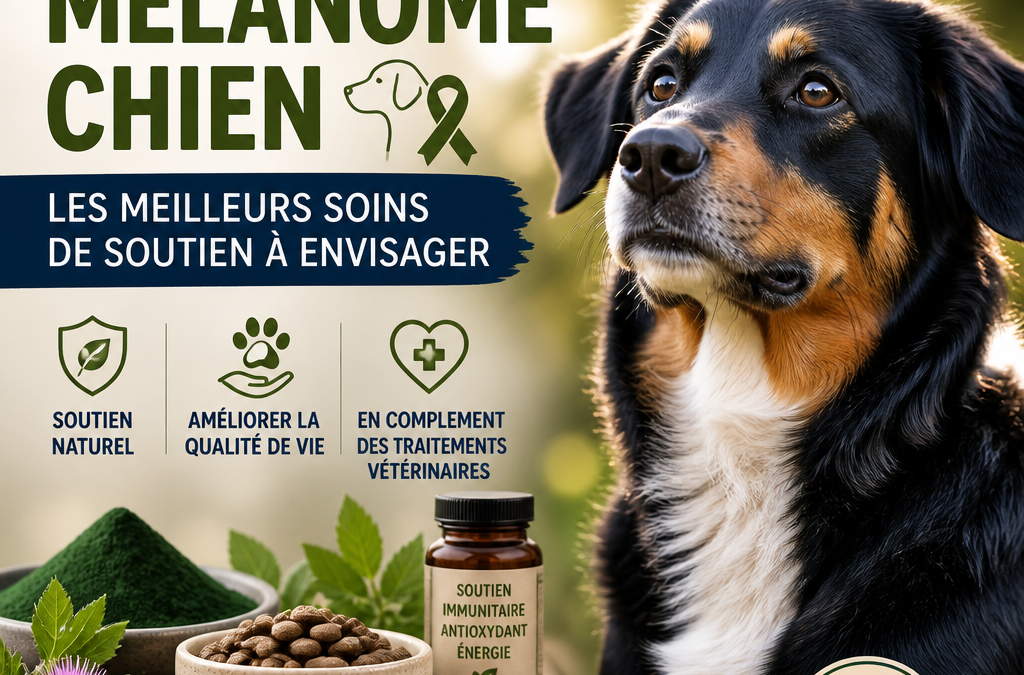
The complément mélanome chien peut aider à soutenir l’organisme d’un animal atteint, mais il ne remplace jamais le diagnostic, la chirurgie, l’immunothérapie ou tout autre traitement recommandé par le vétérinaire. Le mélanome est une tumeur formée à partir des mélanocytes, les cellules responsables de la pigmentation. Chez le chien, il peut apparaître dans la bouche, sur la peau, au niveau des doigts ou autour des yeux. Son évolution dépend notamment de sa localisation, de sa taille, de son grade et de la présence éventuelle de métastases. Une approche globale associe donc les soins médicaux à une alimentation adaptée, une surveillance attentive et des mesures visant à préserver la qualité de vie.
- Comprendre le mélanome chez le chien
- Complément mélanome chien : quels objectifs rechercher ?
- Soutien nutritionnel et maintien du poids
- Oméga-3, vitamines et antioxydants : prudence et mesure
- Mélanome chien soutien : améliorer le confort au quotidien
- Les plantes et produits naturels : une vigilance indispensable
- Suivi vétérinaire et signes d’alerte
Comprendre le mélanome chez le chien
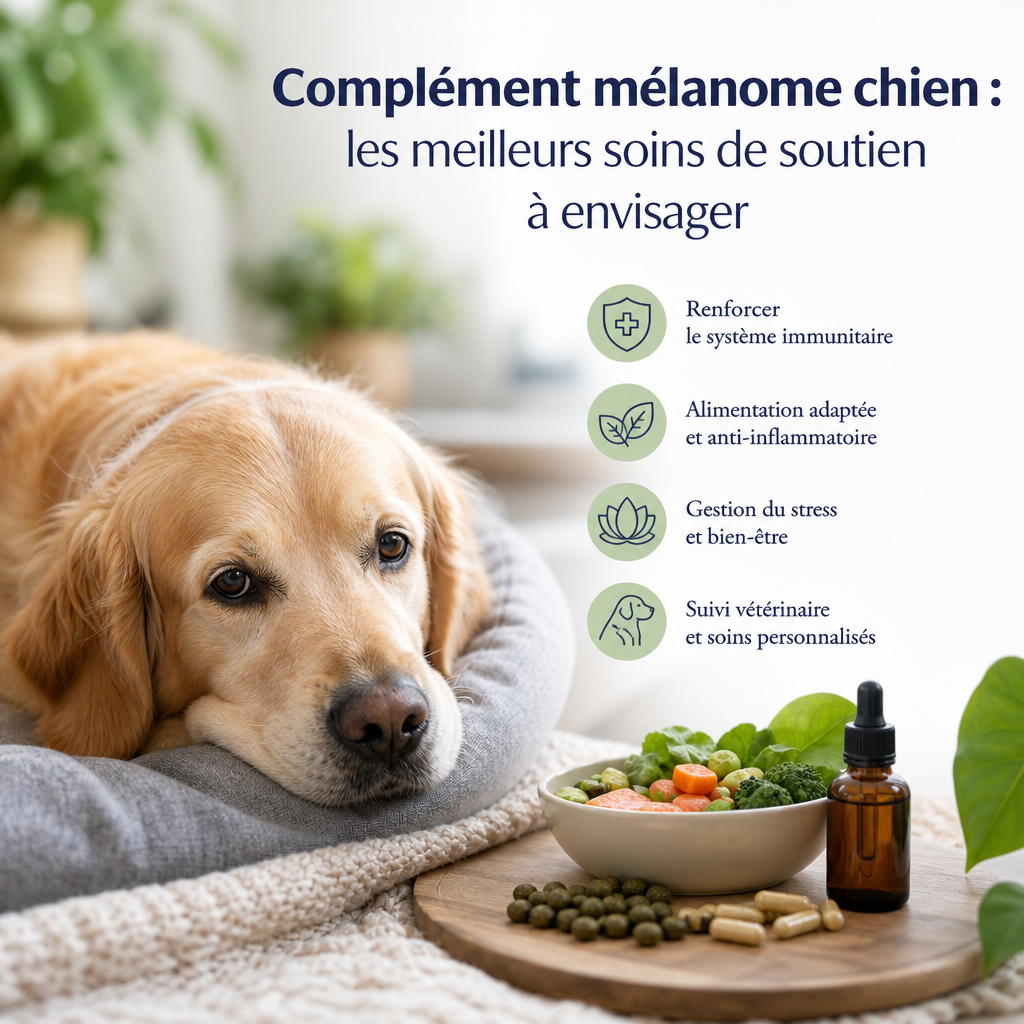
Tous les mélanomes canins ne présentent pas le même comportement. Les mélanomes cutanés de petite taille, notamment lorsqu’ils se développent sur des zones peu pigmentées, peuvent parfois être moins agressifs. En revanche, les mélanomes situés dans la cavité buccale ou au niveau des doigts sont souvent plus susceptibles d’évoluer rapidement.
The signs depend on the area concerned. A pigmented mass that changes appearance, persistent bad breath, bleeding in the mouth, difficulty eating, limping, or local swelling should prompt a consultation. The veterinarian may recommend cytology, a biopsy, blood tests, and imaging examinations to accurately assess the situation.
The main treatment may include surgical excision, radiotherapy, immunotherapy, or a combination of several options. Dietary supplements are only involved as support, after validation by the professional caring for the animal. To better understand tumor progression and possible consequences, you can also consult this article on metastasis and the spread of cancers in dogs.
As part of a complément mélanome chien, it is useful to keep a simple vision: the goal is not to promise a miraculous action, but to help the animal better endure the care, to maintain its strength, and to limit certain daily discomforts.
Complément mélanome chien : quels objectifs rechercher ?
A supplement intended for a dog with melanoma should not be presented as an autonomous anticancer treatment. Its potential interest rather concerns the support of important functions during the disease or treatments: maintenance of general condition, nutritional intake, muscle support, digestive comfort, and assistance in recovery.
The choice must meet a clearly identified need. A dog that is losing weight will not have the same priorities as an animal that is eating normally but shows significant fatigue after a procedure. Similarly, a product suitable for a dog with healthy kidneys may be contraindicated in an animal suffering from kidney failure.
Before any administration, it is essential to check the composition, dosages, and any potential interactions with prescribed medications. Products intended for humans are not always suitable for dogs, as certain substances or concentrations may be toxic.
Un complément mélanome chien Bien choisi doit rester cohérent avec les priorités cliniques du moment. Si l’animal est douloureux, la priorité est d’abord le contrôle de la douleur. Si l’appétit baisse, il faut d’abord sécuriser les apports alimentaires. Si la tumeur provoque des saignements ou une gêne importante, la surveillance vétérinaire devient la base de tout le reste.
It is also important to distinguish between two situations. Some dogs receive a supplement to support recovery after surgery. Others need broader support, for example when the tumor is advanced or accompanied by persistent fatigue. In both cases, the strategy must be individualized.
Soutien nutritionnel et maintien du poids
Loss of appetite and weight loss can weaken a dog with cancer. A complete, palatable, and sufficiently energetic diet is therefore a priority. The veterinarian may recommend a therapeutic diet or a personalized ration based on age, weight, activity, tumor location, and any associated diseases.
Proteins play an important role in maintaining muscle mass, but their quantity must be adapted to the animal's profile. Fats can increase the energy density of meals, while some dogs may not tolerate them well digestively. It is also important to consider nausea, pain, or difficulty chewing when a melanoma affects the mouth.
To stimulate appetite, it can sometimes be helpful to offer small portions several times a day, to slightly warm the food, or to choose a texture that is easier to swallow. Any significant modification should, however, be gradual and monitored. In some cases, the veterinarian may recommend a better dog cancer dietary supplement adapted to the animal's profile to help maintain energy and appetite.
Monitoring weight once a week helps to quickly spot muscle wasting or a decline in overall condition. Even a modest variation can be significant in a sick dog, especially if it is accompanied by a decrease in meals or a change in behavior.
When evaluating a complément mélanome chien, the most useful criterion often remains its ability to support daily life without worsening digestive disorders. A product that is too rich, poorly tolerated, or difficult to administer quickly becomes counterproductive, even if it seems interesting on paper.
For some dogs, nutritional adjustment involves more frequent meals, a softer texture, or better palatability. For others, it is mainly about avoiding sudden changes and maintaining a stable routine. The veterinarian may also suggest monitoring food intake for several days to identify the best options.
If the dog eats less, one should not wait for weight loss to be visible to react. Muscle wasting can begin before apparent weight loss. This is why regular monitoring of weight, body condition, and muscle mass is so important in the follow-up of an animal with cancer.
Oméga-3, vitamines et antioxydants : prudence et mesure
Omega-3s, particularly from fish oil, are often studied in the context of nutritional support for sick dogs. They can contribute to the balance of the diet and the maintenance of skin and coat. However, they must be used at a dose appropriate to the animal's weight and health status. An excessive amount can cause digestive disorders or pose problems in some dogs.
Vitamins and antioxidants also require caution. A complete diet generally covers current needs, and unjustified supplementation can lead to imbalances. Some antioxidants or plant extracts can alter the action of medications or influence coagulation.
In the search for a complément mélanome chien, quality and transparency are more important than the number of ingredients. It is better to choose a clearly labeled formula, designed for dogs and recommended by a veterinarian, rather than a mixture presented as capable of curing the tumor.
The choice of a product must also take into account digestive tolerance. A dog that is already weakened may react to a change in formula, even when the ingredients seem simple. Introducing a new product one at a time makes it easier to identify any intolerance.
Omega-3s can sometimes be considered in a support strategy, but they do not replace clinical evaluation or cancer treatment. A good practice is to ask what exact dose is relevant, for how long, and with what concrete objective. This approach avoids excesses and limits disappointments.
On the vitamin side, the temptation is often to “boost” the animal as much as possible. However, in sick dogs, more is not always better. An excessively high intake of certain vitamins can disrupt the overall balance, especially if the animal is already receiving a complete diet. This is why each complément mélanome chien should be considered as a piece of the puzzle and not as an isolated solution.
Antioxidants deserve the same caution. Their role is sometimes mentioned to support cells against oxidative stress, but their use must remain consistent with the medical protocol. In case of doubt, the veterinarian or veterinary oncologist is best placed to arbitrate between potential benefit and risk of interaction.
Mélanome chien soutien : améliorer le confort au quotidien
The melanoma dog support is not limited to dietary supplements. Daily comfort is a major component of care. Effective pain management can improve appetite, sleep, mobility, and interactions with family. Pain relief medications should be prescribed and adjusted by the veterinarian.
The environment can also be adapted. A comfortable bed, stable temperature, less slippery floors, and easy access to water reduce unnecessary effort. If the dog suffers from a mouth lesion, soft meals can facilitate eating. In case of lameness, it is better to limit intense activities while maintaining short outings suited to its abilities.
Quality of life should be assessed regularly. Appetite, pain, breathing, mobility, hygiene, sleep, and interest in usual activities are useful indicators. Noting these elements over the days allows for quicker detection of deterioration.
Les moments de repos doivent être respectés, mais il ne faut pas non plus laisser l’animal s’isoler complètement. Un chien qui garde des repères familiers et un rythme de vie prévisible récupère souvent mieux au quotidien.
Une routine simple aide beaucoup : repas aux mêmes horaires, sorties régulières, zone de couchage calme et interactions rassurantes. Chez un chien atteint de cancer, ce cadre réduit le stress inutile. Le stress n’explique pas la maladie, mais il peut compliquer l’alimentation, le sommeil et l’acceptation des soins.
Il faut aussi penser à la bouche, souvent trop peu observée. Quand le mélanome touche la cavité buccale, la gêne peut être discrète au début puis s’aggraver rapidement. Une diminution du temps passé à mâcher, un refus de certains aliments, une salivation accrue ou une haleine plus forte doivent alerter. Dans ce contexte, le complément mélanome chien le plus pertinent est souvent celui qui facilite la prise en charge globale sans ajouter de contrainte supplémentaire.
Enfin, le soutien psychologique de la famille compte aussi. Un chien sensible perçoit les changements de rythme et de ton. Lui parler calmement, éviter les manipulations inutiles et rester cohérent dans les soins peuvent améliorer son confort émotionnel et rendre les traitements plus faciles à vivre.
Les plantes et produits naturels : une vigilance indispensable
Natural products are not automatically safe. Turmeric, certain seaweeds, medicinal mushrooms, essential oils, and various plants are sometimes suggested to support dogs with cancer. However, their effectiveness in canine melanoma remains variably documented, and some may interact with chemotherapy, immunotherapy, anti-inflammatory drugs, or anticoagulants.
Essential oils are particularly delicate to use in dogs and should not be administered orally without specialized veterinary supervision. Similarly, a product that seems to improve immunity could theoretically disrupt a treatment aimed precisely at modulating the immune response.
Before introducing a plant or extract, it is essential to communicate to the veterinarian the exact name of the product, its concentration, and the intended dose. This precaution helps avoid risky combinations and maintain consistent care.
For general guidelines on trends and best practices in animal health, the Directives mondiales sur la nutrition de la WSAVA provides useful recommendations on nutritional assessment in dogs.
Another common mistake is to multiply products in the hope of increasing the chances of success. In practice, this mainly makes it more difficult to identify a side effect or intolerance. If a dog is already taking several medications, it is better to simplify as much as possible what is not essential.
In the case of a complément mélanome chien, the most cautious approach often remains the most reasonable: one addition at a time, close monitoring, and then a reevaluation with the veterinarian. This framework limits risks and allows for a clear view of what truly helps the animal.
Suivi vétérinaire et signes d’alerte
Un complément mélanome chien should never delay a consultation. A rapid increase in mass, bleeding, increasing difficulty eating or breathing, repeated vomiting, marked fatigue, or significant weight loss require prompt professional advice.
Follow-up appointments are used to monitor the tumor, look for possible metastases, monitor side effects, and adjust treatments. Regular tests may be necessary, especially if the dog is receiving multiple medications or suffers from a chronic illness.
The veterinarian can also help prioritize: controlling pain, maintaining hydration, supporting nutrition, and reducing potential side effects. This coordination avoids multiplying unnecessary products and simplifies long-term management.
It is helpful to prepare for appointments with a few simple notes: appetite, weight, meal frequency, energy level, episodes of pain, vomiting, abnormal stools, and visible changes in mass. This information often provides a more accurate picture than the general impression at the moment.
If the dog has an oral tumor, it is also important to monitor the ability to chew, swallow, and open the mouth without pain. If the lesion is on the skin, the appearance of the mass, the presence of ulceration, and any excessive licking should be checked. If it is located on a toe, limping and local swelling are particularly useful signals.
This vigilance is not meant to cause unnecessary worry, but to act quickly when it matters. The earlier changes are detected, the easier it is to adjust treatment and improve the animal's comfort.
In summary, the best complément mélanome chien is the one that meets a real need, integrates into a balanced diet, and remains compatible with the veterinary protocol. The most effective support relies on a combination of care: tumor treatment, appropriate nutrition, pain management, comfortable environment, and attentive observation. This personalized approach helps to preserve the dog's well-being as much as possible throughout its support.
When the goal is to support a sick animal, consistency matters as much as the choice of product. A complément mélanome chien Correctly selected, administered with moderation, and regularly reassessed can contribute to overall comfort, without ever forgetting that veterinary follow-up remains the central pillar of care.