
When the dog tumor returns after surgery, the situation is particularly difficult for owners to experience. Even when the surgery went well, a recurrence can appear several weeks, months, or years later. This development does not necessarily mean that all hope is lost, but it requires a precise veterinary evaluation to understand the nature of the mass, its location, and the available solutions.
In this guide, you will find the main signs to watch for, useful examinations, and support options to discuss with your veterinarian. The goal is to help you move forward with clear information and a calmer vision of the next steps, while keeping in mind that the dog tumor returns after surgery can sometimes be managed more comfortably with appropriate care.
Table of contents
Understanding the recurrence of a tumor in dogs
A dog tumor recurrence corresponds to the reappearance of a mass after the removal of a first tumor. It can develop in the same place, referred to as a local recurrence, or appear in another region due to tumor cells migrating to other organs. In some cases, it may also be a new tumor, independent of the first.
The risk depends on several factors:
- the type of tumor, benign or malignant; ;
- its grade and level of aggressiveness; ;
- the possible presence of tumor cells on the surgical margins; ;
- the location of the mass; ;
- the speed of its growth; ;
- the general condition and age of the dog; ;
- the presence of metastases.
The histological analysis of the tissue removed during the operation is essential. It generally helps identify the nature of the tumor and assess the risk of recurrence. If this analysis has not been performed, it is important to discuss it with the veterinarian.
In the case of a dog tumor returns after surgery, it is useful to ask the practitioner if the removed mass had healthy margins, as this point often influences follow-up decisions. The more precise the initial information, the more tailored the management can be.
It is also important to keep in mind that the rate of progression is not always the same from one dog to another. Some masses reappear slowly and remain localized, while others progress more quickly and require a more active approach. This difference explains why two animals that have undergone comparable surgery may receive very different recommendations.
Dans la pratique, une conversation détaillée avec le vétérinaire aide à replacer chaque résultat dans son contexte. Le diagnostic initial, l’âge, la race, l’état général et les traitements déjà reçus sont autant d’éléments qui influencent l’interprétation de la situation. Quand la dog tumor returns after surgery, il est souvent utile de revoir l’ensemble du dossier médical avant de décider de la suite.
What signs should alert after surgery?
Après une chirurgie, une petite inflammation ou une cicatrice épaissie peut être normale pendant la phase de guérison. Toutefois, certains changements doivent inciter à consulter rapidement :
- apparition d’une nouvelle boule près de la cicatrice ;
- augmentation rapide du volume de la zone ;
- rougeur, chaleur, douleur ou écoulement ;
- léchage excessif de la cicatrice ;
- perte d’appétit persistante ;
- amaigrissement inexpliqué ;
- fatigue inhabituelle ;
- difficultés respiratoires, digestives ou locomotrices selon la localisation ;
- saignements ou plaies qui ne cicatrisent pas.
Une masse qui revient après une opération n’est pas toujours une récidive cancéreuse. Il peut aussi s’agir d’un sérome, d’un abcès, d’une inflammation ou d’une réaction à un fil chirurgical. Seul un examen vétérinaire, parfois accompagné d’une cytologie, d’une biopsie ou d’examens d’imagerie, permet de faire la différence.
Si vous observez un changement rapide, évitez d’attendre plusieurs semaines. Une prise en charge précoce améliore souvent la lecture de la situation et facilite les choix à venir, surtout quand la dog tumor returns after surgery de façon visible ou douloureuse.
A good reflex is to note the date of appearance, the approximate size, and the daily evolution of the mass. This simple information can help the veterinarian determine whether it is a transient inflammatory evolution or a more concerning problem. For a worried family, this monitoring can also make the situation more concrete and less vague.
It is also useful to monitor the dog's general behavior. An animal that hides, refuses walks, or reacts when the operated area is touched may be expressing discomfort. These signals, even if subtle, deserve to be mentioned during the consultation.
The veterinary assessment before any decision
When a tumor reappears, the veterinarian may suggest several tests. A fine needle aspiration often allows for quick collection of cells for analysis. A biopsy may be necessary when the aspiration does not provide enough information.
Depending on the context, chest X-rays, abdominal ultrasound, a CT scan, or an MRI may be recommended. These tests are particularly used to look for disease spread and to determine if new surgery is relevant.
The treatment will depend on the diagnosis.
To better understand the diagnostic and treatment options, you can also consult recognized veterinary resources such as the Manuel vétérinaire Merck, which explains the general principles of veterinary oncology and complementary examinations.
Before making a decision, it is often helpful to ask what the examination actually shows on a local and general level. An isolated mass does not call for the same choices as an already widespread disease. That is why the assessment is not only used to confirm a recurrence: it also guides the level of urgency, the type of treatment, and realistic objectives.
In some cases, the veterinarian may also recommend comparing the images and reports with the documents from the first surgery. This approach helps to determine whether the new lesion is likely related to the previous one or if it is a different condition. When the dog tumor returns after surgery, this comparison can save valuable time.
Discussing support options concretely
Once the diagnosis is better defined, the discussion should remain very practical. It is not just about whether to treat or not, but about determining what supports are useful now, which will be needed later, and how to adapt them to the dog's condition.
Several simple questions can guide the exchange:
- Does the dog experience pain on a daily basis?
- Is he eating enough?
- Is he drinking properly?
- Does he move with ease?
- Does the mass interfere with an important function?
- Can complementary treatment improve comfort?
Answering these questions helps to choose useful measures and avoid overly general solutions. In many situations, the most effective support is the one that targets a specific problem: pain, fatigue, loss of appetite, nausea, or decreased mobility.
Supporting the body during management
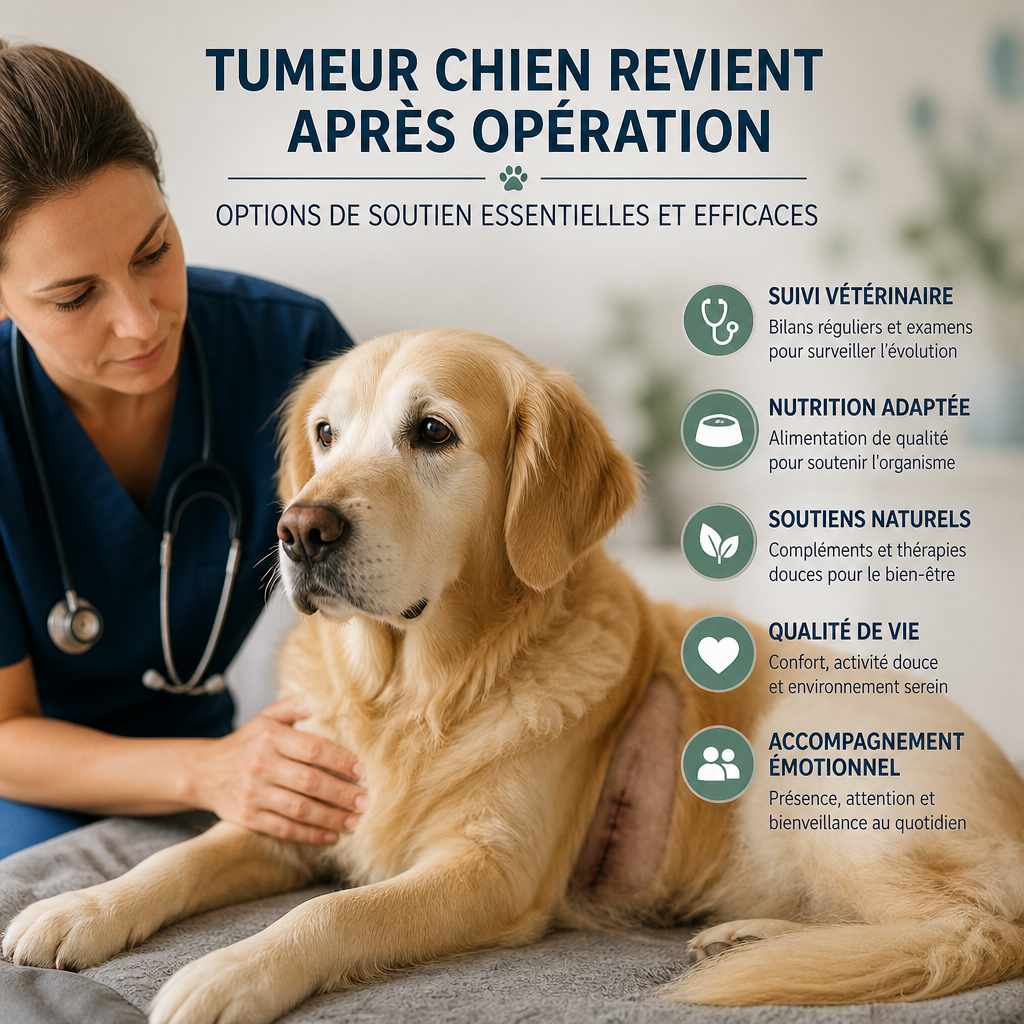
General support never replaces oncological treatment, but it can contribute to the comfort and maintenance of the dog's physical condition. The goal is to preserve his weight, muscle mass, hydration, and quality of life.
The diet must be adapted to his condition. A sick dog may have less appetite or experience nausea related to the illness and treatments. Smaller meals, given several times a day, may be better accepted. It is preferable to choose a complete and balanced diet, validated by the veterinarian, rather than radically changing the ration without professional guidance.
Hydration is also important. A decrease in water intake, vomiting, or diarrhea should be reported, as dehydration can worsen fatigue and complicate certain treatments.
Daily comfort also matters a lot. A soft bed, limited movement during recovery, shorter outings, and a calm environment can reduce stress. When the dog tumor returns after surgery, these simple adjustments often contribute to better tolerance of care.
Pain management deserves special attention. A painful dog may become more immobile, sleep more, lose appetite, or growl when touched. Pain relief treatments must always be adapted by the veterinarian, as some medications used in humans are dangerous for dogs.
Sleep and resting habits also play a role. A stable environment, without excessive agitation, promotes a more peaceful recovery. If several animals live in the household, it may be wise to provide a separate space to avoid sudden contacts or unnecessary sources of stress.
Support points to discuss with the veterinarian
- pain management; ;
- control of nausea; ;
- food palatability; ;
- prevention of dehydration; ;
- maintenance of weight and muscle mass; ;
- adaptation of exercise; ;
- local care of the scar or mass.
Il peut aussi être utile de demander si certains médicaments doivent être administrés à heure fixe ou avec la nourriture. Cette précision réduit les oublis et améliore l’observance du traitement. En période de stress, une fiche écrite ou un tableau simple à la maison facilite le suivi quotidien.
Choosing a supplement after dog tumor surgery
La recherche d’un complément après chirurgie tumeur chien est fréquente, mais son utilisation doit rester prudente. Certains produits peuvent soutenir l’apport nutritionnel, la récupération musculaire ou la digestion, tandis que d’autres peuvent interagir avec une chimiothérapie, un anti-inflammatoire ou un médicament hépatique.
Avant d’administrer un complément, il convient de vérifier :
- sa composition exacte ;
- la dose adaptée au poids du chien ;
- les éventuelles interactions médicamenteuses ;
- la qualité et la traçabilité du produit ;
- la compatibilité avec le type de tumeur et le traitement en cours.
Les compléments riches en acides gras oméga-3, certains soutiens digestifs ou des produits destinés à préserver la masse musculaire peuvent parfois être intéressants. Toutefois, les plantes, extraits concentrés, antioxydants à fortes doses et produits présentés comme capables de « détruire » une tumeur nécessitent une vigilance particulière. Naturel ne signifie pas automatiquement sans danger.
Il est recommandé de fournir au vétérinaire la liste complète des produits utilisés, y compris les friandises, huiles, poudres et préparations naturelles.
When the dog tumor returns after surgery, le bon réflexe consiste à valider chaque ajout avec le vétérinaire avant de commencer. Cette précaution limite les interactions et évite les dépenses inutiles pour des produits peu adaptés.
Dans certains foyers, un complément est envisagé surtout parce que le chien mange moins ou récupère difficilement après l’anesthésie. Dans ce cas, l’objectif n’est pas de remplacer un traitement médical, mais de soutenir l’organisme sur des points concrets comme l’énergie, le transit ou l’entretien musculaire. Le choix doit donc rester personnalisé.
Approches complémentaires utiles à évoquer
En plus des traitements médicaux, certains propriétaires souhaitent discuter d’approches complémentaires. Celles-ci ne remplacent pas la prise en charge classique, mais elles peuvent parfois soutenir le confort général si elles sont encadrées par un professionnel.
- physiothérapie douce après chirurgie ;
- adaptation de l’activité selon l’état du chien ;
- massage léger autour de zones non douloureuses, si le vétérinaire l’autorise ;
- accompagnement nutritionnel individualisé ;
- surveillance du transit et de l’appétit ;
- réduction du stress avec une routine stable.
Il est important de ne pas multiplier les produits ou les méthodes en même temps. Une approche simple, cohérente et bien suivie donne souvent de meilleurs résultats qu’une accumulation de solutions mal coordonnées.
A good communication with the veterinary team also avoids duplicates. For example, some owners combine several supplements in the idea of optimizing recovery, while these products are not always compatible with each other. A clear plan is more reassuring and more effective.
When the dog tumor returns after surgery, complementary approaches should be seen as support, not as an alternative to medical evaluation. Their main role is to improve comfort and support validated treatments.
Monitoring quality of life on a daily basis
When the tumor returns, quality of life becomes a central indicator. It can be useful to note daily appetite, mobility, sleep, pain, interactions with family, and enjoyment during usual activities.
A dog that continues to eat, seeks contact, moves comfortably, and enjoys pleasant moments can sometimes benefit from active or palliative care. Conversely, persistent pain, significant weakness, breathing difficulties, or an inability to eat should lead to a rapid reevaluation of treatment.
Les soins palliatifs peuvent inclure des antidouleurs, des médicaments contre les nausées, un soutien nutritionnel, des soins de plaie et des adaptations de l’environnement. Ils ne signifient pas que l’on abandonne les soins : ils visent à réduire la souffrance et à préserver le bien-être.
La discussion avec le vétérinaire doit rester ouverte et régulière, surtout si les symptômes évoluent. Dans certains cas, le meilleur choix est d’alléger les soins agressifs pour se concentrer sur le confort et les moments de qualité avec l’animal.
Il peut être utile de s’aider d’une grille simple pour suivre l’évolution de la situation, par exemple en attribuant une note au repas, à la mobilité et au confort général. Cette méthode ne remplace pas l’avis vétérinaire, mais elle aide à objectiver les changements sur plusieurs jours. Si la dog tumor returns after surgery, ce type de repère facilite souvent la discussion lors des contrôles.
Comment préparer la prochaine consultation ?
Avant de revoir le vétérinaire, rassemblez tous les éléments utiles : compte rendu opératoire, résultat d’histologie, liste des médicaments, compléments administrés, photos de la masse et notes sur les symptômes récents. Plus le dossier est complet, plus la consultation peut être efficace.
Préparer à l’avance quelques questions permet aussi de ne rien oublier. Par exemple :
- la masse correspond-elle à une récidive ou à une autre cause ?
- faut-il refaire un prélèvement ou une imagerie ?
- quels sont les bénéfices et limites d’un nouveau traitement ?
- comment surveiller la douleur à la maison ?
- quels signes doivent pousser à consulter sans attendre ?
Cette préparation réduit le stress pendant la visite et aide à prendre une décision réfléchie. Elle est particulièrement importante quand plusieurs options sont possibles et que chacune comporte des avantages, des contraintes et des effets indésirables potentiels.
Regular follow-up remains essential
Après une récidive, les contrôles vétérinaires doivent être planifiés selon le type de tumeur et l’évolution observée. Un suivi régulier permet de mesurer la masse, d’anticiper les complications et d’ajuster rapidement les soins.
Le propriétaire peut contribuer efficacement à cette surveillance en palpant délicatement la zone selon les recommandations du vétérinaire, en prenant des photos comparatives et en signalant tout changement. Il ne faut toutefois pas manipuler excessivement une masse douloureuse ou ulcérée.
La récidive d’une tumeur chez le chien est une épreuve éprouvante, mais une prise en charge personnalisée peut offrir des solutions adaptées. Entre examens complémentaires, traitements spécifiques, alimentation équilibrée, compléments soigneusement sélectionnés et soins de confort, chaque décision doit être guidée par le vétérinaire et centrée sur la qualité de vie de l’animal. Quand la dog tumor returns after surgery, l’objectif reste de combiner clarté du diagnostic, soutien pratique et décisions réalistes pour votre compagnon.
If you have any doubts about a lump, a changing scar, or a generally concerning sign, seek veterinary advice promptly. The earlier the assessment, the more calmly options can be discussed and the follow-up can be adapted responsibly.
By maintaining a structured approach, it becomes easier to decide which care to keep, which to adjust, and when to return for consultation. This method does not eliminate worry, but it often helps regain some control during an emotionally difficult time. If the dog tumor returns after surgery, the most important thing is to move forward step by step, with reliable information and regular veterinary follow-up.