oleh TCMVET | 8 Feb 2026 | Kanser & Tumor Anjing
Apa maksud “sel spindle” dalam anjing
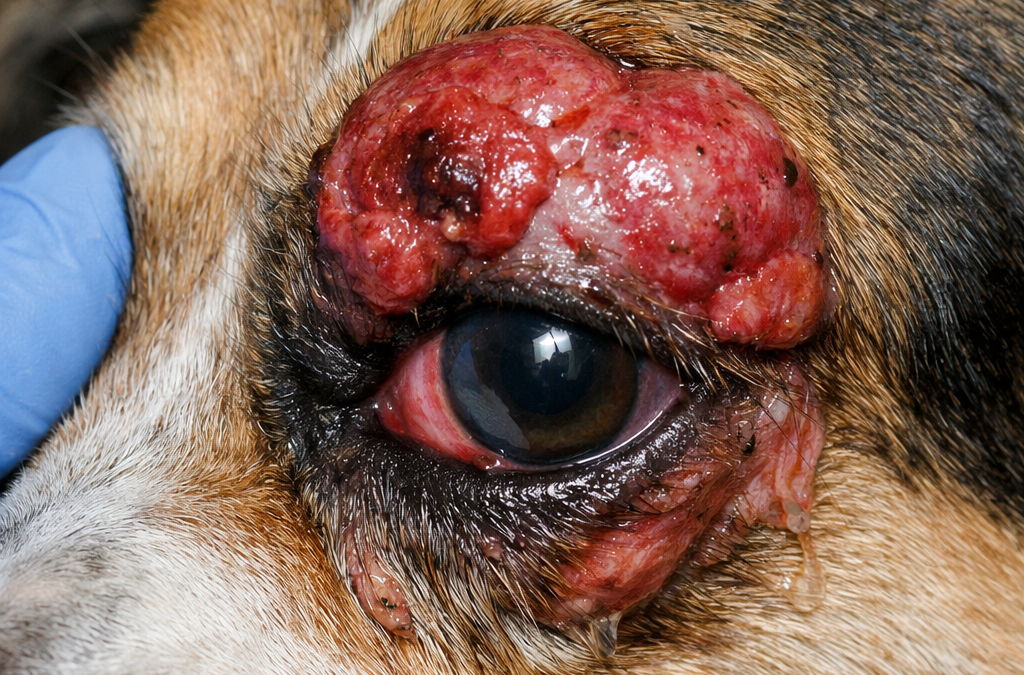
“Sel spindle” biasanya menggambarkan bagaimana sel tumor kelihatan di bawah mikroskop—panjang, meruncing, dan berserat—daripada menamakan satu jenis kanser. Dalam anjing, deskripsi ini sering bertindih dengan sarkoma tisu lembut (STS) dan tumor jenis sarkoma yang berkaitan, yang dikenali kerana invasif tempatan: mereka boleh meluas secara mikroskopik melebihi apa yang anda boleh lihat atau rasa. Corak pertumbuhan itu adalah salah satu sebab utama kebangkitan semula tempatan menjadi kebimbangan utama.
Betapa jarangnya tumor sel spindle berhampiran mata?
Ia bergantung kepada sama ada jisim itu adalah pertumbuhan kelopak mata superfisial atau tumor periocular/orbital yang lebih dalam.
Banyak tumor kelopak mata anjing adalah biasa dan sering jinak, yang memberi ketenangan dalam amalan mata sehari-hari. Namun, tumor jenis sel spindle/sarkoma yang malignan yang tumbuh dengan cepat atau dalam di sekitar mata adalah senario yang berbeza. Penyakit orbital dan retrobulbar (penyakit di soket mata atau di belakang bola mata) adalah kurang biasa daripada benjolan kelopak mata yang sederhana dan biasanya memerlukan perancangan yang lebih kompleks.
Gejala yang biasa diperhatikan oleh pemilik
Tumor “di atas mata” boleh kelihatan seperti benjolan keras atau bengkak berhampiran alis atau kelopak mata, tetapi penyakit yang lebih dalam mungkin menunjukkan perubahan fungsi. Anjing mungkin menyipit, mengeluarkan air mata secara berlebihan, mengalami pelepasan berterusan, menggosok mata atau muka, atau kelihatan takut dengan kepala. Jika orbit terlibat, tanda klasik boleh termasuk eksophthalmos (mata yang membonjol), protrusi kelopak mata ketiga, dan kesakitan di sekitar mata.
Kesakitan dan penderitaan: berapa banyak ia menyakitkan?
Kesakitan berbeza-beza dengan luas dan dipacu oleh apa yang dilakukan tumor secara tempatan.
Jisim boleh menjadi sangat tidak selesa jika ia mengubah kedudukan kelopak mata atau menyebabkan kerengsaan kornea kronik dengan berkedip. Panduan oftalmologi veterinar mencatat bahawa jisim kelopak mata sering membesar dari masa ke masa dan boleh merengsakan permukaan ocular, mempengaruhi keselesaan dan kualiti hidup. Penyakit orbital juga boleh menyakitkan—terutamanya apabila bengkak, tekanan, atau keradangan hadir—dan kesakitan sering disebut di antara tanda klinikal dalam keadaan orbital.
Mengapa rawatan berhampiran mata sangat mencabar
Untuk tumor jenis sarkoma, matlamatnya biasanya adalah kawalan tempatan yang kuat, kerana “jari” tumor mikroskopik boleh meluas melebihi apa yang kelihatan tidak normal. Di batang badan atau anggota badan, pakar bedah sering bertujuan untuk margin yang lebih luas untuk mengeluarkan sambungan yang tidak kelihatan itu. Di sekitar mata, margin yang luas boleh sukar dicapai tanpa merosakkan struktur kritikal, itulah sebabnya doktor mungkin terdengar berhati-hati tentang jaminan.
Pilihan rawatan: apa yang biasanya dipertimbangkan
Kebanyakan pelan rawatan berputar di sekitar kawalan tempatan dan keselesaan, sering menggabungkan pelbagai pendekatan.
Pembedahan biasanya merupakan asas apabila boleh, kedua-duanya untuk mengeluarkan beban tumor dan untuk mendapatkan patologi definitif. Untuk sarkoma tisu lembut anjing, kesempurnaan eksisi sangat mempengaruhi hasil; ulasan menekankan bahawa tumor yang tidak dikeluarkan sepenuhnya mempunyai risiko kebangkitan semula tempatan yang lebih tinggi. Dalam beberapa kes, pakar bedah mungkin mengesyorkan prosedur yang lebih radikal untuk mencapai kawalan di lokasi yang sukar (termasuk pembedahan yang melibatkan orbit) kerana sarkoma tertentu boleh memerlukan pendekatan radikal apabila anatomi mengehadkan lebar margin.
Terapi radiasi sering dibincangkan apabila margin dekat atau tidak lengkap, atau apabila anatomi menjadikan eksisi yang luas mustahil. Ia digunakan dengan niat untuk mengawal sel-sel residu mikroskopik dan mengurangkan kemungkinan pertumbuhan semula, walaupun hasilnya berbeza mengikut tingkah laku tumor, perancangan dos, dan spesifik setiap kes.
Risiko kebangkitan semula: apa yang ditunjukkan oleh penyelidikan berulang kali
Dalam literatur STS anjing, dua pendorong muncul berulang kali: gred histologi dan status margin.
Ulasan mengenai STS anjing yang tidak dikeluarkan sepenuhnya atau sempit melaporkan kadar kebangkitan semula yang diterbitkan kira-kira dalam julat 17%–37% merentasi kajian, menggambarkan mengapa “margin bersih” sangat penting. Satu lagi tinjauan yang sering disebut mencatat bahawa dengan eksisi lengkap, kebangkitan semula tempatan dalam anjing boleh menjadi sangat rendah, dan margin yang tidak lengkap meningkatkan risiko kebangkitan semula secara ketara.
Pandangan kelangsungan hidup dan “garis masa kelangsungan hidup”: cara praktikal untuk memikirkan prognosis
Kerana “tumor sel spindle” boleh mewakili pelbagai jenis tumor, masa kelangsungan hidup tidak dapat diringkaskan dengan satu nombor secara boleh dipercayai. Cara yang lebih boleh dipercayai untuk memahami prognosis adalah dengan mengaitkan jangkaan kepada apa yang paling kuat meramalkan tingkah laku:
Tumor gred rendah yang boleh dikawal sepenuhnya secara tempatan biasanya mempunyai pandangan yang lebih baik berbanding tumor gred tinggi atau yang tidak dapat dikeluarkan sepenuhnya kerana lokasi. Dalam STS anjing, risiko metastatik biasanya diterangkan sebagai bergantung kepada gred, dengan tumor gred tinggi mempunyai peluang penyebaran yang lebih tinggi secara bermakna sepanjang penyakit. Dalam tumor periocular secara khusus, “sejauh mana penyakit tempatan dapat dikawal” sering menjadi faktor dominan yang membentuk kualiti hidup dan hasil keseluruhan.
Apa yang boleh dilakukan pemilik awal yang sering penting (tanpa terperangkap dalam butiran)
Titik fokus yang paling berguna pada awalnya adalah mengesahkan sejauh mana penyakit yang sebenar dan melindungi keselesaan.
Pengimejan lanjutan seperti CT atau MRI sering disyorkan dalam kes orbital/periocular kerana pemeriksaan rutin tidak selalu dapat menunjukkan apa yang berlaku di belakang mata, dan pengimejan membantu membimbing pembedahan dan perancangan radiasi. Keselesaan juga menjadi pusat: tumor periocular boleh mencetuskan kerengsaan dan keradangan kornea, dan mengurangkan geseran/trauma serta menangani kerengsaan permukaan mata boleh membuat perbezaan yang bermakna dalam kesejahteraan harian.
Soalan Lazim: jawapan cepat yang dicari pemilik haiwan peliharaan
Adakah setiap tumor berhampiran kelopak mata adalah malignan?
Tidak. Tumor kelopak mata adalah biasa dalam anjing dan banyak yang berkelakuan dengan cara jinak, walaupun sebarang jisim yang tumbuh dengan cepat, ulser, berdarah, atau menyakitkan memerlukan penilaian segera.
Mengapa doktor haiwan mengesyorkan mengeluarkan mata?
Apabila tumor sangat invasif atau margin tidak dapat dicapai dengan selamat, pembedahan tempatan yang lebih agresif mungkin disyorkan untuk meningkatkan kawalan tempatan di kawasan di mana ruang adalah terhad.
Mengapa pembedahan dan radiasi tidak dapat menjamin ia tidak akan kembali?
Tumor jenis sarkoma boleh meluas secara mikroskopik, dan di sekitar mata mungkin sukar untuk mengeluarkan tisu sekeliling yang mencukupi. STS yang tidak dikeluarkan sepenuhnya mempunyai risiko berulang yang didokumentasikan dalam pelbagai kajian.
Apa yang paling kuat meramalkan prognosis?
Gred patologi dan sama ada tumor dikeluarkan dengan margin bersih sering disorot sebagai pendorong utama risiko berulang dan penyebaran dalam STS anjing.
Bagaimana Baituxiao boleh membantu sebagai penjagaan sokongan
Tumor sel spindle periocular biasanya diuruskan dengan kawalan tempatan terlebih dahulu—selalunya pembedahan, dan kadang-kadang radiasi—kerana tumor ini boleh menjadi invasif secara tempatan dan kawasan mata mengehadkan margin yang luas. Dalam konteks itu, banyak pemilik juga mempertimbangkan penjagaan sokongan integratif untuk membantu mengekalkan keselesaan, selera makan, dan kualiti hidup keseluruhan bersama dengan pelan rawatan utama.
Baituxiao adalah formula botani TCVM yang diposisikan oleh pengeluar untuk anjing dan kucing dengan “tumor dan benjolan,” dan biasanya dibincangkan sebagai pilihan tambahan dan bukannya penyelesaian berdiri sendiri. Kerana formula botani boleh berinteraksi dengan ubat yang digunakan sekitar pembedahan, kawalan kesakitan, keradangan, atau penjagaan onkologi, ia paling baik digunakan sebagai sebahagian daripada pelan yang diselaraskan dengan pasukan veterinar.
oleh TCMVET | 14 Jan 2026 | Kanser & Tumor Anjing
Benjolan ekor pada anjing boleh mengganggu bagi mana-mana penjaga haiwan peliharaan, terutama ketika pemikiran yang membimbangkan tentang tumor kelenjar anal muncul. Memahami apa yang mungkin ditunjukkan oleh benjolan ini—dan bagaimana untuk mengambil tindakan yang bijak dan bertanggungjawab—boleh memberikan ketenangan sambil menyokong kesejahteraan haiwan peliharaan anda. Panduan komprehensif ini meneroka kemungkinan penyebab benjolan ekor pada anjing, tanda-tanda untuk diperhatikan, cara veterinari menilai tumor kelenjar anal, tips penjagaan harian, dan bagaimana untuk tetap proaktif dengan keselesaan dan kualiti hidup anjing anda.
—
Memahami Benjolan Ekor pada Anjing
Benjolan ekor mungkin berkembang untuk beberapa sebab, dari pertumbuhan jinak hingga kebimbangan yang lebih serius. Walaupun beberapa benjolan tetap kecil dan tidak berbahaya, yang lain mungkin memerlukan perhatian veterinar untuk menilai sifatnya.
Kemungkinan Penyebab Benjolan Ekor
– Sista sebum: Saku kecil yang tumbuh perlahan mengandungi bahan berminyak.
– Lipoma: Tumor lemak yang sering dijumpai pada anjing yang lebih tua, biasanya lembut dan boleh bergerak.
– Jangkitan kulit atau abses: Akibat daripada kecederaan atau folikel yang tersumbat.
– Jisim berkaitan kelenjar anal: Jisim yang berasal dari kelenjar berhampiran anus.
– Tumor atau nodul lain: Boleh berkembang dari pelbagai jenis tisu.
Tidak setiap benjolan berbahaya, tetapi penting untuk memantau sebarang perubahan dari masa ke masa, terutama berhampiran pangkal ekor.
—
Tumor Kelenjar Anal: Apa yang Perlu Diketahui Pemilik Haiwan Peliharaan
Tumor kelenjar anal adalah pertumbuhan yang berasal dari kantung anal yang terletak di kedua-dua sisi anus. Tumor ini boleh berkisar dari jinak hingga malignan, dan penilaian veterinar awal adalah kritikal untuk menentukan sifatnya dan langkah terbaik yang perlu diambil.
Mengapa Kelenjar Anal Penting
– lokasi: Terletak di bawah ekor, kelenjar boleh mengalami kelainan yang muncul sebagai benjolan atau bengkak.
– Fungsi: Mereka mengeluarkan bau yang digunakan untuk komunikasi antara anjing.
– Risiko: Keradangan, perubahan struktur, atau tumor boleh menyebabkan ketidakselesaan, bau, atau komplikasi lain.
Pemerhatian Umum
– Kesukaran untuk duduk dengan selesa
– Menggesel atau menjilat kawasan anal
– Pembengkakan atau ketegasan berhampiran anus
– Menggoyangkan ekor atau enggan untuk menggoyangkan
Apabila tanda baru atau berterusan muncul, jadualkan pemeriksaan dengan doktor haiwan. Penilaian profesional mencegah salah tafsir simptom dan membantu mengenal pasti sama ada ujian lanjut diperlukan.
—
Benjolan Ekor Anjing: Mengenali Tanda Awal
Oleh kerana benjolan ekor yang dialami anjing boleh muncul secara beransur-ansur, tetap waspada membantu menangkap masalah lebih awal. Usahakan untuk memeriksa kawasan ekor anjing anda dengan lembut semasa sesi grooming, memerhatikan sebarang perubahan dalam saiz atau tekstur.
Tanda yang Perlu Diperhatikan
– Pembengkakan berterusan: Terutama jika keras atau membesar.
– Perubahan kulit: Kemerahan, kehilangan bulu, atau tekstur kasar.
– Ketidakselesaan: Bertindak balas apabila kawasan tersebut disentuh.
– Perubahan tingkah laku: Tenaga berkurangan, selera makan yang buruk, atau bersembunyi yang tidak biasa.
Tanda-tanda ini tidak secara automatik menunjukkan tumor kelenjar anal, tetapi mereka memerlukan lawatan ke doktor haiwan untuk penjelasan dan ketenangan fikiran.
—
Bagaimana Doktor Haiwan Menilai Benjolan Ekor
Profesional veterinar menggunakan pelbagai ujian untuk menilai benjolan dan menentukan langkah seterusnya. Pendekatan tepat bergantung pada usia anjing anda, sejarah perubatan, dan ciri-ciri benjolan tersebut.
Langkah Diagnostik Tipikal
1. Pemeriksaan fizikal: Memeriksa saiz, lokasi, dan konsistensi.
2. Aspirasi jarum halus atau biopsi: Mengumpul sel atau tisu untuk analisis.
3. Pengimejan: Ultrasound, X-ray, atau imbasan CT untuk menilai struktur dalaman.
4. Ujian darah: Memberikan pandangan tentang kesihatan keseluruhan.
Bincangkan proses secara terbuka dengan doktor haiwan anda, meminta penjelasan yang mudah difahami tentang apa yang dapat ditunjukkan oleh setiap ujian. Ibu bapa haiwan peliharaan yang terlibat dan berinformasi sering merasa lebih yakin menyokong anjing mereka sepanjang penilaian.
—
Menyokong Anjing Melalui Penjagaan Tumor Kelenjar Anal
Apabila doktor haiwan mengenal pasti tumor kelenjar anal, pelan yang teliti dirancang berdasarkan situasi unik anjing tersebut. Oleh kerana arahan perubatan adalah dalam persekitaran klinikal, pemilik haiwan peliharaan boleh memberi tumpuan kepada menyediakan persekitaran rumah yang tenang dan mengikuti saranan profesional dengan teliti.
Petua Praktikal untuk Sokongan di Rumah
– Simpan jurnal: Catat pemerhatian, termasuk selera makan, tahap tenaga, dan kualiti najis.
– Pantau keadaan badan: Kekalkan berat badan yang sihat untuk mengurangkan tekanan tambahan.
– Berikan senaman lembut: Jalan ringan atau permainan yang merangsang mental menjaga anjing anda terlibat.
– Tawarkan tempat rehat yang selesa: Tilam lembut membantu mengurangkan tekanan pada kawasan sensitif.
– Kekal terkini dengan pemeriksaan: Lawatan susulan membolehkan doktor haiwan menjejaki kemajuan dan menyesuaikan pelan penjagaan.
Dengan memberi tumpuan kepada keselesaan, konsistensi, dan panduan veterinar, pemilik dapat membantu anjing merasa selamat semasa perjalanan penjagaan mereka.
—
Pertimbangan Pemakanan dan Kesihatan Semula Jadi
Walaupun makanan dan suplemen tidak dapat mendiagnosis atau menyembuhkan keadaan serius, pemakanan yang sihat menyokong vitaliti keseluruhan. Tanya doktor haiwan anda tentang diet seimbang yang sesuai dengan umur, baka, dan tahap aktiviti anjing anda.
Pandangan Umum tentang Pemakanan
– Protein dan lemak seimbang: Menyokong kesihatan otot dan tenaga.
– Sumber serat: Menggalakkan pencernaan dan penghapusan yang teratur.
– Asid lemak omega: Mungkin membantu mengekalkan kesihatan kulit dan bulu yang berkilat.
– Penghidratan: Pastikan akses berterusan kepada air segar.
Pendekatan kesejahteraan semula jadi—seperti persekitaran yang tenang, penjagaan lembut, dan aktiviti pengayaan—juga boleh mempromosikan rasa keselamatan. Sentiasa berunding dengan doktor haiwan anda sebelum memperkenalkan sebarang perubahan diet atau suplemen baru.
—
Amalan Pencegahan dan Pengesanan Awal
Walaupun tidak semua benjolan ekor boleh dicegah, pemerhatian rutin dan penjagaan veterinar pencegahan membuat perbezaan yang ketara.
Tabiat Berguna
– Dandanan berkala: Membantu anda mengesan benjolan baru lebih awal.
– Jadual mandi yang konsisten: Menjaga kulit bersih dan membolehkan anda memeriksa sebarang isu.
– Lawatan veterinar rutin: Pemeriksaan kesejahteraan menangkap perubahan halus.
– Latihan dan pengendalian: Ajar anjing anda untuk bertoleransi dengan pengendalian ekor dan bahagian belakang supaya pemeriksaan lebih mudah.
Menetapkan tabiat ini memupuk hubungan kerjasama dengan doktor haiwan anda dan memastikan haiwan peliharaan anda selesa.
—
Soalan untuk Ditanyakan kepada Doktor Haiwan Anda
Pengetahuan memberdayakan pemilik anjing untuk membuat keputusan yang bijak. Pertimbangkan untuk membawa senarai soalan ke temu janji.
Permulaan Perbincangan
– Apa jenis benjolan yang ada pada anjing saya, dan ujian apa yang mengesahkannya?
– Adakah terdapat sebarang penyesuaian gaya hidup yang boleh membuat anjing saya selesa?
– Seberapa kerap saya perlu memantau benjolan itu?
– Apakah tanda-tanda yang menunjukkan saya perlu menjadwalkan susulan segera?
Komunikasi aktif memastikan anda memahami setiap langkah dalam pelan penjagaan anjing anda.
—
Sokongan Emosi untuk Pemilik Haiwan Kesayangan
Menemui benjolan di ekor anjing anda boleh menjadi cabaran emosi. Luangkan masa untuk memproses maklumat dan hubungi untuk sokongan apabila diperlukan.
Strategi Mengatasi
– Bersandar pada pasukan veterinar anda: Mereka boleh menjelaskan penemuan dan langkah seterusnya.
– Sambungkan dengan komuniti yang menyokong: Forum dalam talian atau kumpulan tempatan boleh berkongsi pengalaman yang berguna.
– Amalkan penjagaan diri: Makanan seimbang, rehat, dan masa di luar meningkatkan daya tahan.
– Raikan momen sehari-hari: Jalan-jalan lembut, masa berpelukan, dan bermain menguatkan ikatan anda.
Kekal berfikiran tenang dan penuh harapan membantu anda tetap menjadi tiang sokongan yang tenang untuk haiwan peliharaan anda.
—
Kekal Dimaklumkan Mengenai Tumor Kelenjar Anal
Maklumat yang boleh dipercayai membentuk keputusan yang bertanggungjawab. Fokus pada sumber yang berdasarkan bukti seperti pakar veterinar bersertifikat lembaga, artikel yang disemak rakan sebaya, dan organisasi kesihatan haiwan yang bereputasi.
Menilai Sumber Maklumat
– Semak kelayakan: Cari doktor haiwan berlesen atau institusi yang diiktiraf.
– Berhati-hati dengan penyelesaian cepat: Elakkan tuntutan atau rawatan yang tidak disahkan.
– Tanya doktor haiwan anda: Mereka boleh mengesyorkan bahan bacaan atau pakar yang dipercayai.
Menjadi selektif tentang maklumat memastikan kesejahteraan anjing anda tetap terjaga dan mengelakkan salah faham.
—
Pemikiran Holistik untuk Kesejahteraan Anjing
Penjagaan holistik bermaksud mempertimbangkan keselesaan fizikal, kesejahteraan emosi, dan persekitaran yang tenang. Tilam lembut, rutin yang konsisten, penjagaan lembut, dan interaksi yang tenang semuanya menyumbang kepada rasa keselamatan secara keseluruhan.
Amalan Holistik yang Sederhana
– Jalan-jalan yang penuh perhatian: Perjalanan yang tenang membolehkan mengendus dan meneroka.
– Urutan dan sentuhan lembut: Apabila disetujui oleh doktor haiwan anda, urutan ringan mungkin membantu merelaksasikan otot.
– Mainan pengayaan: Pengumpan teka-teki, permainan mengendus perlahan, dan mainan kunyah lembut menjaga minda aktif.
– Muzik dan aromaterapi: Bunyi yang menenangkan atau bau yang disetujui oleh doktor haiwan boleh mencipta suasana yang tenang.
Sentiasa perhatikan reaksi anjing anda dan hentikan apa-apa yang menyebabkan ketidakselesaan.
—
Kesimpulan: Menyokong Kesejahteraan Semula Jadi dengan Penjagaan
Setiap anjing berhak mendapat perhatian yang penuh kasih, terutama apabila benjolan baru menimbulkan persoalan. Dengan terus memerhatikan, bekerjasama dengan profesional veterinar, dan mencipta persekitaran rumah yang selesa, anda boleh mengatasi benjolan ekor dengan keyakinan dan penjagaan. Ingat untuk mendekati setiap langkah dengan sabar, mengekalkan komunikasi terbuka dengan pasukan penjagaan haiwan peliharaan anda, dan terus meneroka amalan kesejahteraan semula jadi yang lembut yang memupuk keseimbangan keseluruhan anjing anda.
oleh TCMVET | 14 Jan 2026 | Kanser & Tumor Anjing
Herba anjing senior boleh memainkan peranan yang lembut dan menyokong dalam tahun-tahun emas anjing anda, menawarkan keselesaan semula jadi di samping penjagaan veterinar yang biasa. Apabila anjing menua, keperluan mereka berubah—mobiliti melambat, pencernaan berubah, dan kesejahteraan keseluruhan memerlukan lebih banyak perhatian. Banyak ibu bapa haiwan peliharaan melihat pilihan holistik seperti herba dan perubahan gaya hidup sebagai sebahagian daripada pelan penjagaan yang seimbang. Panduan ini meneroka cara menggunakan herba anjing senior dengan bijak, apa yang perlu dipertimbangkan, dan bagaimana meningkatkan keselesaan rakan tua anda melalui strategi praktikal dan penjagaan yang penuh perhatian.
—
Memahami Penuaan dalam Anjing Senior
Anjing biasanya memasuki tahun senior mereka sekitar usia tujuh tahun, walaupun ini berbeza mengikut baka dan saiz. Apabila metabolisme melambat dan organ matang, anjing menjadi lebih sensitif terhadap tekanan, diet, tahap aktiviti, dan perubahan persekitaran. Perubahan berkaitan usia boleh termasuk:
– Tahap tenaga yang lebih rendah
– Pencernaan yang sensitif atau selera makan yang berkurangan
– Kekakuan sendi atau keberatan untuk bergerak
– Perubahan tingkah laku seperti peningkatan vokalisasi, kekeliruan, atau kegelisahan
– Keperluan yang meningkat untuk kehangatan, rutin, dan keselesaan
Memahami peralihan ini membantu anda menyokong anjing anda dengan kesabaran dan kasih sayang, sambil bekerjasama dengan doktor haiwan dan meneroka strategi keselesaan berasaskan herba yang lembut.
—
Apakah Herba Anjing Senior?
Herba anjing senior adalah botani yang mungkin dapat mengurangkan cabaran penuaan yang biasa dengan cara yang selamat dan terukur. Herba boleh dalam bentuk kering, segar, atau dalam bentuk formula (kapsul, serbuk, teh, atau tincture). Mereka muncul dari amalan tradisional di seluruh dunia—dari Ayurveda hingga herba Barat—di mana tumbuhan semula jadi digunakan untuk menyokong kesejahteraan.
Prinsip utama termasuk:
– Menyokong vitaliti, bukan menekan gejala
– Melengkapi penjagaan veterinar dan bukannya menggantikannya
– Mendengar respons anjing anda terhadap herba dan menyesuaikan mengikut keperluan
Herba mempunyai pelbagai sifat, seperti menenangkan, menenangkan pencernaan, atau pemakanan umum, yang mungkin bermanfaat semasa tahun senior. Sentiasa berunding dengan doktor haiwan, idealnya yang berpengalaman dalam penjagaan herba atau integratif, sebelum memperkenalkan botani baru.
—
Herba Anjing Senior untuk Diterokai bagi Keselesaan
Chamomile dan Pengaruh Menenangkannya
Aroma lembut chamomile sering menenangkan anjing yang cemas atau gelisah. Ia mungkin membantu apabila anjing senior mengalami berjalan malam, gangguan pencernaan ringan, atau rasa tidak selesa secara umum. Chamomile biasanya ditawarkan sebagai infusi teh yang boleh anda tambahkan ke dalam makanan atau air, atau sebagai herba kering yang dicampur dengan makanan. Oleh kerana chamomile adalah lembut, banyak anjing mentolerirnya dengan baik, tetapi pemantauan untuk alahan tetap penting.
Skullcap untuk Relaksasi
Skullcap adalah herba yang dihormati kerana sifat relaksasinya tanpa sedasi berat. Ia mungkin berguna untuk anjing yang lebih tua yang kelihatan tegang, reaktif, atau sensitif terhadap bunyi dan perubahan. Dalam kombinasi dengan pengubahsuaian gaya hidup (rutin yang konsisten, ruang yang tenang, waktu makan yang boleh diramalkan), skullcap dapat menyokong keseimbangan emosi.
Milk Thistle untuk Sokongan Hati yang Lembut
Hati memainkan peranan penting dalam metabolisme dan detoksifikasi, dan anjing senior sering mendapat manfaat daripada sokongan hati yang lembut. Milk thistle, kaya dengan silymarin, biasanya digunakan oleh pengamal kerana sifat antioksidannya dan potensi kesan pelindung. Banyak penjaga haiwan peliharaan menggabungkan milk thistle dalam rotasi atau kursus sekali-sekala, bukannya bergantung padanya secara berterusan. Sekali lagi, doktor haiwan harus membimbing tempoh dan kesesuaian, terutama jika anjing anda mengambil ubat.
Kunyit dan Sifat Antioksidannya
Kunyit mengandungi curcumin, sebatian dengan sifat antioksidan dan menenangkan yang telah banyak dikaji. Anjing senior mungkin menghargai makanan yang diperkaya kunyit untuk keselesaan umum, walaupun ia harus dipadankan dengan lemak seperti minyak kelapa atau minyak ikan untuk meningkatkan penyerapan. Oleh kerana kunyit boleh berinteraksi dengan beberapa ubat atau keadaan pencernaan, periksa dengan doktor haiwan anda sebelum menggunakannya secara berkala.
Hawthorn untuk Sokongan Jantung dan Peredaran
Buah dan daun hawthorn telah lama digunakan untuk menyokong kesejahteraan peredaran. Beberapa doktor haiwan integratif memperkenalkan hawthorn untuk anjing senior yang menunjukkan tanda-tanda sistem kardiovaskular yang menua, walaupun pengawasan yang teliti adalah penting. Ia sering menjadi sebahagian daripada protokol yang lebih luas termasuk diet, senaman terkawal, dan pemeriksaan rutin.
Spirulina dan Alfalfa untuk Peningkatan Nutrien
Spirulina dan alfalfa adalah suplemen herba yang kaya dengan nutrien yang mungkin memberikan sokongan tambahan berasaskan tumbuhan untuk tenaga dan ketahanan imun. Spirulina kaya dengan klorofil dan asid amino, sementara alfalfa mengandungi vitamin, mineral, dan serat yang menyokong. Menambah ini dalam jumlah sederhana ke dalam diet anjing senior mungkin membantu mengisi kekurangan nutrisi.
—
Pertimbangan Utama Ketika Memilih Herba untuk Anjing Senior
1. Perundingan: Seorang doktor haiwan yang biasa dengan perubatan herba boleh mencadangkan herba yang sesuai, membantu mengelakkan interaksi berbahaya, dan memantau kemajuan.
2. Kualiti: Pilih herba dari sumber yang dipercayai yang menawarkan sumber yang telus dan ujian pihak ketiga untuk pencemaran.
3. Borang: Tentukan antara serbuk, kapsul, tincture, atau teh. Sesetengah anjing lebih suka herba dicampur dengan makanan lembap; yang lain lebih baik dengan kapsul.
4. Alahan: Perkenalkan satu herba pada satu masa dalam jumlah kecil, memerhatikan tanda-tanda intoleransi seperti gatal, muntah, atau cirit-birit.
5. Ketekalan: Herba biasanya bertindak secara beransur-ansur. Penggunaan yang konsisten dan terukur sering berfungsi lebih baik daripada dos yang sporadis.
—
Tips Keselesaan Persekitaran untuk Anjing Senior
Herba paling baik dipadankan dengan strategi keselesaan praktikal dan harian. Pertimbangkan cara berikut untuk membantu anjing senior anda merasa selamat, disokong, dan puas:
– Tilam yang selesa: Katil ortopedik, tepi yang tinggi, atau pad pemanas (direka untuk haiwan peliharaan) boleh menenangkan sendi yang kaku dan memberikan kehangatan.
– Permukaan tidak licin: Karpet atau pelari mengurangkan tergelincir di atas lantai kayu keras, mengurangkan tekanan pada sendi dan meningkatkan keyakinan.
– Air dan makanan yang mudah diakses: Letakkan mangkuk di atas karpet tidak licin dan pertimbangkan stesen makanan yang sedikit tinggi.
– Dandanan rutin: Menyikat secara berkala dan urutan lembut meningkatkan peredaran dan menawarkan masa ikatan.
– Tempat rehat yang tenang: Kawasan rehat yang ditetapkan jauh dari bunyi rumah membantu anjing berehat dan merasa selamat.
– Pencahayaan lembut pada waktu malam: Lampu redup atau lampu malam memandu anjing senior yang mempunyai penglihatan yang berkurangan atau kebimbangan malam.
—
Diet dan Sokongan Pencernaan
Kepentingan Pemakanan Seimbang
Anjing senior sering mendapat manfaat daripada diet yang kaya nutrien dan mudah dicerna. Walaupun terdapat formula senior komersial, berunding dengan doktor haiwan atau pakar pemakanan anjing untuk memastikan makanan anjing anda memenuhi keperluan individu. Memutar protein, memasukkan sayur-sayuran yang dimasak lembut, dan termasuk lemak sihat dapat mengekalkan minat dalam makanan dan menyokong berat badan yang sihat.
Herba yang Menyokong Pencernaan
– Halia: Dikenali kerana menenangkan ketidakselesaan perut, halia mungkin membantu anjing yang mengalami loya sekali-sekala. Gunakan dengan sederhana dan dapatkan nasihat veterinar untuk anjing yang mengambil ubat pencair darah.
– Akar dandelion: Kadang-kadang digunakan untuk menyokong pencernaan dan fungsi hati, akar dandelion boleh ditambah ke dalam makanan dalam jumlah yang sangat kecil.
– Pucuk adas: Mungkin menenangkan gas ringan atau kembung. Rasa seperti liquorice biasanya diterima dengan baik oleh anjing.
Penghidratan
Anjing senior harus sentiasa mempunyai akses kepada air segar. Anda boleh meningkatkan penghidratan dengan memasukkan makanan yang kaya dengan kelembapan seperti kaldu tulang, sayur-sayuran yang dikisar, atau penambah kibble yang dipenuhi air.
—
Aktiviti dan Mobiliti
Senaman Lembut untuk Anjing Senior
Bahkan anjing yang lebih tua mendapat manfaat daripada pergerakan, yang menjaga otot kuat dan sendi fleksibel. Sasarkan untuk berjalan kecil yang kerap daripada satu perjalanan panjang. Pantau kelajuan anjing anda dan beri masa untuk menghidu—stimulasi mental sama pentingnya dengan fizikal.
Herba yang Fokus pada Mobiliti
Beberapa herba menyokong keselesaan dan fleksibiliti sendi:
– Boswellia: Sering digunakan dalam pelan kesihatan tradisional untuk sokongan sendi kerana sebatian resinousnya.
– Cakar syaitan: Biasanya disyorkan oleh pengamal holistik untuk penjagaan sendi; walau bagaimanapun, ia harus dielakkan dalam anjing dengan keadaan kesihatan tertentu.
Bincangkan kombinasi atau penggunaan jangka panjang dengan doktor haiwan anda untuk memastikan keselamatan.
Terapi Pelengkap
Akupunktur, urut, hidroterapi, atau senaman terapi fizikal boleh melegakan ketegangan dan menggalakkan pergerakan. Modaliti ini harus dipandu oleh profesional berkelayakan yang berpengalaman dalam bekerja dengan anjing senior.
—
Kesejahteraan Emosi dan Tingkah Laku
Mengenali Perubahan Emosi
Anjing senior mungkin mengalami perubahan kognitif atau kebimbangan. Tanda-tanda termasuk berjalan tanpa arah, terjaga di waktu malam, bersuara, atau peningkatan kelekatan. Kesabaran dan jaminan yang konsisten adalah penting semasa peringkat kehidupan ini.
Sokongan Tenang Berasaskan Herba
– Akar Valerian: Sering digunakan untuk melegakan tekanan yang berlaku. Perkenalkan secara beransur-ansur, kerana baunya yang tanah boleh menjadi kuat.
– Bunga Passion: Herba lembut yang mungkin mengurangkan kegelisahan dan menyokong keseimbangan emosi.
Menggabungkan ini dengan penyesuaian gaya hidup (muzik lembut, penyebar aromaterapi menggunakan bau yang selamat untuk anjing, rutin yang boleh diramal) boleh memupuk relaksasi.
—
Mewujudkan Kit Alat Herba untuk Anjing Senior
Pertimbangkan untuk mengatur produk herba dan barang sokongan anda di satu tempat:
1. Labelkan bekas dengan nama herba, tujuan yang dimaksudkan, dan sebarang nota.
2. Jejaki penggunaan dalam jurnal, mencatat tingkah laku, selera makan, dan sebarang perubahan.
3. Jadualkan daftar masuk dengan doktor haiwan anda untuk menyemak pelan herba dan memastikan ia masih sesuai dengan profil kesihatan anjing anda.
4. Putar herba apabila sesuai, memberikan rehat untuk mengelakkan ketergantungan berlebihan.
—
Bekerja dengan Profesional Veterinar
Doktor haiwan yang terlatih dalam perubatan herba, penjagaan integratif, atau Perubatan Veterinar Tradisional Cina (TCVM) boleh merancang protokol yang disesuaikan. Mereka akan menilai:
– Umur, baka, dan kesihatan keseluruhan
– Ubat atau suplemen semasa
– Pengambilan nutrisi dan tahap aktiviti
– Petunjuk tingkah laku
Pendekatan kolaboratif ini memastikan herba adalah tambahan kepada pemeriksaan veterinar biasa, ujian darah, penjagaan gigi, dan sebarang diagnostik yang diperlukan.
—
Herba Anjing Senior dan Keselamatan
Keselamatan mesti kekal sebagai keutamaan utama:
– Ketahui kontraindikasi: Beberapa herba mungkin tidak sesuai untuk anjing dengan keadaan buah pinggang, hati, atau jantung.
– Elakkan minyak pati secara dalaman: Banyak minyak, walaupun berasal dari herba, tidak selamat untuk dimakan.
– Simpan herba dengan betul: Jauhkan daripada kelembapan, cahaya matahari, dan haiwan peliharaan yang ingin tahu.
– Perhatikan anjing anda dengan teliti: Jika anda perhatikan perubahan dalam najis, selera makan, pernafasan, atau tingkah laku, hentikan penggunaan herba dan berunding dengan doktor haiwan anda.
—
Menghormati Rutin dan Kestabilan
Anjing senior berkembang dengan kepastian. Padankan sokongan herba dengan rutin yang teliti:
– Waktu bangun, makan, dan berjalan yang konsisten
– Gangguan minimum kepada kawasan tidur
– Pengenalan perlahan apabila pengunjung datang
– Bau bau yang biasa, mainan, dan selimut
Langkah-langkah ini mengurangkan tekanan dan memudahkan anjing anda menyesuaikan diri dengan perubahan halus.
—
Kesejahteraan Semula Jadi Di Luar Herba
Selain herba untuk anjing senior, pertimbangkan strategi kesejahteraan semula jadi yang lebih luas:
– Makanan ringan yang berkhasiat: Pilih makanan kunyah lembut atau makanan ringan yang dehidrasi dengan lembut yang mudah untuk gigi.
– Dandanan yang teliti: Gunakan tuala hangat, berus lembut, dan sapuan menenangkan.
– Masa luar: Pendedahan kepada cahaya matahari (pada cuaca yang sesuai) membantu mengatur tidur dan mood.
– Rangsangan mental: Pengumpan teka-teki, permainan bau, atau sesi latihan pendek menjaga minda aktif.
Kesejahteraan semula jadi adalah tentang memelihara keseluruhan diri anjing anda—badan, minda, dan hati.
—
Merayakan Momen Kecil
Setiap anjing senior mempunyai keperluan dan kegembiraan yang unik. Rayakan kemenangan kecil: tidur yang selesa, ekor yang bergoyang, atau malam yang tenang di sisi anda. Sokongan herba, digabungkan dengan kesabaran, pemahaman, dan panduan veterinar, mencipta persekitaran yang menyokong untuk tahun-tahun akhir anjing anda.
—
Kesimpulan
Herba untuk anjing senior, apabila digunakan dengan bijak, menawarkan keselesaan lembut sebagai sebahagian daripada pelan kesejahteraan yang komprehensif. Dengan bekerjasama dengan doktor haiwan anda, memilih botani berkualiti tinggi, dan mengekalkan rutin yang konsisten, anda boleh membantu anjing anda menua dengan maruah dan mudah. Teruskan memerhatikan keperluan teman anda, menyesuaikan amalan penjagaan, dan menikmati masa yang anda kongsikan. Pendekatan semula jadi, berlandaskan belas kasihan dan pengetahuan, boleh membawa pengayaan dan keharmonian kepada kehidupan anjing senior anda.
oleh TCMVET | 14 Jan 2026 | Kanser & Tumor Anjing
Sokongan semula jadi chemo menjadi topik penting bagi penjaga anjing apabila haiwan peliharaan mereka menjalani kemoterapi. Emosi boleh menjadi tinggi, dan adalah perkara biasa untuk mencari cara lembut untuk memastikan teman anda selesa sambil tetap selaras dengan nasihat veterinar. Memahami apa yang dimaksudkan dengan “sokongan semula jadi”—rutin berkhasiat, keselesaan emosi, dan penyesuaian gaya hidup yang bijak—membantu anda membuat pilihan yang berinformasi yang menghormati sains dan keperluan unik anjing anda.
Mengapa Penjagaan Sokongan Penting Semasa Kemoterapi
Kemoterapi boleh menjadi usaha yang signifikan bagi mana-mana anjing, menyentuh segala-galanya dari tahap tenaga hingga selera makan. Walaupun doktor haiwan mengawasi pelan perubatan, penjaga haiwan peliharaan memainkan peranan besar dalam mencipta persekitaran yang tenang dan menyokong di rumah. Penjagaan sokongan tidak menggantikan ubat-ubatan atau panduan profesional; sebaliknya, ia meningkatkan kesejahteraan keseluruhan anjing anda melalui rutin yang konsisten, penglibatan mental, dan pemerhatian yang teliti.
Asas Sokongan Semula Jadi Chemo
Membangunkan rangka kerja untuk sokongan semula jadi chemo bermakna memberi tumpuan kepada tiga tiang: pemakanan, pengurusan tekanan, dan keselesaan sehari-hari. Setiap tiang bekerjasama untuk membantu anjing anda merasa selamat dan dijaga sepanjang rawatan. Perubahan kecil—seperti menyediakan tempat rehat yang tenang atau menawarkan teka-teki pengayaan—boleh membuat perbezaan yang ketara.
Pertimbangan Pemakanan dan Hidrasi
Diet yang seimbang memberikan anjing anda blok bangunan untuk kekuatan. Walaupun anda harus sentiasa mengikuti saranan doktor haiwan anda, beberapa idea asas boleh membantu membimbing pilihan anda:
– Hidangan seimbang: Cari makanan yang menawarkan protein tanpa lemak, karbohidrat kompleks, dan lemak yang bermanfaat untuk mengekalkan tenaga yang stabil.
– Bahan lembut: Pilihan yang mudah dicerna—seperti sayur-sayuran yang dimasak atau protein sederhana—boleh membantu jika perut anjing anda nampak sensitif.
– Fokus pada hidrasi: Pertukaran air segar harus kerap. Beberapa anjing menikmati kiub ais berperisa atau sup rendah natrium yang dicairkan untuk variasi.
– Hidangan kecil dan kerap: Menyajikan bahagian yang lebih kecil dengan lebih kerap mungkin mendorong makan apabila selera berfluktuasi.
– Pantau reaksi: Simpan diari makanan yang sederhana untuk mencatat sebarang perubahan dalam najis, tenaga, atau minat terhadap makanan tertentu. Kongsikan pemerhatian dengan doktor haiwan anda.
Keselesaan Emosi dan Rutin yang Konsisten
Anjing sering merasakan keselamatan dari jadual yang boleh diramalkan. Menjaga ritual yang biasa—jalan pagi, pelukan petang, atau sesi penjagaan lembut—memberi jaminan kepada teman anda bahawa hidup masih mempunyai keselesaan dan kestabilan.
– Zon tenang: Cipta kawasan rehat yang selesa jauh dari bunyi rumah, lengkap dengan selimut dan mainan kegemaran.
– Pengayaan deria: Tawarkan muzik lembut, ruang tanpa bau, atau pencahayaan semula jadi yang disebarkan untuk mengurangkan rangsangan berlebihan.
– Interaksi yang penuh perhatian: Perhatikan isyarat anjing anda. Beberapa hari mereka mungkin menginginkan kasih sayang; hari lain mereka mungkin mahu lebih banyak ruang peribadi.
Aktiviti Lembut dan Sokongan Mobiliti
Pergerakan ringan menjaga sendi dilincirkan dan otot terlibat. Bincangkan tahap aktiviti yang sesuai dengan doktor haiwan anda, kemudian sesuaikan mengikut keperluan:
– Jalan pendek: Jalan singkat di permukaan lembut boleh jadi lebih mudah untuk kaki dan sendi.
– Mainan teka-teki: Latihan mental, seperti mainan yang mengeluarkan makanan, melibatkan minda tanpa memerlukan usaha fizikal yang berat.
– Tilam yang selesa: Katil ortopedik atau tikar sokongan membantu menyokong kawasan yang lembut dan menggalakkan rehat yang betul.
Bekerjasama Dengan Pasukan Veterinar Anda
Komunikasi terbuka dengan onkologi veterinar atau doktor am anda adalah penting untuk sokongan semula jadi chemo. Mereka boleh mencadangkan masa untuk pemeriksaan, menandakan tanda amaran, dan membantu anda mentafsir perubahan tingkah laku. Pertimbangkan untuk menyimpan log tentang:
– Kebiasaan waktu makan
– Pengambilan air
– Pilihan bermain atau berehat
– Tindak balas terhadap teknik menenangkan
– Sebarang tingkah laku baru yang muncul antara janji temu
Berkongsi pemerhatian ini membolehkan doktor haiwan anda menyesuaikan cadangan khusus untuk pengalaman anjing anda.
Titik Sentuhan Holistik Tanpa Tuntutan Perubatan
Beberapa penjaga meneroka amalan kesejahteraan lembut seperti aromaterapi dengan minyak pati yang selamat untuk haiwan peliharaan (sentiasa dicairkan dan diluluskan oleh doktor haiwan), teknik urutan perlahan, atau masa yang diawasi di bawah sinar matahari. Pendekatan ini memberi tumpuan kepada relaksasi dan bukannya rawatan. Ingat:
– Kelulusan doktor haiwan adalah kunci: Bahkan produk semula jadi boleh berinteraksi dengan ubat-ubatan.
– Kurang adalah lebih: Perkenalkan satu elemen baru pada satu masa supaya anda dapat memerhatikan bagaimana anjing anda bertindak balas.
– Keselesaan dahulu: Jika anjing anda menunjukkan ketidakminatan atau ketidakselesaan, hentikan amalan itu dan kembali kepada keselesaan yang biasa.
Petua Praktikal untuk Sokongan Harian
Rutin harian boleh menjadi lebih mudah untuk dilalui dengan satu set strategi yang boleh digunakan:
1. Rancang penyediaan makanan lebih awal: Pembahagian makanan boleh mengurangkan tekanan pada hari-hari sibuk.
2. Tetapkan penggera peringatan: Gunakan penggera telefon untuk waktu pengambilan ubat, pemeriksaan air segar, atau sesi senaman pendek.
3. Putar pengayaan: Simpan pilihan kecil mainan dan putar setiap minggu untuk mengekalkan minat.
4. Gunakan alat penjagaan lembut: Berus lembut atau sarung tangan penjagaan boleh membantu mengeluarkan bulu longgar tanpa kerengsaan.
5. Pantau tenaga rumah tangga: Minta ahli keluarga untuk menjaga tahap bunyi rendah dan mengelakkan perubahan mendadak dalam rutin.
Membaca Isyarat Anjing Anda
Bahasa tubuh anjing mendedahkan banyak tentang tahap keselesaan. Kerana kemoterapi boleh meningkatkan sensitiviti, cari isyarat:
– Postur santai: Menunjukkan kepuasan.
– Menguap atau menjilat bibir: Boleh menandakan tekanan ringan.
– Berjalan atau gelisah: Mungkin bermakna ketidakselesaan atau keperluan untuk rehat yang tenang.
– Mencari kasih sayang: Banyak anjing lebih bersandar pada penjaga mereka apabila mereka memerlukan jaminan.
Tanggapan dengan menyesuaikan persekitaran—reduksi cahaya, kurangkan bunyi, atau tawarkan gosokan lembut jika anjing anda suka sentuhan.
Mengintegrasikan Perspektif Kesejahteraan Semula Jadi
Kesejahteraan semula jadi menekankan keharmonian antara keperluan fizikal dan keseimbangan emosi. Bagi anjing yang menjalani kemoterapi, ini mungkin bermakna:
– Rehat udara segar: Tempoh pendek di luar boleh memberikan bau baru dan rangsangan lembut.
– Persahabatan yang penuh perhatian: Hanya duduk di sebelah anjing anda, membaca atau bercakap perlahan, menggalakkan hubungan tanpa memerlukan tenaga.
– Ruang tamu yang bersih: Basuh katil, mangkuk, dan mainan secara berkala dengan pembersih lembut yang selamat untuk haiwan peliharaan untuk mengekalkan kebersihan.
– Peneguhan positif: Raikan kemenangan kecil—menyelesaikan makanan, meneroka halaman, atau bermain dengan mainan.
Mengimbangi Optimisme Dengan Jangkaan Realistik
Adalah perkara biasa untuk berharap yang terbaik, tetapi kekal berpijak membantu anda bertindak balas dengan berkesan. Percayalah kepada kepakaran pasukan veterinar anda dan bersikap baik kepada diri sendiri sepanjang proses ini. Beberapa hari mungkin terasa mencabar; yang lain mungkin membawa kejutan yang menghangatkan hati. Bergantunglah kepada sokongan keluarga, rakan, atau komuniti penjagaan haiwan peliharaan apabila anda memerlukan dorongan.
Kesimpulan
Menyokong anjing melalui kemoterapi melibatkan kesabaran, pemerhatian, dan fokus yang mantap pada keselesaan. Dengan mengintegrasikan amalan sokongan semula jadi chemo—pemakanan seimbang, persekitaran tenang, aktiviti lembut, dan komunikasi rapat dengan doktor haiwan anda—anda mencipta rutin yang menenangkan yang menghormati keperluan anjing anda. Setiap pilihan yang penuh perhatian menyumbang kepada pendekatan kasih sayang dan berpijak kepada kesejahteraan semula jadi.
oleh TCMVET | 14 Jan 2026 | Kanser & Tumor Anjing
Risiko kanser Cavalier, tanda awal tumor dalam Cavalier, kanser biasa dalam baka ini adalah topik yang banyak pemilik penyayang akhirnya cari apabila anjing mereka semakin tua. Cavalier King Charles Spaniels dihargai kerana sifat lembut mereka, mata ekspresif, dan cinta kepada syarikat manusia—tetapi seperti semua baka, mereka menghadapi cabaran kesihatan tertentu, termasuk tumor dan kanser. Memahami apa yang mungkin dihadapi oleh Cavalier anda, bagaimana untuk mengenal pasti tanda amaran awal, dan bagaimana untuk menyokong mereka di tahun-tahun senior mereka boleh membuat perbezaan nyata dalam kualiti hidup.
—
A. Gambaran Keseluruhan Baka
Cavalier King Charles Spaniels adalah anjing teman kecil, biasanya berat 13–18 paun. Mereka penyayang, berorientasikan manusia, dan sering digambarkan sebagai “anjing velcro” kerana mereka suka tinggal dekat dengan keluarga mereka. Temperamen mereka secara amnya:
– Lembut dan mesra
– Baik dengan kanak-kanak dan haiwan peliharaan lain
– Boleh menyesuaikan diri dengan kehidupan di apartmen dan rumah, asalkan mereka mendapat interaksi harian dan senaman sederhana
Jangka hayat purata mereka adalah sekitar 10–14 tahun, walaupun ini boleh berbeza berdasarkan genetik, persekitaran, dan penjagaan kesihatan keseluruhan.
Cavalier dikenali dengan isu keturunan tertentu, terutamanya:
– Penyakit jantung (terutamanya penyakit injap mitral)
– Masalah neurologi seperti malformasi Chiari-like dan syringomyelia
– Masalah ortopedik seperti patela yang terluxasi
Walaupun mereka tidak dianggap sebagai baka “berisiko kanser tinggi” secara universal seperti beberapa baka gergasi, banyak Cavalier mengalami tumor dan kanser seiring dengan usia mereka. Beberapa jenis sering dilihat pada anjing baka kecil dan juga dilaporkan dengan kerap dalam Cavalier, terutamanya tumor kulit dan tisu lembut, serta kanser berkaitan darah tertentu.
—
B. Memahami risiko kanser Cavalier, tanda awal tumor dalam Cavalier, kanser biasa dalam baka ini
Tidak setiap Cavalier akan menghidap kanser, tetapi menyedari pola yang dilihat dalam baka ini membantu anda kekal proaktif. Jenis tumor dan kanser berikut sering dilaporkan dalam Cavalier dan baka kecil yang serupa:
1. Tumor Sel Mast (MCT)
Tumor sel mast adalah salah satu kanser kulit yang paling biasa dalam anjing dan dilihat dengan agak kerap dalam Cavalier. Mereka biasanya muncul sebagai:
– Benjolan atau tonjolan kulit yang mungkin tumbuh, mengecut, atau berubah secara tiba-tiba
– Lesi yang mungkin gatal, merah, atau meradang
Dalam baka kecil, tumor ini mungkin pertama kali diperhatikan sebagai benjolan kecil yang menyerupai “gigitan serangga” yang tidak hilang. Oleh kerana tumor sel mast boleh berkisar dari tahap rendah (tumbuh perlahan) hingga sangat agresif, penilaian veterinar segera terhadap sebarang benjolan baru adalah penting.
2. Lipoma dan Tumor Tisu Lembut
Tumor lemak jinak (lipoma) adalah biasa dalam anjing pertengahan umur dan lebih tua, termasuk Cavalier. Ini biasanya terasa:
– Lembut, boleh bergerak, dan berada di bawah kulit
– Tidak menyakitkan apabila disentuh
Walau bagaimanapun, tidak setiap benjolan yang “rasa berlemak” adalah jinak. Beberapa sarkoma tisu lembut boleh meniru lipoma dari segi rasa dan penampilan. Oleh sebab itu, sebarang benjolan harus diperiksa dan bukan dianggap tidak berbahaya, terutamanya dalam Cavalier senior.
3. Limfoma (Limfosarkoma)
Limfoma adalah kanser sistem limfa (nodus limfa dan organ berkaitan). Cavalier, seperti banyak baka lain, boleh terjejas. Pemilik mungkin pertama kali menyedari:
– Nodus limfa yang tegang dan membesar di bawah rahang, di hadapan bahu, atau di belakang lutut
– Pembengkakan umum, lesu, atau penurunan berat badan
Limfoma boleh dirawat, dan diagnosis awal menawarkan lebih banyak pilihan, menjadikan pemeriksaan badan secara berkala dan lawatan veterinar penting, terutamanya selepas usia pertengahan.
4. Hemangiosarcoma (HSA)
Hemangiosarkoma adalah kanser malignan sel-sel saluran darah, sering mempengaruhi limpa, hati, atau jantung. Ia lebih terkenal dalam baka besar, tetapi ia juga boleh berlaku dalam anjing kecil seperti Cavalier. Ia sering “senyap” sehingga menyebabkan pendarahan dalaman. Tanda-tanda mungkin termasuk:
– Kelemahan atau keruntuhan secara tiba-tiba
– Gusi pucat
- Perut buncit
Oleh kerana tanda-tanda boleh halus sehingga tahap lanjut, pemeriksaan kesihatan secara berkala dan ujian darah dalam senior kadang-kadang boleh menangkap isu berkaitan lebih awal.
5. Tumor Otak atau Saraf Tunjang
Cavalier sudah mempunyai predisposisi baka kepada isu neurologi yang tidak berkaitan dengan kanser, jadi ia boleh menjadi sangat sukar untuk mengetahui apa yang berlaku apabila tanda neuro baru muncul. Tumor di otak atau saraf tunjang boleh menyebabkan:
– Kejang baru
– Perubahan tingkah laku yang tiba-tiba
– Kesukaran berjalan, berpusing, atau kepala condong
Sebarang simptom neurologi baru atau yang semakin teruk dalam Cavalier harus diambil serius dan dibincangkan dengan doktor haiwan, kerana pelbagai keadaan (bukan hanya kanser) mungkin terlibat.
Mengapa Cavalier Mungkin Berisiko
Beberapa faktor mempengaruhi risiko kanser dalam baka ini:
– Saiz dan jangka hayat: Baka yang lebih kecil sering hidup lebih lama, jadi mereka mempunyai lebih banyak tahun di mana kanser boleh berkembang.
– Botol genetik: Baka tulen yang popular seperti Cavalier mungkin berkongsi genetik yang predisposisi kepada penyakit tertentu.
– Keadaan badan: Seperti semua anjing, Cavalier yang berlebihan berat badan atau obes mungkin berisiko lebih tinggi untuk beberapa tumor dan mempunyai kesukaran untuk menghadapi penyakit.
Menyedari kecenderungan ini membolehkan pemilik untuk berwaspada tanpa merasa cemas.
—
C. Tanda Amaran Awal Yang Perlu Diperhatikan Oleh Pemilik
Menangkap tumor awal boleh memberikan anjing anda lebih banyak pilihan dan peluang yang lebih baik untuk keselesaan. Perhatikan:
1. Perubahan Kulit & Subkutan
– Ketulan atau benjolan baharu
– Benjolan yang sedia ada yang membesar, berubah warna, atau menjadi keras
– Luka yang tidak sembuh
– Kehilangan bulu di kawasan yang terhad
Lakukan “pemeriksaan badan lembut sekali sebulan”:
1. Jalankan tangan anda perlahan-lahan di sepanjang seluruh badan Cavalier anda, termasuk ketiak, pangkal paha, dada, perut, dan pangkal ekor.
2. Catat sebarang benjolan baru atau perubahan dalam saiz/tekstur yang sedia ada.
3. Simpan log dengan tarikh dan saiz anggaran (contohnya, “saiz kacang,” “saiz anggur”).
Dapatkan rawatan veterinar jika:
– Benjolan adalah baru dan bertahan lebih dari 2–4 minggu.
– Benjolan tumbuh dengan cepat, menjadi menyakitkan, atau mengalami ulser.
– Terdapat beberapa benjolan yang muncul dalam jangka waktu yang singkat.
2. Perubahan Kesihatan Umum
– Penurunan berat badan tanpa perubahan diet
- Kurang selera makan atau menjadi cerewet dengan makanan
– Lebih kerap minum atau membuang air kecil
– Kelesuan, kurang minat berjalan atau bermain
Tanda-tanda ini boleh disebabkan oleh banyak keadaan, bukan hanya kanser, tetapi ia harus sentiasa mendorong lawatan ke veterinar.
3. Mobiliti, Kesakitan dan Perubahan Tingkah Laku
– Kekakuan, limp, atau enggan melompat ke atas perabot
– Menjerit apabila diangkat atau disentuh di kawasan tertentu
– Tiba-tiba mengelak dari tangga atau aktiviti kegemaran
Kerana Cavaliers adalah stoik dan juga cenderung kepada masalah sendi dan neurologi, sebarang masalah mobiliti baru atau yang semakin teruk memerlukan penilaian segera.
4. Pernafasan, Pendarahan, dan Tanda-tanda Bahaya Lain
– Batuk berterusan
– Kesukaran bernafas atau pernafasan yang cepat semasa rehat
– Pendarahan hidung atau lebam yang tidak dapat dijelaskan
- Perut bengkak, terutamanya jika tiba-tiba
Sebarang simptom ini harus dianggap sebagai mendesak, memerlukan penjagaan veterinar segera atau penilaian kecemasan.
—
D. Pertimbangan Penjagaan Warga Emas untuk Cavalier
Apabila Cavaliers memasuki tahun senior mereka (selalunya sekitar usia 8 tahun dan lebih), risiko mereka terhadap tumor dan penyakit lain meningkat. Penjagaan senior yang bijaksana boleh menyokong kesihatan keseluruhan dan membantu mengesan masalah lebih awal.
1. Pemakanan dan Keadaan Badan
Cavaliers suka makanan dan boleh menambah berat badan dengan mudah, yang memberi tekanan kepada jantung dan sendi mereka dan boleh menyukarkan pengurusan kanser.
– Sasarkan pinggang yang kelihatan dan tulang rusuk yang mudah dirasa (tanpa ketara tajam).
– Pertimbangkan diet senior atau kawalan berat yang disyorkan oleh veterinar yang sesuai dengan status kesihatan anjing anda.
– Pantau berat badan setiap 1–2 bulan di rumah atau di klinik.
Sebarang perubahan diet harus dibincangkan dengan veterinar anda, terutamanya jika anjing anda mempunyai penyakit jantung atau keadaan kronik lain.
2. Pelarasan Senaman dan Aktiviti
Cavaliers yang lebih tua masih mendapat manfaat daripada pergerakan harian:
– Jalan pendek dan kerap sering lebih baik daripada keluar yang panjang dan intens.
– Permainan lembut dan pengayaan mental (permainan menghidu, mainan teka-teki) membantu mengekalkan kesejahteraan keseluruhan.
– Elakkan keletihan berlebihan, terutama dalam cuaca panas atau jika anjing anda mempunyai masalah jantung atau pernafasan.
3. Penjagaan Sendi dan Pengurusan Kesakitan
Dengan usia, artritis dan masalah tulang belakang mungkin berkembang:
– Sediakan tempat tidur yang lembut dan lantai yang tidak licin jika boleh.
– Gunakan ramp atau tangga untuk mengurangkan melompat masuk dan keluar dari perabot.
– Bincangkan suplemen sokongan sendi, ubat-ubatan, atau strategi pengurusan kesakitan lain dengan doktor haiwan anda—jangan sekali-kali memulakan atau mengubah ubat penghilang rasa sakit tanpa panduan profesional.
4. Pemeriksaan dan Saringan Veterinar
Untuk Cavalier dewasa yang sihat, pemeriksaan tahunan biasanya disyorkan. Untuk warga emas, banyak doktor haiwan menasihatkan:
– Pemeriksaan kesihatan setiap 6 bulan
– Ujian darah dan air kencing secara berkala
– Pemeriksaan tekanan darah dan penilaian jantung (terutama penting dalam baka ini)
– Pengimejan berkala (contohnya, X-ray atau ultrasound) jika ditunjukkan berdasarkan tanda klinikal
Lawatan ini membolehkan doktor haiwan anda mengesan perubahan halus lebih awal, termasuk kemungkinan perkembangan tumor.
—
E. Pencegahan Tumor Am & Sokongan Kesejahteraan
Tiada strategi yang dapat sepenuhnya mencegah kanser, tetapi menyokong kesihatan keseluruhan Cavalier anda mungkin mengurangkan beberapa faktor risiko dan meningkatkan ketahanan.
1. Kekalkan Berat Badan yang Sihat
– Gunakan hidangan yang diukur dan bukannya makan secara percuma.
– Hadkan makanan ringan tinggi kalori dan kongsi bahagian kecil pilihan sihat (seperti sayur-sayuran biasa) jika doktor haiwan anda meluluskan.
– Gabungkan kawalan kalori dengan senaman harian yang disesuaikan dengan keadaan anjing anda.
2. Diet Seimbang dan Penghidratan
– Beri diet lengkap dan seimbang yang diformulasikan untuk tahap kehidupan dan keperluan perubatan anjing anda.
– Pastikan akses berterusan kepada air tawar.
– Jika anda berminat dengan diet yang dimasak di rumah atau khusus, bekerjasama dengan doktor haiwan anda atau pakar pemakanan veterinar yang disahkan untuk mengelakkan kekurangan nutrisi.
3. Aktiviti Fizikal dan Mental yang Berkala
– Jalan harian, permainan yang sesuai, dan permainan pengayaan membantu menjaga otot, sendi, dan sistem imun dalam keadaan yang lebih baik.
– Stimulasi mental mengurangkan tekanan, yang mungkin secara tidak langsung menyokong kesihatan keseluruhan.
4. Minimumkan Risiko Alam Sekitar Jika Mungkin
– Elakkan pendedahan kepada asap tembakau.
– Gunakan produk pembersih yang selamat untuk haiwan peliharaan dan elakkan membenarkan anjing anda berjalan di atas rumput yang baru dirawat dengan bahan kimia sehingga benar-benar kering dan selamat mengikut arahan produk.
– Lindungi Cavalier anda dari sinar matahari yang berlebihan pada kawasan yang sedikit pigmen untuk mengurangkan risiko beberapa kanser kulit.
5. Penggunaan Suplemen dan Sokongan Integratif yang Bertimbang Rasa
Sesetengah pemilik meneroka:
– Asid lemak Omega-3 untuk sokongan umum sendi dan kulit
– Diet atau suplemen yang kaya dengan antioksidan
– Produk berasaskan herba atau cendawan yang diiklankan untuk “sokongan imun”
Bukti untuk produk-produk ini berbeza-beza, dan ia bukan pengganti untuk penjagaan perubatan. Sentiasa:
– Bincangkan sebarang suplemen dengan doktor haiwan anda sebelum memulakan.
– Maklumkan kepada onkologi veterinar anda jika anjing anda sedang menerima rawatan kanser, kerana beberapa suplemen boleh berinteraksi dengan ubat atau terapi.
—
F. Bahagian Penjagaan Integratif Pilihan: Pendekatan Pelengkap untuk Cavaliers
Pendekatan integratif atau holistik mungkin memainkan peranan sokongan untuk Cavaliers yang hidup dengan tumor atau kanser, apabila digunakan bersama penjagaan veterinar standard.
Sesetengah keluarga meneroka:
– Akupunktur untuk menyokong keselesaan dan mobiliti
– Urutan atau fisioterapi lembut untuk relaksasi dan sokongan sendi
– Formulasi yang diinspirasikan oleh TCM atau herba yang bertujuan untuk menyokong vitaliti dan ketahanan
Kaedah ini bukan penyembuhan dan tidak seharusnya menggantikan pembedahan, kemoterapi, radiasi, atau rawatan lain yang disyorkan. Jika anda berminat dengan pilihan ini:
– Cari doktor haiwan yang terlatih dalam perubatan integratif.
– Pastikan semua pengamal berkoordinasi dengan doktor haiwan utama atau onkologi veterinar anda.
– Elakkan sebarang produk atau terapi yang mendakwa untuk “menyembuhkan” kanser atau menggantikan rawatan perubatan.
—
Kesimpulan
Cavaliers menghadapi banyak risiko tumor dan kanser yang sama seperti anjing lain, dengan tumor kulit dan tisu lembut, limfoma, dan kanser dalaman antara isu yang lebih biasa dilihat dalam baka ini. Mempelajari untuk mengenali tanda amaran awal dan tetap peka terhadap perubahan halus dalam tingkah laku, selera makan, atau mobiliti anjing anda boleh membawa kepada pengesanan lebih awal dan pilihan yang lebih baik. Dengan penjagaan senior yang teliti, pemeriksaan veterinar berkala, dan pendekatan proaktif yang peka terhadap baka untuk kesejahteraan, anda boleh membantu Cavalier anda menikmati sebanyak mungkin tahun yang selesa dan bahagia bersama anda.
oleh TCMVET | 14 Jan 2026 | Kanser & Tumor Anjing
Pertumbuhan tumor pada anjing boleh menjadi salah satu penemuan yang paling menyedihkan bagi mana-mana pemilik haiwan peliharaan, dan ia sering menimbulkan banyak soalan tentang apa maknanya untuk kesejahteraan jangka panjang teman mereka. Walaupun tidak setiap benjolan berbahaya, adalah perkara biasa untuk menginginkan kejelasan, pandangan yang berguna, dan panduan yang boleh dipercayai tentang cara bertindak balas. Panduan panjang ini meneroka apa yang perlu diketahui oleh pemilik anjing tentang perkembangan tumor, faktor-faktor yang berpotensi mempengaruhi kemajuan kanser, dan langkah-langkah praktikal yang menyokong penjagaan sepanjang perjalanan kesihatan.
—
Memahami Pertumbuhan Tumor dalam Anjing
Mengiktiraf Kepentingan Benjolan pada Anjing
Benjolan boleh berkisar dari jisim lemak yang jinak hingga tumor yang lebih membimbangkan. Apabila benjolan baru muncul, ia adalah isyarat untuk memberi perhatian—tanpa mengandaikan yang terburuk. Faktor seperti tekstur, saiz, lokasi, dan kadar pertumbuhan membantu doktor haiwan membuat penilaian yang lebih tepat.
– Ketulan jinak mungkin tumbuh perlahan dan kekal terhad.
– Tumor ganas boleh merebak ke tisu sekeliling.
Walaupun pemeriksaan fizikal dan ujian diagnostik dari doktor haiwan adalah perlu untuk mengesahkan apa yang berlaku, memantau badan anjing secara berkala memastikan perubahan dapat dikesan awal.
Peranan Kemajuan Kanser
Kemajuan kanser merujuk kepada seberapa cepat sel-sel abnormal menggandakan diri dan bergerak ke tisu atau organ lain. Oleh kerana setiap tumor berkelakuan secara unik, kemajuan ini boleh perlahan dalam satu anjing dan cepat dalam yang lain. Umur, kecenderungan baka, status imun, dan gaya hidup keseluruhan semuanya memainkan peranan. Walaupun pemilik anjing tidak dapat mengawal banyak pembolehubah biologi, kesedaran dan penglibatan veterinar yang cepat membantu membentuk jalan yang lebih berinformasi ke hadapan.
—
Mengapa Sesetengah Anjing Mengalami Tumor
Pertimbangan Genetik dan Persekitaran
Baka tertentu, seperti Golden Retrievers dan Boxers, mempunyai predisposisi yang lebih tinggi untuk tumor tertentu. Predisposisi genetik tidak menjamin kanser, tetapi ia memerlukan pemerhatian yang teliti dan penjagaan doktor haiwan secara rutin. Faktor persekitaran—seperti pendedahan matahari yang berpanjangan atau hubungan rapat dengan toksin—boleh mempengaruhi perkembangan tumor, jadi meminimumkan ini adalah langkah pencegahan yang bermakna.
Dinamik Hormon dan Sistem Imun
Hormon boleh mempengaruhi tingkah laku tumor tertentu, terutamanya yang berkaitan dengan organ reproduktif. Ini adalah salah satu sebab mengapa pemandulan atau pensterilan mungkin disyorkan di bawah panduan veterinar. Sistem imun memainkan peranan penting dalam mengenali sel-sel abnormal. Walaupun tindak balas imun yang kuat tidak selalu menghentikan perkembangan tumor, menyokong kesihatan imun melalui gaya hidup yang seimbang boleh memberikan manfaat.
—
Sorotan tentang “pertumbuhan tumor pada anjing” dalam Kehidupan Seharian
Pemerhatian Rutin dan Penyimpanan Rekod
Pengesanan awal boleh bermula di rumah. Banyak pemilik haiwan peliharaan dengan ringan mengusap badan anjing mereka semasa waktu grooming, memberi perhatian khusus kepada kawasan di mana benjolan sering muncul:
- Dada dan perut
– Anggota badan dan sendi
– Leher dan kepala
Merekod perubahan—seperti peningkatan saiz secara tiba-tiba atau benjolan baru—memudahkan untuk memberikan maklumat yang tepat kepada doktor haiwan anda.
Diagnostik Veterinar
Apabila benjolan ditemui, profesional veterinar sering mengesyorkan ujian, seperti:
– Aspirasi jarum halus: sel-sel dikeluarkan dan diperiksa di bawah mikroskop.
– Biopsi: sampel tisu kecil dianalisis dengan lebih mendalam.
– Pengimejan: X-ray, ultrasound, atau imbasan CT mendedahkan sejauh mana tumor.
Pendekatan ini membantu dalam menentukan jenis pertumbuhan dan memandu pengambilan keputusan tentang langkah seterusnya, sama ada itu melibatkan pemantauan, pengurusan bukan pembedahan, atau intervensi lain.
—
Bagaimana Gaya Hidup Mempengaruhi Perkembangan Kanser
Faktor Holistik
Walaupun tiada perubahan gaya hidup yang menghentikan pembentukan tumor secara langsung, tabiat sokongan boleh mencipta persekitaran yang lebih sihat di dalam badan:
– Pemakanan seimbang: Fokus pada bahan berkualiti tinggi dan pastikan makanan memenuhi keperluan pemakanan anjing anda pada setiap peringkat kehidupan.
– Senaman yang kerap: Kekalkan tahap aktiviti yang sesuai tanpa berlebihan, menjaga otot kuat dan berat badan terkawal.
– Pengurangan tekanan: Anjing juga merasakan tekanan. Sediakan rutin menenangkan, persahabatan yang stabil, dan latihan lembut untuk mengurangkan kebimbangan.
Pengurusan Berat Badan
Menjaga berat badan yang sihat adalah penting. Obesiti boleh mempengaruhi tahap hormon dan proses metabolik, yang berpotensi mempengaruhi tingkah laku tumor. Bekerjasama dengan doktor haiwan anda untuk memastikan diet dan pelan senaman anjing anda selaras dengan keperluan tenaga mereka.
—
Petua Praktikal untuk Memantau Benjolan Anjing
1. Simpan Jurnal Benjolan: Catat tarikh ditemui, saiz anggaran, dan sebarang perubahan dari semasa ke semasa.
2. Dapatkan Panduan Profesional: Jadwalkan pemeriksaan veterinar secara berkala dan bincangkan sebarang pemerhatian baru dengan segera.
3. Amalkan Penanganan Lembut: Apabila memeriksa kawasan sensitif, kekalkan sentuhan yang tenang dan meyakinkan untuk mengelakkan ketidakselesaan.
4. Perhatikan Gejala Sekunder: Perubahan dalam selera makan, tahap tenaga, atau mobiliti mungkin menandakan bahawa penilaian perubatan diperlukan.
—
Bekerja dengan Doktor Haiwan Anda
Komunikasi Penting
Kongsikan sebanyak mungkin butiran—apabila benjolan pertama kali muncul, sama ada ia telah berubah, jika anjing anda pernah mengalami masalah serupa sebelum ini, dan sebarang kebimbangan kesihatan lain. Tinjauan lengkap membolehkan doktor haiwan anda menyesuaikan pelan diagnostik.
Meneroka Pilihan
Doktor haiwan mungkin mencadangkan pendekatan yang berbeza berdasarkan situasi, seperti memantau benjolan jinak kecil atau mempertimbangkan pembuangan pembedahan. Kuncinya adalah untuk menilai potensi manfaat, sebarang risiko yang berkaitan, dan apa yang terbaik untuk keselesaan dan kualiti hidup anjing.
—
Mengambil Kira Kesejahteraan Semula Jadi
Langkah Sokongan
Kesejahteraan semula jadi berkisar pada memelihara tubuh melalui tabiat lembut dan seimbang daripada mencari penyelesaian cepat. Pertimbangkan:
– Pengoptimuman pemakanan: Bekerjasama dengan pasukan veterinar anda untuk memilih makanan dengan bahan sokongan.
– Penghidratan: Pengambilan air yang mencukupi membantu mengekalkan kesihatan keseluruhan.
– Strategi relaksasi: Urutan, aromaterapi (hanya bau yang selamat untuk anjing), atau masa ikatan yang tenang boleh mempromosikan tingkah laku yang tenang.
Kerjasama dengan Profesional
Jika anda ingin meneroka produk kesejahteraan semula jadi, bincangkan dengan doktor haiwan anda untuk memastikan kesesuaian dengan pelan penjagaan keseluruhan anjing anda. Adalah penting untuk mengesahkan keselamatan mana-mana suplemen atau alat holistik sebelum menambahkannya ke dalam rutin anjing anda.
—
Sokongan Emosi untuk Pemilik Anjing
Mencari Komuniti
Menjaga anjing dengan tumor boleh terasa menyendiri. Sambungkan dengan kumpulan sokongan tempatan atau dalam talian untuk ibu bapa haiwan peliharaan yang menghadapi cabaran serupa. Berkongsi pengalaman dan petua mungkin membawa keselesaan dan pandangan praktikal.
Memberdayakan Diri dengan Pengetahuan
Bergantung pada sumber yang boleh dipercayai dan panduan veterinar. Sentiasa berwaspada terhadap nasihat yang baik tetapi tidak disahkan dalam talian. Keputusan yang berinformasi sering kali adalah keputusan yang paling penuh belas kasihan.
—
Melihat ke hadapan
Menghadapi pertumbuhan tumor dalam anjing memerlukan pemerhatian, kesabaran, dan hubungan yang kuat dengan profesional veterinar. Dengan memantau perubahan, mencari penilaian perubatan tepat pada masanya, dan mengamalkan amalan gaya hidup yang menyokong kesejahteraan keseluruhan, pemilik haiwan peliharaan mencipta persekitaran penjagaan dan perhatian. Walaupun hasilnya tetap tidak pasti, pendekatan yang stabil dan penyayang dapat menjadikan kehidupan seharian terasa lebih selamat dan selesa untuk rakan-rakan anjing kita.
Ingat bahawa perjalanan setiap anjing adalah unik, dan tetap peka terhadap perubahan kecil boleh memberikan pandangan yang bermakna. Kesejahteraan semula jadi—termasuk pemakanan berkualiti tinggi, persekitaran rumah yang tenang, dan aktiviti fizikal yang kerap—boleh menawarkan sokongan lembut di jalan yang akan datang.
