Periocular Spindle Cell Tumors in Dogs: Rarity, Symptoms, Pain, Treatment, Recurrence, and Survival Outlook
What “spindle cell” means in dogs
“Spindle cell” usually describes how tumor cells look under the microscope—long, tapered, and fibrous—rather than naming a single cancer type. In dogs, this description often overlaps with soft tissue sarcomas (STS) and related sarcoma-type tumors, which are known for local invasiveness: they can extend microscopically beyond what you can see or feel. That growth pattern is one big reason local recurrence becomes a key concern.
How rare is a spindle cell tumor near the eye?
It depends on whether the mass is a superficial eyelid growth or a deeper periocular/orbital tumor.
Many canine eyelid tumors are common and often benign, which is reassuring in everyday eye practice. However, a malignant spindle-cell/sarcoma-type tumor that is fast-growing or deep around the eye is a different scenario. Orbital and retrobulbar disease (disease in the eye socket or behind the globe) is less common than simple eyelid bumps and typically demands more complex planning.
Symptoms owners commonly notice
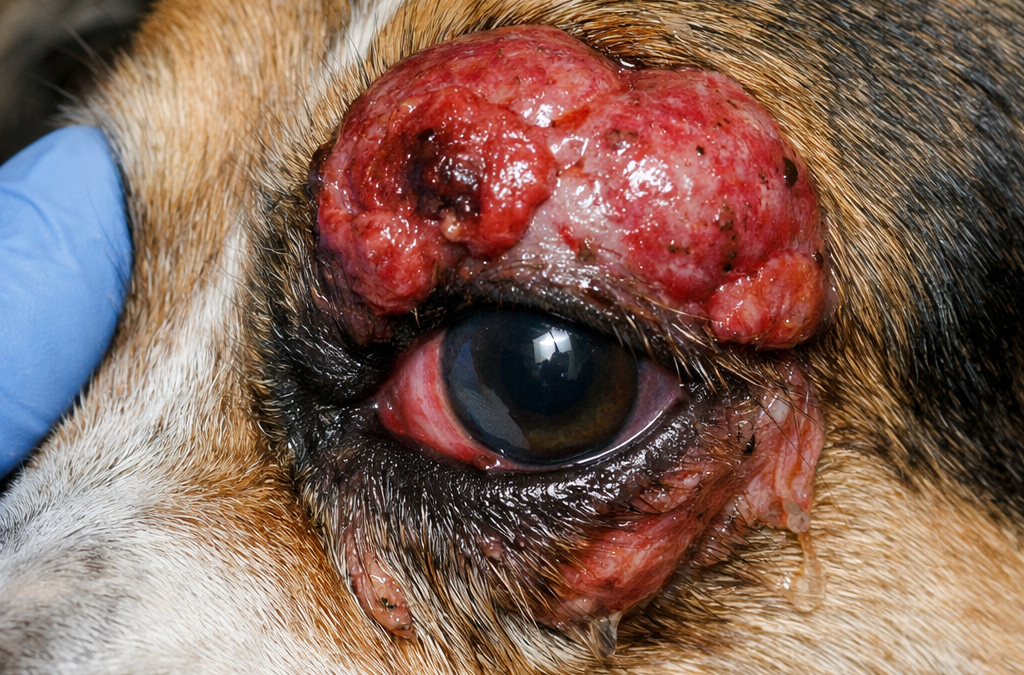
A tumor “over the eye” can look like a firm lump or swelling near the brow or eyelids, but deeper disease may show up through function changes. Dogs may squint, tear excessively, develop persistent discharge, rub at the eye or face, or seem head-shy. If the orbit is involved, classic signs can include exophthalmos (a bulging eye), third eyelid protrusion, and pain around the eye.
Pain and suffering: how much does it hurt?
Pain varies widely and is driven by what the tumor is doing locally.
A mass can become very uncomfortable if it distorts eyelid position or causes chronic corneal irritation with blinking. Veterinary ophthalmology guidance notes that eyelid masses often enlarge over time and can irritate the ocular surface, affecting comfort and quality of life. Orbital disease can also be painful—especially when swelling, pressure, or inflammation is present—and pain is frequently mentioned among the clinical signs in orbital conditions.
Why treatment near the eye is so challenging
For sarcoma-type tumors, the goal is usually strong local control, because microscopic tumor “fingers” can extend beyond what looks abnormal. On the trunk or limbs, surgeons often aim for wider margins to remove those invisible extensions. Around the eye, wide margins can be hard to achieve without damaging critical structures, which is why doctors may sound cautious about guarantees.
Treatment options: what’s typically considered
Most treatment plans revolve around local control and comfort, often combining multiple approaches.
Surgery is commonly the cornerstone when feasible, both to remove tumor burden and to obtain definitive pathology. For canine soft tissue sarcomas, completeness of excision strongly influences outcomes; reviews emphasize that incompletely excised tumors carry higher local recurrence risk. In some cases, surgeons may recommend more radical procedures to achieve control in difficult locations (including surgeries involving the orbit) because certain sarcomas can require radical approaches when anatomy limits margin width.
Radiation therapy is often discussed when margins are close or incomplete, or when anatomy makes wide excision impossible. It is used with the intent of controlling microscopic residual cells and lowering the chance of regrowth, though results vary by tumor behavior, dose planning, and the specifics of each case.
Recurrence risk: what the research repeatedly points to
Across canine STS literature, two drivers show up again and again: histologic grade and margin status.
A review on incompletely or narrowly excised canine STS reports published recurrence rates roughly in the 17%–37% range across studies, illustrating why “clean margins” matter so much. Another widely cited overview notes that with complete excision, local recurrence in dogs can be very low, and incomplete margins increase recurrence risk substantially.
Survival outlook and “survival timeline”: the practical way to think about prognosis
Because “spindle cell tumor” can represent multiple tumor types, survival time can’t be reliably summarized with one number. A more dependable way to understand prognosis is to anchor expectations to what most strongly predicts behavior:
A lower-grade tumor that can be completely controlled locally generally carries a better outlook than a higher-grade tumor or one that can’t be fully removed due to location. In canine STS, metastatic risk is commonly described as grade-dependent, with higher-grade tumors carrying a meaningfully higher chance of spread over the course of disease. In periocular tumors specifically, “how well local disease can be controlled” often becomes the dominant factor shaping both quality of life and overall outcome.
What owners can do early that often matters (without getting lost in details)
The most useful focus points early on are confirming the true extent of disease and protecting comfort.
Advanced imaging such as CT or MRI is frequently recommended in orbital/periocular cases because routine exams can’t always show what’s happening behind the eye, and imaging helps guide surgery and radiation planning. Comfort is also central: periocular tumors can trigger corneal irritation and inflammation, and reducing rubbing/trauma and addressing eye-surface irritation can make a meaningful difference in day-to-day wellbeing.
FAQ: quick answers pet owners search for
Is every tumor near the eyelid malignant?
No. Eyelid tumors are common in dogs and many behave in a benign way, although any fast-growing, ulcerated, bleeding, or painful mass needs prompt evaluation.
Why would a vet recommend removing the eye?
When a tumor is deeply invasive or margins can’t be achieved safely, more aggressive local surgery may be recommended to improve local control in a region where space is limited.
Why can’t surgery and radiation guarantee it won’t come back?
Sarcoma-type tumors can extend microscopically, and around the eye it may be difficult to remove enough surrounding tissue. Incompletely excised STS has documented recurrence risk in multiple studies.
What most strongly predicts prognosis?
Pathology grade and whether the tumor was removed with clean margins are repeatedly highlighted as major drivers of recurrence and spread risk in canine STS.
How Baituxiao may help as supportive care
Periocular spindle cell tumors are usually managed with local control first—most often surgery, and sometimes radiation—because these tumors can be locally invasive and the eye region limits wide margins. In that setting, many owners also consider integrative supportive care to help maintain comfort, appetite, and overall quality of life alongside the primary treatment plan.
Baituxiao is a TCVM botanical formula positioned by the manufacturer for dogs and cats with “tumors and lumps,” and it is typically discussed as an adjunct option rather than a stand-alone solution. Because botanical formulas can interact with medications used around surgery, pain control, inflammation, or oncology care, it’s best used as part of a coordinated plan with the veterinary team.