
Baituxiao vs STUBBS S-Onco is a comparison many Portuguese dog owners consider when looking for supportive care during a canine tumor diagnosis. Both products are discussed as complementary options, but they should never replace veterinary diagnosis, surgery, chemotherapy, radiation therapy, pain control, or other treatments recommended by a qualified veterinarian. The best choice depends on the dog’s tumor type, overall health, current medication, nutritional needs, and treatment plan.
For many families, the hardest part is sorting through claims that sound helpful but do not always reflect clinical reality. That is why a careful Baituxiao vs STUBBS S-Onco review should focus on ingredient transparency, dosing instructions, product quality, and safety during active treatment. In practice, the right decision is usually the one that fits the dog’s medical situation and can be monitored closely by the veterinary team.
- Why a dog tumor support comparison matters
- Baituxiao vs STUBBS S-Onco: understanding the different roles
- What to check before buying
- STUBBS S-Onco comparison: key factors to evaluate
- Comparing ingredients and potential benefits
- Safety during cancer treatment
- Choosing between the two products in Portugal
- A practical decision framework
- Final perspective
Why a dog tumor support comparison matters
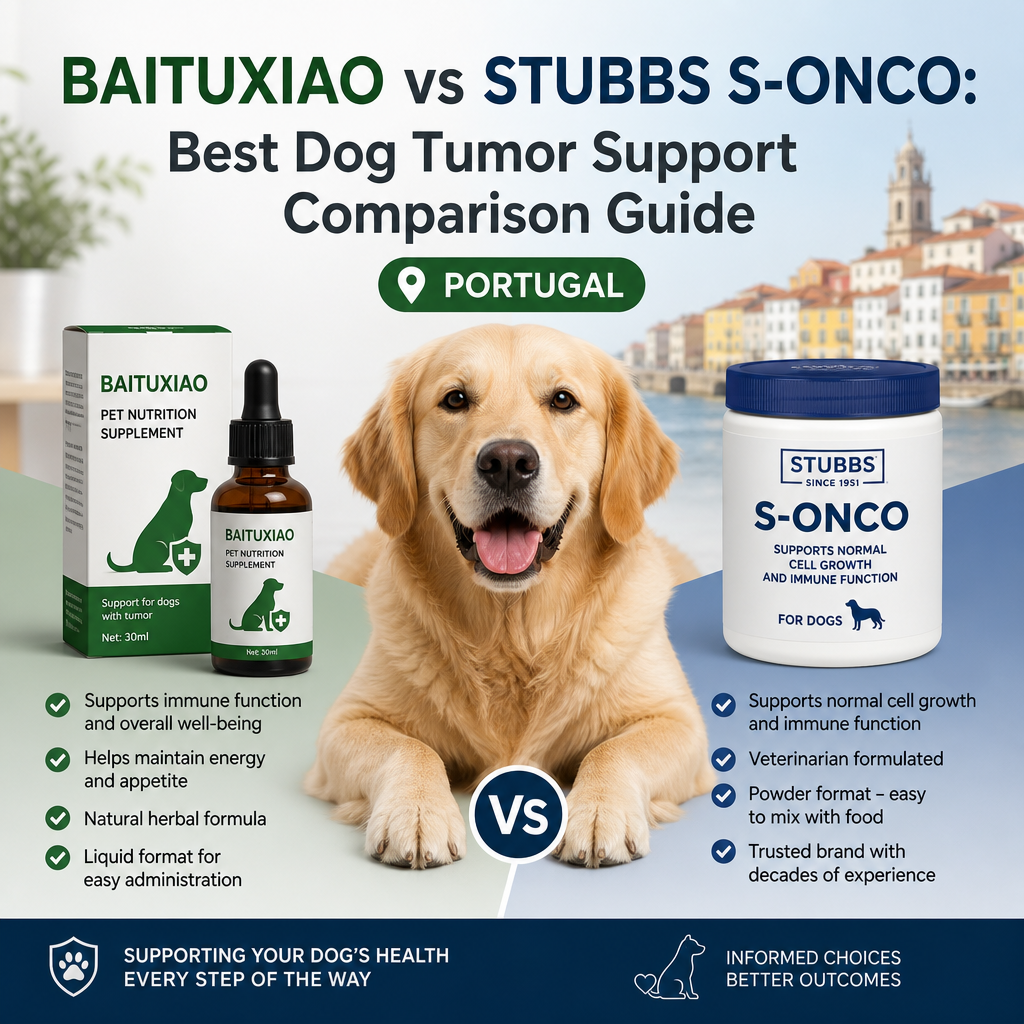
A tumor diagnosis can be overwhelming. Dogs may need several forms of care at once, including clinical treatment, appetite support, digestive assistance, pain management, and close monitoring. Supplements may play a role in a broader wellness plan, but their purpose is generally supportive rather than curative. That is the central reason why Baituxiao vs STUBBS S-Onco should be evaluated with caution and realistic expectations.
A careful dog tumor support comparison should examine ingredients, intended use, safety considerations, administration, product quality, and compatibility with conventional treatment. It is also important to distinguish between evidence from laboratory studies, animal research, and properly controlled clinical trials. Marketing claims may sound promising, but they do not automatically prove that a product can shrink tumors or extend survival. The more serious the illness, the more important it becomes to verify facts before adding any supplement.
In Portugal, owners should also consider where products are sourced, whether labels are available in Portuguese or another understandable language, and whether the product is intended for veterinary use. Buying through reliable suppliers helps reduce the risk of counterfeit, expired, or improperly stored supplements. It also makes it easier to verify lot numbers, expiration dates, and storage requirements if a concern arises later.
Another reason this comparison matters is that dogs with cancer often receive multiple medicines at once. Even a supplement that seems simple can affect appetite, liver metabolism, blood clotting, or digestive comfort. A Baituxiao vs STUBBS S-Onco decision should therefore fit into the dog’s full medical picture instead of being made in isolation.
Baituxiao vs STUBBS S-Onco: understanding the different roles
Baituxiao and STUBBS S-Onco are commonly presented as complementary products for dogs with tumor-related health concerns. However, formulations can vary by manufacturer, seller, product version, and market. Owners should always check the current packaging, ingredient list, dosage instructions, lot number, and expiration date instead of relying solely on online descriptions. This step matters because the exact formula is far more important than the brand name alone.
Baituxiao is often marketed around botanical and nutritional support, with ingredients that may be associated with immune function, inflammation balance, or general vitality. STUBBS S-Onco is also positioned as a supportive product for animals affected by cancer or tumor-related illness. The practical difference may therefore depend less on product names and more on the exact formulation and the dog’s individual medical circumstances. In other words, Baituxiao vs STUBBS S-Onco is not just a label-to-label comparison; it is a case-by-case assessment.
When comparing them, avoid assuming that a longer ingredient list means a better product. Multiple herbs and compounds can increase the possibility of interactions, especially when a dog is receiving chemotherapy, corticosteroids, nonsteroidal anti-inflammatory drugs, anticoagulants, anticonvulsants, or medication for liver and kidney disease. A simpler formula can sometimes be easier to manage, especially when the dog already has a complex treatment plan.
It is also worth noting that owners may describe both products as “support” even though support can mean very different things in practice. For one dog, support may mean appetite and digestion. For another, it may mean helping the dog stay comfortable during a difficult treatment cycle. A good Baituxiao vs STUBBS S-Onco review should therefore ask what problem the product is meant to solve and whether that problem truly exists for the individual dog.
For owners who are also comparing other supplement options, it can help to review a separate veterinary resource such as this Ocoxin Pets alternative guide for the UK to understand how supportive products are commonly evaluated.
What to check before buying
Before choosing between the two products, make sure the decision is based on verifiable details rather than store descriptions or social media claims. A practical Baituxiao vs STUBBS S-Onco comparison starts with the label and product documentation.
Look for the following:
- Complete ingredient list: Identify the exact active ingredients and any additives, flavorings, or preservatives.
- Serving size and concentration: Check how much is in each capsule, scoop, or milliliter so you can calculate the true dose.
- Weight-based instructions: The label should explain dosing for small, medium, and large dogs.
- Warnings and contraindications: Clear caution statements are a sign of better transparency.
- Manufacturer details: A reliable brand should provide a real address, contact information, and batch or lot details.
- Storage guidance: Heat, light, and humidity can affect product quality, especially during shipping.
- Veterinary suitability: The product should make sense for dogs, not just for general health claims.
If the label is vague or incomplete, that is a red flag. Many owners focus on benefits first, but the safest Baituxiao vs STUBBS S-Onco choice begins with what the manufacturer is willing to disclose. Transparency often matters more than advertising language.
Product form also matters. Some dogs accept powders more easily, while others tolerate capsules or liquids better. A dog with nausea may struggle to take a large capsule, and a dog with mouth pain may not tolerate certain powders mixed into food. These practical issues can affect whether the supplement is used consistently enough to matter.
STUBBS S-Onco comparison: key factors to evaluate
A meaningful STUBBS S-Onco comparison should begin with transparency. Look for a complete list of active and inactive ingredients, amounts per serving, manufacturing information, storage requirements, and clear instructions for dogs of different weights. The same approach applies when assessing Baituxiao vs STUBBS S-Onco side by side.
Consider the following points:
– Formulation: Identify whether the product contains herbs, mushrooms, vitamins, minerals, antioxidants, or other compounds.
– Dose clarity: The label should explain how much to give according to body weight and whether the amount changes during illness.
– Quality control: Prefer products from manufacturers that provide batch testing, contamination controls, and clear contact information.
– Administration: Powders, capsules, and liquids may differ in convenience, particularly for dogs with poor appetite or difficulty swallowing.
– Tolerance: Watch for vomiting, diarrhea, constipation, lethargy, itching, or reduced appetite after introducing any supplement.
– Veterinary compatibility: Ask the treating veterinarian to review the full ingredient list before use.
A product should not be selected solely because it is described as “natural.” Natural substances can still produce adverse effects, alter blood clotting, affect blood pressure, influence liver enzymes, or interfere with prescribed treatment. A careful Baituxiao vs STUBBS S-Onco decision should therefore be grounded in safety, not in marketing style.
If you want to compare similar tumor-support formulations in another European market, the European Medicines Agency is a useful official reference for medicine safety and regulatory context.
Owners in Portugal may also want to think about how easy the product is to obtain again if it appears to help. If supply is inconsistent, a dog may be switched between versions, batch sources, or formulations, which can make monitoring more difficult. Consistency is often an overlooked part of the Baituxiao vs STUBBS S-Onco decision.
Comparing ingredients and potential benefits
The central issue in a Baituxiao vs STUBBS S-Onco review is not simply which product has more ingredients. It is whether the ingredients are relevant to the dog’s needs and supported by credible safety information. In the context of canine cancer care, usefulness depends on the specific problem being addressed.
Some supplements are designed to support appetite, digestion, antioxidant defenses, or general immune health. These goals may be useful when a dog is losing weight or experiencing treatment-related stress. However, supplements that stimulate the immune system may not be suitable in every situation, particularly when immune-modulating drugs or autoimmune conditions are involved. That is why even a well-known Baituxiao vs STUBBS S-Onco choice can be wrong for a particular patient.
Antioxidant products also require careful discussion. Although antioxidants are important for normal cellular function, high-dose supplementation during chemotherapy or radiation may not always be appropriate. Certain treatments rely partly on oxidative mechanisms, so the timing and dose of antioxidant ingredients should be reviewed with the veterinary oncology team. The same caution applies if the dog has liver issues or is already receiving multiple supplements.
Owners should also be cautious about products claiming to target cancer cells directly. Laboratory findings do not necessarily translate into a proven clinical benefit for dogs. A supplement may have interesting biological properties without being shown to treat a specific canine tumor. This is one reason why Baituxiao vs STUBBS S-Onco should be treated as a supportive-care question, not a cure discussion.
In some cases, the potential benefit is less about the ingredient list itself and more about improving the dog’s daily comfort. If a supplement helps preserve appetite, maintain hydration, or make a dog more willing to eat, it may support overall wellbeing even without acting on the tumor directly. That kind of benefit can matter, but it still needs to be assessed honestly and monitored over time.
Owners should also watch for unrealistic expectations. A dog with cancer may still need prescription medication, nutrition changes, and follow-up imaging regardless of which supplement is chosen. Baituxiao vs STUBBS S-Onco is best viewed as part of a broader care plan, not as a replacement for it.
Safety during cancer treatment
Before giving Baituxiao, STUBBS S-Onco, or any other supplement, provide the veterinarian with a complete list of everything the dog receives. This includes prescription medicines, flea and tick products, vitamins, herbal products, CBD preparations, and human foods used as remedies. A full medication history is essential because even products that seem unrelated can still affect treatment safety.
Veterinary approval is especially important when the dog has:
– Liver or kidney disease
– A bleeding or clotting disorder
– Diabetes
– Seizures
– Heart disease
– A history of pancreatitis
– An autoimmune condition
– A planned surgery or biopsy
– Chemotherapy or radiation treatment
Stop the supplement and contact the veterinarian if the dog develops repeated vomiting, severe diarrhea, unusual bruising, pale gums, weakness, collapse, breathing difficulty, jaundice, or a sudden change in behavior. These signs may be related to the disease or another medication, but they require prompt attention. If a Baituxiao vs STUBBS S-Onco choice triggers new symptoms, do not wait to see whether they resolve on their own.
It is also sensible to introduce one supplement at a time. When several products start together, it becomes difficult to know what caused a side effect or whether the dog is actually benefiting. A slow, measured approach makes the Baituxiao vs STUBBS S-Onco comparison much easier to evaluate in real life.
For more context on tumor-related care and early warning signs in a large breed, owners may also find Alaskan Malamute cancer risks and early tumor signs helpful.
Choosing between the two products in Portugal
For Portuguese owners, the most sensible choice is the product that fits the veterinary plan and can be obtained through a trustworthy channel. Check whether the seller provides an original seal, expiration date, storage information, and documentation about manufacturing standards. Be cautious with unusually low prices, vague claims, missing labels, or sellers who promise guaranteed tumor shrinkage. Those warning signs can appear with either brand, so the decision should be based on evidence rather than presentation.
It may also be useful to ask the veterinarian or veterinary pharmacist about availability, import requirements, and whether the product is appropriate for the dog’s size and condition. Products purchased from outside the European Union may have different labeling standards and could involve delays, customs issues, or uncertain storage conditions. If the product is part of a long-term plan, availability matters almost as much as formula quality.
Cost matters, but value should be judged by transparency, consistency, safety, and practical usefulness. A less expensive product is not necessarily safer, while a premium product is not automatically more effective. A sensible Baituxiao vs STUBBS S-Onco choice weighs the full picture: price, ingredients, compliance, and veterinary oversight.
Owners should also think about how the product will be given at home. If a dog resists the taste, spits out capsules, or refuses food after the supplement is mixed in, the product may create stress without offering much practical benefit. Ease of administration can make one option clearly better than the other even if the formulas appear similar on paper.
A practical decision framework
A structured approach can make the decision easier:
1. Confirm the tumor diagnosis and treatment plan.
2. Ask the veterinarian whether supplementation is appropriate.
3. Obtain the exact labels for Baituxiao and STUBBS S-Onco.
4. Compare ingredients, amounts, warnings, and administration instructions.
5. Check for possible interactions with current medication.
6. Introduce only one new product at a time unless the veterinarian advises otherwise.
7. Monitor appetite, stool, energy, weight, and treatment response.
8. Reassess regularly with the veterinary team.
Keeping a simple record can help identify whether the dog is tolerating the product. Note the daily dose, appetite, bowel movements, energy level, vomiting, weight, and any medication changes. This information gives the veterinarian a clearer picture and prevents confusion when several treatments are being used. It also helps turn a Baituxiao vs STUBBS S-Onco decision into something measurable rather than purely subjective.
Owners may find it useful to create a one-page comparison sheet with the product name, ingredients, dose, price, source, and any observed side effects. A simple record like that often reveals which option is easier to use and which one is less likely to cause problems. If the dog’s comfort improves, it becomes easier to justify continuing the product under veterinary supervision.
In some cases, owners find it useful to compare support products across European markets, including options discussed in the K9 Immunity alternative guide for France, before making a final decision.
Final perspective
Baituxiao vs STUBBS S-Onco should be approached as a supportive-care decision, not as a substitute for evidence-based veterinary oncology. Neither product should be assumed to cure cancer, replace prescribed treatment, or work equally well for every dog. The most responsible dog tumor support comparison focuses on verified ingredients, product quality, interaction risks, realistic expectations, and professional supervision.
For families in Portugal, the safest path is to discuss both options with the veterinarian managing the dog’s case, choose a transparent and reputable source, and monitor the animal closely. Supportive products may be considered as part of individualized care, but the dog’s diagnosis, comfort, nutrition, and medical treatment must remain the foundation of every decision. In that context, Baituxiao vs STUBBS S-Onco becomes less about marketing and more about matching the right supportive tool to the right clinical situation.
When in doubt, ask your veterinary team to review the full product label and compare it with the current treatment plan. That extra step can prevent avoidable interactions and help ensure the supplement, if used, truly supports the dog’s care. With that guidance, Baituxiao vs STUBBS S-Onco can be assessed in a balanced, practical, and medically responsible way.