Finding an Ocoxin Pets alternative in Cyprus can help dog owners explore accessible, affordable nutritional support during a difficult time. Supplements cannot replace veterinary diagnosis, surgery, chemotherapy, radiation, or prescribed medication, but the right product may help maintain appetite, body condition, energy, and overall quality of life.
Choosing a supplement for a dog with cancer requires more than comparing prices. The product should have transparent ingredients, suitable dosing information, good manufacturing standards, and a safety profile appropriate for dogs. It is also important to consider the type of tumor, the dog’s age, current medication, liver and kidney function, and whether treatment is already underway. For general guidance on safe use of supplements, the VCA Hospitals guide to dietary supplements for dogs is a helpful reference.
Why dog owners look for an Ocoxin Pets alternative
Ocoxin Pets is known as a veterinary nutritional supplement used as supportive care for dogs and cats with serious illness, including cancer. However, several practical concerns may lead owners to search for an Ocoxin Pets alternative.
Availability can be inconsistent, especially for pet owners living in Cyprus who may need to order products from overseas. Shipping fees, import delays, limited local stock, and currency differences can make a supplement more expensive than expected. Some dogs may also refuse products with a strong smell or taste, while others may need a formulation that is easier to mix with food.
A suitable alternative should not be selected solely because it is cheaper. It should provide useful nutritional support and fit the dog’s individual medical needs. A veterinarian can help determine whether a general immune-support product, omega-3 supplement, medicinal mushroom formula, antioxidant blend, or high-calorie nutritional product is most appropriate. In many cases, the best Ocoxin Pets alternative is the one the dog can take consistently.
What to look for in dog tumor supplements Cyprus owners can access
When comparing dog tumor supplements Cyprus pet owners should focus on quality, safety, and realistic benefits. A reliable supplement label should clearly state the active ingredients, amount per serving, recommended use, storage instructions, batch information, and manufacturer details.
Useful features may include:
Ingredients supported by veterinary or nutritional research
Clear dosing instructions based on body weight
No undisclosed proprietary blends
Appropriate formulation for dogs
Evidence of quality control and contamination testing
Compatibility information for dogs receiving cancer treatment
A product that can be sourced consistently in Cyprus
It is also wise to avoid products that promise to cure cancer, shrink every tumor, or replace conventional treatment. Such claims are a serious warning sign. Supplements may support nutrition and wellbeing, but no over-the-counter product should be presented as a guaranteed cancer treatment. A careful Ocoxin Pets alternative should support care, not replace it.
Potential ingredients in an Ocoxin Pets alternative
Different supplements use different combinations of nutrients and botanical ingredients. The best option depends on the dog’s condition rather than on the longest ingredient list. Some of the most common ingredients used in supportive formulas are below.
Omega-3 fatty acids
Fish oil providing EPA and DHA is commonly considered for dogs with cancer because it may support normal inflammatory balance and help maintain body condition. Omega-3 fatty acids can also contribute to skin, coat, and general cardiovascular health. However, high doses may cause digestive upset or affect blood clotting, so the product should be used under veterinary guidance, especially before surgery. For many owners, this becomes a practical Ocoxin Pets alternative when appetite support and everyday nutrition matter more than a complex formula.
Medicinal mushrooms
Some veterinary supplements contain extracts from mushrooms such as turkey tail, reishi, or maitake. These ingredients are studied for their effects on immune function, but the evidence varies by mushroom, extract, dose, and type of cancer. A mushroom product should be standardized where possible, and the veterinarian should review it before use alongside immunotherapy, steroids, or chemotherapy. When used appropriately, this type of Ocoxin Pets alternative may fit a broader supportive-care plan.
Antioxidant nutrients
Vitamins such as vitamin E, vitamin C, selenium, and other antioxidant compounds may be included in supportive formulas. Their use during chemotherapy or radiation treatment should always be discussed with the veterinary oncologist. Timing and dosage matter, and more is not necessarily better. The right Ocoxin Pets alternative should be chosen with treatment timing in mind.
Digestive and nutritional support
Cancer and its treatment may lead to poor appetite, nausea, weight loss, or digestive changes. Some products focus on probiotics, prebiotics, digestive enzymes, or calorie-dense nutrition. These may be more immediately useful than a complex herbal formula when the main problem is maintaining food intake and muscle mass. For many families, this practical support is the most valuable part of an Ocoxin Pets alternative.
When a simpler formula is enough
Not every dog needs a long ingredient panel. In some cases, a single-purpose supplement with clear dosing and fewer variables is easier to tolerate and monitor. This can be especially useful if the dog is already taking several medications. A streamlined Ocoxin Pets alternative may also be easier to source locally in Cyprus.
Seven practical supplement approaches worth discussing with your veterinarian
If you are comparing an Ocoxin Pets alternative, it can help to think in categories rather than brand names. The following approaches are commonly used in supportive care, and each may suit a different dog depending on the diagnosis, appetite, and treatment plan.
Omega-3 fish oil formulas for dogs that need nutritional support with a simple ingredient profile.
Medicinal mushroom blends when a veterinarian wants to include standardized immune-support ingredients.
Antioxidant formulas for carefully timed use alongside a cancer-care plan.
High-calorie nutritional supplements for dogs that are losing weight or eating less.
Probiotic or digestive support products for nausea, loose stool, or medication-related digestive upset.
Multinutrient recovery supplements when overall strength and intake are the main concerns.
Simple single-ingredient products when fewer variables are better for a dog already on multiple medications.
These categories do not replace diagnosis-specific treatment, but they can help owners compare options more realistically. In practice, the best dog tumor supplements Cyprus owners choose are often the ones that match the dog’s immediate needs and are easy to give every day.
How to compare products beyond the label
Marketing language can make many products sound similar, but practical details often separate one supplement from another. Compare the cost per daily dose rather than the sticker price. Check whether the manufacturer provides a batch number, expiry date, and contact information. If a product is imported, ask whether it has been stored correctly during shipping and warehousing.
It also helps to review the format. Liquids may be easier for dogs that will not swallow tablets. Capsules may be more accurate for dosing. Powdered products can be mixed into meals, but only if the dog is still eating reliably. For some families, the easiest-to-administer product is the most valuable Ocoxin Pets alternative because consistency matters more than a long ingredient list.
If you are unsure how a product compares with other options, speak with a veterinary professional who can weigh the likely benefits against the cost. A modest supplement that your dog accepts may be more useful than a premium formula that sits unused in the cupboard.
Safety considerations for dogs with cancer
Before giving any Ocoxin Pets alternative, provide the veterinarian with the full ingredient list. Supplements can interact with prescribed medicines, anesthetics, blood thinners, anti-inflammatory drugs, steroids, and chemotherapy agents. Dogs with liver disease, kidney disease, pancreatitis, diabetes, or bleeding disorders may require additional precautions.
Never use human supplements without professional approval. Human products may contain unsafe doses, xylitol, iron, concentrated herbs, or other ingredients that are dangerous to dogs. Essential oils and highly concentrated herbal extracts can also be harmful when ingested.
Introduce one new product at a time and monitor the dog for vomiting, diarrhea, reduced appetite, itching, lethargy, or unusual behavior. Stop the supplement and contact the veterinarian if concerning symptoms appear. Keep all products stored securely, particularly in Cyprus during hot weather, because heat and humidity can reduce product stability.
It is also sensible to keep a simple log of the supplement name, start date, dose, and any changes in appetite or behavior. This makes it easier to tell whether an Ocoxin Pets alternative is helping or causing a problem.
Questions to ask before you buy
When choosing supportive products, a few practical questions can save time and money:
Is this product formulated for dogs, not humans?
Does the label clearly list every active ingredient and amount?
Can it be used safely with the current treatment plan?
Will the dog actually take it without a struggle?
Is it available locally or from a reliable supplier in Cyprus?
Does the cost per day make sense for long-term use?
These questions are especially important if the dog has a fragile appetite or is already receiving several medications. A supplement that seems impressive on paper may not be practical in daily life. The right Ocoxin Pets alternative should be both medically sensible and easy for the owner to use.
Affordable options for pet owners in Cyprus
Affordability does not always mean choosing the lowest-priced container. Compare the cost per daily dose, shipping charges, delivery time, and the number of days each package will last. A locally available product may be better value than a cheaper imported supplement with high delivery costs.
Cyprus pet owners can ask veterinary clinics, licensed pharmacies, reputable pet shops, and established online retailers about stock and sourcing. Look for products with sealed packaging, expiration dates, and clear manufacturer information. Avoid unverified marketplace listings where storage conditions and authenticity are uncertain.
A balanced complete dog food is also an important part of supportive care. In many cases, improving the dog’s regular diet, adding veterinary-approved calories, and treating nausea or pain can have a greater effect on quality of life than purchasing multiple supplements. This is why the most useful Ocoxin Pets alternative is often part of a nutrition-first plan.
If you are comparing products online, check whether the seller provides a full ingredient label and a real business address. Reliable vendors are more likely to stock a legitimate Ocoxin Pets alternative rather than a product with unclear sourcing.
Building a practical supportive-care plan
The most effective approach combines veterinary treatment with careful daily observation. Track appetite, water intake, weight, bowel movements, activity, sleep, pain signs, and interest in normal activities. This information can help the veterinarian assess whether a supplement is providing useful support or causing unwanted effects.
Discuss the dog’s goals of care openly. For one dog, the priority may be maintaining strength during chemotherapy. For another, it may be encouraging appetite and comfort during palliative care. The appropriate supplement, dose, and timing may be different in each situation. A good Ocoxin Pets alternative should match those goals rather than follow a one-size-fits-all approach.
It may also help to review treatment options with a specialist if the diagnosis is complex. Veterinary oncology resources such as the American College of Veterinary Internal Medicine can help owners better understand evidence-based cancer care and the role of supportive nutrition.
Ultimately, the best Ocoxin Pets alternative is not necessarily the most popular or most expensive product. It is a safe, transparent, veterinarian-reviewed option that meets the dog’s nutritional needs and is realistically affordable and available in Cyprus. Used responsibly, supportive supplements may complement medical care, but the foundation should remain accurate diagnosis, appropriate treatment, good nutrition, pain control, and regular veterinary monitoring.
Complément chien tumeur : accompagner son animal avec prudence et méthode demande de distinguer les solutions réellement utiles des promesses excessives. Une tumeur, qu’elle soit bénigne ou maligne, doit toujours être évaluée par un vétérinaire. Les compléments ne remplacent ni la chirurgie, ni la chimiothérapie, ni la radiothérapie, ni les soins palliatifs, mais certains peuvent contribuer au confort général du chien, à son état nutritionnel et à sa récupération lorsqu’ils sont intégrés dans une prise en charge personnalisée.
Avant d’acheter un produit, il est utile de comparer les ingrédients, les dosages, la qualité de fabrication et la cohérence avec le traitement en cours. Dans ce guide, vous verrez comment évaluer un complément chien tumeur sans vous laisser séduire par des promesses irréalistes, tout en gardant une approche calme et rigoureuse.
Comprendre les besoins d’un chien atteint d’une tumeur
Le terme « tumeur » désigne une masse anormale qui peut avoir des origines et des comportements très différents. Certaines lésions restent localisées et évoluent lentement, tandis que d’autres peuvent envahir les tissus voisins ou se propager à distance. L’âge, la race, la localisation de la masse, le type histologique et l’état général de l’animal influencent fortement les choix thérapeutiques.
Avant d’envisager un complément alimentaire chien tumeur, plusieurs éléments doivent être vérifiés :
– le diagnostic confirmé par une cytologie ou une biopsie ;
– le stade d’évolution de la maladie ;
– le poids et l’état corporel du chien ;
– son appétit et sa digestion ;
– les traitements déjà prescrits ;
– les éventuelles maladies du foie, des reins ou du pancréas.
Cette étape est essentielle, car un produit présenté comme naturel peut tout de même provoquer des effets indésirables ou modifier l’action d’un médicament. Un complément chien tumeur doit donc être pensé comme un outil de soutien, pas comme une solution autonome.
Il est aussi utile de considérer le tempérament du chien, ses habitudes alimentaires et son niveau de tolérance aux changements. Un animal sensible au niveau digestif ne réagira pas comme un chien en pleine forme apparente. Dans la pratique, la meilleure option n’est pas toujours la plus “complète”, mais celle qui s’intègre le mieux à la situation clinique réelle.
Un bon complément ne doit pas être choisi uniquement parce qu’il affirme « combattre » ou « éliminer » une tumeur. Les objectifs les plus réalistes concernent généralement le soutien de l’organisme et de la qualité de vie.
Maintenir un état nutritionnel satisfaisant
La perte d’appétit et l’amaigrissement sont fréquents chez les chiens malades. Or, la masse musculaire joue un rôle important dans la mobilité, la récupération et la tolérance aux traitements. Selon les besoins, le vétérinaire peut recommander une alimentation plus énergétique, des protéines hautement digestibles ou un complément destiné à stimuler l’apport calorique.
Les acides gras oméga-3, notamment ceux provenant d’huiles de poisson contrôlées, sont parfois utilisés dans les protocoles nutritionnels. Ils peuvent participer au maintien d’un équilibre inflammatoire normal et soutenir la peau, le pelage et l’état général. Leur dosage doit cependant être adapté, car un excès de matières grasses peut être mal toléré par certains chiens.
Un complément chien tumeur orienté vers le soutien nutritionnel sera souvent plus utile s’il complète une ration déjà bien construite. Dans certains cas, améliorer la densité énergétique des repas produit un effet plus visible qu’ajouter plusieurs produits différents.
Soutenir la digestion et l’appétit
Les traitements anticancéreux, la douleur ou le stress peuvent entraîner des nausées, des selles irrégulières ou une baisse de l’envie de manger. Des probiotiques vétérinaires, des fibres adaptées ou certains produits digestifs peuvent être proposés dans des situations précises.
Il est préférable d’introduire un seul produit à la fois. Cette méthode permet d’identifier plus facilement son effet et d’éviter de surcharger le système digestif. En cas de vomissements répétés, de diarrhée persistante ou de refus total de s’alimenter, une consultation rapide est nécessaire.
Certains propriétaires cherchent un complément chien tumeur pour « redonner de l’appétit ». L’objectif est compréhensible, mais il doit rester encadré. Une baisse d’appétit peut signaler une douleur, une nausée ou un effet secondaire de traitement, et il ne faut pas masquer le problème sans en chercher la cause.
Préserver le confort et la vitalité
Un soutien tumeur chien peut aussi viser le confort quotidien : maintien de la mobilité, récupération après une intervention, soutien articulaire ou amélioration de l’état général. Des nutriments comme les vitamines, les minéraux, certains acides aminés ou les antioxydants peuvent être utiles lorsque l’alimentation ne couvre pas correctement les besoins.
Toutefois, les vitamines ne sont pas automatiquement bénéfiques en quantité élevée. Une supplémentation excessive peut être toxique ou perturber l’équilibre alimentaire. Un complément pertinent doit donc être dosé, traçable et cohérent avec la ration du chien.
Si vous souhaitez mieux comprendre la logique des soins intégratifs en clinique vétérinaire, vous pouvez aussi consulter notre page sur les approches de soutien vétérinaire.
Dans cette perspective, le complément chien tumeur le plus intéressant est souvent celui qui aide à stabiliser le quotidien : manger un peu mieux, garder de l’énergie, récupérer plus facilement et mieux vivre les périodes de traitement.
Les ingrédients fréquemment proposés
Plusieurs familles d’ingrédients apparaissent dans les formules destinées aux chiens fragilisés. Les oméga-3 issus de poissons sauvages ou d’élevage contrôlé sont recherchés pour leur profil nutritionnel. Les probiotiques peuvent contribuer à l’équilibre du microbiote intestinal. Certaines formules contiennent également des extraits végétaux, des champignons médicinaux ou des composés antioxydants.
La prudence est particulièrement importante avec les plantes. Le curcuma, le thé vert, le resvératrol, l’ail, le ginseng ou certaines huiles essentielles ne sont pas interchangeables et ne présentent pas le même niveau de sécurité chez le chien. L’extrait, la concentration et la forme utilisée changent considérablement le risque. Les huiles essentielles, par exemple, peuvent être dangereuses lorsqu’elles sont ingérées ou mal dosées.
Aucun ingrédient ne devrait être présenté comme une alternative garantie aux traitements vétérinaires. Les allégations commerciales telles que « détruit les cellules tumorales » ou « remplace la chimiothérapie » doivent être considérées avec beaucoup de méfiance.
Pour vérifier les bases de sécurité autour de certains actifs nutritionnels et de leurs usages, un repère utile reste la fiche de référence de l’Autorité européenne de sécurité des aliments.
Selon les cas, un complément chien tumeur peut aussi inclure des antioxydants, des acides aminés ou des ingrédients de soutien hépatique. Là encore, l’intérêt dépend surtout de la qualité des dosages et de l’objectif poursuivi, pas du nombre d’actifs listés sur l’étiquette.
Comment comparer les compléments ?
Pour comparer efficacement un complément alimentaire chien tumeur, il faut examiner plusieurs critères plutôt que de se fier uniquement au prix ou aux témoignages. Un complément chien tumeur pertinent doit rester simple à analyser et transparent sur ses limites.
La transparence de la composition
L’étiquette doit indiquer les ingrédients, les quantités par dose, les excipients et les recommandations selon le poids. Une liste vague, utilisant des termes comme « complexe naturel » sans dosage précis, ne permet pas d’évaluer correctement le produit.
Un complément chien tumeur sérieux affiche aussi les formes exactes des ingrédients, car deux produits qui mentionnent la même substance peuvent avoir une biodisponibilité très différente. Cette précision aide à comparer des formules proches sans se laisser guider par le marketing.
La lecture attentive de la composition permet également d’éviter les doublons. Si le chien reçoit déjà plusieurs produits, ajouter un nouveau complément chien tumeur contenant les mêmes vitamines ou huiles peut alourdir inutilement la ration et compliquer le suivi.
La qualité et la traçabilité
Privilégiez les fabricants capables de fournir des informations sur l’origine des matières premières, les contrôles microbiologiques, les métaux lourds et les contaminants. La présence d’un numéro de lot et d’une date de péremption clairement indiquée est également importante.
Quand la marque publie des analyses ou des fiches techniques, il devient plus facile de distinguer un produit fiable d’un simple mélange d’ingrédients. C’est un point clé pour tout complément chien tumeur destiné à être utilisé sur plusieurs semaines.
La traçabilité compte d’autant plus quand le chien suit déjà un protocole médical. Un complément chien tumeur de qualité doit pouvoir être identifié, documenté et, si besoin, retiré rapidement en cas d’effet indésirable.
L’adaptation au profil du chien
Un produit destiné à un chien âgé souffrant d’insuffisance rénale ne sera pas nécessairement adapté à un animal jeune traité pour une tumeur cutanée. Le choix doit tenir compte du poids, des analyses sanguines, de la fonction digestive et des médicaments administrés.
Le vétérinaire peut aussi tenir compte de la chirurgie prévue, de la perte de poids récente et de l’appétit réel. Dans certains cas, un complément chien tumeur trop riche ou trop complexe sera moins utile qu’un soutien nutritionnel plus ciblé.
Cette logique d’adaptation est importante, car deux chiens ayant une masse tumorale similaire peuvent avoir des besoins très différents. L’un aura surtout besoin d’aide pour manger, l’autre d’un soutien digestif, et un autre encore d’un accompagnement postopératoire plus simple.
L’absence de promesses irréalistes
Un complément sérieux parle de soutien nutritionnel, de digestion, de vitalité ou de confort. Il ne garantit pas la disparition d’un cancer. Les résultats varient selon les animaux et doivent être évalués avec des critères concrets : appétit, poids, selles, mobilité, douleur et qualité du sommeil.
En pratique, un complément chien tumeur de qualité se reconnaît aussi à la clarté de ses recommandations. Si la posologie est floue ou si le fabricant évite de mentionner les limites d’utilisation, mieux vaut passer à une autre option.
Il faut aussi se méfier des comparatifs trop simplistes. Un prix plus élevé n’est pas toujours un gage d’efficacité, et un produit très populaire n’est pas forcément le plus adapté. L’important est de garder une évaluation clinique, concrète et nuancée.
Le rapport entre bénéfice attendu et facilité d’administration
Un chien malade peut refuser les gélules trop volumineuses, les poudres au goût marqué ou les huiles très odorantes. Le meilleur produit sur le papier n’est pas forcément le plus utile au quotidien. Pour comparer correctement, il faut aussi vérifier la forme galénique, la fréquence d’administration et la compatibilité avec l’alimentation habituelle.
Si un complément chien tumeur nécessite plusieurs prises compliquées ou provoque un stress important, son intérêt pratique baisse rapidement. Une formule plus simple, mieux tolérée et régulière sera souvent préférable.
Dans une situation réelle, la simplicité facilite aussi l’observance. Un produit facile à donner augmente les chances que la routine soit suivie sur la durée, ce qui est souvent plus utile qu’une solution théoriquement idéale mais impossible à administrer.
Le coût réel sur la durée
Comparer les compléments demande enfin de calculer le coût par jour ou par semaine, et non le prix du flacon seul. Deux produits au tarif proche peuvent avoir des concentrations très différentes. Un complément chien tumeur concentré peut paraître plus cher à l’achat, tout en revenant moins coûteux sur la durée si le dosage quotidien est plus faible.
Cette lecture évite de privilégier un flacon bon marché qui doit être utilisé en grande quantité. Le bon choix est celui qui reste cohérent avec le budget, le mode de vie du chien et les objectifs de soutien définis avec le vétérinaire.
Au moment de comparer, il peut être utile de noter les points suivants : nombre de prises, goût, conservation, format du flacon, stabilité du produit et facilité de stockage. Ces détails pratiques influencent réellement l’efficacité d’un complément chien tumeur dans la vie quotidienne.
Choisir selon la situation clinique
La meilleure façon d’évaluer un produit est de le rapporter à la situation précise du chien. Un complément chien tumeur ne sera pas sélectionné de la même manière avant une chirurgie, après une opération ou pendant un traitement de longue durée.
Avant une intervention chirurgicale
Avant une chirurgie, la priorité est de respecter les consignes du vétérinaire. Certains compléments sont à arrêter suffisamment tôt pour limiter les risques liés à la coagulation, à l’anesthésie ou à la digestion. D’autres peuvent être maintenus si leur tolérance est bonne et si le praticien l’autorise.
Dans cette phase, un complément chien tumeur ne doit jamais être choisi seul, car l’objectif principal reste la sécurité peropératoire. Une bonne coordination avec la clinique réduit les risques et évite les mauvaises surprises.
Pendant la chimiothérapie ou les traitements médicamenteux
Lorsque le chien reçoit un traitement anticancéreux, les interactions deviennent un point important. Certains ingrédients peuvent modifier le métabolisme hépatique ou renforcer des effets secondaires digestifs. La vigilance doit être maximale si plusieurs médicaments sont déjà prescrits.
Le vétérinaire peut alors recommander un complément chien tumeur centré sur le soutien digestif, l’appétit ou le confort général, plutôt que sur une formule multi-ingrédients difficile à contrôler. Plus le protocole est lourd, plus la simplicité devient un avantage.
En phase de récupération
Après une intervention ou un épisode de fatigue, l’objectif est souvent de soutenir la reprise d’état. Un complément chien tumeur peut alors accompagner la reprise alimentaire, la vitalité et la récupération musculaire. Dans cette phase, le suivi du poids et de l’appétit est particulièrement utile.
Si le chien recommence à manger correctement, si les selles sont stables et si l’énergie revient, le produit choisi répond peut-être bien à son rôle. Si les symptômes persistent, il faut réévaluer la stratégie avec le vétérinaire plutôt que multiplier les ajouts.
Quand l’objectif est surtout le confort
Dans certaines situations, la maladie est avancée et l’enjeu principal devient le confort. Le complément chien tumeur n’a alors pas vocation à modifier l’évolution de la tumeur, mais à soutenir le mieux-être quotidien : alimentation plus facile, digestion plus stable, mobilité conservée et aide au maintien d’un cadre de vie apaisé.
Cette approche palliative peut être très utile, à condition d’avoir des attentes réalistes. Le meilleur indicateur n’est pas la promesse commerciale, mais l’amélioration observable du quotidien.
Les précautions indispensables
Avant de commencer une supplémentation, transmettez au vétérinaire la composition complète du produit. Cette précaution est nécessaire, car certains compléments peuvent modifier la coagulation, influencer le métabolisme hépatique ou interagir avec des médicaments.
N’augmentez jamais la dose parce qu’un produit est naturel. Respectez la quantité recommandée et surveillez l’apparition de signes inhabituels : vomissements, diarrhée, démangeaisons, fatigue marquée, saignements ou aggravation de la douleur. Un carnet de suivi peut aider à noter la dose, l’alimentation, le poids et les changements observés.
Un complément chien tumeur ne doit pas non plus être ajouté en même temps que plusieurs nouveautés alimentaires. Introduire les changements un par un permet de savoir ce qui aide réellement et ce qui doit être retiré. Cette méthode est plus sûre et plus lisible pour le suivi vétérinaire.
Enfin, le meilleur soutien reste souvent global : alimentation adaptée, hydratation suffisante, gestion de la douleur, activité douce selon les capacités, environnement calme et suivi vétérinaire régulier. Utilisé avec discernement, un complément peut compléter cette prise en charge, mais il ne doit jamais retarder un diagnostic ou un traitement essentiel.
Une règle simple aide souvent à décider : si un produit complique le traitement, augmente le stress ou gêne l’animal, il n’est probablement pas le bon choix. Un complément chien tumeur doit faciliter la prise en charge, pas l’alourdir.
Questions fréquentes
Un complément peut-il guérir une tumeur ?
Non. Un complément chien tumeur n’a pas pour rôle de guérir une tumeur. Il peut accompagner le confort, l’état nutritionnel ou la digestion, mais il ne remplace jamais le diagnostic ni le traitement vétérinaire.
Faut-il éviter tous les compléments pendant un traitement ?
Pas forcément. Certains produits peuvent être utiles, mais ils doivent être choisis avec prudence. Le vétérinaire peut aider à déterminer si un complément chien tumeur est compatible avec les médicaments et l’état général du chien.
Comment savoir si un produit est utile ?
Observez des critères simples : appétit, poids, selles, niveau d’énergie, confort et tolérance digestive. Si aucun changement positif n’apparaît après une période raisonnable, ou si des effets indésirables surviennent, il faut réévaluer le choix.
Les produits naturels sont-ils toujours plus sûrs ?
Non. Naturel ne veut pas dire sans risque. Certaines plantes, huiles ou extraits concentrés peuvent être inadaptés chez le chien malade. Un complément chien tumeur doit toujours être évalué comme un produit actif, avec ses bénéfices et ses limites.
Quel est le meilleur conseil avant d’acheter ?
Demandez-vous d’abord quel objectif précis vous cherchez : stimuler l’appétit, soutenir la digestion, aider la récupération ou améliorer le confort. Ensuite, comparez les formules avec votre vétérinaire et privilégiez la sécurité, la transparence et la simplicité.
Bien choisi, un complément chien tumeur peut donc accompagner la prise en charge sans la perturber, à condition de rester cohérent avec le diagnostic, le suivi vétérinaire et les besoins réels de l’animal. Le bon réflexe consiste à comparer avec méthode, à privilégier la transparence et à demander l’avis du vétérinaire à chaque étape.
En résumé, la meilleure décision repose rarement sur un argument unique. Un complément chien tumeur vraiment pertinent combine une composition claire, une tolérance correcte, un objectif réaliste et une intégration logique dans le traitement global du chien.
An Ocoxin Pets alternative can be helpful for Greek dog owners who want supportive nutrition during a pet’s cancer journey. While no supplement can replace veterinary diagnosis, surgery, chemotherapy, radiation, or other prescribed treatment, carefully selected products may help support appetite, immune function, digestion, energy, and overall quality of life. The right choice depends on the dog’s diagnosis, medications, age, weight, and general health.
Before adding any supplement, speak with a veterinarian—ideally one experienced in veterinary oncology. Some natural ingredients can interact with chemotherapy, affect blood clotting, influence the liver, or interfere with prescription medicines. A supplement should be part of a coordinated care plan rather than a stand-alone treatment. For general guidance on safer veterinary nutrition decisions, you can also review the WSAVA Global Nutrition Guidelines.
In many cases, the goal is not to find a miracle product but to choose the most practical supportive option. That might mean improving appetite, protecting the digestive tract, supporting weight maintenance, or adding specific nutrients the dog is missing. A thoughtful Ocoxin Pets alternative should fit into the day-to-day reality of the dog’s treatment and the owner’s ability to use it consistently.
Why consider alternatives to Ocoxin Pets?
Ocoxin Pets is commonly associated with supportive care for dogs with serious illness, but availability, price, shipping, and individual tolerance can vary. Some owners may also prefer products that are easier to purchase locally in Greece or that contain a more specific ingredient, such as medicinal mushrooms, omega-3 fatty acids, or digestive support.
When comparing an Ocoxin Pets alternative, focus on quality rather than impressive marketing claims. A useful product should have a clearly stated ingredient list, appropriate dosing information, batch or quality controls, and transparent guidance for use in dogs. Avoid products promising to “cure” tumors or replace conventional veterinary care. Such claims are generally unreliable and may delay effective treatment.
It also helps to think about the dog’s current stage of care. Some dogs need appetite and calorie support first, while others benefit more from digestive support or inflammation management. In practice, the best Ocoxin Pets alternative is the one that fits the dog’s condition and can be used consistently under veterinary supervision.
Owners also need to consider the full treatment plan. A dog receiving chemotherapy may have different nutritional needs from a dog recovering from surgery or living with a slow-growing tumor under monitoring. The most suitable Ocoxin Pets alternative is not always the one with the longest ingredient list. Often, the better option is the one with the cleanest formula and the clearest purpose.
1. Medicinal mushroom supplements
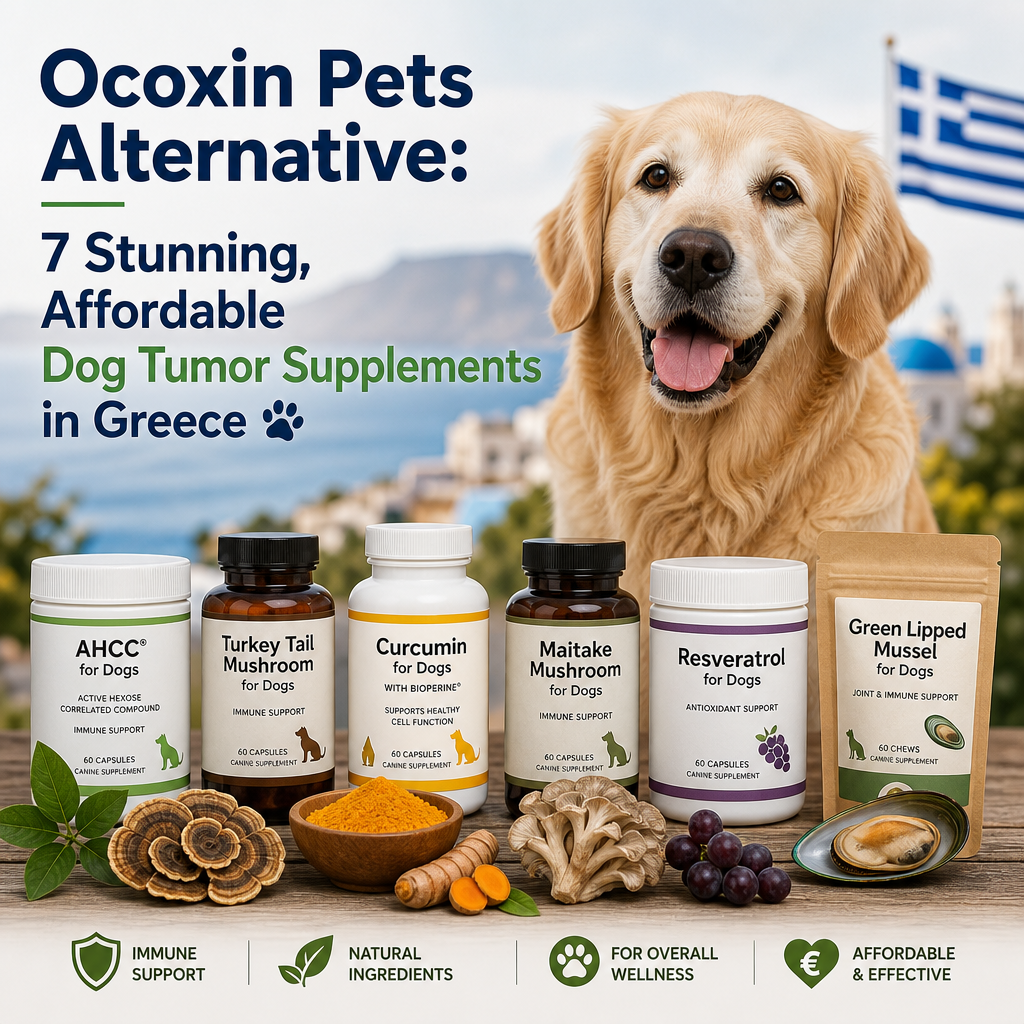
Medicinal mushrooms are among the most widely discussed dog tumor supplements Greece pet owners can find through veterinary clinics, specialist retailers, and reputable online suppliers. Products may contain turkey tail, reishi, maitake, shiitake, or a blend of mushroom extracts.
Turkey tail is particularly well known because of research into mushroom polysaccharides and immune response. However, evidence in dogs is still developing, and mushroom supplements are not interchangeable. Extract quality, concentration, growing conditions, and extraction method all matter.
Choose products designed specifically for dogs, and check whether the label identifies active compounds such as beta-glucans. Dogs with autoimmune disease or those taking immune-modulating medication may require additional caution. Mushroom products can also cause digestive upset in some animals.
When a clinician recommends mushroom support, it is usually because the goal is supportive care rather than direct tumor control. That distinction matters. A well-chosen mushroom product may complement treatment, but it should never be presented as a replacement for evidence-based oncology care.
Some owners ask whether a mushroom blend is a better Ocoxin Pets alternative than a single-ingredient formula. The answer depends on the dog. A blend can be useful when it offers a balanced, clearly labeled extract profile, but a simpler product may be preferable if the dog has a sensitive stomach or takes multiple medications. In either case, the product should be introduced gradually and monitored carefully.
Fish oil containing EPA and DHA may be a practical supportive option for dogs with cancer, especially when inflammation, weight loss, or poor skin and coat condition is present. These fatty acids are commonly used in veterinary nutrition and may support inflammatory balance and general wellbeing.
A high-quality product should state the actual amount of EPA and DHA rather than only listing the total amount of fish oil. It should also be purified, tested for contaminants, and protected from oxidation. Refrigeration may be necessary after opening.
Omega-3 supplements can increase the risk of bleeding in certain situations, particularly at high doses or when combined with anticoagulant medication. They may also cause loose stools or vomiting. Ask your veterinarian for a dose based on your dog’s body weight and medical condition.
Because omega-3 formulas are widely available, they are often easier to source than specialty blends. That makes them a practical Ocoxin Pets alternative for some families, especially when the care plan emphasizes nutrition and comfort rather than multiple active ingredients.
Omega-3 support is also easy to integrate into daily feeding routines. For dogs that accept food well, it may be one of the simplest ways to add a meaningful supportive nutrient. For dogs with poor appetite, however, it may be better to focus first on improving caloric intake before layering in additional supplements. The best Ocoxin Pets alternative should match the dog’s current stage, not just the diagnosis.
3. Antioxidant and vitamin support
Some veterinary formulas include antioxidants such as vitamin E, vitamin C, selenium, or plant-based compounds. These ingredients may help support normal cellular protection, but more is not always better. High doses of certain vitamins can be harmful, while antioxidant use during cancer treatment should be discussed with the treating veterinary team.
A complete commercial dog food usually provides essential vitamins and minerals. Supplementation is most appropriate when there is a documented nutritional need or a veterinarian recommends it. Avoid combining several multivitamins, immune products, and herbal formulas without professional guidance, as this can lead to excessive intake.
In many cases, the main benefit of this category is not “fighting cancer” but supporting a dog whose appetite, energy, or nutrient intake has declined. Used carefully, this type of Ocoxin Pets alternative may fit a broader plan that prioritizes steady nutrition and symptom control.
It is especially important to avoid giving human supplements without checking the ingredient list. Some tablets contain sweeteners, flavorings, or additives that are inappropriate for dogs. Others may deliver overly concentrated doses. A cautious approach can prevent unnecessary side effects and help the veterinary team interpret changes in appetite, energy, or lab work more accurately.
4. Digestive and probiotic supplements
Cancer treatment, stress, changes in diet, and medication can all affect a dog’s digestive system. Probiotics, prebiotics, and digestive enzymes may help some dogs maintain more regular bowel movements and better appetite, although results vary.
Look for a product that lists the bacterial strains and guaranteed amounts through the expiration date. Veterinary-specific probiotics are preferable because they are formulated with canine use in mind. A slowly introduced supplement may be better tolerated than a full dose from the first day.
Dogs with severe vomiting, diarrhea, dehydration, or intestinal disease need veterinary assessment rather than self-treatment. Digestive supplements may provide support, but they cannot address obstruction, infection, pancreatitis, or serious treatment complications.
For dogs that lose interest in food during treatment, digestive support can be an important part of recovery. In that setting, the most useful Ocoxin Pets alternative may be the one that helps the dog eat more comfortably and absorb nutrients more effectively.
Digestive support can also help when a dog is taking medications that upset the stomach. Even a mild change in gut comfort can improve willingness to eat and drink, which matters a great deal when a dog is already under stress. If digestive signs worsen instead of improving, the supplement should be stopped and the veterinarian contacted promptly.
5. Milk thistle and liver-support formulas
Liver-support supplements are sometimes considered for dogs receiving medication or experiencing abnormal liver enzyme results. Milk thistle, particularly its active compound silymarin, appears in many veterinary products. Other formulas may include SAMe, phospholipids, or complementary nutrients.
These products should be selected carefully because liver disease has many causes, and abnormal blood tests require interpretation. A supplement may be unsuitable if the dog has gallbladder disease, digestive problems, or a medication interaction. Veterinary monitoring through blood tests is essential when liver support is being used alongside cancer treatment.
For owners searching for an Ocoxin Pets alternative in Greece, liver-support products can be appealing because they are relatively common in veterinary pharmacies. Still, they should only be used when there is a clear reason to do so and a clinician is following the dog’s progress.
Milk thistle formulas are often discussed as gentle supportive products, but they still deserve the same careful review as any other supplement. A supportive ingredient can be inappropriate if the dog is on certain medications or has a condition that changes how the liver processes compounds. The best results usually come from choosing a product for a specific reason, not from using several liver-related supplements at once.
6. High-calorie nutritional support
For dogs that are losing weight or eating poorly, a calorie-dense nutritional gel, recovery diet, or veterinary appetite-support formula may be more useful than a general “tumor supplement.” Maintaining body condition can help preserve strength and improve tolerance of treatment.
A veterinarian or veterinary nutritionist can recommend the right balance of calories, protein, fat, and moisture. Some dogs benefit from small, frequent meals, warmed food, or a change in texture. Sudden dietary changes may worsen nausea or diarrhea, so introduce new foods gradually unless urgent clinical advice says otherwise.
Never force-feed a dog that is vomiting, severely nauseated, or unable to swallow safely. These signs require prompt veterinary care.
This category is often overlooked, yet it can make a dramatic difference in daily comfort. If a dog is not eating well, the best Ocoxin Pets alternative may be a practical nutrition strategy rather than a complicated supplement blend.
High-calorie support can also be valuable during periods when treatment temporarily lowers appetite. In those situations, a simple and palatable product often does more good than a broad formula with many added ingredients. If the dog is willing to eat only a few bites at a time, the strategy should focus on making every bite count.
7. Targeted herbal and botanical products
Some dog owners explore botanical ingredients such as turmeric, boswellia, green tea compounds, or cannabis-derived products. Although these substances are often marketed as natural support, “natural” does not automatically mean safe or effective. Concentration, purity, metabolism, and interactions can vary substantially.
Turmeric products, for example, may affect digestion or blood clotting, while some herbal ingredients can place additional demands on the liver. Cannabis-derived products also require particular caution because product quality and cannabinoid concentration may be inconsistent, and dogs can react adversely.
Only use a botanical product after discussing it with a veterinarian who knows the dog’s complete treatment plan. Products intended for humans may contain xylitol, alcohol, essential oils, or other ingredients that are dangerous to dogs.
If you choose this route, keep the goal modest and specific: comfort, appetite support, or inflammation support. That approach makes it easier to judge whether the product is helping and reduces the risk of stacking too many overlapping ingredients.
Botanical formulas are sometimes chosen by owners seeking a more natural Ocoxin Pets alternative, but the safest choices are still the ones supported by transparent labeling and veterinary oversight. A product that looks gentle on paper can still cause problems if it is too concentrated or combined with the wrong medication.
How to choose dog tumor supplements in Greece
When comparing dog tumor supplements Greece owners can access, consider five practical points: veterinary approval, ingredient transparency, independent quality testing, realistic claims, and total cost over time. A low-priced product may provide too little of an active ingredient, while a premium product is not automatically superior.
Check whether the seller provides a full label, expiration date, storage instructions, and contact information. Purchase from established veterinary pharmacies, clinics, or reputable distributors rather than relying on anonymous marketplace listings. Import restrictions and storage conditions can also affect products ordered from abroad.
Keep a written record of every supplement, dose, and start date. Note changes in appetite, stool, energy, vomiting, itching, or behavior. Stop the product and contact your veterinarian if concerning symptoms appear.
Ultimately, the best Ocoxin Pets alternative is not necessarily the most expensive or heavily advertised option. It is the product that fits the dog’s diagnosis, treatment plan, nutritional needs, and budget while meeting appropriate safety and quality standards. Supportive supplementation can be valuable, but attentive veterinary care, balanced nutrition, pain management, and regular monitoring remain the foundation of responsible cancer support for dogs. If you are comparing options now, revisit the Ocoxin Pets alternative choice with your veterinarian after each treatment update, because a dog’s needs can change quickly.
Common mistakes to avoid
One of the most common mistakes is assuming that every supplement can be layered together safely. A dog receiving appetite support, a mushroom product, an antioxidant blend, and an herbal formula may end up with overlapping ingredients or unnecessary strain on digestion and metabolism. The better approach is usually to start with one clear goal and one product at a time.
Another mistake is using a supplement without tracking the response. If appetite, stool quality, and energy are not improving after a reasonable trial, the product may not be worth continuing. A veterinarian can help decide whether a change in dose, brand, or strategy is needed.
Finally, some owners delay proven treatment because a supplement seems promising. An Ocoxin Pets alternative can be part of supportive care, but it should never replace diagnostic workup or oncology treatment when those are recommended. The safest plan is the one that combines practical support with professional medical oversight.
Practical shopping checklist
Confirm the product is made for dogs or approved by a veterinarian for canine use.
Read the label for active ingredients, exact amounts, and serving instructions.
Check expiration date, storage requirements, and batch details.
Avoid products that promise to cure cancer or replace treatment.
Ask whether the supplement may interact with chemotherapy, pain medicine, or clotting-related medication.
Track changes in appetite, weight, stool quality, and energy after starting it.
Choose the simplest product that meets the dog’s current need.
For Greek dog owners, the most useful decision is often the most practical one. A carefully chosen Ocoxin Pets alternative can support comfort, nutrition, and quality of life, especially when it is selected with a veterinarian’s help and matched to the dog’s treatment stage. The right supplement is the one that supports the whole care plan without creating extra risk.
Ocoxin Pets alternative options are becoming increasingly relevant for Croatian dog owners looking for supportive nutrition during cancer treatment. While veterinary care remains the foundation of managing tumors, selected supplements may help maintain appetite, body condition, digestion, and general resilience. The right product should be affordable, easy to obtain in Croatia, and appropriate for the dog’s diagnosis, medications, and overall health.
Ocoxin Pets is generally used as a complementary nutritional product for dogs and cats facing serious illness, including tumor-related conditions. Its purpose is not to replace surgery, chemotherapy, radiation, or other veterinary treatment. Instead, products in this category are typically intended to support nutritional status and quality of life.
When searching for an Ocoxin Pets alternative, dog owners should focus less on finding an identical product and more on identifying supplements that provide comparable supportive benefits. These may include antioxidants, omega-3 fatty acids, medicinal mushroom extracts, vitamins, minerals, and ingredients designed to encourage eating or support digestion.
Because supplements can interact with prescription medicines, every new product should be discussed with a veterinarian—especially when a dog is receiving chemotherapy, corticosteroids, anti-inflammatory drugs, or medication for liver, kidney, or heart disease.
In practice, the best Ocoxin Pets alternative is the one that fits the dog’s current condition. A young dog with a recently diagnosed mass may need different support from an older patient already dealing with weight loss, nausea, or reduced mobility.
What Makes a Good Ocoxin Pets Alternative?
A suitable Ocoxin Pets alternative should be selected according to the dog’s individual needs rather than marketing claims. Important factors include:
Veterinary compatibility: The formula should be reviewed alongside current medication and treatment.
Clear ingredient information: Products should list active ingredients and their quantities.
Reliable manufacturing: Choose supplements from reputable companies with quality-control standards.
Practical dosing: The product should be easy to administer and suitable for the dog’s weight.
Digestive tolerance: Dogs with cancer may have nausea, diarrhea, constipation, or a sensitive stomach.
Cost and availability: Croatian owners should consider whether the product can be purchased consistently from a veterinary clinic, pharmacy, or dependable online supplier.
Avoid products that promise to cure cancer, dissolve tumors, or replace professional treatment. Such claims are not a reliable basis for purchasing decisions and may delay necessary veterinary care.
It also helps to think in terms of goals. Some families want appetite support, others want immune support, and others are mainly looking for a practical Ocoxin Pets alternative that is easier to buy locally in Croatia. Matching the product to the goal improves the odds of a sensible choice.
Popular Dog Tumor Supplements in Croatia
The market for dog tumor supplements Croatia owners can access includes several broad categories. Each has a different potential role, and not every supplement is appropriate for every patient. For many families, the search for an Ocoxin Pets alternative begins with one of the options below.
Omega-3 fatty acids
Fish oil containing EPA and DHA is often considered one of the most useful nutritional supplements for dogs with chronic illness. Omega-3 fatty acids may support healthy inflammatory responses and help maintain skin, coat, and general body condition. They can also be useful when a dog has reduced appetite or is losing weight, as they provide additional calories.
However, fish oil must be dosed appropriately. Excessive amounts may cause digestive upset or increase bleeding risk, particularly in dogs taking anticoagulant medication or undergoing surgery. A veterinarian can recommend a dose based on the dog’s weight and health status.
If a dog already eats a therapeutic diet, owners should count the added calories and fat load before introducing more oil. Even a helpful Ocoxin Pets alternative can become counterproductive if it is layered on top of other rich products without a plan.
Medicinal mushroom extracts
Products containing mushrooms such as turkey tail, shiitake, maitake, or reishi are sometimes used as complementary supplements. These mushrooms contain compounds that may influence immune function, although scientific evidence varies by extract, dose, and medical condition.
A mushroom supplement should come from a manufacturer that identifies the mushroom species, extraction method, and concentration. Avoid vague blends with no measurable quantities. Dogs with autoimmune disorders or those receiving immune-modulating treatment may require special caution.
For owners comparing an Ocoxin Pets alternative with mushroom-based products, quality matters more than trendy branding. A clearly labeled extract is easier for a veterinarian to evaluate than a generic “immune support” formula.
Antioxidant formulas
Some canine supplements contain vitamins C and E, selenium, zinc, or plant-based antioxidants. These ingredients can contribute to normal cellular protection and general nutritional support. Nonetheless, high-dose antioxidants are not automatically better. In some cancer-treatment situations, large amounts may be inappropriate, depending on the therapy being used.
For this reason, antioxidant products should be coordinated with the veterinary oncologist rather than added casually to an existing supplement routine. A carefully selected Ocoxin Pets alternative may include antioxidant support, but the dosage should still be individualized.
Digestive and appetite support
Maintaining food intake is one of the most important goals for many dogs with tumors. Probiotics, prebiotic fibers, digestive enzymes, and appetite-support products may help selected dogs, particularly those experiencing treatment-related digestive problems.
A probiotic is most useful when it contains clearly identified strains and provides storage and dosing information. Dogs with persistent vomiting, bloody diarrhea, severe lethargy, or complete food refusal need prompt veterinary attention instead of relying on supplements.
For dogs that are difficult to feed, an Ocoxin Pets alternative may need to do more than support general wellness. In some cases, palatable digestive support is more useful than a broad formula with many ingredients.
Nutritional oils and calorie support
Some dogs struggle to maintain weight because of reduced appetite, increased nutritional demands, or difficulty chewing. Veterinary nutritional gels, calorie-dense pastes, and carefully selected oils may provide additional energy. These products should be introduced gradually because sudden dietary changes can worsen diarrhea or nausea.
When weight loss is the main concern, a simple calorie-support product may be a more practical Ocoxin Pets alternative than a complex blend. The most useful option is often the one the dog will actually eat consistently.
How to Compare Alternatives to Ocoxin Pets
When comparing alternatives to Ocoxin Pets, begin by identifying the primary goal. Is the dog losing weight, refusing food, experiencing digestive problems, or needing general nutritional support? A product aimed at appetite support may not be appropriate for a dog whose main issue is inflammation, and an antioxidant blend may not solve a calorie deficit.
Next, review the label carefully. Look for exact ingredient amounts, feeding instructions, batch information, expiration dates, and manufacturer contact details. Products sold through veterinary channels often provide more transparent information than unverified marketplace listings.
Price should also be calculated by daily dose rather than package price. A less expensive bottle may contain a lower concentration and require several servings per day. Conversely, a moderately priced product may last longer and be easier to administer.
Finally, introduce only one new supplement at a time. This makes it easier to identify side effects and determine whether the product is helping. Monitor appetite, stool quality, vomiting, energy, weight, and any changes in behavior.
For Croatian dog owners, availability is also important. An Ocoxin Pets alternative that can be reordered reliably is usually more useful than a product that arrives late or changes formulation from one purchase to the next.
Helpful background reading on veterinary supplement quality can be found in the FDA guidance on using pet health products safely, which explains why ingredient transparency and veterinary oversight matter.
Some owners also look to educational resources from veterinary oncology groups when discussing supportive care. For example, the Veterinary Cancer Society offers general information that can help families ask better questions during treatment planning.
Safe Use for Dogs Receiving Cancer Treatment
Supplements are not automatically harmless because they are labeled natural. Some herbs can affect liver enzymes, blood clotting, blood pressure, or the way chemotherapy medicines are processed. Fish oil, mushroom extracts, turmeric, herbal mixtures, and concentrated vitamins may all require professional evaluation.
Keep a written list of every product the dog receives, including treats and home-prepared additions. Share this list with the veterinarian before treatment begins and whenever the formula changes. Contact the clinic promptly if the dog develops repeated vomiting, diarrhea, unusual bruising, marked weakness, jaundice, or sudden loss of appetite.
The best dog tumor supplements Croatia pet owners can choose are those used thoughtfully, with realistic expectations and regular veterinary monitoring. A well-selected Ocoxin Pets alternative may support comfort, nutrition, and quality of life, but it should remain part of a broader care plan that includes diagnosis, appropriate treatment, pain control, hydration, and emotional support.
When to Contact a Veterinarian
It is wise to contact a veterinarian before starting any new Ocoxin Pets alternative, especially if the dog already has liver disease, kidney disease, clotting problems, or a history of food sensitivity. Dogs on multiple medications need extra caution because even common supplements can change how treatment is tolerated.
Seek prompt advice if the dog stops eating for more than a day, vomits repeatedly, has black stools, seems painful, or becomes unusually quiet. These signs may indicate a complication that needs medical attention, not a different supplement.
When used correctly, an Ocoxin Pets alternative can be one part of a thoughtful support plan. The goal is not to chase a miracle product, but to improve comfort, maintain nutrition, and help the dog move through treatment with as much stability as possible.
Nahrungsergänzung Hund Tumor ist ein sensibles Thema, denn betroffene Hunde brauchen vor allem eine fundierte tierärztliche Behandlung, eine passende Ernährung und eine sorgfältige Begleitung im Alltag. Ergänzungsmittel können unter bestimmten Voraussetzungen sinnvoll sein, ersetzen jedoch weder Operation, Chemotherapie, Bestrahlung noch eine andere medizinisch empfohlene Therapie. Wer Produkte vergleicht, sollte deshalb nicht auf große Werbeversprechen, sondern auf Inhaltsstoffe, Qualität, Verträglichkeit und die individuelle Situation des Hundes achten.
Was Nahrungsergänzungsmittel bei einem Tumor leisten können
Ein Tumor beeinflusst den Organismus je nach Art, Größe, Lage und Krankheitsstadium sehr unterschiedlich. Manche Hunde verlieren an Gewicht, andere haben weniger Appetit oder leiden unter Verdauungsproblemen. Zusätzlich können Medikamente und Behandlungen den Körper belasten. Ein geeignetes Ergänzungsmittel kann in solchen Situationen beispielsweise die Nährstoffversorgung unterstützen, die Futteraufnahme erleichtern oder zur Erhaltung der normalen Körperfunktionen beitragen.
Wichtig ist die realistische Einordnung: Ein Nahrungsergänzungsmittel kann keine Krebszellen zuverlässig beseitigen. Aussagen wie „heilt Tumore“, „stoppt Krebs“ oder „ersetzt die Therapie“ sind Warnsignale. Seriöse Produkte beschreiben vielmehr eine begrenzte, unterstützende Funktion und weisen darauf hin, dass die Anwendung mit der Tierarztpraxis abgestimmt werden sollte.
Gerade bei einer begleitenden Nahrungsergänzung Hund Tumor zählt also nicht der lauteste Werbetext, sondern die Frage, ob das Produkt überhaupt zum Gesundheitszustand des Hundes passt. Ein Präparat kann sinnvoll sein, wenn es Mangelzustände vorbeugt, die Futteraufnahme erleichtert oder einen klaren ernährungsbezogenen Zweck erfüllt. Es ist jedoch nie die Haupttherapie.
Im Alltag hilft es, sich an einem einfachen Grundsatz zu orientieren: Zuerst die medizinische Lage klären, dann die Ernährung anpassen und erst danach über einzelne Ergänzungsfuttermittel entscheiden. Das klingt unspektakulär, ist aber meist der sicherste Weg, um Fehlkäufe und unnötige Belastungen zu vermeiden.
Nahrungsergänzung Hund Tumor sinnvoll vergleichen
Beim Vergleich verschiedener Produkte lohnt sich zunächst ein Blick auf das konkrete Ziel. Soll der Hund besser fressen? Geht es um die Versorgung mit bestimmten Nährstoffen? Sollen Gelenke, Haut, Verdauung oder das allgemeine Wohlbefinden unterstützt werden? Ohne klare Zielsetzung besteht die Gefahr, mehrere Präparate gleichzeitig einzusetzen, obwohl ihre Wirkungen sich überschneiden oder unerwünschte Wechselwirkungen entstehen können.
Entscheidend ist außerdem die Deklaration. Auf dem Etikett sollten die enthaltenen Stoffe, Mengenangaben, Fütterungsempfehlungen und Hinweise zur Lagerung nachvollziehbar aufgeführt sein. Mischungen mit unklaren Sammelbegriffen wie „Vitalstoffkomplex“ oder „Kräuterformel“ sind schwer zu beurteilen. Je transparenter ein Hersteller die Zusammensetzung angibt, desto besser kann die Tierärztin oder der Tierarzt das Produkt einschätzen.
Auch die Darreichungsform spielt eine Rolle. Pulver, Kapseln, Tropfen oder Pasten müssen für den Hund praktisch verabreichbar sein. Ein Mittel, das der Hund konsequent verweigert, ist im Alltag wenig hilfreich. Bei Appetitlosigkeit können gut verträgliche, geschmacksneutrale Produkte geeigneter sein als Präparate mit intensivem Eigengeschmack.
Ein guter Vergleich berücksichtigt außerdem den Preis pro Tagesration statt nur die Packungskosten. Manche Produkte wirken auf den ersten Blick günstig, enthalten aber nur kleine Mengen oder verlangen eine hohe Dosierung. Bei der Nahrungsergänzung Hund Tumor ist deshalb die tatsächliche Versorgung über mehrere Wochen oft aussagekräftiger als der Einzelpreis.
Wer mehrere Angebote nebeneinanderlegt, sollte außerdem auf das Verhältnis von Werbeaussage und Nutzwert achten. Ein seriöses Präparat muss nicht laut auftreten. Oft ist ein Produkt mit klarer Zweckbestimmung, wenigen Zusatzstoffen und nachvollziehbarer Dosierung die bessere Wahl als eine große Mischformel mit unklaren Versprechen.
Hilfreich ist es auch, Produkte nach ihrer Alltagstauglichkeit zu sortieren: Lässt sich die tägliche Gabe gut in das Futter integrieren? Ist das Präparat für den Hund geschmacklich akzeptabel? Muss es gekühlt werden? Je weniger Hürden im Tagesablauf entstehen, desto wahrscheinlicher ist eine konsequente und ruhige Anwendung.
Woran ein sinnvoller Vergleich erkennbar wird
Ein sinnvoller Vergleich fragt nicht nur nach der Produktbeschreibung, sondern nach dem konkreten Nutzen für den einzelnen Hund. Wenn ein Präparat beispielsweise Omega-3-Fettsäuren enthält, sollte geprüft werden, ob die Menge überhaupt zu den Zielen der Fütterung passt. Bei Vitamin- oder Mineralstoffmischungen ist die exakte Dosierung besonders wichtig, weil eine Überversorgung ebenso ungünstig sein kann wie ein Mangel.
Auch die Herstellerangaben zur Qualität sind relevant. Werden Rohstoffe geprüft? Gibt es eine Chargenkennzeichnung? Ist nachvollziehbar, woher die Zutaten stammen? Gerade bei sensiblen Hunden können solche Details entscheidend sein, weil sie das Risiko von Verunreinigungen oder unklaren Zusammensetzungen reduzieren.
Im Zweifel sollte das Produkt dokumentiert und mit der tierärztlichen Behandlung abgestimmt werden. Das ist besonders wichtig, wenn der Hund bereits Medikamente erhält oder auf bestimmte Stoffe empfindlich reagiert.
Nährstoffe und Inhaltsstoffe im Überblick
Bei einer Unterstützung Hund Tumor werden häufig Omega-3-Fettsäuren, Vitamine, Mineralstoffe, Antioxidantien oder bestimmte Pflanzenstoffe genannt. Omega-3-Fettsäuren aus Fischöl können beispielsweise Bestandteil einer ausgewogenen Ernährungsstrategie sein. Dabei müssen jedoch Qualität, Reinheit und die passende Dosierung berücksichtigt werden. Fischöl kann zudem zusätzliche Kalorien liefern und bei empfindlichen Tieren zu Verdauungsproblemen führen.
Vitamine und Mineralstoffe sind nur dann sinnvoll, wenn ein tatsächlicher Bedarf besteht oder die Fütterung entsprechend angepasst werden soll. Eine hochdosierte Gabe ist nicht automatisch besser. Einige fettlösliche Vitamine können sich im Körper anreichern, während bestimmte Mineralstoffe die Aufnahme anderer Nährstoffe beeinflussen können.
Pflanzliche Extrakte und medizinische Pilze werden ebenfalls häufig als ergänzende Produkte angeboten. Ihre Zusammensetzung und Qualität können stark schwanken. Außerdem sind natürliche Stoffe nicht grundsätzlich frei von Nebenwirkungen. Manche Pflanzen beeinflussen die Blutgerinnung, die Leber oder den Abbau von Arzneimitteln. Besonders vor Operationen und während einer Chemotherapie ist daher Vorsicht geboten.
Hilfreich ist auch ein Blick auf die Herkunft und Verarbeitung der Rohstoffe. Reine, nachvollziehbar geprüfte Inhaltsstoffe sind in der Regel besser einschätzbar als komplexe Mischungen mit vielen Zusätzen. Wer Nahrungsergänzung Hund Tumor sinnvoll auswählen möchte, sollte immer fragen: Welchen konkreten Nutzen bringt der einzelne Inhaltsstoff, und ist dieser Nutzen für den Hund überhaupt relevant?
Ein weiterer Punkt ist die Wechselwirkung zwischen dem Produkt und dem bestehenden Futter. Ergänzungen können die Gesamtenergiedichte erhöhen, die Verdauung beeinflussen oder die Akzeptanz des Futters verbessern oder verschlechtern. Gerade bei einem kranken Hund ist nicht nur der Stoff an sich wichtig, sondern auch die Frage, wie er sich in die gesamte Ration einfügt.
Worauf bei einzelnen Produktgruppen zu achten ist
Omega-3-Produkte: Auf Frische, Oxidationsschutz und gute Verträglichkeit achten.
Vitaminpräparate: Nicht pauschal hochdosiert einsetzen, sondern Bedarf prüfen.
Mineralstoffmischungen: Auf das Verhältnis der Inhaltsstoffe achten, besonders bei Spezialfutter.
Kräuter- und Pilzextrakte: Nur mit klarer Deklaration und nach Rücksprache verwenden.
Fett- oder ölhaltige Präparate: Bei empfindlichem Magen vorsichtig einschleichen.
Gerade wenn ein Produkt mehrere dieser Gruppen kombiniert, steigt die Komplexität. Dann ist es oft schwer einzuschätzen, welcher Bestandteil welchen Effekt hat. Deshalb sind einfache Formulierungen mit klarer Zielsetzung häufig die bessere Wahl.
Sicherheit vor Wirkung
Bevor ein neues Präparat eingesetzt wird, sollte die behandelnde Tierarztpraxis über alle bereits verabreichten Mittel informiert werden. Dazu gehören auch Produkte aus dem Reformhaus, Kräutermischungen, Öle und frei verkäufliche Vitaminpräparate. Nur so lässt sich beurteilen, ob ein Zusammenspiel mit Medikamenten, Narkosen oder einer speziellen Therapie möglich ist.
Besondere Vorsicht ist bei Hunden mit Leber- oder Nierenerkrankungen, Blutgerinnungsstörungen, Magen-Darm-Problemen oder stark reduziertem Allgemeinzustand notwendig. Auch das Alter, das Körpergewicht und die aktuelle Futtermenge beeinflussen die Auswahl. Ein Präparat, das bei einem gesunden, großen Hund gut verträglich ist, kann für einen kleinen oder geschwächten Hund ungeeignet sein.
Neue Produkte sollten möglichst einzeln und langsam eingeführt werden. So lässt sich besser erkennen, ob der Hund mit Durchfall, Erbrechen, Juckreiz, Müdigkeit oder Appetitverlust reagiert. Bei solchen Symptomen sollte die Gabe beendet und tierärztlicher Rat eingeholt werden. Verschlechtert sich der Allgemeinzustand, verliert der Hund deutlich Gewicht oder verweigert er Futter und Wasser, ist eine zeitnahe medizinische Abklärung besonders wichtig.
Wer sich zusätzlich fachlich informieren möchte, findet hilfreiche Grundlagen zur Bewertung von Ergänzungsfuttermitteln und Nährstoffbedarf in der Übersicht der FDA zu Tierfutter und Ergänzungsmitteln. Solche Quellen ersetzen keine individuelle Beratung, helfen aber dabei, Werbeaussagen besser einzuordnen.
Auch in scheinbar harmlosen Produkten können Stoffe enthalten sein, die nicht zu jedem Hund passen. Deshalb ist eine schrittweise Einführung mit genauer Beobachtung oft sinnvoller als der spontane Start mit mehreren Mitteln gleichzeitig. Je klarer die Ausgangslage dokumentiert ist, desto einfacher lässt sich im Zweifel auf Veränderungen reagieren.
Unterstützung Hund Tumor: Ernährung und Alltag ganzheitlich betrachten
Die beste Unterstützung besteht selten aus einem einzelnen Produkt. Eine bedarfsgerechte Ernährung, ausreichend Flüssigkeit, eine angenehme Umgebung und eine gute Schmerz- und Übelkeitskontrolle sind häufig wichtiger als zusätzliche Kapseln oder Pulver. Manche Hunde profitieren von mehreren kleinen Mahlzeiten, leicht erwärmtem Futter oder einer individuell abgestimmten energiereichen Nahrung. Solche Änderungen sollten bei speziellen Erkrankungen ebenfalls mit der Tierarztpraxis abgestimmt werden.
Hilfreich kann ein einfaches Tagebuch sein. Darin lassen sich Futteraufnahme, Gewicht, Trinkmenge, Kot, Erbrechen, Aktivität und besondere Beobachtungen festhalten. Dadurch wird sichtbar, ob eine Maßnahme tatsächlich einen positiven Effekt hat. Gleichzeitig erhält die Tierärztin oder der Tierarzt wertvolle Informationen für die weitere Behandlung.
Beim Kauf sollten Halter außerdem auf einen seriösen Hersteller, nachvollziehbare Qualitätskontrollen und eine klare Chargenkennzeichnung achten. Produkte für Menschen sind nicht automatisch für Hunde geeignet. Süßstoffe wie Xylit, bestimmte ätherische Öle oder falsch dosierte Mineralstoffe können für Hunde gefährlich sein.
Auch die Erwartungen sollten realistisch bleiben. Eine gute Nahrungsergänzung Hund Tumor kann das Wohlbefinden unterstützen, aber nicht jede Phase der Erkrankung spürbar verbessern. Manchmal ist der größte Nutzen, dass ein Hund sein Futter besser annimmt oder bestimmte Mangelrisiken reduziert werden. Das ist wertvoll, aber kein Ersatz für eine gezielte Therapie.
Wenn ein Hund bereits stark belastet ist, können kleine Anpassungen oft mehr bewirken als große Produktmengen. Dazu gehören ein ruhiger Futterplatz, gleichbleibende Fütterungszeiten und eine gute Beobachtung der Verträglichkeit. Die Kombination aus alltagstauglicher Fütterung und sorgfältig ausgewählter Ergänzung ist meist deutlich sinnvoller als ein unübersichtlicher Produktmix.
Praktische Fragen für den Alltag
Viele Halter profitieren von einer einfachen Routine: Wann wird das Produkt gegeben? Wie wird die Aufnahme kontrolliert? Gibt es Auffälligkeiten nach der Gabe? Solche Notizen helfen, den Verlauf objektiver zu beurteilen. Gerade bei einer längeren Begleitung ist das wertvoller als eine rein gefühlte Einschätzung.
Wenn der Hund Futter verweigert oder empfindlich reagiert, sollte zunächst die Verträglichkeit überprüft werden, bevor ein weiteres Mittel ergänzt wird. Oft ist weniger mehr, insbesondere wenn die Krankheit selbst schon viel Energie kostet.
Praktische Checkliste für den Produktvergleich
Diese Fragen helfen dabei, verschiedene Präparate nüchtern zu vergleichen und unnötige Fehlkäufe zu vermeiden:
Welches konkrete Problem soll das Produkt lösen?
Sind alle Inhaltsstoffe mit Mengenangaben vollständig deklariert?
Passt die Darreichungsform zum Hund und zum Alltag?
Gibt es mögliche Wechselwirkungen mit Medikamenten oder Behandlungen?
Ist die Dosierung für Gewicht, Alter und Gesundheitszustand geeignet?
Stammt das Produkt von einem Hersteller mit nachvollziehbarer Qualitätssicherung?
Ist das Preis-Leistungs-Verhältnis über die Tagesration betrachtet fair?
Wer diese Punkte nacheinander prüft, kann die Auswahl deutlich eingrenzen. Gerade bei der Nahrungsergänzung Hund Tumor ist es oft besser, ein einziges gut begründetes Produkt zu wählen als mehrere Mittel unkoordiniert zu kombinieren. Weniger ist häufig mehr, vor allem wenn der Hund bereits belastet ist.
Ein praktischer Ansatz ist außerdem, jede Ergänzung zuerst mit einer kleinen Menge zu testen und Veränderungen im Verhalten genau zu beobachten. Wenn nach einigen Tagen keine positive Wirkung sichtbar wird oder Nebenwirkungen auftreten, sollte das Produkt nicht einfach weitergegeben werden. Eine Anpassung durch die Tierarztpraxis ist dann sinnvoller als ein weiterer spontaner Produkttest.
Zusätzlich kann es hilfreich sein, die Kaufentscheidung in drei Stufen zu treffen: Erstens die medizinische Eignung, zweitens die Verträglichkeit und drittens die Alltagstauglichkeit. Wenn eines dieser Kriterien nicht erfüllt ist, sollte das Produkt eher nicht eingesetzt werden. So bleibt die Auswahl nachvollziehbar und sicher.
Mini-Check vor dem Kauf
Passt das Produkt zur aktuellen Diagnose und zur laufenden Therapie?
Ist die Deklaration verständlich und vollständig?
Ist die Tagesration realistisch und bezahlbar?
Kann der Hund das Produkt voraussichtlich gut aufnehmen?
Gibt es klare Hinweise zu Kontraindikationen oder Vorsichtsmaßnahmen?
Häufige Fehler beim Kauf und Einsatz
Ein häufiger Fehler ist der Kauf nach Schlagworten wie „stärkt das Immunsystem“ oder „natürlich gegen Tumore“. Solche Aussagen klingen überzeugend, sagen aber wenig über den tatsächlichen Nutzen aus. Ebenso problematisch ist es, mehrere Produkte parallel zu starten, ohne zu wissen, welches davon überhaupt etwas bewirkt.
Ebenso sollte man nicht davon ausgehen, dass ein hoher Preis automatisch für Qualität steht. Auch teure Produkte können ungeeignet dosiert oder schlecht zusammengesetzt sein. Umgekehrt gibt es solide Präparate mit klarer Deklaration, die nicht mit Werbeversprechen überladen sind.
Besonders wichtig ist, die Tagesdosis exakt einzuhalten. Bei der Nahrungsergänzung Hund Tumor kann eine zu hohe Menge Nebenwirkungen verstärken oder andere Therapien stören. Mehr hilft hier nicht automatisch mehr, sondern kann die Situation sogar erschweren.
Ein weiterer Fehler ist, Veränderungen zu spät zu bemerken. Wenn der Hund plötzlich weniger frisst, häufiger erbricht oder apathischer wirkt, sollte nicht einfach weiter experimentiert werden. In solchen Fällen ist medizinische Rücksprache wichtiger als der nächste Produktvergleich.
Fazit
Ein Nahrungsergänzung Hund Tumor kann in ausgewählten Fällen eine sinnvolle Ergänzung der Behandlung sein, wenn das Produkt zum individuellen Bedarf passt und fachlich begleitet wird. Beim Vergleich zählen eine transparente Deklaration, realistische Versprechen, geprüfte Qualität und eine sichere Dosierung. Entscheidend bleibt, den Hund als Ganzes zu betrachten: medizinische Therapie, Ernährung, Symptomkontrolle und Lebensqualität sollten eng zusammenpassen. Ergänzungsmittel sind dabei höchstens ein Baustein – nicht die eigentliche Tumorbehandlung.
Wer strukturiert vergleicht und Rücksprache mit der Tierarztpraxis hält, trifft meist die bessere Entscheidung. So lässt sich die Nahrungsergänzung Hund Tumor nicht nur sicherer, sondern auch gezielter einsetzen. Auf diese Weise entsteht ein durchdachter, möglichst positiver Beitrag zur Begleitung des Hundes im Alltag.
Ocoxin Pets alternative options are attracting attention among dog owners in Slovenia who want supportive, affordable products for pets affected by tumors or undergoing demanding veterinary treatment. Although supplements cannot replace diagnosis, surgery, chemotherapy, radiation, or other professional care, carefully selected nutritional support may help maintain appetite, energy, digestion, and general wellbeing.
Choosing an Ocoxin Pets alternative is not about replacing medical care. It is about finding a practical way to support a dog’s comfort and nutrition while a veterinarian manages the underlying condition. For many families, the best option is one that is safe, easy to give, and realistic to use every day.
Why owners look for an Ocoxin Pets alternative
Ocoxin Pets is known as a supportive veterinary supplement used by some owners during cancer care. However, it may not be the most practical choice for every household. Availability, shipping costs, dosage requirements, taste, and price can all influence the decision. Slovenian pet owners may also prefer products that are easier to purchase locally or that provide a clearer ingredient list and more flexible dosing.
Looking for alternatives to Ocoxin Pets does not necessarily mean searching for an identical product. A suitable alternative may be a combination of nutritional support, such as an omega-3 supplement, a high-quality veterinary multivitamin, a digestive support formula, or a calorie-dense nutritional paste. The goal should be to support the dog’s condition safely rather than to promise a cure.
When families compare an Ocoxin Pets alternative, they usually want something that fits the dog’s routine without causing extra stress. That may mean a product with a simple dosing schedule, a pleasant flavor, or a formulation that can be mixed with food. In many cases, the most useful solution is the one the dog will actually accept consistently.
Another reason owners search for an Ocoxin Pets alternative is the emotional pressure that comes with a cancer diagnosis. When a dog is ill, every feeding decision feels important. A clear, practical supplement plan can help reduce uncertainty and make daily care more manageable for the whole household.
Some owners also want a backup option in case the preferred product is temporarily unavailable. In that situation, knowing a few reasonable alternatives to Ocoxin Pets can be helpful, especially if the dog is already in the middle of a treatment cycle and consistency matters.
If you are comparing products for the first time, remember that the best Ocoxin Pets alternative is rarely the one with the loudest claims. It is the one that supports the dog’s current needs without creating new problems.
What to look for in dog tumor supplements Slovenia
When comparing dog tumor supplements Slovenia owners should examine quality, safety, and purpose rather than relying only on attractive marketing claims. Useful considerations include:
Transparent ingredients: The label should clearly identify active ingredients, quantities, and serving instructions.
Veterinary suitability: Products made specifically for dogs are generally preferable to human supplements.
Batch and quality information: Reputable manufacturers provide production details, expiration dates, and appropriate storage guidance.
Practical dosing: The supplement should be easy to administer according to the dog’s size and health status.
Compatibility with treatment: The veterinarian should review the product alongside prescription medicines and planned procedures.
Palatability: A supplement is of limited value if the dog refuses it consistently.
Reasonable cost: Long-term support should be financially sustainable for the household.
Avoid products that claim to dissolve tumors, cure cancer, or replace conventional treatment. Such promises are not reliable and may encourage dangerous delays in veterinary care.
If a product seems too vague, it is usually better to choose a different Ocoxin Pets alternative with a more transparent label. Clear dosing, a known manufacturer, and a realistic purpose are all signs of a more trustworthy product.
It can also help to check where the product is sold. Veterinary clinics, established pharmacies, and reputable pet-health retailers often provide better storage conditions and clearer product information than unverified marketplaces. That extra step may reduce the chance of purchasing a supplement that is expired, mishandled, or not suitable for a dog undergoing treatment.
For many families, the phrase dog tumor supplements Slovenia is a broad search term rather than a final answer. The key is to narrow the options by the dog’s actual needs: appetite, calories, digestion, inflammation support, or general nutritional maintenance.
Nutrients commonly considered for supportive care
Some nutrients are frequently discussed in canine cancer support, although their usefulness varies between individual dogs. Omega-3 fatty acids from purified fish oil may support normal inflammatory balance and help maintain skin, coat, and general nutritional health. They should be used carefully in dogs with clotting problems, pancreatitis, or upcoming surgery.
Antioxidant ingredients are also common in veterinary formulas. Vitamins C and E, selenium, and plant-derived compounds may support normal cellular protection, but high doses are not automatically better. Antioxidants may also require special consideration during chemotherapy or radiation, so the treatment team should approve their use.
Digestive support can be valuable when illness or medication causes nausea, loose stools, constipation, or reduced appetite. Probiotics, prebiotic fibers, and easily digestible foods may help some dogs, but persistent digestive symptoms require veterinary assessment. A dog that cannot keep food or water down may need urgent medical attention rather than another supplement.
Protein and calories are equally important. Many dogs with serious illness lose weight or muscle, making a complete, palatable diet a central part of supportive care. A veterinary nutritionist can help design a feeding plan when ordinary food is no longer adequate.
For owners researching an Ocoxin Pets alternative, nutrient balance matters more than hype. The most sensible choice is often the formula that supports appetite, digestion, and calorie intake without overcomplicating the dog’s treatment plan.
Common supportive options families discuss
Veterinarians may suggest omega-3 oils, probiotic products, nutritional pastes, appetite-support formulas, or complete recovery diets depending on the dog’s needs. Each option serves a different purpose, so an Ocoxin Pets alternative should be matched to the symptom or nutrition gap that needs attention most.
Supportive care should also account for medications already in use. A supplement that seems harmless can still create issues if it changes blood clotting, affects digestion, or adds unnecessary strain during treatment. That is why professional guidance is essential before starting anything new.
In practical terms, this means owners should avoid building a supplement stack without a plan. One well-chosen product may be more useful than several loosely selected items, especially if the dog is tired, nauseated, or already receiving multiple medications.
When the goal is comfort and steady nutrition, consistency matters more than novelty. If a product improves daily intake and does not interfere with treatment, it may be a better fit than a more complex formula that the dog dislikes or cannot tolerate.
How to compare alternatives to Ocoxin Pets
When assessing alternatives to Ocoxin Pets, begin by identifying the specific need. Is the dog losing weight, refusing food, experiencing digestive upset, or struggling with low energy? A product designed for appetite and calories is not the same as one intended to provide omega-3 fatty acids or micronutrient support.
Next, check whether the product has evidence behind its ingredients and whether its formulation is appropriate for dogs. “Natural” does not automatically mean safe. Certain herbs, concentrated extracts, and essential oils may be toxic to dogs or interfere with prescribed medicines. Garlic, high-dose turmeric, concentrated green tea extracts, and some herbal blends deserve particular caution unless approved by a veterinarian.
Cost should be assessed over the full course of use. A low-priced product may require several daily servings, while a more concentrated formula may last longer. Calculate the monthly expense and compare it with the dog’s treatment budget. Buying from a reputable Slovenian veterinary clinic, pharmacy, or established pet-health supplier can also reduce the risk of counterfeit or poorly stored products.
In practice, the best Ocoxin Pets alternative is often the one that matches the dog’s current stage of illness. A dog that is eating well may need a different kind of support than a dog that has lost weight or is recovering from a difficult treatment cycle. A flexible plan is usually safer than chasing one “perfect” supplement.
It is also wise to read the full ingredient panel and the feeding instructions before buying. A product may look affordable on the shelf but become expensive if the serving size is large. Comparing the total monthly cost often gives a better picture than comparing the bottle price alone.
Before switching products, it can help to ask whether the change solves a real problem. If the dog is already stable and tolerating the current plan, the safest Ocoxin Pets alternative may be no change at all. Stability is valuable in cancer support care, especially when appetite and digestion are already fragile.
Owners should also think about the form of the product. Powders, liquids, soft chews, and pastes each have strengths and limitations. A dog with a sensitive stomach may do better with a divided liquid dose, while a picky eater may accept a palatable paste mixed into food. Matching the format to the dog’s behavior can improve compliance and reduce stress.
For Slovenian pet owners, local availability matters as much as formulation. A supplement that must be ordered repeatedly from abroad may be harder to sustain than a simpler, locally stocked option. In a long treatment journey, convenience can make a meaningful difference.
Questions to ask before you buy
What exact problem is this product meant to support?
Is the formula designed for dogs, not people?
Could it affect surgery, clotting, or chemotherapy?
Is the label clear enough to verify the ingredients and dose?
Can I maintain the product for several weeks if needed?
These questions help narrow down the safest Ocoxin Pets alternative for a dog with a tumor. They also reduce the risk of buying a supplement that sounds impressive but does not suit the animal’s condition.
In addition, asking about monitoring is useful. A good veterinary team can tell you what changes to watch for and when to re-evaluate the plan. That makes the supplement choice part of a broader care strategy rather than a guess.
7 practical ways to support dogs during tumor care
If you are comparing an Ocoxin Pets alternative, it can help to think in terms of support categories rather than brand names. The following approaches are common in veterinary nutrition discussions, and the right fit depends on the dog’s diagnosis, appetite, and treatment plan.
1. Omega-3 fatty acid support
Purified fish oil is often considered when the goal is to support general inflammation balance, skin health, and overall nutrition. It may be useful for some dogs with cancer-related weight loss or poor coat condition. However, quality matters, and the dose must be tailored to the dog. Too much fish oil can contribute to digestive upset or complicate clotting concerns.
When used wisely, omega-3 support may be one of the more practical alternatives to Ocoxin Pets for dogs that can tolerate fats well and are not facing surgical risks.
2. Recovery diets and calorie-dense nutrition
A complete, energy-rich diet is often more important than any single supplement. Recovery formulas and highly palatable veterinary diets can be useful if a dog has lost weight or is eating small amounts. The purpose is to deliver calories, protein, and digestible nutrients in a form the dog is likely to accept.
For many households, this is the most meaningful Ocoxin Pets alternative because it addresses the everyday challenge of maintaining body condition.
3. Digestive support products
Probiotic and prebiotic products may help some dogs whose digestion has been affected by stress, medication, or illness. They are not a cure, and they are not suitable for every dog, but they can be part of a steady supportive plan. If nausea, vomiting, or diarrhea is persistent, veterinary examination should come first.
Digestive products can be especially helpful when the dog’s appetite is present but not reliable. In those cases, supporting the gut may help the dog keep more of the calories it does consume.
4. Appetite-friendly nutritional pastes
Highly palatable pastes can provide concentrated calories in a small volume, which may be useful for dogs eating less than usual. These products are not interchangeable with medicinal supplements, but they can help bridge the gap between what the dog should eat and what the dog can tolerate.
Some owners like this format because it is easy to offer in small portions throughout the day, making it a simple Ocoxin Pets alternative when food intake is low.
5. Veterinary multivitamins formulated for dogs
A balanced multivitamin may help when a veterinarian identifies a nutritional shortfall or reduced intake. More is not always better, though. Dogs receiving a complete commercial diet may not need extra vitamins, and unnecessary supplementation can create imbalances. A multivitamin should support a specific plan, not replace a balanced diet.
This option can be helpful when the priority is gentle nutritional insurance rather than aggressive supplementation.
6. Joint and mobility support when needed
Some dogs with tumors are also dealing with pain, reduced mobility, or age-related stiffness. While joint supplements do not treat cancer, they may improve comfort and help the dog stay active enough to eat, drink, and interact normally. Mobility support can therefore be an indirect but important part of whole-dog care.
When movement becomes easier, feeding and rest routines often improve too.
In many cases, the best strategy is not a single product at all. A veterinarian may recommend a combination of diet adjustment, omega-3 support, digestive care, and symptom management. That tailored approach may be more effective than searching for a direct one-to-one substitute.
For families who want an Ocoxin Pets alternative, this individualized path often provides the most realistic long-term support.
Safe use and monitoring
Introduce one new supplement at a time whenever possible. This makes it easier to identify side effects and determine whether the product is helping. Follow the label dosage unless the veterinarian gives different instructions, and never increase the amount simply because the dog appears unwell.
Monitor appetite, body weight, stool quality, vomiting, thirst, urination, energy, and behavior. Keep a simple record that can be shared with the veterinarian. Stop the product and seek professional advice if the dog develops repeated vomiting, severe diarrhea, unusual bruising, marked lethargy, breathing difficulties, or a sudden change in appetite.
Supplements work best as one part of a broader care plan that includes pain control, hydration, appropriate nutrition, regular examinations, and emotional comfort. In Slovenia, owners can ask their local veterinarian about oncology referrals, nutritional consultations, and products that meet European quality and labeling standards.
For more background on veterinary cancer care and nutrition, pet owners can review the guidance provided by the WSAVA Global Nutrition Guidelines. This kind of primary-source information can help families ask better questions before choosing an Ocoxin Pets alternative.
It is also helpful to schedule follow-up checks after introducing a new product. Even a seemingly gentle supplement can cause problems if it does not suit the dog’s current condition. A short recheck helps confirm whether the plan is working or needs adjustment.
If a dog is already receiving chemotherapy, radiation, pain relief, or other medicines, every supplement should be reviewed for interactions. That may sound cautious, but it is the safest way to protect the dog during a medically complex period.
Owners should pay attention to simple day-to-day signals as well. Is the dog finishing meals more easily? Is the stool normal? Is there less nausea or restlessness? These practical observations often tell you more than a label or marketing claim.
When to call the veterinarian right away
Some changes should never be managed with supplements alone. Call the veterinarian promptly if the dog has persistent vomiting, severe diarrhea, black or bloody stool, trouble breathing, collapse, obvious pain, sudden swelling, or a complete refusal of food and water. These signs can indicate a serious complication that needs urgent medical care.
It is also important to contact the clinic before starting any new product if the dog is scheduled for surgery or has a known clotting disorder. Even a product that seems helpful can create unnecessary risk if it is introduced at the wrong time.
Putting the options into perspective
The most effective Ocoxin Pets alternative is not necessarily the most expensive or the most heavily advertised. It is the option that matches the dog’s medical needs, fits safely alongside treatment, and can be used consistently under veterinary supervision. Thoughtful selection, realistic expectations, and close monitoring can help owners provide meaningful support while keeping professional cancer care at the center of the dog’s treatment plan.
If you are comparing an Ocoxin Pets alternative in Slovenia, keep the focus on safety, practicality, and veterinary oversight. That approach gives your dog the best chance of receiving support that is both helpful and appropriate during a difficult time.
In many homes, the right answer is a stable nutrition plan plus one carefully chosen support product, not a stack of supplements. That simpler approach is often easier for the dog, easier for the owner, and more likely to be sustained over time.
For families looking at dog tumor supplements Slovenia offers, the safest mindset is to treat supplements as support tools. They may improve comfort and intake, but they do not replace diagnosis, treatment, or follow-up care. That balance keeps the dog’s welfare at the center of every decision.
Used this way, an Ocoxin Pets alternative can become part of a sensible, veterinarian-guided plan rather than a hopeful gamble. That is usually the most responsible and most humane path for dogs with tumors.