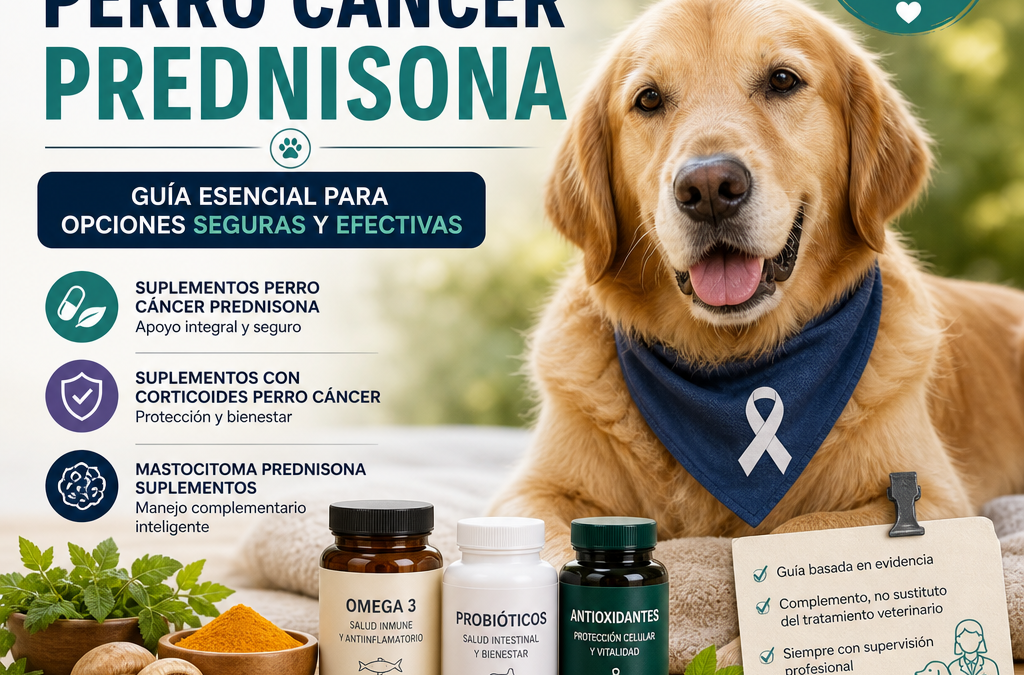
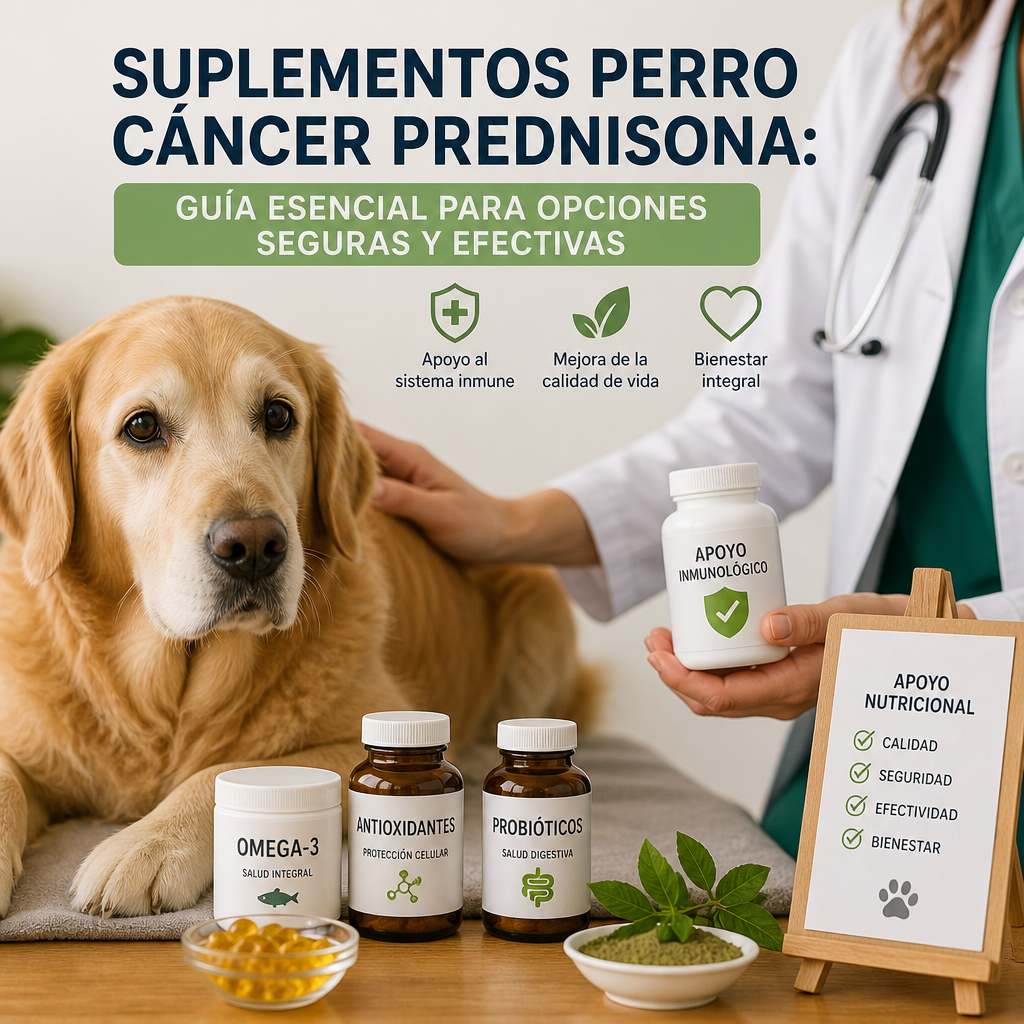
Suplementos perro cáncer prednisona es una búsqueda cada vez más frecuente entre quienes acompañan a un animal diagnosticado con cáncer y desean mejorar su bienestar. Sin embargo, combinar prednisona con complementos nutricionales no debe hacerse de forma improvisada. La seguridad depende del tipo de tumor, la dosis del corticoide, otros tratamientos, la función del hígado y los riñones, y el estado general del perro. Un suplemento puede ser útil en determinados casos, pero también puede interferir con la medicación o causar efectos adversos.
Cuando se habla de suplementos perro cáncer prednisona, la pregunta correcta no es solo “qué producto sirve”, sino “qué producto es adecuado para este perro, en este momento y con este tratamiento”. Esa revisión individual ayuda a evitar errores frecuentes y a priorizar lo que realmente aporta calidad de vida.
¿Qué función cumple la prednisona en perros con cáncer?
La prednisona es un corticoide utilizado en medicina veterinaria por sus efectos antiinflamatorios e inmunosupresores. En oncología puede formar parte del tratamiento de algunos linfomas, mastocitomas y enfermedades asociadas a inflamación intensa. También puede ayudar a disminuir temporalmente ciertos síntomas, como dolor, inflamación, falta de apetito o náuseas.
No obstante, la prednisona no actúa igual en todos los tipos de cáncer. En algunos tumores puede ser un componente terapéutico importante, mientras que en otros su función es principalmente paliativa. Además, el uso prolongado puede producir aumento de la sed y la orina, hambre excesiva, jadeo, debilidad muscular, cambios de conducta, mayor riesgo de infecciones y alteraciones metabólicas.
Por esta razón, nunca debe suspenderse de manera repentina ni modificarse la dosis sin supervisión veterinaria. La retirada suele requerir una reducción gradual para permitir que el organismo recupere su producción normal de corticoides.
También conviene recordar que los perros no responden igual al tratamiento si están desnutridos, deshidratados o muy débiles. En esos casos, cualquier decisión sobre suplementos perro cáncer prednisona debe hacerse con más cautela, porque el margen de tolerancia puede ser menor.
Suplementos con corticoides perro cáncer: una combinación que requiere prudencia
La expresión suplementos con corticoides perro cáncer puede llevar a confusión. Los suplementos nutricionales no sustituyen a la prednisona ni deben considerarse una forma “natural” de administrar corticoides. Algunos productos herbales poseen efectos antiinflamatorios o inmunomoduladores, pero eso no significa que sean seguros al combinarse con un tratamiento oncológico.
Por ejemplo, ciertos extractos vegetales pueden aumentar el riesgo de sangrado, modificar la actividad del hígado o alterar la absorción de otros fármacos. También existen complementos que estimulan el sistema inmunitario, algo que podría no ser apropiado en perros que reciben corticoides o tratamientos destinados a controlar una respuesta inmunitaria concreta.
Antes de administrar cualquier producto conviene revisar:
Ingredientes y concentración exacta.
Fabricante y controles de calidad.
Dosis recomendada para el peso del perro.
Posibles interacciones con prednisona, quimioterapia o antiinflamatorios.
Estado del hígado, riñones, estómago y sistema inmunitario.
Objetivo concreto del suplemento.
Los productos destinados a humanos merecen especial precaución. Pueden contener xilitol, dosis excesivas de determinadas vitaminas, cafeína, edulcorantes u otros ingredientes peligrosos para los perros.
Si el plan terapéutico incluye más de un medicamento, conviene revisar la información del fármaco en una fuente veterinaria fiable como el resumen clínico sobre prednisona de VCA para entender mejor sus efectos y riesgos generales.
En las búsquedas sobre mastocitoma prednisona suplementos, es importante entender que el mastocitoma puede liberar histamina y otras sustancias capaces de provocar inflamación, vómitos, diarrea, úlceras digestivas o reacciones parecidas a una alergia. La prednisona puede utilizarse en algunos protocolos para reducir inflamación y controlar determinados signos, pero el tratamiento depende del grado del tumor, su localización, la posibilidad de cirugía y los resultados de las pruebas diagnósticas.
En perros con mastocitoma, el veterinario puede valorar medidas de protección gastrointestinal, especialmente si existen antecedentes de vómitos, heces oscuras, dolor abdominal o pérdida de apetito. No es recomendable añadir por cuenta propia plantas, enzimas, antiácidos o productos para “reforzar las defensas”. La prioridad es evitar complicaciones digestivas y mantener un plan coordinado con oncología veterinaria.
Un suplemento de omega-3 procedente de aceite de pescado purificado puede considerarse en algunos pacientes, pero debe ajustarse la dosis y comprobarse la tolerancia. No todos los perros lo necesitan, y una cantidad excesiva puede causar diarrea, aumento de peso o problemas relacionados con la coagulación. Su uso debe comunicarse al veterinario, sobre todo si el perro será operado o recibe otros medicamentos.
En este contexto, suplementos perro cáncer prednisona no significa sumar productos sin orden, sino elegir solo aquellos que encajen con el objetivo clínico y con el estado del animal.
Qué revisar antes de dar suplementos perro cáncer prednisona
Antes de incorporar suplementos perro cáncer prednisona a un plan de apoyo, la revisión debe ser individual y práctica. Lo ideal es valorar primero si el perro realmente necesita el producto, qué problema se intenta resolver y si existe una alternativa más sencilla o más segura. En muchos casos, la alimentación completa y el control de síntomas aportan más beneficio que una larga lista de complementos.
La primera revisión es la compatibilidad con el tratamiento actual. Un suplemento puede parecer inocuo, pero en perros con cáncer puede alterar la absorción de la medicación, aumentar la irritación digestiva o sobrecargar órganos ya comprometidos. También hay que revisar si el perro toma antieméticos, analgésicos, antibióticos, quimioterapia o protectores gástricos, porque la suma de productos cambia el riesgo real.
La segunda revisión es el origen del producto. Las fórmulas con etiquetado claro, buena trazabilidad y composición estable suelen ser preferibles. Si el envase no detalla la cantidad exacta de cada ingrediente, o si promete resultados curativos, conviene desconfiar. En oncología veterinaria, la transparencia es tan importante como el ingrediente elegido.
La tercera revisión es el momento clínico. Un perro estable, que come bien y mantiene peso, no necesita el mismo enfoque que otro con náuseas, pérdida muscular o diarrea. En fases de debilidad, priorizar la tolerancia digestiva y el aporte calórico suele ser más útil que añadir suplementos múltiples. Cuando el perro está deshidratado, vomita o presenta dolor, el suplemento debe esperar.
La cuarta revisión es el historial de sensibilidad. Si el perro ha reaccionado mal a aceites, levaduras, proteínas nuevas o comprimidos con saborizantes, esa información ayuda a evitar recaídas. En los casos en los que ya se han probado varios productos, puede ser mejor simplificar el plan y regresar a lo esencial antes de añadir más variables.
¿Cuándo puede tener sentido añadir un complemento?
Puede tener sentido cuando existe un objetivo concreto, como mejorar la palatabilidad de la dieta, apoyar la masa muscular, ayudar a la función intestinal o corregir una deficiencia conocida. En esos casos, el suplemento se integra dentro de un plan veterinario y se monitoriza su efecto. Si no aporta un beneficio observable en un plazo razonable, lo prudente es reevaluarlo.
Señales de que el producto no está sentando bien
Los signos de intolerancia suelen ser digestivos, pero no siempre. Si después de empezar un producto aparecen vómitos, diarrea, aumento brusco del gas intestinal, picor, apatía, empeoramiento del apetito o cambios en las heces, el suplemento debe suspenderse y consultarse con el veterinario. En algunos perros, el problema no es el ingrediente principal, sino excipientes, aceites, saborizantes o dosis demasiado altas.
Cómo afecta el tratamiento al apetito, la digestión y el peso
La prednisona puede aumentar el apetito de forma notable, pero eso no siempre significa que el perro esté comiendo mejor. A veces come más cantidad, aunque la calidad de la dieta no sea la ideal o la digestión no acompañe. Otras veces el hambre crece, pero aparecen náuseas, molestias gástricas o cambios en el tránsito intestinal que dificultan aprovechar bien los nutrientes.
En perros con cáncer, la pérdida de peso no siempre se debe a que coman poco. Puede existir desgaste muscular, inflamación sistémica o peor asimilación de nutrientes. Por eso, antes de pensar en suplementos perro cáncer prednisona, conviene revisar la ración total, el contenido energético, la proteína disponible y la frecuencia de las comidas.
La digestión también importa. Un complemento con aceite, fibra o varios extractos puede ser útil para un perro, pero demasiado pesado para otro con estómago sensible. Si el animal tiene náuseas frecuentes, conviene evitar cambios bruscos y mantener una pauta sencilla. La prioridad es que la dieta se tolere de forma constante.
Cuando el peso baja a pesar del apetito, el veterinario puede valorar ajustes nutricionales más concretos. En algunos casos será mejor subir calorías con una dieta más densa; en otros, ofrecer raciones pequeñas y frecuentes; y en otros, reducir el número de productos para evitar saturación digestiva.
Complementos que pueden evaluarse con supervisión
La nutrición es una parte esencial del cuidado del perro con cáncer. En lugar de buscar un único producto milagroso, suele ser más útil revisar la alimentación completa. El objetivo es mantener una condición corporal adecuada, conservar la masa muscular y asegurar una ingesta suficiente de agua y nutrientes.
Entre los complementos que un profesional podría valorar se encuentran:
Ácidos grasos omega-3
Los omega-3, especialmente EPA y DHA, pueden contribuir al control de ciertos procesos inflamatorios y apoyar la salud de la piel y las articulaciones. Deben proceder de productos de calidad, correctamente conservados y formulados para animales. El veterinario puede recomendar evitarlos temporalmente si existen alteraciones de coagulación, cirugía próxima o intolerancia digestiva.
Probióticos
Los probióticos pueden ser útiles en algunos perros con diarrea o alteraciones intestinales, aunque su beneficio depende de la cepa y de la causa del problema. En animales inmunodeprimidos o sometidos a quimioterapia, la elección debe ser especialmente cuidadosa.
Antioxidantes
Vitaminas y antioxidantes no son automáticamente beneficiosos durante un tratamiento oncológico. Algunos protocolos pueden verse afectados por dosis elevadas de determinados antioxidantes, y el exceso de vitaminas liposolubles puede acumularse y causar toxicidad. Solo deben utilizarse cuando exista una indicación clara.
Apoyo nutricional
Si el perro come poco, pierde peso o presenta dificultades para mantener la masa muscular, puede ser más importante ajustar la dieta, ofrecer alimentos de alta palatabilidad o utilizar una alimentación veterinaria específica que añadir varios suplementos. La pérdida de peso persistente debe comunicarse rápidamente al equipo médico.
Soporte digestivo y hepático
En algunos pacientes, el veterinario puede priorizar productos que favorezcan la tolerancia gastrointestinal o ayuden a mantener la función hepática. Esto no significa que deban usarse de forma automática, sino que pueden evaluarse cuando haya una necesidad concreta y datos clínicos que lo respalden.
El enfoque correcto en suplementos perro cáncer prednisona es pensar en objetivos medibles: mejor apetito, menos diarrea, más energía o mejor estabilidad ponderal. Si no hay un objetivo claro, lo más prudente suele ser no añadir nada.
Cómo elegir un suplemento de forma responsable
La seguridad empieza por definir el objetivo. No es lo mismo apoyar el apetito que tratar una diarrea, proteger la piel o complementar una dieta insuficiente. Un producto con muchos ingredientes no es necesariamente mejor; de hecho, las fórmulas complejas dificultan identificar qué componente causa una reacción o una interacción.
Es preferible escoger productos con composición transparente, dosis verificables y controles de fabricación. Deben evitarse las promesas de curar el cáncer, disolver tumores o reemplazar la quimioterapia, la cirugía o la radioterapia. Los suplementos pueden formar parte del cuidado integral, pero no sustituyen el tratamiento indicado.
La mejor estrategia consiste en informar al veterinario de todos los productos administrados, incluidos aceites, plantas medicinales, vitaminas y premios funcionales. Con una evaluación individual, es posible decidir qué complementos aportan un beneficio real y cuáles conviene evitar mientras el perro recibe prednisona.
También ayuda llevar un registro sencillo. Anotar fecha de inicio, dosis, cambios en el apetito, heces, peso y conducta permite valorar si el suplemento está funcionando o no. Este seguimiento convierte una decisión subjetiva en una revisión más objetiva y útil para el equipo veterinario.
Si quieres ampliar criterios generales sobre cuidados veterinarios y manejo clínico, también puedes revisar la información general del sitio TCM Vet como referencia institucional, aunque las decisiones terapéuticas siempre deben individualizarse.
Preguntas frecuentes sobre suplementos y prednisona
¿Puedo dar vitaminas por mi cuenta?
No es recomendable sin orientación profesional. Algunas vitaminas pueden ser innecesarias y otras pueden acumularse. En perros con cáncer y tratamiento con corticoides, la evaluación debe ser individual.
¿Los productos naturales son siempre más seguros?
No. “Natural” no significa inocuo. Varias plantas y extractos pueden interactuar con medicamentos, irritar el estómago o afectar el hígado.
¿Puedo combinar varios suplementos a la vez?
Solo si el veterinario lo considera apropiado. Cuantos más productos se añaden, más difícil es saber cuál ayuda y cuál perjudica. En muchos casos, menos es más.
¿Qué pasa si mi perro toma prednisona desde hace tiempo?
El uso prolongado puede cambiar el metabolismo, el apetito y la masa muscular. Por eso, los suplementos perro cáncer prednisona deben revisarse periódicamente y no mantenerse por rutina sin objetivo clínico.
¿Sirven para todos los tipos de cáncer?
No. La elección depende del tumor, el estadio de la enfermedad, el plan terapéutico y las comorbilidades. Lo que es adecuado en un perro puede no serlo en otro.
Señales de alarma durante el tratamiento
Un perro que toma prednisona puede presentar más sed, hambre y micción, pero hay signos que requieren atención veterinaria. Entre ellos se incluyen vómitos repetidos, diarrea intensa, heces negras o con sangre, encías pálidas, fiebre, debilidad marcada, dificultad respiratoria, abdomen muy distendido, rechazo total de la comida o empeoramiento repentino.
También es importante observar cambios en la piel, aparición de infecciones, heridas que no cicatrizan y pérdida acelerada de masa muscular. Llevar un registro de apetito, peso, consumo de agua, deposiciones y medicación puede ayudar al veterinario a detectar problemas y ajustar el tratamiento.
Cuando aparecen signos digestivos, los suplementos con corticoides perro cáncer deben revisarse de inmediato, porque el problema puede deberse a una interacción, a una dosis inadecuada o a una intolerancia individual. Una pausa temporal y una reevaluación suelen ser más seguras que seguir añadiendo productos.
Si además el perro está decaído, tiembla, respira rápido o deja de interesarse por la comida, no conviene esperar a la siguiente revisión programada. En estas situaciones, el control precoz evita complicaciones y permite ajustar mejor el manejo del paciente.
Cómo hablar con el veterinario antes de comprar suplementos
Una conversación breve pero concreta puede ahorrar muchos problemas. Conviene llevar el nombre exacto del producto, foto de la etiqueta, dosis propuesta y objetivo que se pretende alcanzar. También es útil mencionar si se trata de suplementos perro cáncer prednisona ya empezados por cuenta propia o solo de una idea de compra.
Las preguntas útiles suelen ser: ¿es compatible con la medicación actual?, ¿qué beneficio esperado tiene?, ¿cuánto tiempo debo probarlo?, ¿qué signos indican que lo suspenda? y ¿hay una opción más simple o más segura? Con esas respuestas, la decisión se vuelve más clara y más segura.
En algunos casos, el veterinario preferirá no añadir nada. Esa recomendación no significa falta de opciones, sino que el balance entre beneficio y riesgo no justifica el producto en ese momento. Esa prudencia suele ser una buena señal.
Conclusión
En resumen, suplementos perro cáncer prednisona solo debería significar una cosa: revisar con calma, confirmar la compatibilidad y priorizar la seguridad. Si el objetivo es mejorar la calidad de vida, el plan más útil suele ser el que combina vigilancia clínica, nutrición adecuada y decisiones prudentes sobre cada producto.
La combinación de corticoides y complementos no es necesariamente mala, pero sí requiere criterio. Con supervisión veterinaria, un suplemento puede aportar apoyo real; sin ella, puede convertirse en una fuente de problemas evitables. Cuando se trata de un perro con cáncer, cada elección cuenta.
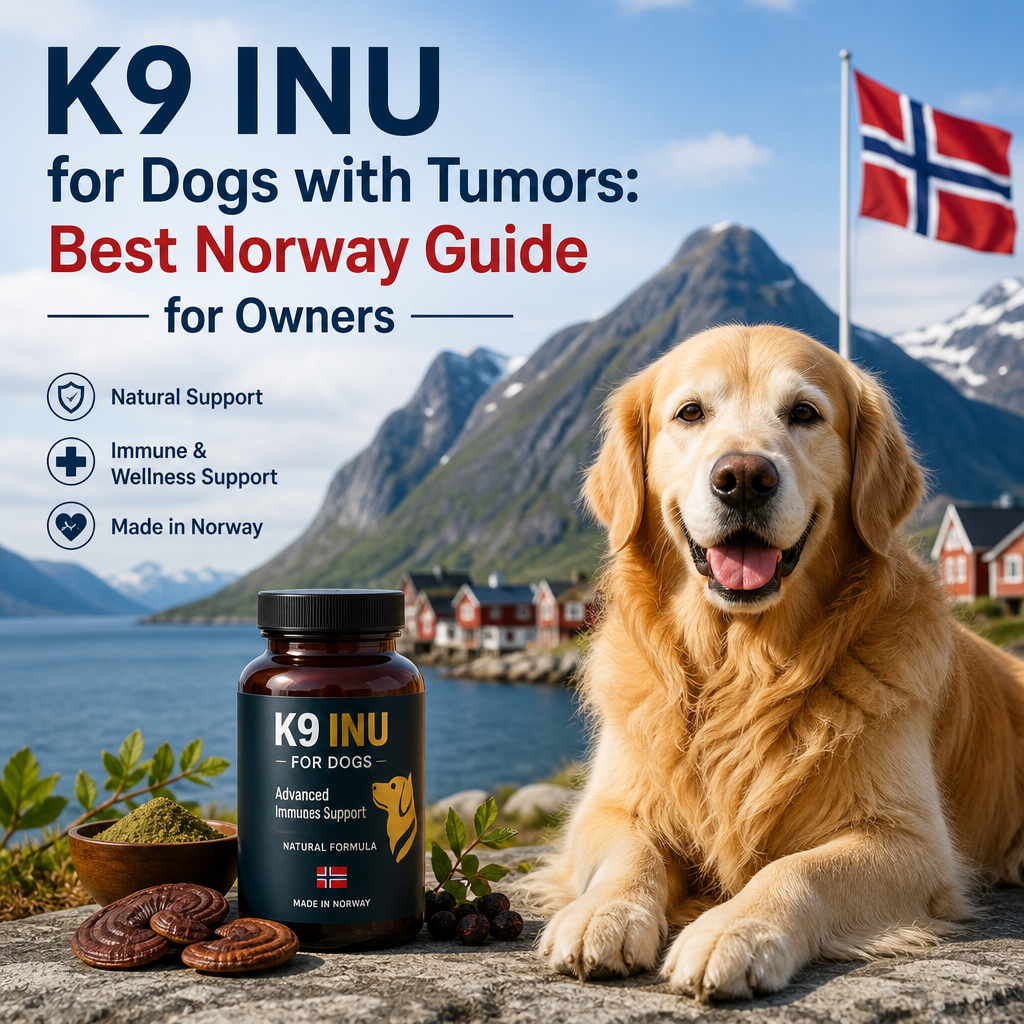
K9 INU is often searched by dog owners looking for additional support when a beloved pet has been diagnosed with a tumor. In Norway, interest in supplements marketed for canine cancer support has grown alongside awareness of nutrition, quality of life, and integrative veterinary care. However, choosing a product should never replace professional diagnosis or treatment. Owners need clear information about what a supplement may offer, how it should be used, and what questions to ask a veterinarian before adding it to a dog’s care plan.
A tumor is an abnormal growth of cells. Some tumors are benign, meaning they may not spread to other parts of the body, while malignant tumors can invade nearby tissue or metastasize. Canine cancer may appear as a lump under the skin, unexplained weight loss, persistent coughing, changes in appetite, bleeding, reduced energy, or changes in bathroom habits.
Because these signs can also result from infections or other health conditions, a veterinary examination is essential. Diagnostic tests may include a physical examination, blood work, fine-needle aspiration, biopsy, ultrasound, or imaging such as X-rays and CT scans. A confirmed diagnosis helps determine whether surgery, chemotherapy, radiation, immunotherapy, pain management, or palliative care is appropriate.
Owners sometimes begin researching supplements at the same time they are trying to understand the diagnosis itself. That is understandable, but it is important to keep priorities clear: the first step is identifying the tumor type and the stage of disease. Once that information is known, a veterinarian can explain whether supportive nutrition, symptom control, or a treatment plan offers the best chance of helping the dog feel better.
Different tumor types behave very differently. Some grow slowly and remain localized, while others progress quickly or spread to other organs. This is one reason why general internet advice can be misleading. A supplement that seems promising in one situation may be unsuitable in another, especially when a dog is already taking medication or has other health concerns.
In practice, supportive care often works best when it is matched to the dog’s specific condition. A young, otherwise healthy dog may tolerate treatment differently from an older dog with kidney, liver, or heart disease. That is why any new supplement should be discussed in the context of the full medical picture, not as a stand-alone solution.
What Is K9 INU?
K9 INU is commonly presented as a nutritional supplement intended to support dogs facing serious illness, including tumor-related conditions. Products in this category may contain a combination of plant extracts, medicinal mushrooms, vitamins, minerals, antioxidants, or other ingredients associated with immune and general health support.
The exact formula, dosage, and manufacturing standards are important. Product names alone do not confirm effectiveness, and formulations can vary by country or distributor. Before purchasing K9 INU in Norway, owners should check the official ingredient list, serving instructions, batch information, storage requirements, and whether the product is legally marketed for animals.
A supplement should be viewed as supportive care rather than a cure. There is no responsible basis for claiming that a nutritional product can eliminate cancer or replace evidence-based veterinary treatment.
It is also worth noting that the word “support” can be used very loosely in supplement marketing. In some cases, it may simply mean general wellness. In others, it may imply stronger claims about immunity, recovery, or tumor control without strong evidence to back those claims. Reading labels carefully helps owners separate marketing language from practical usefulness.
If the product lists several active ingredients, the best question is not just what is included, but why those ingredients are there and in what amounts. Without that information, it becomes difficult to judge whether the formula is meaningful, underdosed, or likely to cause unnecessary expense without real benefit.
Owners may also want to compare the product’s instructions with the dog’s current diet. A complete and balanced diet already provides many essential nutrients, so adding a supplement should have a clear purpose. Otherwise, the dog may simply be taking extra capsules or powder with little measurable effect.
K9 INU dog cancer support: What Owners Should Know
The phrase “K9 INU dog cancer support” refers to the idea of using a supplement alongside veterinary care to help maintain a dog’s general condition. Potential goals may include supporting appetite, maintaining body weight, helping normal immune function, and contributing to overall wellbeing. These goals are especially relevant for dogs undergoing treatment or experiencing reduced energy.
However, evidence for individual supplements can be limited. Research conducted on a particular ingredient, laboratory model, or human population does not automatically prove that a complete product will benefit dogs with cancer. The dog’s tumor type, age, breed, medications, liver and kidney function, and current diet all affect safety and suitability.
Owners should also be cautious about immune-related claims. Some cancer treatments work partly by influencing the immune system, and adding immune-active substances without veterinary guidance could theoretically interfere with treatment or worsen certain conditions. “Natural” does not always mean harmless.
Some dogs with cancer experience reduced appetite, nausea, constipation, or fatigue. In those situations, families often hope a supplement will help restore strength quickly. While that hope is understandable, the safest approach is to look for measurable improvements such as better eating, stable weight, more interest in daily life, or fewer digestive problems rather than expecting dramatic changes from a single product.
Supportive care should also be realistic. A supplement may help some dogs feel a little better, but it cannot replace surgery, chemotherapy, radiation, or pain control when those treatments are medically indicated. A product that fits one dog’s care plan may be unnecessary for another, which is why individualized advice matters so much.
For broader background on supplement use in dogs with cancer, you may also find this affordable dog tumor supplements guide helpful when comparing products and ingredients.
Owners should keep an eye on timing as well. If a dog is already struggling with medication side effects, introducing a new supplement at the same time can make it hard to tell what is helping or hurting. When possible, changes should be introduced slowly and with clear veterinary oversight.
Another practical point is expectation management. Even when a supplement is well tolerated, the effect may be subtle. Supportive products are often judged by small gains rather than dramatic changes. A dog may eat slightly better, seem a bit brighter, or recover a little faster between appointments. Those modest improvements can matter, but they should be interpreted carefully and in context.
Evaluating a K9 INU review
When reading a K9 INU review, look beyond testimonials and dramatic before-and-after claims. A useful review should explain the product’s ingredients, intended use, possible side effects, manufacturing information, and limitations. It should also distinguish personal experience from clinical evidence.
Consider the following questions:
Is the full ingredient list easy to find?
Are ingredient amounts provided rather than only a proprietary blend?
Does the manufacturer identify quality-control procedures?
Is the product intended specifically for dogs?
Are dosage instructions based on body weight?
Does the review cite veterinary or scientific evidence?
Does it avoid promising to cure cancer?
Is there clear information about refunds, shipping, and customer support?
Independent reviews can be helpful for assessing packaging, taste, delivery, and customer service. They are much less reliable for proving that a supplement treats tumors. A dog may appear better because of surgery, medication, improved nutrition, or natural changes in the disease—not necessarily because of one product.
It also helps to separate emotion from evidence. Reviews written during a stressful medical journey can be sincere and still be medically inconclusive. A family may report that a supplement gave them hope, and that emotional value is real. But hope alone does not show that a product changed the course of disease.
When evaluating any supplement review, look for signs of balanced writing. A trustworthy review usually mentions both strengths and weaknesses, explains who the product might suit, and acknowledges when the evidence is incomplete. Reviews that sound too certain or too dramatic are often the least useful.
If multiple people report the same side effect, that may deserve attention even if formal studies are limited. Repeated reports of digestive upset, refusal to eat, or changes in stool quality can be meaningful for pet owners trying to decide whether a supplement is worth trying. At the same time, one dog’s experience should never be treated as proof for every dog.
K9 INU Norway: Purchasing and Regulatory Considerations
For owners searching for K9 INU Norway, practical issues matter as much as marketing claims. Verify whether the product is shipped from within Norway, the European Economic Area, or another country. International purchases may involve customs procedures, taxes, delivery delays, and different consumer protections.
Check the seller’s business details and read the terms for recurring orders. Some online supplement websites enroll customers in subscriptions unless the buyer actively declines. Owners should also confirm that the product is labeled for animal use and stored correctly during transport, particularly if it contains oils, probiotics, or other ingredients affected by heat and moisture.
Norwegian pet owners can discuss products with a veterinarian and consult relevant Norwegian authorities when they have questions about animal-feed regulations, labeling, or import requirements. A reputable seller should not discourage veterinary consultation or make claims that conflict with established cancer care.
For authoritative guidance on pet food and supplement safety in Europe, the European Food Safety Authority provides science-based information that can help owners evaluate product claims more carefully.
Storage matters after purchase, too. Many supplements lose quality when exposed to humidity, heat, or direct light. In a climate where homes, travel, and shipping conditions can vary, following label instructions helps preserve product integrity. Owners should also avoid using expired supplements, even if they still look and smell normal.
It is sensible to keep the invoice, lot number, and packaging until the product has been used safely for a while. If a dog has a reaction or the product needs to be reported, those details make follow-up easier. Good recordkeeping also helps when comparing one batch with another or checking whether a supplier changed the formula.
Regulatory language can be confusing. Terms such as supplement, feed additive, nutritional support, or complementary product do not automatically mean the product has been proven to treat disease. In general, the more a product sounds like a medical treatment, the more carefully it should be discussed with a veterinarian before use.
Possible Benefits and Limitations
A well-formulated supplement may help fill nutritional gaps or support a dog whose appetite and condition have declined. Some ingredients may have antioxidant or anti-inflammatory properties, but the practical benefit depends on dose, absorption, the dog’s health, and the specific disease.
There are also important limitations. Supplements may cause stomach upset, diarrhea, allergic reactions, or changes in appetite. Certain ingredients can affect blood clotting, blood pressure, blood sugar, or the metabolism of prescription medicines. Products containing high levels of particular vitamins or minerals may be harmful when combined with a complete commercial diet.
Cost is another consideration. Long-term supplementation can become expensive, especially when a dog also needs regular examinations, medication, diagnostic tests, and treatment. Owners should weigh the expected value against the available evidence and the dog’s comfort.
It may also help to compare ingredient priorities across different products before making a decision. Some owners review more than one supplement option, including this best affordable dog tumor supplements guide for Italy, to better understand how formulas, pricing, and intended use can differ by market.
When thinking about benefits, it is useful to define what success would look like. For one dog, it may mean maintaining appetite through treatment. For another, it may mean fewer digestive issues or better energy during recovery. Clear goals make it easier to judge whether the supplement is worth continuing.
Limitations are just as important as potential benefits. A product may be expensive, hard to source, or poorly tolerated, even if the label sounds promising. If the dog does not improve after a reasonable trial period, continuing indefinitely may not make sense. The decision should be based on the dog’s response, not on wishful thinking.
Ingredients can also overlap with what a dog already receives from food or medication. Extra antioxidants, herbs, or mushroom blends may not always add value and may sometimes complicate a treatment plan. The simplest approach is often the safest: add only what has a clear purpose and a good reason for being there.
Finally, owners should remember that quality of life is the main goal. If a supplement helps but creates stress during dosing, disrupts meals, or causes digestive upset, the trade-off may not be worthwhile. The best supportive product is the one that fits the dog comfortably and safely into the overall care plan.
How to Discuss K9 INU With a Veterinarian
Bring the product packaging or a complete photograph of the label to the appointment. Provide the veterinarian with the dog’s current medications, diet, supplements, diagnosis, and treatment schedule. Ask whether any ingredient could interact with chemotherapy, steroids, anti-inflammatory drugs, anesthetics, or other medicines.
The veterinarian may recommend monitoring appetite, stool quality, weight, drinking, energy, pain, and blood-test results. If the supplement is introduced, adding only one new product at a time makes it easier to identify adverse reactions. Stop and seek veterinary advice if the dog develops repeated vomiting, severe diarrhea, facial swelling, breathing difficulty, unusual bleeding, marked weakness, or a sudden decline.
A good conversation is usually more productive when owners bring specific questions. For example: Is there any known benefit for this ingredient in dogs? Could it affect current medication? How long should a trial last before we decide whether it is helping? What signs would mean it should be stopped right away? These questions help move the discussion away from sales claims and toward patient safety.
If the veterinarian is unfamiliar with the product, that does not necessarily mean it is inappropriate; it may simply mean there is not enough reliable information to recommend it confidently. In that case, the most responsible answer is often to proceed cautiously or not at all.
Owners should also be open about online purchases made before the appointment. Vets are much better able to help when they know exactly what has been started, how often it is given, and how the dog has responded so far.
Supporting a Dog With a Tumor
The most valuable support often involves basic comfort and careful monitoring. Follow the prescribed treatment plan, provide fresh water, offer a balanced diet suited to the dog’s condition, and keep meals appealing without making unapproved dietary changes. Maintain gentle activity if the dog is comfortable, provide a quiet resting area, and monitor pain or distress.
Regular veterinary follow-up is essential because treatment needs can change. Quality-of-life discussions can help owners make compassionate decisions based on mobility, appetite, comfort, interaction, and the balance between good and difficult days.
When evaluating K9 INU for dogs with tumors, it is best to treat the supplement as one small part of a larger care plan. For dog owners in Norway, checking ingredients, sourcing, labeling, evidence, and potential interactions is the safest way to make an informed decision while keeping proven medical care at the center of the dog’s treatment.
It can also help to write down daily observations. Short notes about eating, energy, mobility, stool quality, and mood give a more accurate picture than memory alone. If a supplement is tried, those notes make it easier to tell whether the dog is genuinely improving or simply having a temporary good day.
Support can be practical as well as medical. Easy-to-reach water bowls, non-slip flooring, soft bedding, calm routines, and help with stairs or vehicle access can improve comfort more than many owners expect. Small environmental changes often make a noticeable difference for dogs dealing with pain or weakness.
Families should also prepare for changing needs. A dog that tolerates a supplement now may not tolerate the same product later if treatment changes or the disease progresses. Reassessing regularly is part of good care, and that includes stopping products that no longer serve a clear purpose.
Above all, the goal is to support the dog’s comfort, dignity, and safety. Supplements may have a place, but they work best when they are chosen carefully, used with realistic expectations, and kept secondary to veterinary care that is proven, monitored, and tailored to the individual dog.
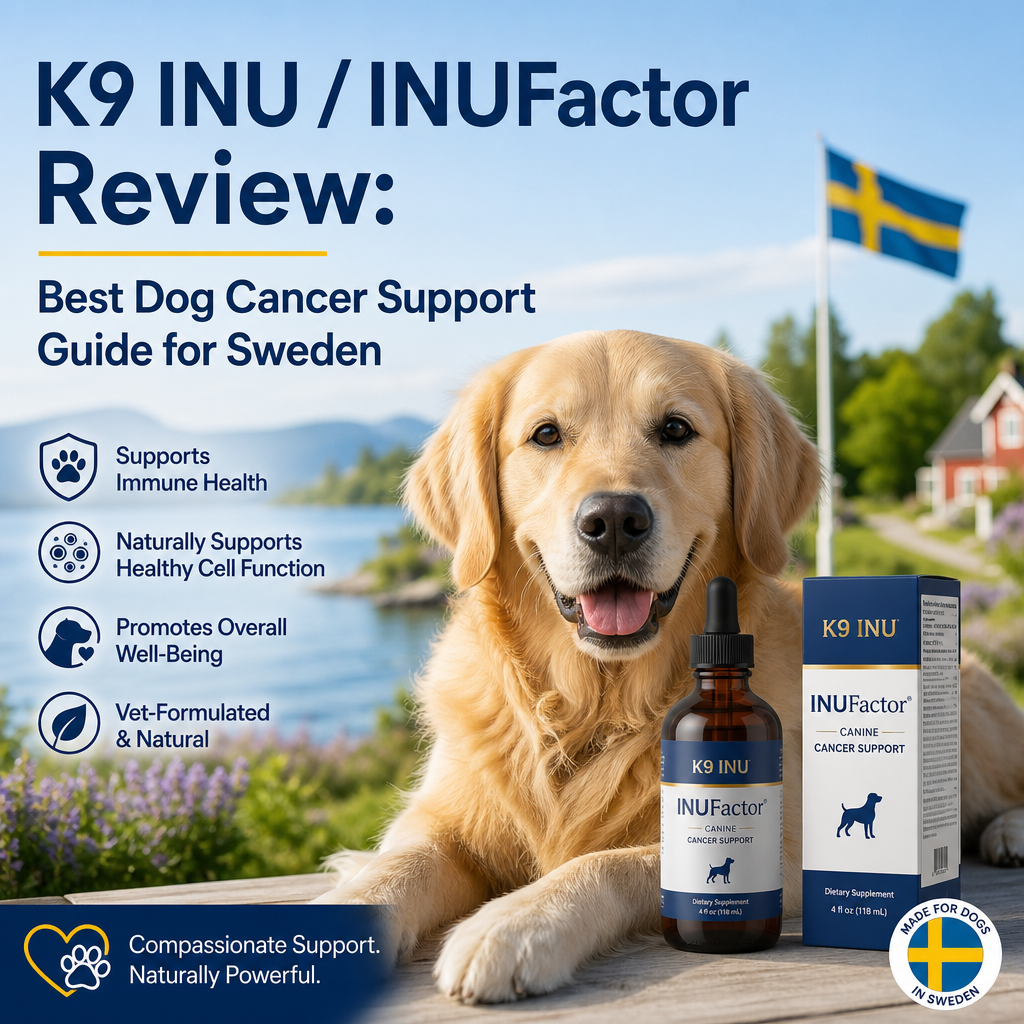
K9 INU / INUFactor is often discussed by Swedish dog owners looking for additional support after a cancer diagnosis. A careful K9 INU / INUFactor review should focus on what the product is intended to do, how it may fit alongside veterinary treatment, what evidence is available, and how to buy and use it responsibly in Sweden. Supplements can sometimes play a supportive role, but they should never replace professional diagnosis, surgery, chemotherapy, radiation, pain management, or other treatments recommended by a veterinarian.
What is K9 INU / INUFactor?
K9 INU / INUFactor is generally presented as a nutritional supplement for dogs, with an emphasis on immune and overall health support. Products in this category are commonly marketed to dogs facing serious health challenges, including cancer, chronic illness, reduced appetite, or recovery after treatment.
The term “support” is important. A supplement is not the same as a proven cancer medicine. Its purpose may be to help maintain nutritional status, normal immune function, energy, or general wellbeing. The exact ingredients, concentration, feeding instructions, and manufacturing standards should always be checked on the official product label or packaging, because formulations and availability can change.
A responsible K9 INU / INUFactor review should therefore avoid making absolute claims. No supplement can guarantee that a tumor will shrink, prevent cancer from returning, or extend a dog’s life. The most useful question is whether the product is appropriate for an individual dog when considered alongside veterinary care.
For many owners, the appeal of K9 INU / INUFactor comes from wanting to do something proactive after hearing a cancer diagnosis. That reaction is completely understandable. Still, a thoughtful decision depends on the dog’s exact diagnosis, current medications, appetite, weight, and overall treatment plan. What works for one dog may be unhelpful or even risky for another.
When owners compare K9 INU / INUFactor with other supportive options, it helps to think in practical terms: can the product fit the dog’s routine, can it be sourced reliably in Sweden, and can it be used without complicating the treatment plan? Those questions matter more than a polished sales page.
K9 INU / INUFactor dog cancer support: What owners should know
When a dog has cancer, nutritional needs can change. Some dogs lose appetite, experience nausea, lose weight, or become less active. Others may continue eating but require closer monitoring because their condition changes rapidly. This is why K9 INU / INUFactor dog cancer support should be viewed as part of a broader care plan rather than a standalone solution.
Supportive care may include:
Maintaining a healthy body weight
Providing adequate protein and calories
Managing pain and nausea
Supporting hydration
Monitoring stool, appetite, and energy
Reducing stress and preserving daily comfort
Following the veterinary treatment schedule
A supplement may be considered if a veterinarian believes its ingredients are suitable and unlikely to interfere with medication. Dogs undergoing chemotherapy, corticosteroid treatment, surgery, or other therapies may be especially sensitive to changes in diet and supplementation.
Owners should keep a written record of everything their dog receives, including prescription medicines, supplements, treats, oils, and herbal products. This makes it easier for the veterinarian to identify possible interactions and assess changes in symptoms.
For general guidance on warning signs, diagnosis, and treatment planning, the American College of Veterinary Internal Medicine provides helpful educational information at the ACVIM website.
It is also wise to remember that supportive products are not judged only by how they sound in marketing copy. A dog with a tumor may seem to improve for several reasons at once, including better pain control, temporary changes in appetite, fluid support, or the natural course of the disease. A clear care plan helps separate those factors as much as possible.
In practice, K9 INU / INUFactor should be seen as one possible part of a larger comfort-and-care strategy. If the dog is already struggling with weight loss or poor appetite, the veterinary team may first focus on stabilizing food intake, hydration, and side effects before considering any supplement.
Evaluating the evidence behind K9 INU / INUFactor
The strongest evidence in veterinary medicine comes from well-designed clinical studies involving dogs with clearly defined conditions. Marketing information, personal testimonials, and online reviews can provide insight into user experiences, but they do not prove that a product treats cancer.
When assessing K9 INU / INUFactor, look for clear information about:
Ingredients: The label should identify active and inactive ingredients, amounts per serving, and any potential allergens.
Quality control: Responsible manufacturers should provide information about production standards, batch testing, and product safety.
Intended use: The product should clearly state whether it is a complete food, complementary feed, or dietary supplement.
Feeding instructions: Dosage should be based on the dog’s weight and health status, not guesswork.
Warnings: The packaging should explain when veterinary advice is necessary.
Independent research: Published evidence is more reliable when studies are transparent, peer-reviewed, and relevant to dogs.
A positive review may describe improved appetite or energy, but these changes can also result from pain control, improved nutrition, treatment response, or natural fluctuations in the disease. Likewise, a negative experience does not necessarily mean every dog will respond in the same way. Individual factors such as tumor type, age, organ function, medication, and stage of disease matter greatly.
Another useful way to evaluate K9 INU / INUFactor is to ask whether the claims are specific enough to be tested. If a company says a supplement “supports immune health,” that phrase may be too broad to mean much on its own. If it states the exact ingredients, dosage, and target use, a veterinarian can more easily judge whether those ingredients are sensible for a particular dog.
What to look for in a trustworthy supplement claim
Helpful product claims are specific and measurable. Vague phrases like “supports the body naturally” or “helps fight cancer” are not enough to judge whether a supplement is appropriate. Better information includes ingredient amounts, usage directions, safety notes, and whether the company can explain how the product is manufactured. If a seller avoids these details, that is a warning sign.
It is also sensible to compare the supplement’s claims with the dog’s actual needs. A product may sound impressive, but if the dog is struggling with nausea, poor appetite, kidney issues, or medication side effects, the first priority is usually to stabilize the underlying problem with veterinary help.
Owners often ask whether any supplement can be truly “cancer supporting” if the evidence is limited. The honest answer is that a supplement may still have a place in comfort-focused care, but only when the expected benefits are realistic and the risks are low. That is why the evidence behind K9 INU / INUFactor should be considered carefully rather than accepted at face value.
When reading studies or product summaries, look for information about the dog population, the duration of use, and whether the results were measured in a meaningful way. Short reports and anecdotal stories may be encouraging, but they are not enough to establish a reliable pattern of benefit.
K9 INU / INUFactor Sweden: Buying and regulatory considerations
For dog owners searching for K9 INU / INUFactor Sweden, purchasing from a reputable source is essential. Check whether the seller provides a physical business address, transparent contact details, clear product labeling, shipping information, and a reasonable returns policy. Be cautious of websites that make guaranteed cancer cure claims or use dramatic before-and-after stories without verifiable evidence.
Swedish buyers should also consider whether the product is classified as a feed supplement, complementary feed, or another type of animal product. Rules may apply to labeling, importation, ingredients, and marketing claims. If the product is shipped from outside Sweden, customs charges, delivery delays, and restrictions on certain ingredients may apply.
Before ordering, confirm:
The product is intended for dogs
The expiry date and batch information are visible
The dosage instructions are clear
The seller explains storage requirements
The product arrives sealed and undamaged
Customer service can answer questions about ingredients and use
A Swedish veterinarian may also help determine whether the product is appropriate and whether a locally available alternative would be easier to monitor.
If you want to verify local animal-health rules and consumer guidance, a good starting point is the Swedish Board of Agriculture, which provides official information on animal-related regulations and feed matters.
When looking at K9 INU / INUFactor Sweden options, pay attention to whether the seller is transparent about ingredients in a way that matches what appears on the label. A trustworthy listing should make it easy to compare the product description with the physical package. If the wording is inconsistent, the safest choice is usually to pause and ask for clarification before buying.
For many buyers, the safest route is to confirm the source before the first order and to save all product documentation. That makes follow-up discussions with the veterinarian much easier if questions arise later.
Possible benefits and limitations
The potential benefit of a product such as K9 INU / INUFactor may lie in supporting general nutrition, appetite, or wellbeing, depending on its formulation. Some dogs tolerate supplements well and may appear more comfortable or energetic. However, these observations should be interpreted carefully.
Possible limitations include digestive upset, refusal to eat the product, allergic reactions, unnecessary calorie intake, or interactions with medicines. Certain ingredients may be unsuitable for dogs with kidney disease, liver disease, diabetes, pancreatitis, bleeding disorders, or upcoming surgery.
Stop using a supplement and contact a veterinarian if the dog develops repeated vomiting, severe diarrhea, facial swelling, breathing difficulty, marked lethargy, worsening pain, or sudden changes in appetite and behavior.
Owners should also remember that “natural” does not automatically mean safe. Herbal ingredients, concentrated extracts, and unusual blends can still affect the body in powerful ways. That is especially important when a dog is already receiving prescription medication or is weakened by cancer-related weight loss.
Another practical limitation is consistency. If a product is difficult to source, expensive to ship, or unavailable at a later date, it may be harder to maintain a stable routine. Consistency matters when a dog is already coping with illness, because sudden changes in supplements can make it difficult to tell what is helping and what is causing side effects.
Some owners also expect a supplement to produce dramatic visible change. That is rarely a realistic expectation. A gentler, more useful goal is steady comfort: keeping food intake acceptable, helping the dog remain settled, and avoiding anything that makes the treatment journey harder.
In this context, K9 INU / INUFactor may be most useful when expectations stay modest. A supplement can support the day-to-day routine, but the major health decisions still depend on the cancer type, the treatment plan, and the dog’s response over time.
When a supplement may not be the right choice
A supplement may be less suitable if the dog is vomiting frequently, is not eating at all, has severe diarrhea, or needs urgent medical care. In those situations, immediate veterinary assessment is more important than adding a new product. The same applies when the treatment plan already includes medications that affect the liver, kidneys, blood clotting, or digestion.
If there is any doubt, a veterinarian can help weigh the possible benefit against the risk of delaying more effective care.
Owners should also reconsider supplementation if the dog becomes less interested in food after starting the product. In a dog already dealing with cancer, appetite changes can become serious quickly, so a new supplement should never be continued blindly if eating worsens.
If the dog seems comfortable and stable, the product can still be reassessed at regular checkups. The point is not to keep a supplement simply because it was started; the point is to keep only what appears to help.
How to discuss the product with your veterinarian
Bring the packaging or a complete ingredient list to the appointment. Explain why you are considering K9 INU / INUFactor, what treatments your dog is receiving, and whether there have been changes in appetite, weight, stool, thirst, or activity.
Useful questions include:
Is this product suitable for my dog’s diagnosis?
Could any ingredient interfere with current treatment?
Is the dosage appropriate for my dog’s weight and organ health?
Should it be stopped before surgery or chemotherapy?
What signs would indicate that the supplement is causing problems?
Are there better-supported nutritional options?
The veterinarian may recommend a nutrition plan, a prescription diet, appetite support, or another form of supportive care instead.
During the conversation, try to be specific rather than general. For example, note whether your dog is eating only part of meals, avoids certain textures, drinks more or less water than usual, or seems nauseated after medication. These details help the veterinarian make a more informed recommendation.
It can also help to ask how to monitor progress over time. A supplement should have a clear purpose, such as supporting appetite or helping maintain weight. If no measurable change is expected or there is no way to tell whether the product is helping, it may not be the best investment.
If your vet agrees to a trial, ask how long the trial should last before reassessment. That keeps the decision practical and avoids using a product indefinitely without evidence that it is helping. A short, monitored trial is often more sensible than an open-ended commitment.
When owners bring K9 INU / INUFactor to a vet visit, the conversation usually becomes more useful if the goal is framed around comfort, not cure. That keeps the discussion honest and makes it easier to identify whether the supplement has any realistic place in the care plan.
Practical monitoring after starting a supplement
If a veterinarian approves the use of K9 INU / INUFactor, monitoring matters just as much as the purchase decision. The goal is not simply to give the supplement, but to see whether the dog actually benefits from it.
A simple home log can include:
Daily appetite and food intake
Body weight, if recommended by the vet
Stool quality and frequency
Vomiting or nausea episodes
Energy level and willingness to move
Sleep quality and restlessness
Any new medication or diet changes
This kind of tracking can reveal trends that are easy to miss from day to day. A dog may have one or two good days and then decline again, or may show a stable appetite but worsening stool quality. Those patterns matter when deciding whether the product should be continued.
Monitoring is especially valuable because cancer support products are often used during periods of change. Surgery, chemotherapy, steroid therapy, pain medication, and appetite stimulants can all alter how a dog feels. Written notes help distinguish the effect of the supplement from the effect of the treatment itself.
Many owners find it helpful to take photos of the package and keep receipts, lot numbers, and expiry dates. If a side effect occurs, that information can help the veterinarian or manufacturer identify whether a specific batch or ingredient profile may be involved.
A simple weekly review can also prevent overreaction to one good or bad day. Looking for trends over time gives a more accurate picture of whether the product deserves to remain in the routine.
Final assessment
A balanced K9 INU / INUFactor review should conclude that the product may be considered as complementary support for some dogs, but it is not a substitute for veterinary cancer care. Evidence, ingredient transparency, product quality, and professional guidance are more important than bold promises or isolated testimonials.
For families in Sweden, the safest approach is to verify the product’s source, review the label carefully, discuss it with a veterinarian, and monitor the dog’s response. The central goal should always be comfort, nutritional support, and quality of life while evidence-based treatment remains at the center of the care plan.
Choosing support for a dog with tumors can feel overwhelming, especially when online claims are emotional or exaggerated. Staying focused on veterinary advice, practical nutrition, and safe monitoring gives owners a clearer path forward. If a supplement is used, it should fit the dog’s condition, not replace medical judgment.
In the end, the best decision is the one that protects the dog’s comfort and avoids unnecessary risk. That means evaluating the product honestly, keeping the veterinarian involved, and prioritizing treatments that are supported by solid evidence.
For Swedish owners specifically, the best outcome usually comes from combining careful research with clear veterinary oversight. That is the most responsible way to evaluate K9 INU / INUFactor and decide whether it belongs in a cancer support plan.
With the right expectations, K9 INU / INUFactor can be assessed as one small part of a larger care strategy rather than a promise of recovery. That perspective helps owners make calmer, safer decisions for their dogs.
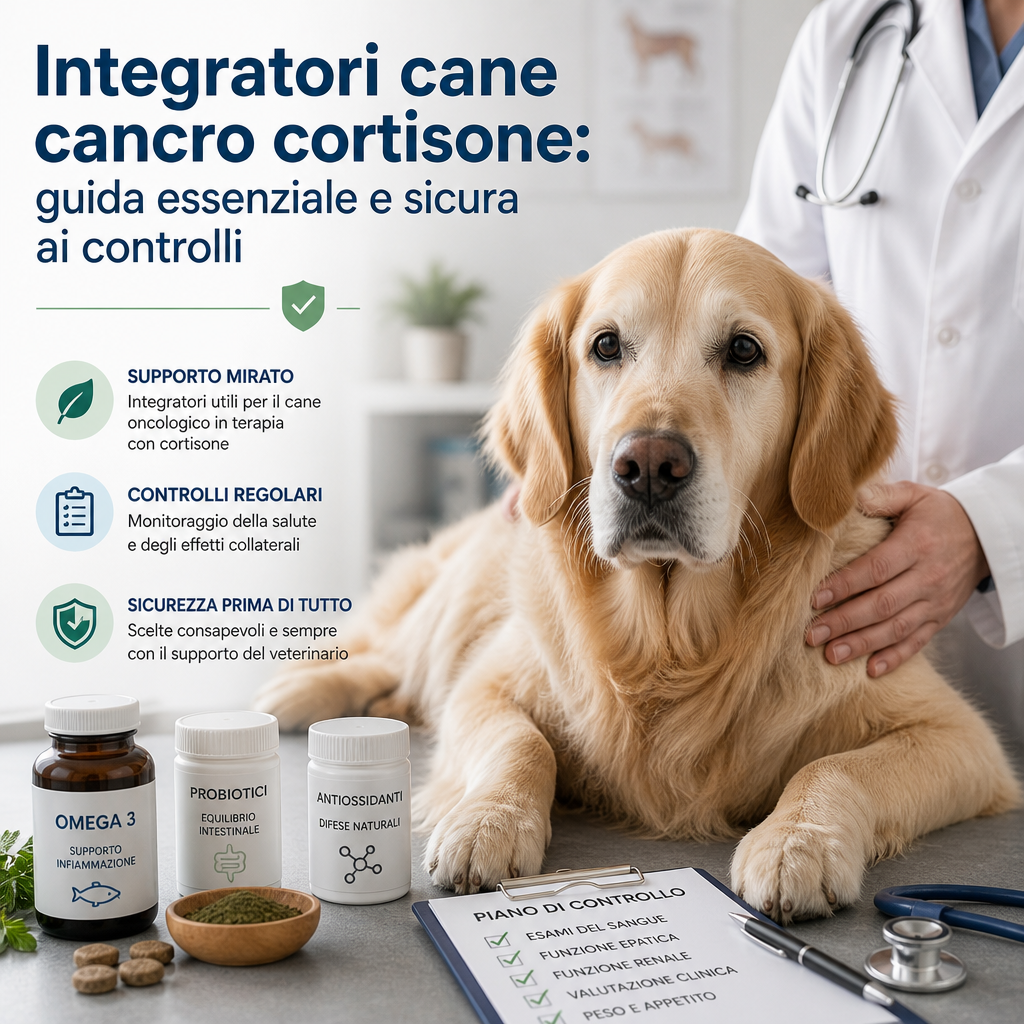
Gli integratori cane cancro cortisone vanno sempre valutati con attenzione quando un cane affronta un tumore e riceve una terapia cortisonica. Il prednisone o il prednisolone possono aiutare a ridurre infiammazione, edema, dolore e alcuni sintomi correlati alla malattia, ma possono anche modificare appetito, metabolismo, sete, urinazione e risposta alle infezioni. Per questo motivo, nessun prodotto dovrebbe essere somministrato autonomamente: la scelta deve dipendere dal tipo di tumore, dalle condizioni generali dell’animale, dai farmaci associati e dagli esami di controllo.
Questa guida pratica aiuta a capire cosa controllare prima di aggiungere un supporto nutrizionale, quali errori evitare e quando è davvero il caso di chiedere un parere professionale. L’obiettivo non è riempire la ciotola di prodotti, ma scegliere in modo sicuro ciò che può essere utile al cane nel suo percorso oncologico.
Perché il cortisone viene utilizzato nei cani con tumore
I corticosteroidi, come il prednisone o il prednisolone, possono essere prescritti in diverse situazioni oncologiche. Non rappresentano sempre una cura antitumorale, ma possono avere un ruolo di supporto importante. Vengono utilizzati, per esempio, per diminuire l’infiammazione, contenere alcuni edemi, migliorare temporaneamente l’appetito e attenuare sintomi come dolore, nausea o difficoltà respiratoria.
In alcuni tumori del sangue, il cortisone può avere anche un’azione diretta sulle cellule neoplastiche o essere inserito in protocolli chemioterapici. Nel caso di masse solide, invece, viene spesso impiegato per controllare i sintomi o le complicazioni associate alla malattia.
La risposta è individuale. Un cane può mostrare maggiore energia e appetito, mentre un altro può sviluppare effetti collaterali più evidenti. La dose, la durata e la modalità di riduzione della terapia devono sempre essere stabilite dal veterinario.
Quando il piano terapeutico è ben impostato, il cortisone può diventare uno strumento utile per gestire meglio il quotidiano del cane. La chiave è distinguere tra beneficio clinico e improvvisazione: un farmaco efficace richiede sempre un monitoraggio attento, soprattutto se il paziente è fragile o sta seguendo altre cure.
Perché servono prudenza e controlli
La parola “integratore” può far pensare a un prodotto innocuo, ma non tutti gli ingredienti sono adatti a un cane oncologico. Alcune sostanze possono interferire con il metabolismo dei farmaci, aumentare il rischio di sanguinamento, sovraccaricare fegato e reni o influenzare il sistema immunitario.
Il cortisone, inoltre, può causare:
aumento della sete e della produzione di urina;
aumento dell’appetito e possibile incremento del peso;
debolezza muscolare;
ansimazione e irrequietezza;
alterazioni della glicemia;
maggiore predisposizione alle infezioni;
irritazione o problemi gastrointestinali, soprattutto in combinazione con altri farmaci;
modifiche degli enzimi epatici.
Prima di introdurre un integratore è quindi importante comunicare al veterinario tutto ciò che il cane assume, compresi prodotti naturali, vitamine, oli, snack funzionali e rimedi acquistati senza prescrizione. In questa fase, gli integratori cane cancro cortisone devono essere considerati solo all’interno di un piano clinico preciso, non come una soluzione autonoma.
Può essere utile anche confrontare sempre il nuovo prodotto con eventuali terapie già in corso. Se il cane assume gastroprotettori, antibiotici, antinfiammatori o farmaci oncologici, il margine di sicurezza si riduce e ogni scelta deve essere verificata con più attenzione.
La ricerca di un “integratore prednisone cane tumore” nasce spesso dal desiderio di ridurre gli effetti indesiderati della terapia o sostenere l’organismo. Tuttavia, non esiste un integratore universale capace di neutralizzare il prednisone o di sostituire i controlli clinici.
Il veterinario può prendere in considerazione alcuni supporti in base alle necessità reali. Gli acidi grassi omega-3, per esempio, possono essere valutati nell’ambito di un piano nutrizionale, soprattutto quando è necessario sostenere la condizione corporea e modulare alcuni processi infiammatori. La loro utilità dipende dalla qualità del prodotto, dal dosaggio e dalla situazione gastrointestinale del cane.
Gli antiossidanti, le vitamine e i minerali possono essere indicati solo in caso di carenze o di specifiche esigenze nutrizionali. Un eccesso di alcune vitamine liposolubili può accumularsi nell’organismo e diventare dannoso. Anche l’uso di prodotti destinati agli esseri umani è sconsigliato, perché dosaggi, eccipienti e combinazioni possono essere inadatti.
Particolare cautela è necessaria con erbe e sostanze ad azione immunostimolante. In oncologia, stimolare il sistema immunitario senza conoscere il tipo di tumore e il protocollo terapeutico potrebbe non essere appropriato. Inoltre, alcune piante possono interferire con la trasformazione dei farmaci a livello epatico.
Un altro punto fondamentale riguarda il momento in cui si introduce un nuovo supporto. Se il cane sta attraversando una fase delicata, con vomito, diarrea, forte inappetenza o alterazioni degli esami del sangue, conviene rimandare qualsiasi novità fino a quando il quadro non è più stabile. In questi casi, la priorità è capire la causa del disturbo, non aggiungere altri prodotti alla routine.
Controlli utili prima di iniziare un supporto nutrizionale
Prima di introdurre nuovi prodotti, il veterinario può voler rivedere la terapia in corso, l’andamento del peso, l’appetito, la presenza di vomito o diarrea, la funzionalità epatica e renale e l’eventuale uso di gastroprotettori, antibiotici o chemioterapici. Nei casi più delicati, la scelta di integratori cane cancro cortisone deve essere rimandata fino a quando il quadro clinico non è stabile.
È utile anche osservare il cane a casa: quanta acqua beve, quante volte urina, come si muove, se ha una maggiore fame, se dorme peggio o se mostra segni di nausea. Questi dettagli aiutano il veterinario a capire se un prodotto può davvero offrire beneficio o se rischia di complicare il trattamento.
Per rendere il controllo più semplice, può essere utile annotare ogni cambiamento in un piccolo diario: appetito, peso, feci, sete, energia e orario di somministrazione dei farmaci. Quando il proprietario porta informazioni precise, la visita diventa più efficace e la scelta degli integratori può essere molto più mirata.
Inoltre, non bisogna dimenticare che alcune formulazioni contengono aromi, conservanti o eccipienti poco adatti a un cane sensibile. Anche un prodotto “ben fatto” può risultare inadatto se il paziente ha intestino fragile, allergie alimentari o una funzionalità epatica già compromessa.
Mastocitoma e terapia cortisonica
La ricerca “mastocitoma cane cortisone integratori” riguarda una delle situazioni in cui il cortisone può avere un ruolo sintomatico. Il mastocitoma deriva dai mastociti, cellule capaci di liberare istamina e altre sostanze infiammatorie. Di conseguenza, il cane può presentare gonfiore, arrossamento, prurito, disturbi gastrointestinali o, nei casi più complessi, reazioni sistemiche.
Il cortisone può contribuire a controllare l’infiammazione e alcune manifestazioni associate al rilascio di mediatori, ma non sostituisce la stadiazione, la chirurgia quando indicata, la valutazione oncologica o gli eventuali farmaci prescritti contro l’istamina e i problemi gastrici.
In presenza di mastocitoma è importante evitare di manipolare ripetutamente la massa e osservare eventuali cambiamenti di dimensione, colore, consistenza o sanguinamento. Anche un integratore apparentemente semplice dovrebbe essere autorizzato dal veterinario, perché il quadro clinico può cambiare rapidamente e il cane potrebbe assumere più medicinali contemporaneamente. In questo scenario, la prudenza con gli integratori cane cancro cortisone è ancora più importante.
Quando il mastocitoma è associato a dolore, prurito o irritazione gastrointestinale, il trattamento deve essere coordinato con precisione. A volte il medico può preferire supporti molto semplici, altre volte può suggerire di non aggiungere nulla finché non vengono chiariti gli esami o l’evoluzione della massa. La tempestività nel controllo dei sintomi conta, ma deve andare di pari passo con la sicurezza.
Integratore prednisone cane tumore: quali errori evitare
Quando si cerca un integratore prednisone cane tumore, l’errore più comune è assumere che un prodotto “naturale” sia automaticamente sicuro. In realtà, anche un estratto vegetale può avere effetti farmacologici importanti. Alcuni ingredienti possono aumentare il rischio di irritazione gastrica, altri possono interferire con la coagulazione o con l’assorbimento dei farmaci.
Un altro errore frequente è cambiare più prodotti insieme. Se il cane sviluppa diarrea, vomito o inappetenza, diventa difficile capire quale sostanza abbia causato il problema. Per questo motivo è preferibile introdurre un solo supporto per volta, solo se realmente necessario e sempre sotto controllo professionale.
Bisogna inoltre evitare di usare integratori come “compensazione” per una dose non corretta di cortisone. Il prednisone non va modificato in autonomia, e un eventuale calo o sospensione deve essere deciso dal veterinario. Gli integratori cane cancro cortisone non servono a correggere un dosaggio sbagliato o una terapia seguita in modo irregolare.
È altrettanto importante non fidarsi delle formule molto complesse, soprattutto se promettono più effetti contemporaneamente: energia, immunità, digestione e sollievo dal dolore nello stesso prodotto. Nei cani oncologici, la semplicità spesso è la scelta migliore, perché riduce il rischio di interazioni e rende più facile capire se il supporto sta funzionando davvero.
Prodotti che richiedono cautela
Tra i prodotti che meritano attenzione ci sono formulazioni con erbe ad effetto immunomodulante, miscele con molte vitamine, integratori per uso umano, prodotti ad alta concentrazione di oli e preparati con molti attivi insieme. Anche il rischio di sovradosaggio non va sottovalutato, soprattutto se il cane segue già una dieta terapeutica completa.
In caso di dubbio, la domanda giusta non è “può aiutare in generale?”, ma “può aiutare questo cane, in questo momento, con questa terapia?”. Questa domanda evita scelte affrettate e mette il benessere dell’animale al centro.
Alimentazione e controllo del peso
Durante la terapia cortisonica, l’aumento dell’appetito può favorire sovrappeso e perdita di massa muscolare. Un’alimentazione completa e bilanciata è generalmente più importante di una lunga lista di integratori. Il veterinario può consigliare una dieta commerciale specifica, un alimento ad alta densità energetica oppure un piano personalizzato, soprattutto in caso di dimagrimento, nausea o difficoltà a masticare.
È utile pesare regolarmente il cane e controllare la condizione corporea, senza ridurre drasticamente le razioni. Gli snack devono essere conteggiati nell’apporto giornaliero e non dovrebbero sostituire il pasto. L’acqua fresca deve essere sempre disponibile, poiché la terapia può aumentare la sete.
Se il cane tende a perdere massa magra, il veterinario può valutare un supporto nutrizionale più mirato. In queste situazioni gli integratori cane cancro cortisone possono essere considerati solo dopo aver verificato l’equilibrio della dieta e la tolleranza digestiva.
In pratica, il controllo del peso non serve soltanto a evitare l’obesità: aiuta anche a riconoscere presto una perdita di muscolo, che può passare inosservata se ci si limita a guardare la bilancia. Un cane può sembrare “normale” ma avere già una riduzione significativa della massa muscolare, con conseguenze sulla forza, sull’energia e sulla capacità di recupero.
Quando il cane è inappetente, conviene privilegiare pasti più piccoli e più frequenti, sempre se il veterinario è d’accordo. In questa fase, la tolleranza alimentare vale più della quantità teorica. Spesso una dieta ben accettata, semplice e costante è più utile di un piano complicato con molti prodotti aggiunti.
Esami e segnali da non trascurare
I controlli possono includere esame emocromocitometrico, profilo biochimico, valutazione della glicemia, parametri epatici e renali e, quando necessario, esame delle urine. La frequenza dipende dalla durata della terapia, dalla dose e dalle condizioni del cane.
È importante contattare rapidamente il veterinario in caso di vomito persistente, diarrea scura o con sangue, feci nere, forte debolezza, febbre, difficoltà respiratoria, sete e urinazione estremamente aumentate, addome gonfio o improvviso peggioramento della massa. Non bisogna sospendere il cortisone bruscamente dopo trattamenti prolungati, perché l’organismo può aver ridotto la propria produzione naturale di corticosteroidi.
In presenza di questi segnali, anche gli integratori cane cancro cortisone già in uso devono essere sospesi solo dopo il confronto con il veterinario, soprattutto se il cane assume più farmaci o presenta una malattia concomitante.
Un controllo tempestivo consente spesso di correggere il problema prima che diventi serio. Per esempio, una maggiore sete può essere un effetto atteso del cortisone, ma se si accompagna a letargia, febbre o vomito non va liquidata come un semplice effetto collaterale. Lo stesso vale per la diarrea persistente o per una perdita di appetito improvvisa, che meritano sempre attenzione.
Anche il comportamento generale del cane conta: isolamento, irrequietezza marcata, difficoltà a riposare, zoppia, respirazione accelerata o cambiamenti improvvisi nella capacità di muoversi possono segnalare che il piano terapeutico va rivisto. In questi casi, ogni integratore va riconsiderato insieme al quadro complessivo, non in modo isolato.
Un approccio sicuro e personalizzato
Gli integratori possono avere un ruolo solo quando rispondono a un bisogno concreto e sono inseriti in un piano controllato. Nel cane con tumore e cortisone, la priorità è mantenere una buona qualità di vita, controllare i sintomi, prevenire complicazioni e verificare periodicamente la risposta alla terapia.
La collaborazione tra proprietario, veterinario curante e oncologo permette di valutare benefici e rischi con maggiore precisione. Un prodotto non deve essere scelto sulla base della sola etichetta “naturale” o di testimonianze online: servono diagnosi, dosaggio corretto, monitoraggio e una valutazione complessiva del paziente.
In sintesi, gli integratori cane cancro cortisone possono essere utili solo se scelti con criterio, controllati nel tempo e inseriti in un percorso clinico individuale. L’obiettivo non è aggiungere molti prodotti, ma trovare il supporto davvero adatto al cane, al tumore e alla terapia in corso.
Se vuoi mantenere il piano terapeutico più sicuro possibile, chiedi sempre prima un parere professionale: è il modo migliore per proteggere il cane e per evitare interazioni inutili o potenzialmente dannose. Con una valutazione attenta, anche una scelta semplice può fare la differenza e aiutare il tuo cane a stare meglio nel modo più prudente possibile.
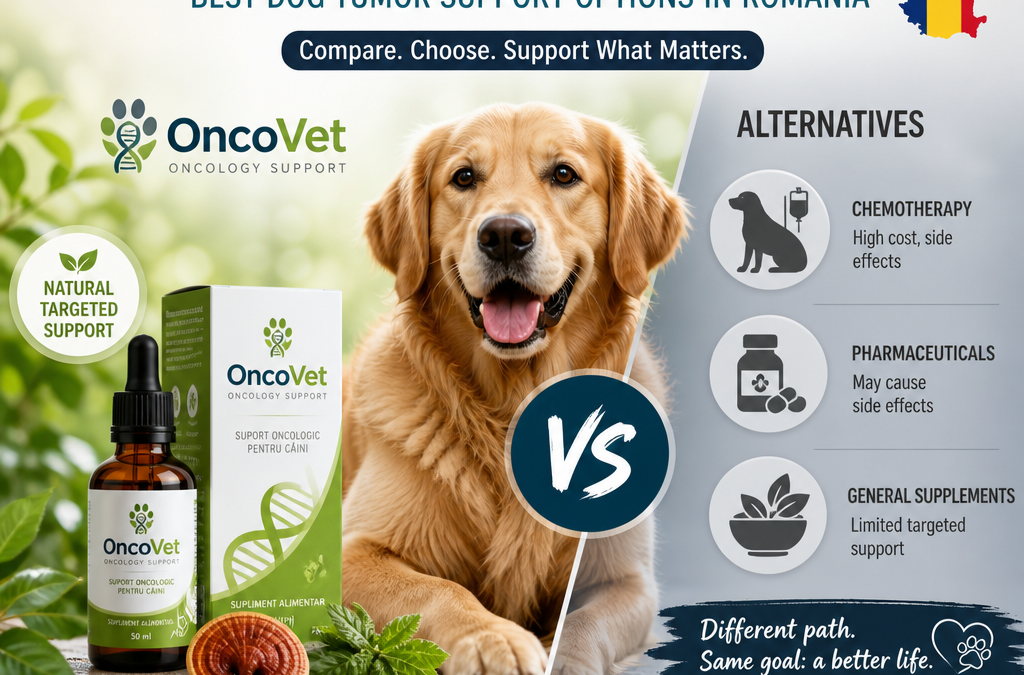
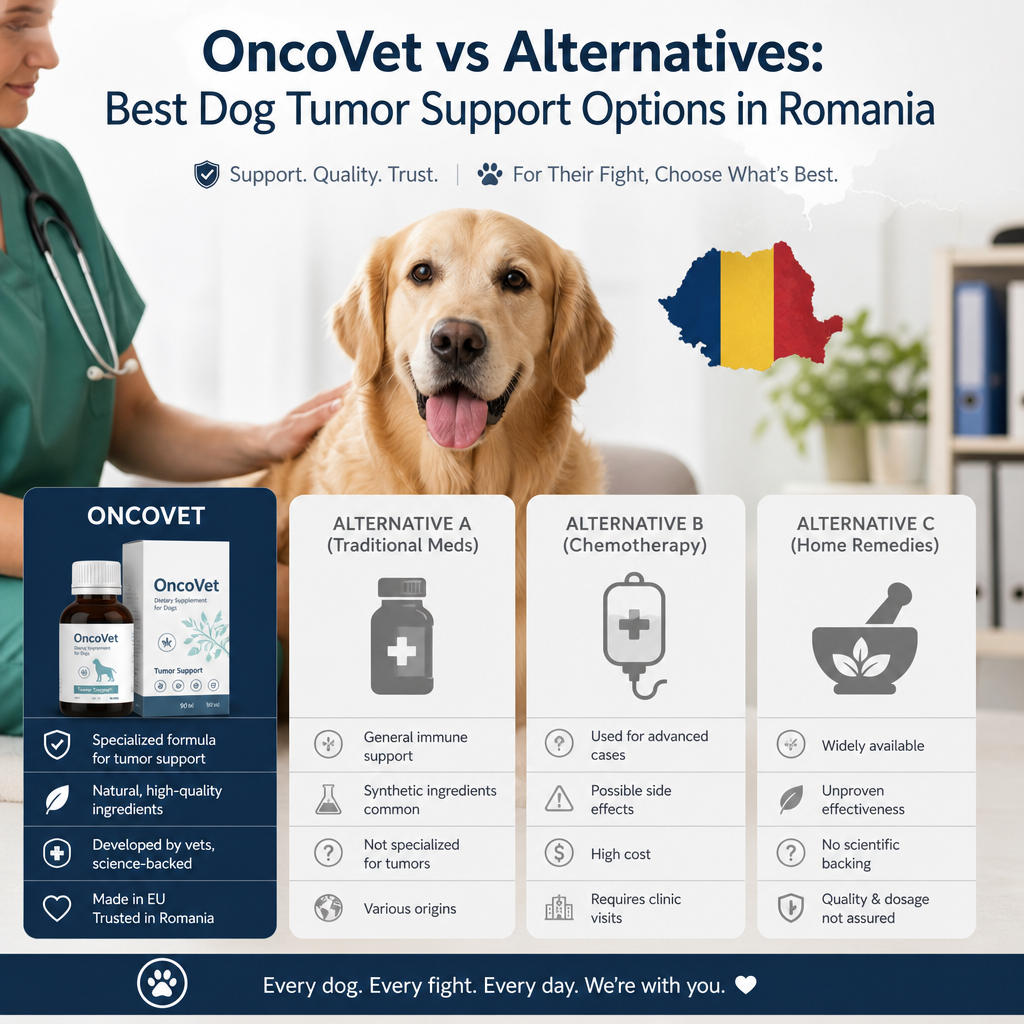
OncoVet vs Alternatives is an important comparison for Romanian dog owners whose pets have been diagnosed with a tumor or are undergoing cancer treatment. Choosing appropriate oncology support involves more than comparing product names. The right option should complement veterinary care, fit the dog’s diagnosis and treatment plan, and support comfort, nutrition, digestion, and overall quality of life without creating unnecessary risks.
Canine cancer treatment may include surgery, chemotherapy, radiation therapy, targeted medication, pain management, or a combination of approaches. Oncology support does not replace these treatments. Instead, it may help address practical challenges that commonly arise during illness, such as reduced appetite, weight loss, digestive upset, fatigue, stress, or recovery after surgery.
The most suitable support depends on several factors:
The type, location, and stage of the tumor
The dog’s age, size, and general health
Kidney and liver function
Current medications and chemotherapy protocols
Appetite, body condition, and hydration
The veterinarian’s treatment goals
Because every cancer case is different, a supplement that is appropriate for one dog may be unsuitable for another. Veterinary supervision is especially important when a dog is receiving chemotherapy, corticosteroids, anti-inflammatory medication, or other prescription treatments.
In many cases, dog tumor support options are most useful when they solve a specific problem rather than trying to do everything at once. A focused product may help digestion, while another may support calorie intake or recovery. The most effective choice is often the one that matches the dog’s current needs.
OncoVet vs Alternatives becomes easier to judge when owners first define the exact problem they are trying to solve. A dog that is losing weight needs different support from a dog that is nauseated, painful, or recovering after surgery.
What owners should compare
When reviewing OncoVet vs alternatives, owners should look beyond marketing claims and compare the practical characteristics of each option. Important considerations include the intended purpose, ingredient transparency, dosage guidance, evidence, safety profile, and compatibility with conventional treatment.
Some products are designed as broad nutritional supplements, while others focus on digestive support, antioxidants, immune function, or recovery after illness. A product marketed for “immune support” may not provide enough calories or protein for a dog losing weight. Similarly, a calorie-dense recovery formula may help nutrition but should not be presented as a treatment for cancer itself.
A careful comparison should include:
Ingredient quality and transparency
The label should clearly identify active ingredients, quantities, serving recommendations, and administration instructions. Avoid products that rely on vague “proprietary blends” without explaining how much of each ingredient is included.
Evidence and realistic claims
Support products should be evaluated according to the strength of available evidence. Some ingredients have research in dogs, while others are supported mainly by laboratory or human studies. Claims that a supplement can cure tumors, replace chemotherapy, or guarantee remission should be treated with caution.
Safety and interactions
Certain herbs, antioxidants, and concentrated extracts can affect blood clotting, liver enzymes, blood pressure, or medication metabolism. This is particularly relevant before surgery and during chemotherapy. A veterinarian should review the complete list of supplements the dog receives.
Ease of administration
A product that is difficult to give may not be useful in practice. Dogs with nausea or mouth pain may reject tablets, powders, or strong flavors. Palatable liquids, soft chews, or easily mixed powders may be more practical, depending on the dog’s needs.
When owners compare OncoVet vs alternatives, they should also ask how the product fits the daily routine. If a supplement cannot be given consistently, even a good formula may not deliver meaningful support.
If owners want to read more about mushroom-based support options, they can also review supporting your dog with tumors naturally with Jinyinhua as part of a broader discussion about oncology support choices.
Dog tumor support options in Romania
Dog tumor support options in Romania generally fall into several categories. Availability may vary between veterinary clinics, pharmacies, pet shops, and online retailers, so owners should check product authenticity, storage conditions, and expiration dates.
Veterinary nutritional support
Nutritional support is often one of the most important parts of cancer care. Dogs with tumors may lose appetite, muscle mass, or body weight. Veterinary diets and recovery foods can provide concentrated calories, digestible protein, and balanced nutrients in a relatively small volume.
A veterinarian may recommend a therapeutic diet, a recovery formula, or adjustments to the dog’s normal food. Sudden dietary changes should be avoided unless medically necessary, as they may worsen digestive symptoms.
In the OncoVet vs alternatives discussion, therapeutic nutrition often stands out because it addresses a real medical need without relying on vague wellness claims. For many dogs, eating enough is the first step toward better comfort and resilience.
Digestive and appetite support
Nausea, diarrhea, constipation, and reduced appetite can interfere with treatment and recovery. Veterinary anti-nausea medication, appetite stimulants, probiotics, or easily digestible foods may be recommended. These approaches should be selected according to the cause of the problem rather than used indiscriminately.
If a dog has nausea, even the best supplement will not help unless the nausea is controlled. In this situation, OncoVet vs alternatives should be weighed against prescription options and dietary changes that may work faster and more reliably.
Omega-3 fatty acids
Fish oil and other sources of omega-3 fatty acids are sometimes included in supportive care plans. They may help maintain skin, coat, and general nutritional health, but product quality and dosage matter. Excessive amounts can cause gastrointestinal upset or influence clotting, so veterinary guidance is advisable, particularly around surgery.
Antioxidant and herbal products
Some owners consider mushroom extracts, turmeric, milk thistle, or other botanical ingredients. These products may have interesting biological properties, but evidence varies significantly, and “natural” does not automatically mean safe. Herbal products can interact with medication or place additional strain on the liver and kidneys.
Because of that, OncoVet vs alternatives should not be judged only by whether a product sounds natural. The more useful question is whether it helps the dog’s current condition without creating new problems.
Comfort and mobility support
Pain control and mobility assistance are central to quality of life. Prescription analgesics, joint support, orthopedic bedding, ramps, and appropriate exercise may be more valuable than a general supplement. A dog that is comfortable, hydrated, and able to rest may cope better with treatment and daily life.
Comfort support also matters for dogs that seem stable on paper but struggle in daily life. In practical terms, OncoVet vs alternatives is not just a product comparison; it is a decision about which approach helps the dog feel and function better.
OncoVet may be considered by owners looking for a dedicated canine oncology support product. Its suitability should be judged according to the dog’s specific diagnosis, current treatment, and nutritional status rather than its name or category alone.
A veterinary alternative may be preferable when the dog has a clearly defined problem that requires targeted management. For example, a therapeutic recovery diet may be more appropriate for severe weight loss, while prescription anti-nausea medication may be more effective for chemotherapy-related vomiting. In other situations, a carefully selected nutritional supplement may be used alongside treatment to help maintain intake and body condition.
The key difference is often between general support and individualized medical care. General support products can have a role, but they should not delay diagnostic testing, surgery, oncology consultation, or medication for pain and nausea.
For a broader example of a targeted tumor-support ingredient, readers may also find the PubMed Central research library useful when looking for peer-reviewed veterinary and biomedical studies on supportive care ingredients.
In practical terms, the best dog tumor support options are usually those that fit into a treatment plan rather than competing with it. If a product helps a dog eat, recover, or tolerate therapy more comfortably, it may have real value. If it adds complexity without a clear benefit, it is probably not the best choice.
When evaluating OncoVet vs alternatives, think about the dog’s current priorities. Is the biggest issue appetite, nausea, weight loss, inflammation, stress, or recovery after surgery? A good product should address the main problem first.
Another helpful way to approach OncoVet vs alternatives is to separate short-term needs from long-term support. A dog in the middle of chemotherapy may need different help than a dog in post-operative recovery or palliative care.
When a supplement may be enough
Some dogs only need mild support, such as improved nutrition, better hydration, or a palatable product that encourages eating. In those cases, a supplement can be useful as part of an otherwise stable care plan.
When prescription care is more appropriate
If a dog is vomiting, in pain, losing weight rapidly, or refusing food, the first step is usually medical treatment. OncoVet vs alternatives should never replace symptom control when the dog’s condition is clearly worsening.
When combination care makes sense
Many dogs do best with a combination of prescription medication, supportive nutrition, and careful home monitoring. This layered approach often provides more benefit than relying on a single product.
Owners sometimes search OncoVet vs alternatives expecting one “best” answer, but the most responsible choice often changes over time as the dog’s condition changes. Support should evolve with the treatment plan.
7 best dog tumor support options to discuss in Romania
The list below is not a ranking of cures. It is a practical way to compare the most common support categories that Romanian dog owners may discuss with their veterinarian. The best option depends on the dog’s diagnosis, symptoms, and treatment stage.
1. Therapeutic recovery diets
Recovery diets are often among the most practical dog tumor support options because they are calorie-dense, easy to feed, and designed for convalescence. They may help dogs that are eating less than usual or losing weight during treatment.
2. Prescription anti-nausea support
When nausea is the main problem, medication prescribed by a veterinarian can make a significant difference. This is often more effective than trying to stimulate appetite with supplements alone.
3. Appetite support strategies
Appetite stimulants, warming food, hand feeding, and palatable diets can help some dogs eat enough to maintain body condition. These strategies should be used with veterinary advice, especially if the dog is already weak or dehydrated.
4. Omega-3 supplementation
Appropriate omega-3 support may fit into a broader nutrition plan, especially when the goal is to support general health and maintain condition. Careful dosing matters.
5. Digestive support products
Probiotics, fiber adjustments, and easy-to-digest foods may be useful when the dog has loose stools, constipation, or digestive upset. These are often more helpful when chosen to match a specific symptom.
6. Carefully selected herbal or mushroom-based support
Some owners explore herbal or mushroom-based products as part of complementary care. These options should be reviewed with the veterinarian for potential interactions and safety concerns.
7. Comfort and mobility aids
Orthopedic bedding, ramps, temperature control, leash-assisted walking, and pain management can dramatically improve daily comfort. For many dogs, these practical supports matter as much as any supplement.
Compared with many broad marketing claims, these 7 best dog tumor support options give owners a clearer framework for discussion. They also make OncoVet vs alternatives easier to evaluate because each option serves a specific purpose.
Questions to discuss with a veterinarian
Before starting any oncology support product, ask the veterinarian:
Is this product appropriate for my dog’s tumor type and treatment?
Could any ingredient interact with chemotherapy or prescription medication?
Should it be stopped before surgery or anesthesia?
What dose is suitable for my dog’s weight and health status?
How will we know whether it is helping?
Which side effects should prompt immediate contact?
Would a therapeutic diet or prescription treatment address the problem more effectively?
Veterinary oncology services and general veterinary clinics in Romania may also provide referrals for specialist consultation, imaging, pathology review, surgery, and palliative care. Keeping copies of laboratory results, biopsy reports, medication lists, and supplement labels can make these consultations more efficient.
Owners who are exploring canine tumor support products may also want to review the role of mushroom supplements in breast tumor care, including the article on Turkey Tail Mushroom as a natural supplement for supporting breast tumor treatment in dogs.
It can also help to ask whether the product should be used only for a short period or as part of a longer plan. OncoVet vs alternatives often comes down to whether the product has a clear place in the overall timeline of care.
How to monitor whether support is working
A good support plan should be measurable. Owners can track appetite, stool quality, water intake, vomiting, activity level, comfort, body weight, and willingness to move or interact. Small improvements may be meaningful, especially in a dog with cancer.
If a product does not improve any measurable sign after a reasonable trial, it may not be worth continuing. If side effects appear, it should be discussed with the veterinarian right away.
Daily notes can be especially helpful during chemotherapy or recovery. They make it easier to determine whether OncoVet vs alternatives is actually helping or simply adding another item to the routine.
Making the safest choice
The best dog tumor support options are those that serve a clear purpose, have understandable ingredients, and fit into a veterinarian-approved care plan. Owners should monitor appetite, water intake, body weight, stool quality, activity, breathing, pain, and general behavior. Changes should be reported promptly, especially during chemotherapy or after surgery.
Ultimately, the goal of oncology support is not to promise a cure through supplementation. It is to help the dog remain as comfortable, nourished, and active as possible while receiving appropriate medical care. Comparing OncoVet vs alternatives can be useful, but the final decision should be based on clinical need, evidence, safety, and the individual dog’s quality of life.
If your veterinarian recommends a specific supplement strategy, ask how it fits alongside standard care, and whether there is a better evidence-based option for your dog’s current stage of treatment. That approach keeps the focus on safety while still allowing thoughtful supportive care.
For some dogs, the right answer will be a nutritional formula. For others, it may be a targeted digestive aid, a prescription medication, or a carefully selected herbal product. The strongest choice is the one that supports the whole patient, not just the diagnosis.
When in doubt, return to the same practical question: does this support help the dog eat, rest, recover, or tolerate treatment more comfortably? If the answer is yes, it may belong in the plan. If not, OncoVet vs alternatives probably points toward a better option.