by TCMVET | Aug 24, 2026 | Research and News
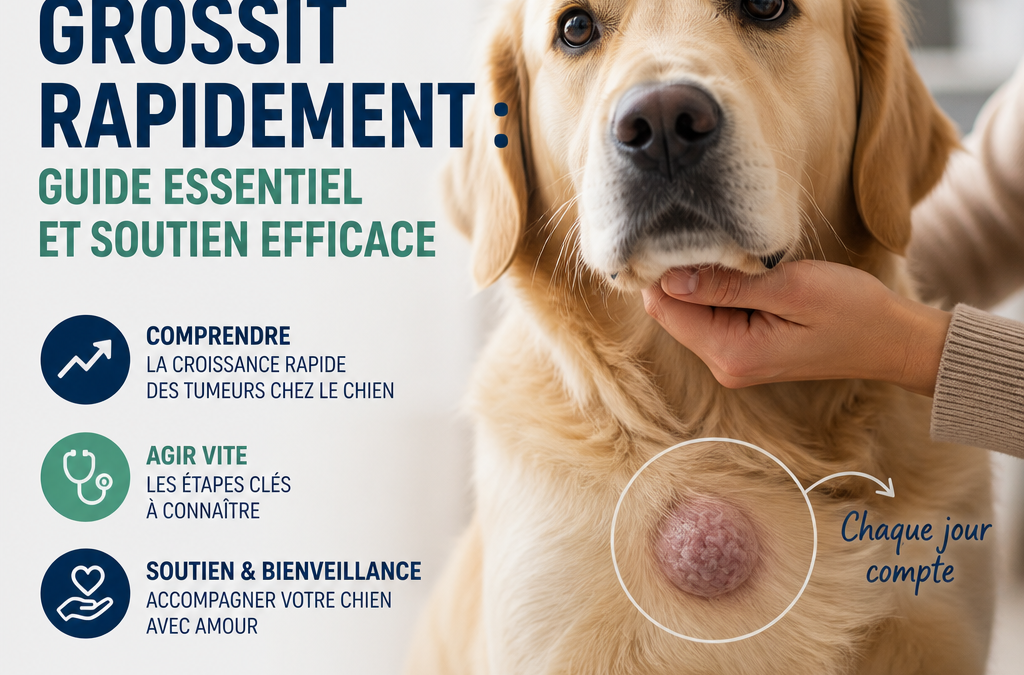
Une tumeur chien grossit rapidement doit toujours être prise au sérieux, même si elle semble indolore ou si le chien garde son comportement habituel. Certaines masses sont bénignes, d’autres peuvent être agressives, infectées ou provoquer des complications en comprimant des organes et des tissus voisins. Une consultation vétérinaire précoce permet d’identifier la nature de la masse et de choisir une prise en charge adaptée.
Pourquoi une tumeur chien croissance rapide doit-elle alerter ?
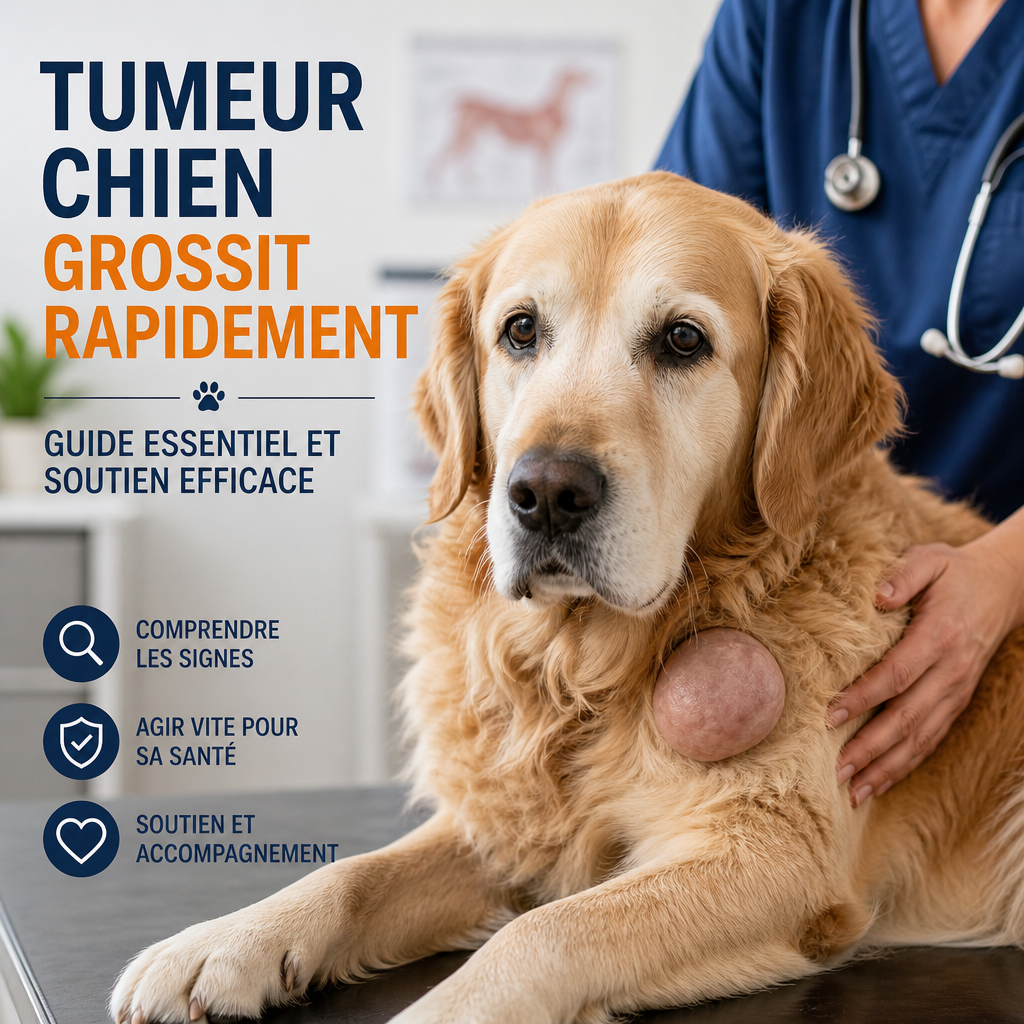
La croissance rapide d’une masse peut avoir plusieurs explications. Il peut s’agir d’une tumeur maligne, mais aussi d’un abcès, d’un hématome, d’un kyste, d’une inflammation ou d’une réaction après une piqûre ou un traumatisme. L’aspect extérieur ne suffit donc pas à établir un diagnostic.
Une masse qui augmente rapidement de volume, devient dure, change de forme ou adhère aux tissus sous-jacents mérite une évaluation sans attendre. La localisation joue également un rôle important. Une tumeur chien grossit rapidement près de la bouche, de la gorge, des yeux, des voies respiratoires ou des organes génitaux peut devenir gênante rapidement, même si sa taille reste modérée.
Certains signes associés doivent renforcer la vigilance :
- perte d’appétit ou amaigrissement ;
- fatigue inhabituelle ;
- douleur au toucher ou lors des déplacements ;
- saignement, suintement ou mauvaise odeur ;
- difficulté à respirer, avaler, uriner ou déféquer ;
- vomissements ou troubles digestifs ;
- ganglions gonflés ;
- changement rapide de couleur ou d’aspect de la peau.
La présence d’un seul de ces symptômes ne signifie pas nécessairement que la tumeur est cancéreuse, mais elle justifie une consultation rapide. Pour mieux comprendre les différentes approches de soutien nutritionnel, vous pouvez aussi consulter ce guide sur le complément alimentaire chien cancer.
À titre de repère médical général, des sources vétérinaires comme la Merck Veterinary Manual rappellent qu’une masse qui change vite doit être évaluée par un professionnel afin d’éviter les retards de diagnostic.
Les principales étapes du diagnostic vétérinaire
Le vétérinaire commence généralement par examiner la masse : diamètre, forme, consistance, mobilité, température, couleur et éventuelle douleur. Il observe aussi l’état général du chien et recherche d’autres anomalies, notamment au niveau des ganglions.
Une cytoponction peut ensuite être proposée. Elle consiste à prélever quelques cellules à l’aide d’une aiguille fine afin de les examiner au microscope. Cet examen est souvent rapide et peu invasif, mais il ne permet pas toujours de conclure. Dans certains cas, une biopsie est nécessaire pour analyser un fragment de tissu avec davantage de précision.
Des examens complémentaires peuvent être recommandés :
- radiographies du thorax ;
- échographie abdominale ;
- analyses sanguines ;
- scanner ou IRM ;
- examen histopathologique après retrait de la masse.
Le diagnostic définitif repose fréquemment sur l’analyse du tissu retiré. Cette étape permet de déterminer si la tumeur est bénigne ou maligne, son degré d’agressivité et la probabilité de récidive. Ces informations sont essentielles pour décider entre surveillance, chirurgie, chimiothérapie, radiothérapie ou soins palliatifs.
Que faire en attendant le rendez-vous ?
Lorsqu’une tumeur chien grossit rapidement, il est préférable de noter précisément son évolution. Mesurez sa longueur et sa largeur avec une règle, prenez une photo régulière avec un repère de taille et indiquez la date. Ces informations aideront le vétérinaire à évaluer la vitesse réelle de croissance.
Évitez de manipuler la masse de façon répétée, de la percer ou d’appliquer des produits destinés aux humains. Les huiles essentielles, crèmes, désinfectants concentrés et traitements anti-inflammatoires non prescrits peuvent aggraver une irritation ou être toxiques pour le chien.
Si la masse est située dans une zone accessible, un chien peut la lécher ou la gratter jusqu’à provoquer une plaie. Une collerette ou un vêtement de protection peut parfois limiter les traumatismes, à condition de ne pas comprimer la zone et de ne pas gêner la respiration ou les mouvements.
En cas de saignement important, appliquez doucement une compresse propre pendant quelques minutes sans frotter. Si le saignement persiste, si la masse s’ouvre ou si l’animal paraît faible, contactez un service vétérinaire d’urgence.
Les options de traitement possibles
Le traitement dépend du type de tumeur, de sa localisation, de sa taille, de la présence éventuelle de métastases et de l’état général du chien. La chirurgie est souvent privilégiée lorsqu’une exérèse complète est possible. Une intervention précoce peut permettre de retirer la masse avec des marges de sécurité suffisantes et de réduire le risque de récidive.
Lorsque la chirurgie n’est pas suffisante ou impossible, le vétérinaire peut envisager une chimiothérapie, une radiothérapie ou une combinaison de traitements. Contrairement à certaines idées reçues, la chimiothérapie vétérinaire est généralement adaptée pour préserver la qualité de vie, avec des protocoles et des doses différents de ceux utilisés chez l’être humain.
Dans les situations avancées, les soins palliatifs visent surtout à contrôler la douleur, les nausées, l’inflammation et les difficultés respiratoires ou digestives. L’objectif est de maintenir le confort du chien aussi longtemps que possible.
Quand discuter d’une approche de soutien pour une tumeur chien grossit rapidement
Un soutien tumeur chien peut être discuté dès le diagnostic, surtout si l’objectif n’est pas seulement de traiter la masse, mais aussi de préserver l’énergie, l’appétit et le confort au quotidien. Selon la situation, le vétérinaire peut recommander des mesures nutritionnelles, des antalgiques, des antiémétiques ou des soins locaux.
Si vous cherchez à comparer les approches possibles, ce guide sur le meilleur complément alimentaire chien cancer peut vous aider à préparer la discussion avec votre vétérinaire, sans remplacer son avis médical.
Organiser un soutien tumeur chien au quotidien
Un soutien tumeur chien efficace repose sur une collaboration étroite avec le vétérinaire. Les médicaments doivent être administrés exactement selon les prescriptions, sans modifier les doses ni interrompre le traitement de sa propre initiative. Un carnet de suivi peut aider à noter l’appétit, la consommation d’eau, les selles, les vomissements, la douleur, la mobilité et le comportement.
L’alimentation doit rester appétente, digestible et adaptée aux besoins de l’animal. Dans certains cas, le vétérinaire recommande une alimentation thérapeutique ou des ajustements nutritionnels. Il ne faut toutefois pas multiplier les compléments alimentaires sans avis professionnel, car certains peuvent interagir avec les traitements ou être inadaptés à une maladie du foie ou des reins.
Le confort compte également beaucoup : couchage moelleux, accès facile à l’eau, promenades courtes et régulières, environnement calme et température agréable. Les activités doivent être adaptées à l’énergie du chien, sans forcer lorsqu’il montre des signes de fatigue ou de douleur.
Enfin, observez sa qualité de vie. Un chien qui mange encore avec plaisir, interagit avec sa famille, dort correctement et profite de moments agréables peut conserver un bon confort malgré la maladie. À l’inverse, une douleur persistante, une incapacité à se déplacer, une détresse respiratoire ou une absence totale d’appétit nécessitent une réévaluation rapide du traitement.
Une tumeur chien grossit rapidement n’annonce pas toujours le pire, mais elle ne doit jamais être surveillée passivement. Un diagnostic précoce, une prise en charge personnalisée et un soutien tumeur chien attentif offrent les meilleures chances de préserver la santé et le bien-être du chien.
Si votre chien présente une masse qui évolue vite, gardez en tête qu’une tumeur chien grossit rapidement doit être évaluée sans délai. Plus la consultation est précoce, plus il est possible d’adapter le traitement, d’organiser le soutien tumeur chien et d’améliorer le confort de l’animal.
Pour aller plus loin, le point le plus important reste la rapidité d’action. Quand une tumeur chien grossit rapidement, un rendez-vous vétérinaire sans tarder permet souvent d’éviter les complications et de mieux orienter les soins. Même si la masse n’est pas forcément cancéreuse, une prise en charge précoce offre toujours plus d’options.
Le suivi ne s’arrête pas au diagnostic. Si une tumeur chien grossit rapidement, il est utile de réévaluer régulièrement l’évolution de la masse, l’état général et la douleur, afin d’ajuster le traitement si nécessaire. Ce suivi attentif aide aussi à repérer plus tôt les signes d’inconfort ou de récidive.
Enfin, n’hésitez pas à demander au vétérinaire quels examens, quels traitements et quel soutien tumeur chien sont les plus adaptés à votre compagnon. Une décision éclairée, prise à temps, est souvent la meilleure manière de préserver sa qualité de vie.
by TCMVET | Aug 24, 2026 | Research and News
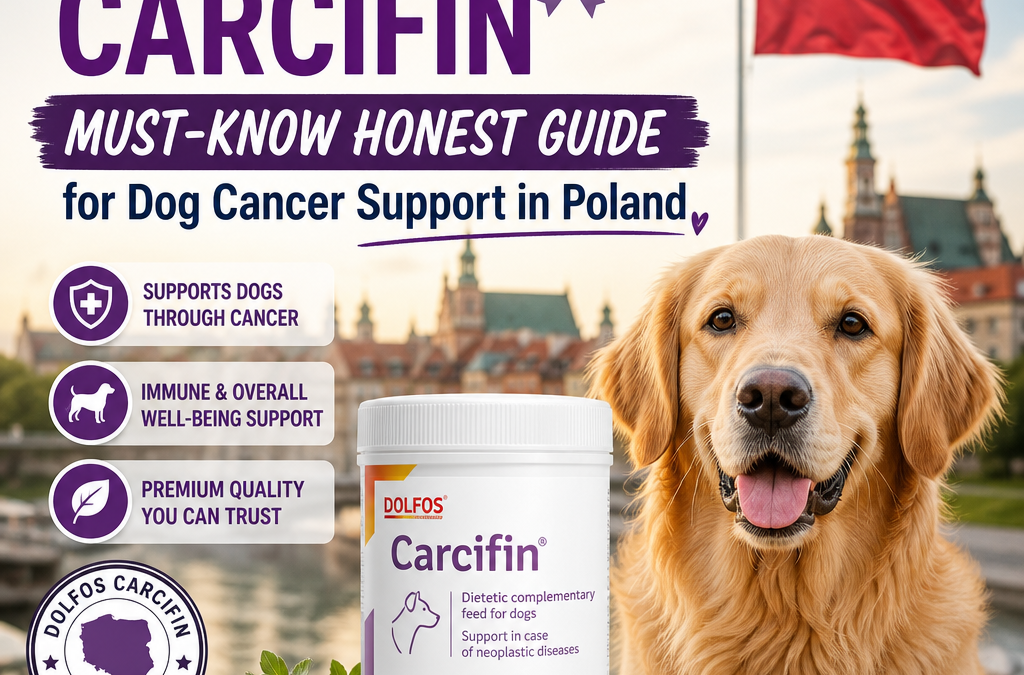
Dolfos Carcifin is a specialist nutritional supplement discussed by dog owners in Poland who are looking for additional support during cancer treatment. It is important to understand what this product can and cannot do before adding it to a dog’s routine. A supplement may help provide nutritional support, but it is not a cure for cancer and should never replace veterinary diagnosis, surgery, chemotherapy, radiotherapy, pain management, or other recommended care.
If you are comparing options for supportive care, it can also help to review broader guidance on cancer care for pets so you can place any supplement in the right context. For background on how supplements are assessed in veterinary nutrition, the FDA’s veterinary dietary supplements guidance is a useful reference.
What is Dolfos Carcifin?
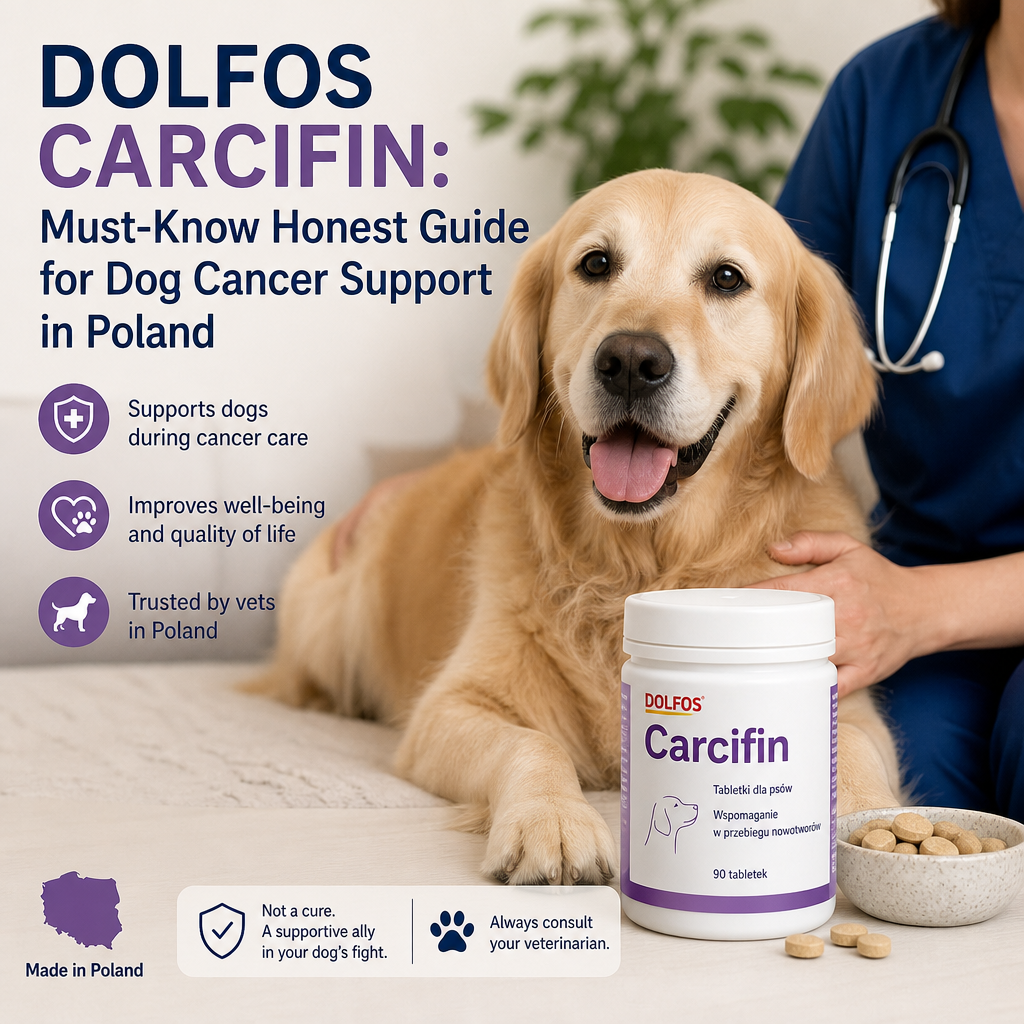
Dolfos Carcifin is a complementary product intended to support dogs during periods of illness, including situations in which cancer affects appetite, body condition, immunity, or general vitality. Products in this category are usually designed to provide selected nutrients or biologically active ingredients that may help the body cope with increased nutritional demands.
Cancer can affect dogs in different ways. Some animals lose weight, eat less, become tired, or experience digestive problems. Others may maintain a normal appetite but gradually lose muscle. These changes can result from the disease itself, inflammation, treatment side effects, or a combination of factors. Nutritional support may therefore be useful, but its suitability depends on the individual dog’s diagnosis, age, weight, medication, and overall health.
The exact formulation, serving instructions, and intended use should always be confirmed on the current product label or through the manufacturer’s information. Formulas and packaging may change, and online descriptions are not always accurate or complete.
For many owners, the first concern is simply whether the dog can continue to eat enough to keep strength up during therapy. That concern is understandable. When a serious diagnosis appears, even small changes in appetite or stool can feel urgent. A supplement may seem like a practical step, but it should be part of a larger strategy that takes the tumor type, stage of disease, current medications, and quality of life into account.
It is also worth noting that different cancers place different demands on the body. A dog with a slowly growing mass and stable appetite may need a very different plan from a dog with vomiting, anemia, or rapid weight loss. That is why products sold as supportive nutrition should never be chosen on marketing claims alone. The value of any product depends on the patient in front of you.
Dolfos Carcifin dog cancer support: what owners should know
The phrase “Dolfos Carcifin dog cancer support” should be understood as supportive care rather than direct cancer treatment. No supplement should be presented as capable of eliminating tumors, preventing metastasis, or guaranteeing a better outcome. Cancer is a complex group of diseases, and treatment decisions must be based on veterinary examination, laboratory testing, imaging, and, when necessary, cytology or biopsy.
A supplement may have a practical role in a broader care plan by helping address nutritional gaps or supporting a dog whose condition has reduced its appetite and resilience. However, benefits can vary considerably. A product that is tolerated well by one dog may cause digestive upset or be unsuitable for another, particularly when kidney, liver, gastrointestinal, or pancreatic disease is also present.
Owners should ask the veterinarian whether the product is appropriate alongside the dog’s current treatment. This is especially important when the dog is receiving chemotherapy, corticosteroids, nonsteroidal anti-inflammatory drugs, antibiotics, anticoagulants, or medication for seizures. Even natural ingredients can interact with medicines or complicate the interpretation of blood tests.
Veterinary teams also look at the bigger picture. A dog that seems weaker may be dealing with pain, nausea, dehydration, infection, or anemia rather than a simple lack of vitamins. If those problems are not addressed first, any supplement will have a limited effect. The most honest way to think about supportive nutrition is as one small tool in a much larger care plan.
In Poland, as in other countries, owners can sometimes be overwhelmed by online claims, local recommendations, and urgent emotions after a diagnosis. That is understandable. Still, the safest choice is to slow down, compare information, and use a product only after checking whether it fits the dog’s medical situation. A calm, measured approach often prevents mistakes.
A realistic Dolfos Carcifin review
A fair Dolfos Carcifin review should consider both potential usefulness and limitations. The main positive point is that a dedicated veterinary supplement can be easier to administer than trying to combine several human products or homemade ingredients. A commercial product may also offer clear dosing guidance based on body weight and may be manufactured under quality-control procedures.
Another possible advantage is convenience. Dogs undergoing cancer treatment often need a simple routine because frequent changes can increase stress. If the supplement is accepted by the dog and does not interfere with meals or medication, it may fit comfortably into daily care.
The limitations are equally important. Evidence for supplements in canine cancer care is often more limited than evidence for conventional treatments. Testimonials and online reviews can describe personal experiences, but they cannot prove that a product caused improvement. A dog may appear better because of pain relief, improved hydration, successful treatment, dietary changes, or natural fluctuations in the disease.
Owners should also avoid judging effectiveness solely by appetite or energy. A dog may eat well while the cancer progresses, or seem tired because of chemotherapy rather than because a supplement is ineffective. Regular veterinary monitoring provides a more reliable assessment.
In practice, the most helpful question is not whether a supplement is “good” in general, but whether it matches the dog’s immediate needs. A patient with weight loss may need calorie-dense feeding strategies, while a dog with nausea may need symptom control before any supplement is introduced. That is why a Dolfos Carcifin review should always be paired with the dog’s diagnosis and treatment plan.
Some owners also ask whether they should expect visible changes in days or whether a longer trial is needed. That depends on the reason for use. If the product is supporting intake and the dog tolerates it well, improvements may show up as steadier appetite, better stool quality, or easier weight maintenance over time. If the dog has advanced disease or severe treatment side effects, however, no supplement should be expected to create dramatic changes on its own.
What a vet may look at before recommending it
A veterinarian may review body weight trends, muscle condition, hydration status, blood chemistry, kidney and liver function, and current medications before advising on supportive nutrition. If the dog has vomiting, diarrhea, poor absorption, or a history of pancreatitis, the choice may need to be adjusted or postponed.
For some dogs, the best outcome comes from simplifying the plan rather than adding more products. The goal is to support comfort and intake without creating extra digestive burden or dosing confusion.
Clinics may also ask whether the dog is already eating a therapeutic diet, whether treats are affecting appetite, and whether the home routine allows consistent administration. Even a well-designed product can be undermined by inconsistent use or by a feeding schedule that does not suit the patient.
How to use the product responsibly
Before giving Dolfos Carcifin, record the dog’s current weight, appetite, stool quality, activity, and medications. Follow the label or veterinary instructions instead of increasing the amount in the hope of achieving faster results. More is not necessarily better, and excessive supplementation can create nutritional imbalances or digestive problems.
Introduce any new product carefully, particularly if the dog has a sensitive stomach. Watch for vomiting, diarrhea, constipation, itching, refusal to eat, unusual tiredness, or other changes. Contact a veterinarian if symptoms appear or worsen. A dog receiving cancer treatment may already be vulnerable to dehydration and weight loss, so persistent digestive problems should not be ignored.
The supplement should also be stored according to the packaging instructions. Check the expiry date, seal, batch information, and method of administration. Do not use a damaged or poorly labeled product.
If the dog misses a dose, avoid doubling the next serving unless a veterinarian explicitly advises it. It is usually safer to resume the normal schedule and observe the dog’s response over the following days.
Many owners find it helpful to create a simple home log. Note the time the product was given, how much food was eaten, whether water intake changed, and whether there were signs of nausea or discomfort. A short record can make follow-up conversations with the clinic much more useful and can help identify patterns that would otherwise be missed.
Signs the plan may need adjustment
- Declining appetite or refusal to eat for more than a day
- Repeated vomiting or loose stool
- Visible weight loss or worsening muscle loss
- New lethargy, restlessness, or discomfort
- Difficulty taking medication or supplements together
These signs do not automatically mean the supplement is harmful, but they do mean the full care plan should be reviewed quickly.
If you are unsure whether a change is minor or urgent, it is safer to call the clinic sooner rather than later. Dogs with cancer can become dehydrated or weak more quickly than healthy dogs, so even a short period of poor intake may matter.
Dolfos Carcifin Poland: buying and veterinary guidance
For people searching for Dolfos Carcifin Poland, the safest approach is to use reputable veterinary clinics, established pet pharmacies, or authorized online retailers. Compare the product name, package size, ingredient list, dosage instructions, and manufacturer details. Avoid listings that make dramatic promises such as curing cancer or replacing professional treatment.
Polish dog owners should also consider asking a local veterinarian or veterinary oncologist for guidance. A professional can assess whether the dog actually needs additional nutritional support and can recommend alternatives if the product is unavailable. In some cases, the priority may be a high-energy veterinary diet, appetite support, anti-nausea medication, pain control, hydration, or treatment of an underlying infection rather than a supplement.
Owners may also want to keep copies of the label, batch number, and purchase receipt. This makes it easier to confirm what was used if questions arise during follow-up appointments.
When buying online, it is sensible to check whether the seller provides the product’s full label, storage instructions, and a clear return policy. If the listing is vague or the photos do not match the official packaging, that is a warning sign. Products used in a vulnerable patient should come from sources that can be traced and verified.
When to seek faster veterinary advice
Contact the clinic promptly if the dog develops dehydration, prolonged vomiting, black or bloody stool, extreme weakness, or sudden breathing changes. These are not routine side effects and may indicate a more serious problem that needs urgent care.
Fast action is especially important if the dog is already receiving chemotherapy or has a known blood-clotting issue. In those cases, waiting to see whether symptoms pass on their own can lead to a preventable emergency.
Questions to ask before starting
Useful questions include:
- Is this product suitable for my dog’s type and stage of cancer?
- Could it interact with current medications?
- Does my dog need blood tests before or during use?
- Should it be given with food or separately?
- What signs would indicate that it should be stopped?
- How will we measure whether it is helping?
These questions encourage a practical, evidence-based approach instead of relying on marketing claims.
It can also help to ask whether the supplement should be introduced before or after meals, and whether the dog’s current feeding schedule should be changed to improve acceptance. Small details often matter more than the product itself.
Another useful question is whether the dog’s current diet already covers the needs the supplement is meant to address. If the dog is eating well and maintaining body condition, the veterinarian may decide that no extra support is necessary. On the other hand, if there is ongoing weight loss or poor intake, the clinic may suggest a broader nutrition plan that includes the supplement only if it adds real value.
Feeding and nutrition support during treatment
Nutrition is one of the most important practical issues during cancer care. Dogs that feel unwell may eat less, and even a brief reduction in intake can worsen weakness. Owners often focus on a single supplement, but the daily feeding plan can matter just as much, or even more.
Some dogs do better with smaller, more frequent meals. Others prefer a consistent routine and will eat best when food is offered at predictable times. Palatability, texture, and temperature can also affect whether a dog accepts food. A slightly warmed meal may smell stronger and be more appealing, while a cold meal may be rejected. These adjustments do not replace treatment, but they can help maintain intake.
If the dog has nausea, the first priority is usually to control that symptom rather than to add extra nutrition immediately. If pain is limiting eating, pain control may improve food acceptance more than any supplement. This is one reason why the most effective supportive plan is often individualized and adjusted over time.
For dogs with significant weight loss, the veterinary team may discuss a more calorie-dense diet or other feeding strategies. In some cases, the goal is not simply to keep the dog eating but to slow muscle loss and preserve strength. That may require a combination of diet changes, medication, and close monitoring rather than a single product.
Owners should also remember that “natural” does not automatically mean safe for every patient. A dog with liver disease, kidney disease, or a history of digestive sensitivity may need a more cautious approach. Whenever a dog is already medically complex, a short discussion with the veterinarian can prevent long-term problems.
Monitoring at home between vet visits
Home monitoring can make a meaningful difference during cancer treatment. Owners see the dog every day and are usually the first to notice small shifts in behavior, appetite, or comfort. Tracking these changes helps the veterinarian make better decisions and can show whether the current plan is working.
Useful things to monitor include appetite, water intake, energy level, stool consistency, vomiting, coughing, mobility, breathing, and any new lumps or swelling. A daily note does not need to be complicated. Even a few words on a calendar or phone app can reveal trends over time.
It is also wise to check whether the dog is able to keep medication down. If tablets, liquids, and supplements are causing stress, the whole routine may need to be simplified. A dog that refuses all oral products may need a different plan rather than repeated forced dosing.
Weight checks are especially useful. Ideally, the dog should be weighed consistently, using the same scale and similar timing if possible. Sudden drops may show that the disease or treatment is affecting nutrition more than expected, even if the dog seems outwardly stable.
If the dog has good and bad days, that pattern should also be discussed with the clinic. Fluctuations can help identify whether the current treatment is easing symptoms or whether new support is needed. This is a practical way to evaluate whether any supplement is truly adding value.
When a supplement may not be the best choice
There are times when even a well-known supportive product is not the right option. Dogs with severe vomiting, uncontrolled diarrhea, marked dehydration, or swallowing difficulty may need immediate medical care first. In such cases, oral supplements can worsen stress or simply fail to stay down long enough to help.
Dogs with pancreatitis, advanced liver disease, or complex gastrointestinal problems may also need a customized nutrition plan. If a product is rich in ingredients that do not suit the patient, the risk may outweigh the potential benefit. Likewise, if the dog is already taking several medications and the routine is becoming difficult to manage, simplification may be the better choice.
Sometimes the bigger issue is quality of life. If the dog is no longer eating with interest, is uncomfortable most of the day, or is losing function despite treatment, the conversation should shift toward comfort-focused care. That does not mean giving up. It means choosing the interventions most likely to help the dog feel better now.
This is where honest expectations matter most. Supportive products can be helpful, but they are not magic. A supplement may be appropriate for one dog and unnecessary for another. The best decision is the one that matches the patient’s condition, the family’s goals, and the veterinarian’s guidance.
Final perspective
Dolfos Carcifin may be considered as one element of supportive care for some dogs, but expectations should remain realistic. The most important goals are maintaining comfort, adequate nutrition, hydration, mobility, and quality of life while following the veterinary treatment plan. A thoughtful Dolfos Carcifin review should therefore recognize that supplements can sometimes complement cancer care, yet they cannot substitute for diagnosis or therapy. Used carefully, with professional guidance and regular monitoring, the product may have a place in an individualized plan for a dog living with cancer in Poland.
In the best-case scenario, supportive care gives the dog more stable days, easier feeding, and better tolerance of treatment. That is a meaningful goal, even when the disease itself still requires ongoing veterinary management.
For owners facing a new diagnosis, the most useful mindset is often one of steady observation rather than urgency. Ask what the dog needs now, what the veterinarian expects next, and whether the supplement genuinely supports those goals. When the plan is practical and closely monitored, even modest improvements can make daily life more comfortable for both the dog and the family.
by TCMVET | Aug 23, 2026 | Research and News
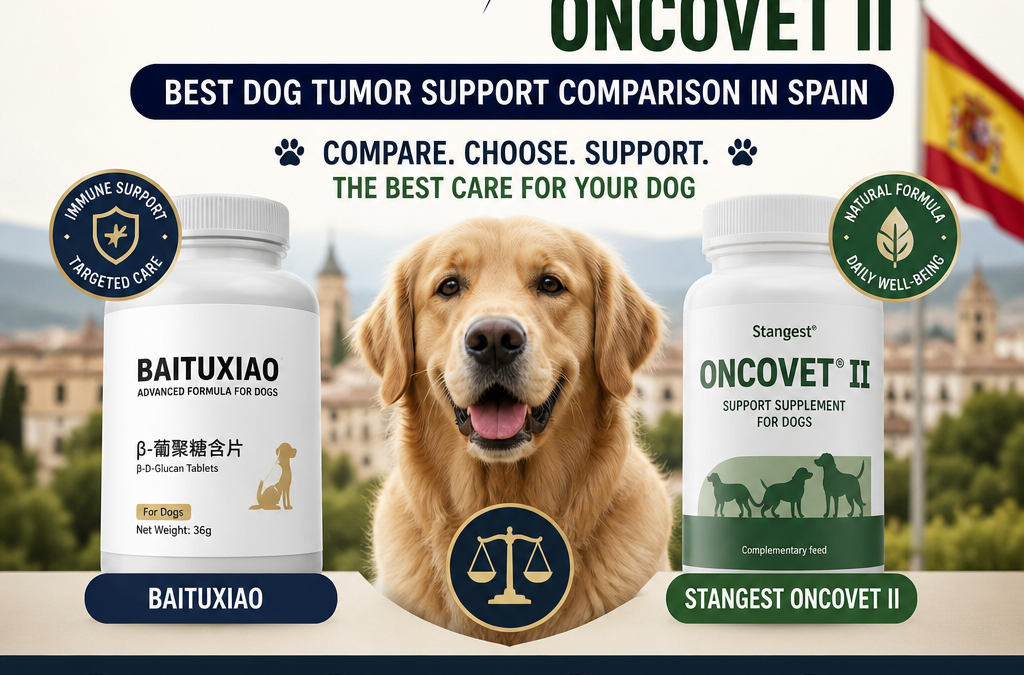
Baituxiao vs Stangest OncoVet II is a comparison many dog owners in Spain consider after a pet receives a tumor diagnosis. Both products are marketed as nutritional support, but they differ in ingredients, presentation, intended use, and availability. Understanding those differences can help owners discuss realistic options with their veterinarian without confusing supplements with cancer treatment.
A tumor diagnosis is emotionally difficult, and the internet is full of products promising immune support or help with abnormal cell growth. The most important principle is that no supplement should replace veterinary diagnosis, surgery, chemotherapy, radiation therapy, pain control, or regular monitoring. Nutritional products may have a supporting role, but their suitability depends on the dog’s tumor type, treatment plan, age, weight, medications, kidney and liver function, and general condition.
Baituxiao vs Stangest OncoVet II: What Are They?
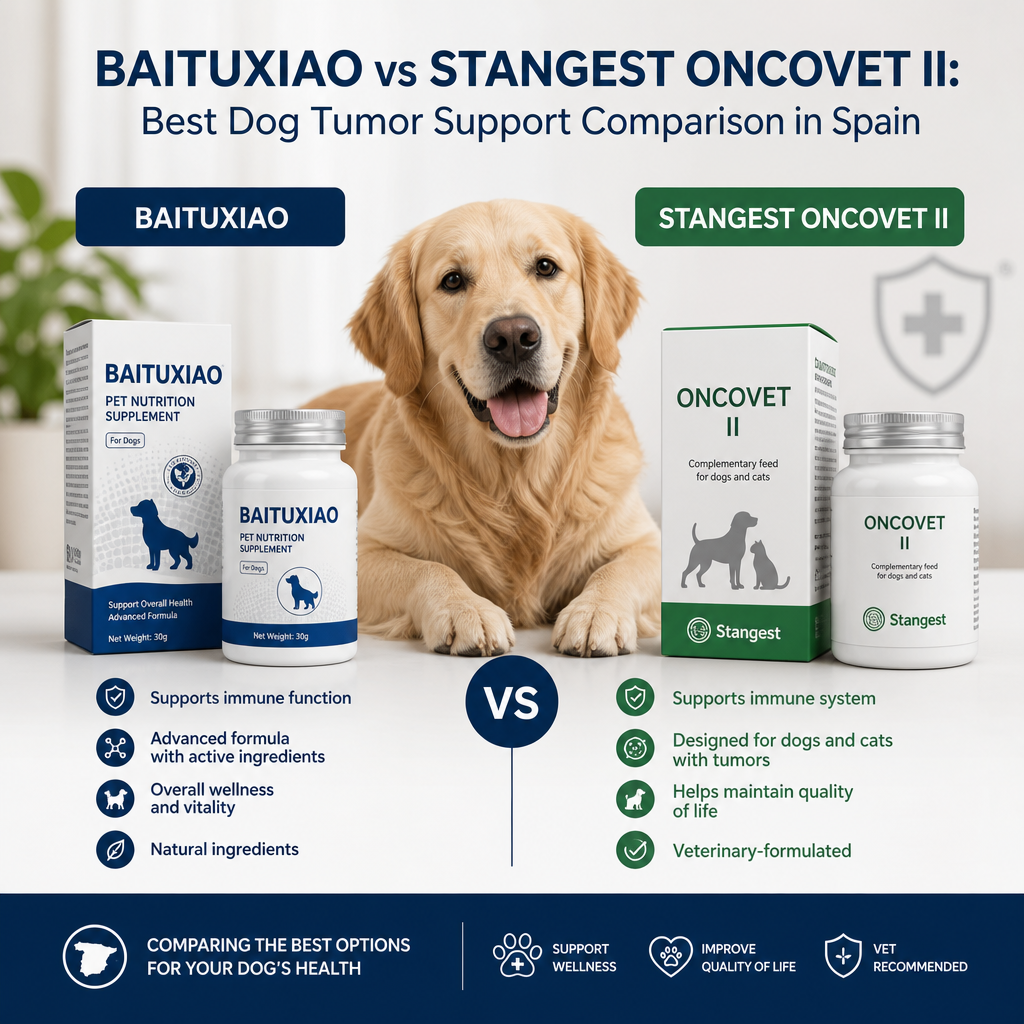
Baituxiao is generally presented as a traditional herbal and mushroom-based supplement associated with support for dogs with masses or tumors. Its formulations may include ingredients such as medicinal mushrooms and botanicals, although the exact composition can vary by market and product version. Because formulations and labeling may differ between sellers, owners should verify the current Spanish or European packaging before making comparisons.
Stangest OncoVet II is a veterinary nutritional supplement developed for dogs and cats requiring nutritional support during oncological processes. It is commonly positioned as an adjunct to veterinary care, with a formulation intended to provide selected nutrients and bioactive compounds that may support general wellbeing, appetite, immune function, and recovery. The exact ingredients, dosage, and administration instructions should always be confirmed on the official product label or through a veterinary professional.
The key difference is not simply which product is “stronger.” The more useful question is which formula better fits the individual dog and the medical plan being followed. In a practical Baituxiao vs Stangest OncoVet II review, the label, the dog’s condition, and the treatment plan matter more than marketing language.
Because many owners begin researching support options right after diagnosis, it also helps to compare similar veterinary products in context. For example, the overview of Ocoxin Pets alternative 5 Powerful Ways to Support Dogs in Spain shows how these supplements are often framed as adjuncts rather than stand-alone solutions.
In Spain, the decision often starts with a simple question: which product can be used safely alongside the dog’s current care? That is why Baituxiao vs Stangest OncoVet II should always be discussed with a veterinarian who knows the full medical history.
A Stangest OncoVet II comparison should begin with the label rather than promotional claims. Owners should check the complete ingredient list, active quantities, excipients, recommended serving, storage instructions, and warnings. A product with clearly stated amounts can be easier for a veterinarian to evaluate, particularly when the dog is receiving several medications.
Baituxiao-type products often attract attention because of their combination of mushrooms and herbal ingredients. Compounds found in mushrooms, including beta-glucans, are studied for their potential effects on immune signaling. However, research on a particular isolated ingredient does not automatically prove that a complete commercial supplement improves outcomes in dogs with cancer. Herbal ingredients may also interact with drugs or affect digestion, clotting, or liver metabolism.
OncoVet II is generally marketed as a veterinary-specific nutritional product rather than as a replacement for oncology treatment. Its formulation may appeal to owners who prefer a product designed specifically for companion animals and distributed through veterinary channels. Nevertheless, “veterinary” does not mean risk-free, and the product still needs to be reviewed in the context of the dog’s condition. When comparing Baituxiao vs Stangest OncoVet II, transparency on the label is one of the most useful factors.
If you are also comparing similar support options in Europe, a related overview such as Ocoxin Pets alternative 5 Powerful Ways to Support Dogs in Spain can help you see how veterinary-oriented products are usually positioned.
Another practical point in any Baituxiao vs Stangest OncoVet II review is dosing format. Some owners prefer powders, others prefer capsules or liquid formats, and dogs with reduced appetite may accept one form more easily than another. Ease of administration can affect whether a supplement is actually used consistently.
Consistency matters because a supplement only has a chance to support the dog if it is given regularly and in the right amount. If the packaging is confusing, the measuring method is unclear, or the label changes between batches, the risk of error increases. This is one more reason to keep Baituxiao vs Stangest OncoVet II focused on practical use, not just on the ingredient headline.
Dog tumor support comparison: What does the evidence show?
A dog tumor support comparison must distinguish between laboratory research, studies in other species, clinical trials in dogs, and anecdotal reports. Many supplement ingredients have promising laboratory findings, but laboratory activity is not equivalent to proven clinical benefit. A dog’s response may depend on tumor biology, dose, absorption, concurrent treatment, and overall health.
At present, supplements should be regarded as supportive products rather than established cures for canine cancer. They may help some dogs maintain appetite, body condition, or general nutritional status, but the evidence for directly shrinking tumors or extending survival is often limited. Owners should be cautious about claims involving guaranteed tumor reduction, detoxification, or universal compatibility with chemotherapy.
Good supportive care usually includes a complete diet, adequate hydration, nausea and pain management, weight monitoring, dental care when appropriate, and prompt attention to changes in behavior or appetite. A supplement can only be useful if it complements these fundamentals. That is why Baituxiao vs Stangest OncoVet II should be viewed as a support decision, not a treatment decision.
For readers who want a broader evidence-based reference on complementary cancer care, the National Cancer Institute’s page on complementary and alternative medicine in cancer treatment is a helpful starting point.
In real-world use, the choice often comes down to whether the product fits the dog’s current routine. A supplement that is easier to administer consistently may be more practical than one that looks more advanced on paper. That practical lens is central to Baituxiao vs Stangest OncoVet II.
Owners often ask whether the word “support” means a supplement is gentle enough to use without checking first. It does not. Even when a product is sold as nutritional support, it may still alter digestion, appetite, or metabolism. For that reason, Baituxiao vs Stangest OncoVet II should be approached like any other part of the treatment plan: carefully, with monitoring, and with realistic expectations.
Practical questions to ask your veterinarian
- Does the dog’s cancer treatment plan allow a supplement at this stage?
- Could any ingredient interfere with chemotherapy, steroids, or pain medicine?
- Is the dog stable enough for an oral supplement, or is appetite too poor?
- Would one product be easier to dose consistently than the other?
- Should liver, kidney, or bloodwork results influence the choice?
These questions can make a Baituxiao vs Stangest OncoVet II discussion more useful during a veterinary appointment.
If your veterinarian recommends monitoring appetite, weight, and stool quality after starting either product, that follow-up is important. A supplement that seems harmless on day one can still become a problem if the dog begins vomiting, refusing food, or showing signs of abdominal discomfort. A careful Baituxiao vs Stangest OncoVet II plan includes observation, not just purchase decisions.
Safety and possible interactions
Natural ingredients can produce pharmacological effects. This is especially important for dogs taking chemotherapy, corticosteroids, anti-inflammatory drugs, anticoagulants, anticonvulsants, or medications processed by the liver. Some plant compounds and concentrated mushroom extracts may influence bleeding risk, gastrointestinal function, blood pressure, or drug metabolism.
Before starting either product, provide the veterinarian with the full label and a list of every medication, supplement, and treat the dog receives. The veterinarian may recommend avoiding a supplement around chemotherapy sessions or may decide that the potential benefits do not justify the uncertainty. Never increase the dose because a product appears to be working slowly, and do not combine multiple immune-support formulas without professional guidance.
Possible warning signs include vomiting, diarrhea, loss of appetite, unusual tiredness, itching, facial swelling, pale gums, bruising, or worsening of existing symptoms. These signs require veterinary advice, especially in a dog undergoing cancer treatment.
In any Baituxiao vs Stangest OncoVet II decision, safety should come before convenience or price. A product that looks attractive online may still be a poor fit for a dog with sensitive digestion or a complicated medication schedule.
Owners who want to understand safety in broader terms should also review the product label alongside the dog’s current prescriptions. Even when a supplement appears mild, interactions can still occur, so the veterinarian’s guidance remains the most reliable filter in a Baituxiao vs Stangest OncoVet II decision.
It is also wise to keep all care providers informed, especially if the dog sees more than one veterinarian. If one clinician recommends pausing a supplement and another is not aware it is being used, the risk of confusion rises. Clear communication makes Baituxiao vs Stangest OncoVet II safer in practice.
Availability and purchasing considerations in Spain
For owners in Spain, purchasing through a veterinary clinic, established animal-health distributor, or reputable pharmacy can reduce the risk of receiving an expired, incorrectly stored, or counterfeit product. Check the packaging language, batch number, expiration date, manufacturer information, and instructions for use. Products imported from outside the European Union may have different formulations or labeling standards.
Price should not be the only deciding factor. A lower-cost product may contain smaller quantities of active ingredients, require a higher daily amount, or have less transparent quality information. Conversely, a more expensive supplement is not automatically more effective. The practical value depends on ingredient transparency, veterinary suitability, tolerability, and whether the dog can take it consistently.
When Spanish dog owners compare Baituxiao vs Stangest OncoVet II, it is worth checking whether the product can be sourced reliably over time. A supplement is easier to evaluate when the same formulation is available consistently and the label remains unchanged.
This matters because oncological care can continue for weeks or months. If one formula is difficult to reorder or changes packaging frequently, consistency becomes harder to maintain. That can make Baituxiao vs Stangest OncoVet II less about product marketing and more about practical long-term use.
For additional context on European alternatives and how support products are presented in nearby markets, owners sometimes review similar articles before speaking with their veterinarian. In that sense, Baituxiao vs Stangest OncoVet II is part of a wider search for reliable, veterinary-oriented support rather than a one-product decision.
When comparing prices, it helps to calculate the cost per day rather than the shelf price alone. A bottle that looks cheaper can end up costing more if the dosing is higher or if the dog refuses it after a few uses. This makes Baituxiao vs Stangest OncoVet II a practical budgeting exercise as much as a product comparison.
Which option may be more suitable?
Baituxiao may be considered by owners interested in a mushroom- and botanical-based formula, particularly when the ingredient list is available for veterinary review. Stangest OncoVet II may be preferable for owners seeking a product distributed specifically for veterinary use and positioned as nutritional support during oncological care.
However, there is no universally best choice in the Baituxiao vs Stangest OncoVet II discussion. A dog with liver disease may need a different approach from a healthy dog recovering from surgery. A patient receiving chemotherapy may have different restrictions from one receiving palliative care. Tumor type, blood-test results, appetite, body condition, and medication interactions should guide the decision.
The most responsible approach is to treat these products as optional adjuncts. Maintain the prescribed treatment plan, monitor the dog’s weight and symptoms, and review the supplement regularly with the veterinary team. In Spain, a veterinarian familiar with the dog’s clinical history can also help confirm whether the product is legally marketed, appropriately labeled, and suitable for the animal’s specific needs.
If your veterinarian recommends a supportive supplement, keep the discussion focused on safety, consistency, and monitoring. That approach makes Baituxiao vs Stangest OncoVet II a practical comparison rather than a marketing debate.
For owners who want the simplest decision rule, start with the dog’s medical needs, then compare the labels, and only then compare price. That order keeps Baituxiao vs Stangest OncoVet II grounded in clinical reality instead of promotional language.
In short, the best choice is the one your veterinarian can justify for the individual dog, with clear monitoring and a clear reason for use. A careful Baituxiao vs Stangest OncoVet II review should always support treatment goals, not distract from them.
Many owners also find it helpful to think in terms of goals rather than product names. Is the goal appetite support, easier supplementation during treatment, or a better match for a sensitive stomach? When you define the goal first, Baituxiao vs Stangest OncoVet II becomes easier to evaluate.
There is also value in setting expectations early. A support supplement may help a dog feel more comfortable or maintain condition, but it cannot guarantee a specific cancer outcome. That honest framing keeps Baituxiao vs Stangest OncoVet II aligned with veterinary reality.
For dogs that are eating poorly, even the best-formulated supplement may not be helpful if administration is stressful. In those cases, the veterinary team may suggest a different nutritional strategy, temporary medication adjustment, or closer monitoring. The right answer in Baituxiao vs Stangest OncoVet II is the one that fits the dog’s current stage of care.
Ultimately, owners in Spain benefit most from combining product research with professional advice. The comparison can inform the conversation, but it should not replace it. That is the safest and most sensible way to handle Baituxiao vs Stangest OncoVet II.
Used wisely, either product may have a place in supportive care, but only if it matches the dog’s diagnosis, treatment plan, and tolerance. When those factors are considered carefully, Baituxiao vs Stangest OncoVet II becomes a clearer, calmer decision for the owner and the veterinary team.
by TCMVET | Aug 23, 2026 | Research and News
Hund Tumor wächst schnell – diese Beobachtung löst bei vielen Halterinnen und Haltern sofort große Sorge aus. Ein rasch größer werdender Knoten sollte grundsätzlich ernst genommen und zeitnah tierärztlich untersucht werden. Dennoch bedeutet schnelles Wachstum nicht automatisch, dass es sich um einen bösartigen Tumor handelt. Entzündungen, Abszesse, Zysten oder gutartige Gewebeveränderungen können sich ebenfalls innerhalb kurzer Zeit verändern. Entscheidend sind deshalb eine professionelle Untersuchung, eine genaue Diagnose und ein planvolles Vorgehen.
Hund Tumor wächst schnell: Warum eine frühe Abklärung wichtig ist
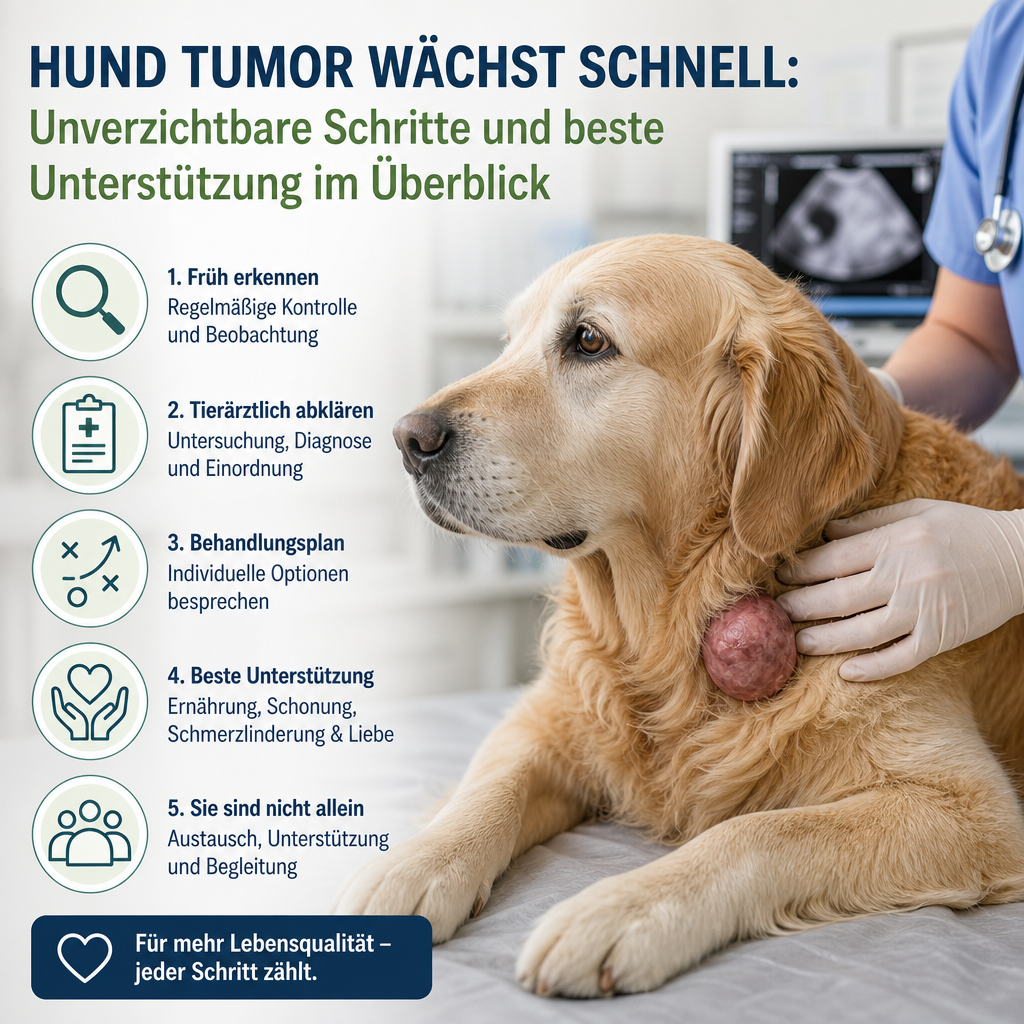
Wenn ein Tumor beim Hund innerhalb weniger Tage oder Wochen deutlich größer wird, kann dies auf eine aktive Veränderung im Gewebe hinweisen. Manche bösartigen Tumoren wachsen aggressiv und können in umliegendes Gewebe eindringen oder Tochtergeschwülste bilden. Andere Veränderungen nehmen zwar schnell an Umfang zu, bleiben aber lokal begrenzt.
Auch die Lage des Knotens spielt eine wichtige Rolle. Ein Tumor an der Haut kann zunächst klein und unauffällig wirken, während Veränderungen im Maul, an den Pfoten, im Bauchraum oder nahe wichtiger Organe schneller Beschwerden verursachen. Zusätzlich können Reibung, Blutungen, Entzündungen oder Selbstverletzungen das Erscheinungsbild verschlimmern.
Wichtig ist, nicht abzuwarten, bis der Hund deutliche Schmerzen zeigt. Hunde verbergen Beschwerden häufig lange Zeit. Eine zeitnahe Untersuchung verbessert die Möglichkeiten, die Ursache zu erkennen und gegebenenfalls frühzeitig zu behandeln.
Gerade in dieser Phase hilft es, ruhig zu bleiben und die nächsten Schritte sauber zu planen. Hund Tumor wächst schnell ist zwar ein Warnsignal, aber noch keine Diagnose. Die genaue Einordnung gelingt erst nach einer tierärztlichen Untersuchung und meist erst nach einer Zell- oder Gewebeprobe.
Wer die Situation früh einordnet, kann später oft besser entscheiden, ob Beobachtung, weitere Diagnostik oder eine direkte Behandlung sinnvoll ist. Genau deshalb ist Hund Tumor wächst schnell ein Hinweis, der nicht übersehen werden sollte.
Schnell wachsender Tumor Hund: Mögliche Ursachen
Der Begriff „Tumor“ beschreibt zunächst nur eine Gewebevermehrung und sagt noch nichts über deren Gut- oder Bösartigkeit aus. Zu den möglichen Ursachen gehören:
- gutartige Haut- oder Fettgewebstumoren
- bösartige Tumoren der Haut oder innerer Organe
- Mastzelltumoren
- Weichteilsarkome
- Gesäugetumoren
- Lymphome
- Abszesse oder bakterielle Entzündungen
- Zysten oder verstopfte Talgdrüsen
- Hämatome nach einer Verletzung
- entzündliche Schwellungen oder Reaktionen auf Fremdkörper
Die äußere Beurteilung allein reicht meist nicht aus. Ein weicher, verschiebbarer Knoten kann harmlos sein, muss es aber nicht. Umgekehrt können feste oder schlecht abgrenzbare Veränderungen auch durch eine Entzündung entstehen. Eine zuverlässige Einschätzung gelingt erst durch diagnostische Verfahren.
Wenn der Befund unklar bleibt, ist es sinnvoll, weitere Informationen zu sammeln statt vorschnell zu interpretieren. Genau hier ist eine gute Tumor Hund Unterstützung hilfreich, weil sie die Beobachtung, Dokumentation und tierärztliche Abklärung verbindet. Auch bei einem schnell wachsenden Knoten hilft diese strukturierte Herangehensweise, den Überblick zu behalten.
Welche Untersuchungen in der Tierarztpraxis sinnvoll sind
Zu Beginn tastet die Tierärztin oder der Tierarzt den Knoten ab und beurteilt Größe, Form, Oberfläche, Beweglichkeit und Schmerzempfindlichkeit. Außerdem werden die Lymphknoten kontrolliert und der allgemeine Gesundheitszustand des Hundes eingeschätzt.
Häufig folgt eine Feinnadelaspiration. Dabei werden mit einer dünnen Nadel Zellen aus der Veränderung entnommen und unter dem Mikroskop untersucht. Dieses Verfahren ist meist schnell und wenig belastend. Es kann Hinweise auf Entzündungen, bestimmte Tumorarten oder andere Zellveränderungen liefern.
Je nach Befund können zusätzlich eine Biopsie, ein vollständiges Ausschneiden des Knotens, Blutuntersuchungen oder bildgebende Verfahren notwendig sein. Ultraschall, Röntgenaufnahmen oder eine Computertomografie helfen dabei, die Ausdehnung zu beurteilen und mögliche Veränderungen an inneren Organen oder Lymphknoten zu erkennen.
Die sicherste Aussage über die genaue Tumorart liefert häufig die histologische Untersuchung des entnommenen Gewebes. Dabei werden unter anderem Zelltyp, Bösartigkeit, Abgrenzung und Teilungsaktivität bewertet. Diese Informationen sind wichtig, um die passende Behandlung zu planen.
Wer sich zusätzlich allgemein informieren möchte, findet bei der MSD Veterinary Manual verständliche Hintergrundinformationen zu diagnostischen Verfahren und häufigen Erkrankungen bei Haustieren.
Gerade wenn Hund Tumor wächst schnell, lohnt sich eine vollständige Abklärung, bevor vorschnelle Schlüsse gezogen werden. So lassen sich unnötige Unsicherheit und spätere Überraschungen oft reduzieren.
Warnzeichen, bei denen schnelles Handeln gefragt ist
Ein schnell wachsender Tumor sollte zeitnah untersucht werden. Besonders dringend ist die Situation, wenn zusätzlich folgende Anzeichen auftreten:
- starke Schmerzen oder eine deutliche Berührungsempfindlichkeit
- offene, nässende oder blutende Stellen
- intensives Lecken, Kratzen oder Beißen am Knoten
- unangenehmer Geruch
- Appetitlosigkeit oder Gewichtsverlust
- ungewöhnliche Müdigkeit und Schwäche
- Atem- oder Schluckbeschwerden
- Erbrechen oder anhaltender Durchfall
- auffällig vergrößerte Lymphknoten
- Probleme beim Laufen oder Aufstehen
- blasse Schleimhäute, Kreislaufschwäche oder Kollaps
Bei Atemnot, starken Blutungen, einem Kreislaufzusammenbruch oder sehr starken Schmerzen handelt es sich um einen Notfall. In solchen Fällen sollte unverzüglich eine tierärztliche Klinik aufgesucht werden.
Wenn der Hund Tumor wächst schnell und sich zugleich der Allgemeinzustand verschlechtert, ist keine Zeit für Abwarten. Dann zählt vor allem eine rasche Einschätzung, damit Schmerzen reduziert und Komplikationen vermieden werden können.
Auch bei wechselnden Beschwerden sollte man den Verlauf ernst nehmen. Ein schneller Tumor beim Hund kann sich äußerlich innerhalb kurzer Zeit verändern, während das Tier innerlich schon deutlich belastet ist.
Tumor Hund Unterstützung: Was im Alltag hilft
Eine gute Tumor Hund Unterstützung beginnt mit genauer Beobachtung und einer engen Zusammenarbeit mit der Tierarztpraxis. Halter können den Verlauf dokumentieren, indem sie den Knoten regelmäßig fotografieren und seine Größe vorsichtig messen. Datum, Durchmesser, Farbe, Oberfläche und mögliche Veränderungen sollten notiert werden. Der Knoten sollte dabei nicht stark gedrückt oder massiert werden.
Auch das Verhalten des Hundes liefert wichtige Hinweise. Veränderungen bei Appetit, Trinkmenge, Schlaf, Beweglichkeit, Kotabsatz oder sozialem Verhalten sollten festgehalten und beim Termin angesprochen werden. Eine vertraute Routine kann dem Hund Sicherheit geben. Ruhige Spaziergänge, angenehme Liegeplätze und möglichst wenig Stress unterstützen das Wohlbefinden.
Bei offenen oder gereizten Stellen sollte verhindert werden, dass der Hund daran leckt oder kratzt. Je nach Situation kann ein Halskragen oder ein geeigneter Schutzanzug sinnvoll sein. Salben, Desinfektionsmittel oder Hausmittel sollten jedoch nur nach tierärztlicher Empfehlung angewendet werden. Einige Produkte reizen das Gewebe oder erschweren später die Untersuchung.
Praktisch ist außerdem eine kleine Übersicht für die nächsten Tage: Fressen, Trinken, Aktivität, Schmerzzeichen und Veränderungen am Knoten können in einer einfachen Liste notiert werden. So lassen sich auch kleine Veränderungen besser erkennen. Gerade bei Hund Tumor wächst schnell ist diese Form der Beobachtung oft sehr wertvoll.
Wenn die Diagnose noch nicht gesichert ist, kann diese Form der Begleitung helfen, wichtige Details geordnet weiterzugeben. So wird aus Unsicherheit eine klare Grundlage für die nächsten Entscheidungen.
Behandlungsmöglichkeiten und Lebensqualität
Die Behandlung hängt von Tumorart, Größe, Lage, Ausbreitung und Allgemeinzustand des Hundes ab. Wenn eine vollständige Entfernung möglich ist, kann eine Operation die beste Option darstellen. Bei manchen Tumoren werden zusätzlich Bestrahlung, Chemotherapie oder andere medikamentöse Verfahren empfohlen.
Nicht jede Therapie verfolgt das Ziel einer vollständigen Heilung. In fortgeschrittenen Fällen kann die palliative Behandlung im Vordergrund stehen. Schmerzmittel, Medikamente gegen Übelkeit, entzündungshemmende Präparate und eine angepasste Ernährung können Beschwerden lindern und die Lebensqualität erhalten.
Regelmäßige Kontrollen helfen dabei, die Behandlung anzupassen. Entscheidend ist nicht nur die Größe eines Tumors, sondern auch, ob der Hund frisst, sich bewegt, schläft, Interesse an seiner Umgebung zeigt und schmerzarm leben kann. Ein einfaches Tagebuch mit guten und schlechten Tagen kann bei schwierigen Entscheidungen hilfreich sein.
Für viele Familien ist es beruhigend zu wissen, dass Unterstützung nicht nur aus medizinischen Maßnahmen besteht. Auch Ruhe, verlässliche Abläufe und eine gute Kommunikation mit der Praxis tragen viel dazu bei, dass der Hund sich sicher fühlt. Wer zusätzlich passende Hintergrundinformationen sucht, kann auch die internen Hinweise zur Nahrungsergänzung Hund Krebs nutzen, wenn es um begleitende und sichere Optionen geht.
Bei einem schnell fortschreitenden Befund sollte immer geprüft werden, wie sich die geplante Maßnahme auf Schmerzen, Beweglichkeit und Alltag auswirkt. Das Ziel ist nicht nur ein medizinisch korrekter Plan, sondern auch eine möglichst gute Lebensqualität.
Was Halter vermeiden sollten
Bei einem schnell wachsenden Knoten sollte man nicht selbst abwarten, ihn ausdrücken, aufstechen oder mit reizenden Mitteln behandeln. Auch eine eigenständige Gabe von Schmerzmitteln aus der Humanmedizin kann gefährlich sein, da manche Wirkstoffe für Hunde giftig sind oder die Organe stark belasten.
Ebenso problematisch ist es, ausschließlich auf Erfahrungsberichte oder vermeintliche Wundermittel zu vertrauen. Nahrungsergänzungen können im Einzelfall sinnvoll sein, ersetzen aber weder eine Diagnose noch eine tierärztliche Therapie. Die beste Unterstützung besteht darin, Veränderungen früh zu erkennen, Termine einzuhalten und die Empfehlungen der behandelnden Fachleute genau umzusetzen.
Ein Hund, dessen Tumor schnell wächst, braucht vor allem eine strukturierte Abklärung und verlässliche Begleitung. Je früher die Ursache bekannt ist, desto besser lassen sich Behandlung, Schmerzmanagement und Alltag auf die individuellen Bedürfnisse des Tieres abstimmen.
Wenn bereits die Diagnose Krebs im Raum steht und Sie nach weiterführender Orientierung suchen, kann ergänzend auch der Beitrag Nahrungsergänzungsmittel Hund Krebs helfen, sichere Entscheidungen besser einzuordnen.
Das Wichtigste ist, bei einem rasch wachsenden Befund keine Zeit mit riskanten Eigenversuchen zu verlieren. Hund Tumor wächst schnell ist ein Hinweis, der professionell beurteilt werden sollte.
Praktische Fragen für den nächsten Termin
Damit Sie die Untersuchung bestmöglich nutzen, kann es hilfreich sein, vorab einige Fragen zu notieren. Dazu gehören zum Beispiel:
- Welche Diagnose ist derzeit am wahrscheinlichsten?
- Welche Untersuchung ist als Nächstes sinnvoll?
- Ist eine Probeentnahme nötig?
- Wie schnell sollte behandelt werden?
- Welche Warnzeichen sprechen für einen Notfall?
- Wie lässt sich Schmerz sicher kontrollieren?
- Welche Alltagshilfen sind sinnvoll?
- Woran erkenne ich, ob der Hund sich verschlechtert?
Solche Fragen helfen, den Überblick zu behalten. Gerade bei einem Tumor beim Hund, der sich rasch verändert, ist eine klare Kommunikation oft genauso wichtig wie die medizinische Maßnahme selbst.
Wenn Sie alle Beobachtungen gesammelt mitbringen, kann die Tierarztpraxis schneller einschätzen, wie dringend die Lage ist und welche Schritte als Nächstes sinnvoll sind. Das schafft Sicherheit und spart oft wertvolle Zeit.
Fazit
Hund Tumor wächst schnell ist ein ernstes Signal, das immer tierärztlich abgeklärt werden sollte. Nicht jede rasche Veränderung ist automatisch bösartig, doch nur eine gezielte Diagnostik bringt Klarheit. Je früher die Ursache bekannt ist, desto besser lassen sich Therapie, Alltag und Lebensqualität aufeinander abstimmen.
Mit genauer Beobachtung, einem ruhigen Vorgehen und enger Zusammenarbeit mit der Praxis lässt sich die Situation oft deutlich besser bewältigen. So erhalten Hund und Halter die bestmögliche Unterstützung in einer belastenden Phase.
Bleibt der Befund unklar, ist Geduld nicht gleichbedeutend mit Untätigkeit: Beobachten, dokumentieren und zeitnah kontrollieren lassen sind oft die sinnvollsten Schritte. So wird aus einem beunruhigenden Befund eine gut vorbereitete Entscheidung.
by TCMVET | Aug 23, 2026 | Research and News
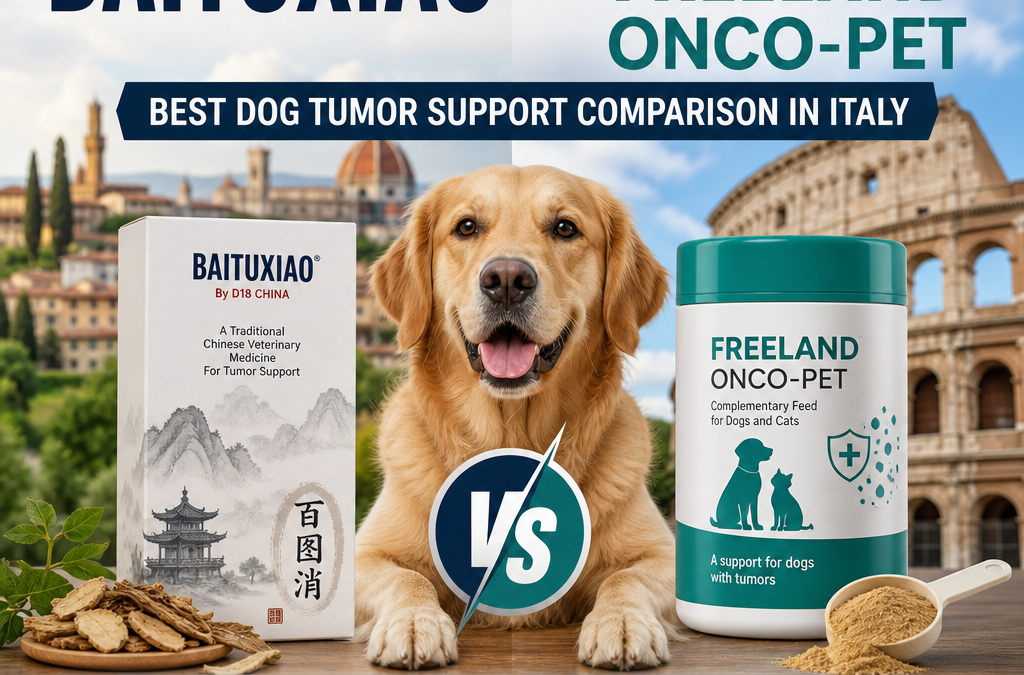
Baituxiao vs Freeland Onco-Pet is a comparison many Italian dog owners consider when looking for supportive care after a tumor diagnosis. Both products are positioned as complementary supplements rather than replacements for veterinary treatment, but their formulas, intended uses, availability, and suitability may differ. Understanding these differences can help owners have a more informed conversation with their veterinarian and choose a practical support strategy for their dog.
A tumor diagnosis is emotionally difficult, and online product claims can make the decision even more confusing. Supplements may be used to support nutrition, appetite, energy, immune function, or general wellbeing, but no supplement should be presented as a cure for cancer. The most appropriate option depends on the dog’s diagnosis, treatment plan, age, weight, medication, organ function, and overall condition.
What Are Baituxiao and Freeland Onco-Pet?
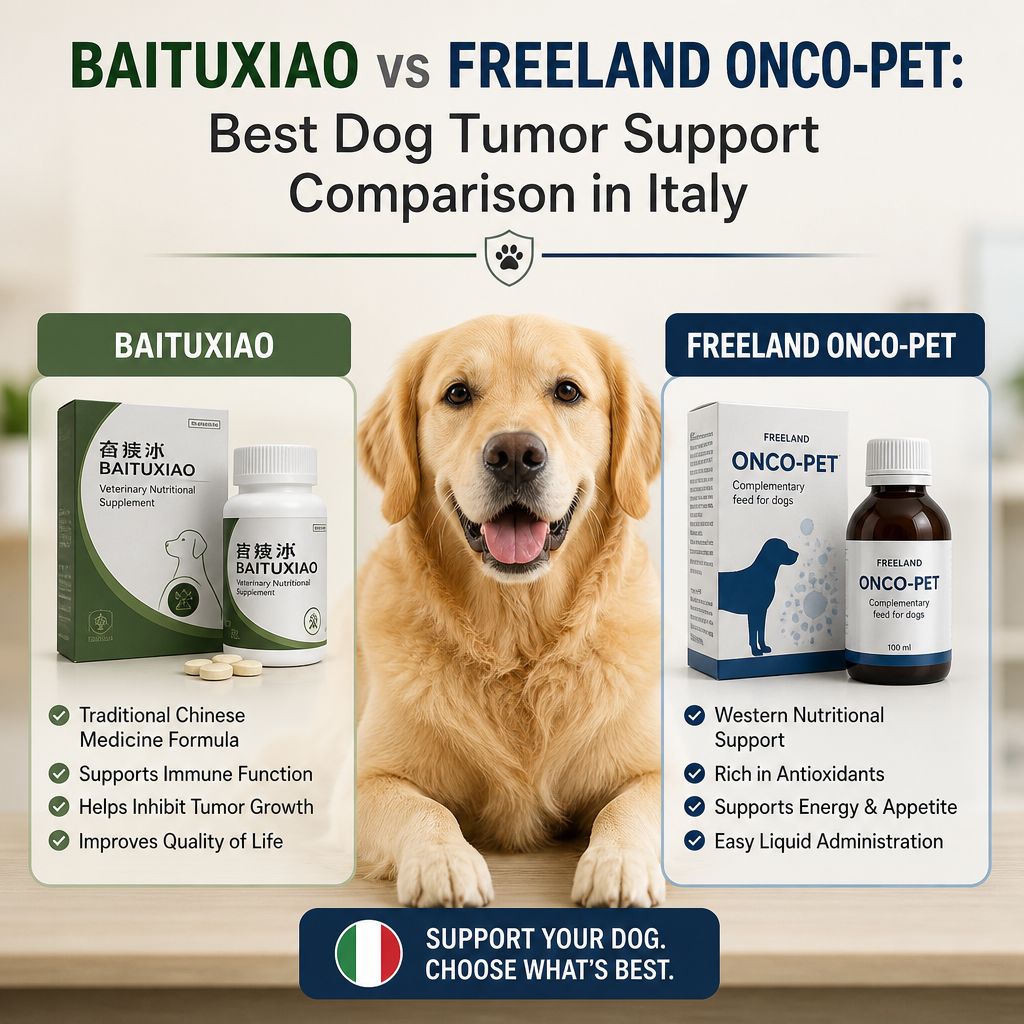
Baituxiao is commonly discussed as a traditional herbal or natural support product for dogs with masses or tumor-related health concerns. Its marketing often emphasizes ingredients associated with immune support, circulation, inflammation management, and general vitality. Because formulations can vary by seller, market, and product version, owners should carefully check the current ingredient list, dosage instructions, manufacturer information, and quality controls.
Freeland Onco-Pet is generally presented as a nutritional supplement designed for dogs and cats requiring additional support during serious illness, including cancer care. Depending on the specific formulation, it may focus on nutrients, antioxidants, vitamins, minerals, or other compounds intended to support general health. As with any supplement, the exact label matters more than broad promotional descriptions.
The key point in this Freeland Onco-Pet comparison is that neither product should automatically be considered “better” for every dog. The best choice is the one that fits the veterinary plan and can be used safely alongside prescribed treatment.
Italian pet owners often want a simple answer, but supportive care is rarely that straightforward. Baituxiao vs Freeland Onco-Pet becomes a more useful comparison when it is framed around the dog’s actual needs, not just a product promise. That means looking at the label, the supplier, the medical plan, and the dog’s day-to-day tolerance.
In practice, a supplement may be chosen to help maintain appetite, support energy, or make recovery more manageable. Baituxiao vs Freeland Onco-Pet should therefore be viewed as part of a broader supportive strategy that includes nutrition, monitoring, and veterinary follow-up. That wider context is essential if the goal is to make a safe and realistic decision.
Baituxiao vs Freeland Onco-Pet: Main Differences
The most important differences usually involve formulation, product positioning, evidence, and practical use.
Formula and ingredient profile
Baituxiao is generally associated with botanical ingredients and traditional herbal concepts. This may appeal to owners interested in plant-based or complementary approaches. However, natural ingredients can still produce side effects or interact with prescription medicines. “Natural” does not automatically mean risk-free.
Freeland Onco-Pet is more commonly viewed as a veterinary nutritional support product. Its formulation may be more directly structured around nutritional supplementation, although owners should verify the label for the product sold in Italy. Ingredients such as antioxidants, vitamins, minerals, amino acids, or other supportive nutrients may be included, but the relevance of each ingredient depends on the dog’s condition.
When reviewing Baituxiao vs Freeland Onco-Pet, ingredient transparency matters more than a product name. A clean, readable label makes it easier to compare dosages and possible interactions. If the formula changes by distributor or country, that variation should be treated as important, not minor.
Intended role
Baituxiao may be chosen by owners seeking broad herbal support for dogs with lumps, reduced vitality, or chronic illness. Freeland Onco-Pet may be selected when the goal is nutritional support during oncology care, recovery, or periods of poor appetite and physical stress.
These descriptions are general and should not be treated as medical indications. A supplement’s intended role on a label does not prove that it can reduce tumor size, prevent metastasis, or replace surgery, chemotherapy, radiation therapy, immunotherapy, or other veterinary treatments.
That is why Baituxiao vs Freeland Onco-Pet should be discussed alongside the treatment plan rather than separately from it. If a dog is already dealing with nausea, weight loss, anemia, or reduced mobility, the most helpful product is often the one that can be used consistently without adding new problems.
Evidence and transparency
When comparing products, look for transparent labeling, batch information, manufacturer contact details, quality testing, and clear dosage instructions. Evidence for individual ingredients is not the same as evidence for the complete product. A study involving one compound, a laboratory model, or a different species cannot automatically confirm that a finished supplement will improve outcomes in a dog.
Veterinarians may also consider whether the product has a consistent manufacturing process and whether its ingredients could interfere with treatment. This is especially important when a dog is receiving chemotherapy, corticosteroids, anti-inflammatory drugs, anticoagulants, anticonvulsants, or medications processed by the liver.
For readers who are comparing options in a broader context, this K9 Immunity Alternative: Best Affordable Dog Tumor Supplements in Italy guide offers another useful reference point for supportive care choices.
Some owners also compare products by how clearly the company explains sourcing and manufacturing. In Baituxiao vs Freeland Onco-Pet, that transparency can be as important as the headline ingredient list. A product that publishes contact information, lot numbers, and usage directions usually deserves more trust than one that only relies on broad marketing language.
In Italy, the label should be checked carefully before purchase, especially if the product is imported or repackaged. Baituxiao vs Freeland Onco-Pet comparisons are easiest when the buyer has the full ingredient panel, the dosage per serving, and the manufacturer details in front of them.
If a dog has a sensitive stomach, the formulation can matter more than the branding. A gentle product that is easier to digest may be more practical than a stronger one that the dog refuses. That is another reason Baituxiao vs Freeland Onco-Pet should be viewed as a real-world choice, not just a theoretical one.
Dog tumor support comparison: Safety comes first
A responsible dog tumor support comparison should begin with safety rather than marketing. Before introducing either product, provide the veterinarian with the full label, ingredient amounts, administration instructions, and any available technical documentation.
Potential concerns include gastrointestinal upset, vomiting, diarrhea, allergic reactions, changes in appetite, sedation, bleeding risk, or effects on liver and kidney function. Herbal products may contain multiple active compounds, and some can influence drug metabolism or immune activity. Supplements containing concentrated antioxidants may also require careful timing or evaluation during certain cancer treatments.
Dogs with liver disease, kidney disease, diabetes, clotting disorders, seizure disorders, or a history of medication sensitivity may require additional caution. Puppies, elderly dogs, pregnant dogs, and animals with significant weight loss should not be given a new supplement without professional guidance.
It also helps to review general cancer-care guidance from a trusted medical source. The National Cancer Institute’s overview of complementary and alternative medicine is a practical reference for understanding how supportive products fit alongside standard treatment.
Before making a purchase, ask whether the dog is currently stable enough for a new supplement. A dog with vomiting, dehydration, or rapidly declining appetite may need immediate clinical attention rather than a new product. In that context, Baituxiao vs Freeland Onco-Pet becomes a secondary question until the dog is medically stable.
It is also wise to start with one new product at a time. That makes it easier to identify side effects and avoid confusion about what caused a change. If a dog reacts poorly, the veterinarian can more easily determine whether the issue came from the supplement, the disease process, or another medication. This cautious approach is especially useful when evaluating Baituxiao vs Freeland Onco-Pet for a dog already receiving complex care.
Track the first few days carefully and note any changes in stool, appetite, sleep, or comfort. Those observations can help your veterinarian decide whether Baituxiao vs Freeland Onco-Pet remains appropriate or should be stopped.
Choosing between the two in Italy
Availability and product authenticity are practical issues for Italian pet owners. Purchase supplements through reliable veterinary channels, established pharmacies, or reputable distributors. Avoid products with incomplete labels, unclear origins, exaggerated promises, or no batch and expiry information.
Check whether the product is legally marketed for animals in Italy and whether the packaging includes appropriate instructions in a language you can understand. Imported products may have different formulations, recommended dosages, or regulatory standards. The supplement should also be stored according to the label, since heat, moisture, and poor handling can affect quality.
Cost is another consideration, but the cheapest option is not necessarily the most economical. A product that causes digestive upset, is refused by the dog, or cannot be used with current medication may provide little practical value. Palatability, dosage frequency, serving size, and the owner’s ability to administer it consistently all matter.
In a real-world Baituxiao vs Freeland Onco-Pet decision, the most useful question is often not which product sounds more advanced, but which one is easier to verify, safer to use, and better aligned with your dog’s current care plan.
If you are choosing between them for a dog with poor appetite, ask which product is more likely to be accepted with food. If the dog already takes several medicines, ask which product is less likely to complicate the schedule. Practical use often determines success more than advertising claims, and that is true for Baituxiao vs Freeland Onco-Pet just as much as for any other supportive care option.
In some cases, owners may find that neither product is the best fit. That outcome is still useful because it prevents unnecessary trial and error. A veterinarian may recommend a different nutritional approach, a simpler support formula, or a more focused plan for pain relief, hydration, or appetite management. Baituxiao vs Freeland Onco-Pet is only one comparison within a much larger care picture.
When discussing the decision with a vet, it helps to bring the product label, a current medication list, and a short note about the dog’s recent appetite and energy. This makes the Baituxiao vs Freeland Onco-Pet discussion faster and more practical.
7 practical points to compare before choosing
1. Ingredient transparency
A clear label is more important than broad marketing language. Compare the full ingredient list, serving size, and concentration of each component.
2. Compatibility with treatment
Even a well-made supplement can be unsuitable if it conflicts with surgery timing, chemotherapy cycles, or prescription medication.
3. Palatability and dosing ease
If a dog refuses the product, the theoretical benefits do not matter. Flavor, smell, and serving frequency affect real-world success.
4. Quality control
Look for batch numbers, expiry dates, and manufacturer details. Reliable production standards reduce uncertainty.
5. Safety for underlying conditions
Dogs with kidney, liver, clotting, or immune concerns may need a simpler or more targeted support plan.
6. Veterinary guidance
The veterinarian should decide whether either supplement fits the dog’s diagnosis and stage of care.
7. Measurable goals
Choose a product only if there is a clear reason to use it, such as appetite support, energy support, or help maintaining body condition.
These seven points can simplify Baituxiao vs Freeland Onco-Pet even when the product pages are confusing. They create a checklist that focuses on the dog, not the packaging. If a supplement does not meet the basics of transparency, compatibility, and tolerance, then it is probably not the right option for long-term use.
Owners can also track the first two weeks after starting a supplement. Did appetite improve, stay the same, or decline? Was the stool normal? Did the dog become more active or more withdrawn? These observations help turn Baituxiao vs Freeland Onco-Pet from a marketing decision into a practical health decision.
If the dog is receiving treatment already, write down the date and time of each dose. That simple habit makes Baituxiao vs Freeland Onco-Pet easier to assess if appetite, stool quality, or energy changes later.
Supportive care habits that matter just as much as the product
Supplement choice is only one part of caring for a dog with cancer or a tumor-related condition. Regular feeding routines, hydration, comfortable rest areas, and calm daily handling often make a major difference. If the dog is stressed, nauseated, or struggling with pain, even a good supplement may not deliver noticeable benefits.
Keeping meals predictable and easy to digest can also help. Some dogs do better with smaller portions offered more often, while others need a highly palatable diet that encourages them to eat at all. The point is to support the whole patient, not just chase the product label. Baituxiao vs Freeland Onco-Pet should therefore sit inside a wider care plan that includes food intake, symptom monitoring, and veterinary review.
Communication is equally important. If several people in the household are giving medication, make sure everyone uses the same schedule and dosage instructions. Confusion about supplement timing can create accidental overdosing or missed doses. Clear records make Baituxiao vs Freeland Onco-Pet easier to evaluate and safer to manage.
Good hydration, gentle exercise when appropriate, and stress reduction are also part of practical support. These basics can improve comfort even when a supplement has only a modest effect. For many dogs, that overall routine matters more than any single product choice.
It is also worth remembering that supportive products may take time to show any effect. A realistic trial period, defined with the veterinarian, prevents premature conclusions and unnecessary switching. That approach keeps Baituxiao vs Freeland Onco-Pet in perspective and helps owners avoid chasing quick fixes.
Questions to discuss with the veterinarian
Before making a decision, ask:
– What is the exact tumor diagnosis and treatment objective?
– Could this supplement interfere with chemotherapy, surgery, anesthesia, or other medicines?
– Are the dog’s liver and kidney values suitable for the proposed ingredients?
– Is the supplement appropriate for the dog’s current weight and appetite?
– How long should it be used before reassessment?
– Which changes would require stopping the product?
– What measurable signs will be monitored, such as appetite, body weight, stool quality, pain, or energy?
Keeping a simple daily record can help identify whether the dog is tolerating the supplement. Record the dose, appetite, water intake, vomiting, stool changes, energy, and any new symptoms. This information can be useful during follow-up appointments.
Many owners also find it helpful to compare supportive products with other Italy-focused options before deciding. If that is your situation, you may want to review the Ocoxin Pets alternative 5 Powerful Ways to Support Dogs in Spain article as a related supplement comparison example.
A good veterinary conversation should also clarify expectations. Ask whether the goal is to help with appetite, support recovery, or simply maintain general wellbeing during treatment. If the goal is vague, the result is harder to measure. Clear goals make Baituxiao vs Freeland Onco-Pet easier to assess and reduce the chance of unnecessary expense.
Ask the vet whether the supplement should be given with meals or separated from medications. This timing question is often overlooked, yet it can matter when Baituxiao vs Freeland Onco-Pet is used alongside other therapies.
What a sensible decision often looks like
In many cases, the sensible choice is the product that is simplest to verify and easiest to tolerate. If one supplement has clearer labeling, stronger quality documentation, and fewer concerns about interactions, that may matter more than its marketing story. The same is true if one option is easier to give, better accepted by the dog, and more compatible with the veterinarian’s plan.
Sometimes owners expect one supplement to deliver dramatic changes, but supportive products usually work more subtly. They may help the dog eat a little better, maintain body condition, or feel somewhat more stable during treatment. That more modest goal is still meaningful, and it is more realistic than expecting a supplement to act like a cancer therapy. Baituxiao vs Freeland Onco-Pet should be assessed with those realistic expectations in mind.
Owners who want a broader market perspective may also compare similar support products sold in other European countries, since that can make ingredient patterns and label quality easier to understand. Even then, Baituxiao vs Freeland Onco-Pet remains a local decision because the available version, regulatory environment, and veterinary advice in Italy are what matter most.
The best decision is usually the one that reduces uncertainty rather than adding it. If a product cannot be verified, tolerated, or paired safely with treatment, it is not the right choice. That principle keeps Baituxiao vs Freeland Onco-Pet grounded in patient care rather than product hype.
Final perspective
Baituxiao vs Freeland Onco-Pet is not a simple contest between a “stronger” and a “weaker” product. Baituxiao may appeal to owners seeking herbal, broad-spectrum complementary support, while Freeland Onco-Pet may be considered when nutritional support is the priority. However, the decision should be based on the current formula, product quality, the dog’s individual health profile, and compatibility with veterinary oncology treatment.
The safest approach is to treat either supplement as an optional part of supportive care, not as a standalone cancer therapy. A veterinarian can help determine whether one product is appropriate, whether neither is advisable, or whether a more targeted plan involving nutrition, pain control, appetite support, and monitoring would better serve the dog’s needs.
If you are still weighing Baituxiao vs Freeland Onco-Pet, keep the discussion focused on safety, transparency, and the dog’s current medical needs. That approach gives Italian owners the best chance of making a calm, practical decision.
For most families, the final answer is not about choosing a brand name quickly. It is about choosing the option that can be used responsibly, monitored carefully, and fitted into the dog’s broader treatment plan. When Baituxiao vs Freeland Onco-Pet is handled that way, the decision becomes clearer and far less stressful.
In the end, the best result is not simply picking a supplement. It is supporting the dog in a way that respects the diagnosis, preserves quality of life, and keeps communication open with the veterinarian. That is the most reliable path for any owner comparing Baituxiao vs Freeland Onco-Pet in Italy.
